
How to Become an Exercise Physiologist in 2026
Is Exercise Physiologist Right for You?
The U.S. Department of Labor's O*NET profile for Exercise Physiologists (SOC 29-1128) describes the work this way: Assess, plan, or implement fitness programs that include exercise or physical activities such as those designed to improve cardiorespiratory function, body composition, muscular strength, muscular endurance, or flexibility.
What the work involves
- Explain exercise program or physiological testing procedures to participants.
- Develop exercise programs to improve participant strength, flexibility, endurance, or circulatory functioning, in accordance with exercise science standards, regulatory requirements, and credentialing requirements.
- Provide clinical oversight of exercise for participants at all risk levels.
- Provide emergency or other appropriate medical care to participants with symptoms or signs of physical distress.
- Interview participants to obtain medical history or assess participant goals.
Skills and knowledge that matter
Skills: Instructing, Reading Comprehension, Active Listening, Speaking, Writing, Critical Thinking.
Knowledge: Medicine and Dentistry, Customer and Personal Service, English Language, Biology.
Tools and technology you may use
Technology: Electronic mail software, Medical software, Spreadsheet software, MEDITECH software, Microsoft Excel, Microsoft Office software.
Typical preparation
O*NET Job Zone Four (Considerable Preparation Needed). Most of these occupations require a four-year bachelor's degree, but some do not. Employees in these occupations usually need several years of work-related experience, on-the-job training, and/or vocational training.
Interest fit
O*NET interest profile: Realistic, Investigative, Social. People who enjoy hands-on, practical work with tools, machines, plants, or materials often find this occupation a good fit.
Source: O*NET 31.0 (updated 2026-10-14)
Quick answer: Training as an exercise physiologist requires a 4-year degree - typically a Bachelor’s in exercise science or kinesiology. The national median pay is $59,460 per year, and BLS projects +12.8% employment change from 2025 to 2035 (BLS OEWS, May 2025; BLS Employment Projections, 2025-35).
Exercise Physiologist at a Glance
| Metric | Detail | Source |
|---|---|---|
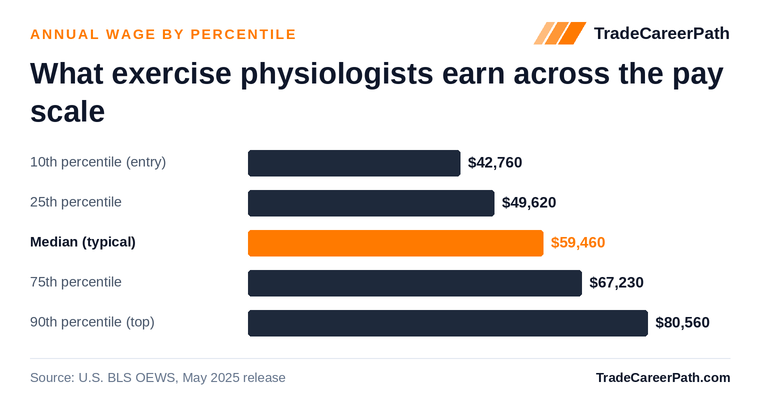
| Median annual wage | $59,460 | BLS OEWS, May 2025 |
| Typical wage range | $42,760 (10th pct) - $80,560 (90th pct) | BLS OEWS, May 2025 |
| Employment | 8,560 nationwide | BLS OEWS, May 2025 |
| Projected growth (2025-35) | +12.8%, about 1,400 openings per year | BLS Employment Projections, 2025-35 |
| Typical education | Bachelor’s in exercise science or kinesiology | BLS Occupational Outlook Handbook |
| License / certification | Licensure only in some states; ACSM certification is the field standard | State licensing boards |
What Does an Exercise Physiologist Do?
Exercise physiologists develop and supervise clinical exercise programs for patients with heart, lung, and metabolic conditions - stress testing, cardiac and pulmonary rehab, and physician-referred fitness plans. It is the clinical, salaried version of personal training: same core skill of getting a human body to move better, but the client is now a patient, the gym is a hospital department, and the program is part of a medical treatment plan.
Day to day, the work depends on the setting. In cardiac rehab - the occupation’s largest employer - a typical shift means running monitored exercise sessions for post-heart-attack and post-surgery patients: checking ECG telemetry, adjusting intensity against physician-set limits, and documenting every session for the medical record. In a stress-testing lab, the exercise physiologist runs graded treadmill or bike protocols, watches for arrhythmias and abnormal blood-pressure responses, and hands clean data to the cardiologist. In pulmonary rehab, corporate wellness, or research settings, the mix shifts toward assessment and program design - VO2 and body-composition testing, teaching patients to exercise safely with their condition, and building progressions that stick. Everything is documented and risk-stratified, because these patients can genuinely be harmed by a badly dosed workout.
If you are coming from personal training: you already do the hardest part of the job - reading a person, cueing movement, and keeping them coming back. What the degree and certification add is the clinical layer: what a beta-blocker does to heart-rate targets, what an ST-segment change on the monitor means, and when to stop a session and call the nurse. Trainers who make this move consistently say the coaching transfers directly; the medicine is the new material.
Skills That Make a Great Exercise Physiologist
- Exercise testing and ECG interpretation
- Clinical program design and progression
- Risk stratification and contraindication screening
- Patient motivation and coaching - the personal-trainer skill set, applied to reluctant patients
- Understanding how common medications alter exercise response
- Clinical documentation and charting in EMR systems
- Communication with nurses, cardiologists, and referring physicians
- BLS/CPR and emergency response readiness
Exercise Physiologist Salary
The national median for exercise physiologists is $59,460 per year, with the 10th percentile at $42,760 and the 90th percentile at $80,560 (BLS OEWS, May 2025). That range tells the real story for career changers: entry-level clinical pay can start below what a busy self-employed trainer grosses, but it comes salaried, with benefits and no 5 a.m.-and-7 p.m. split schedule built around client availability. The mean of $60,940 sitting close to the median also means pay here is compressed and predictable - fewer outliers in either direction than in commission-driven fitness work.
Where the Jobs and the Money Are
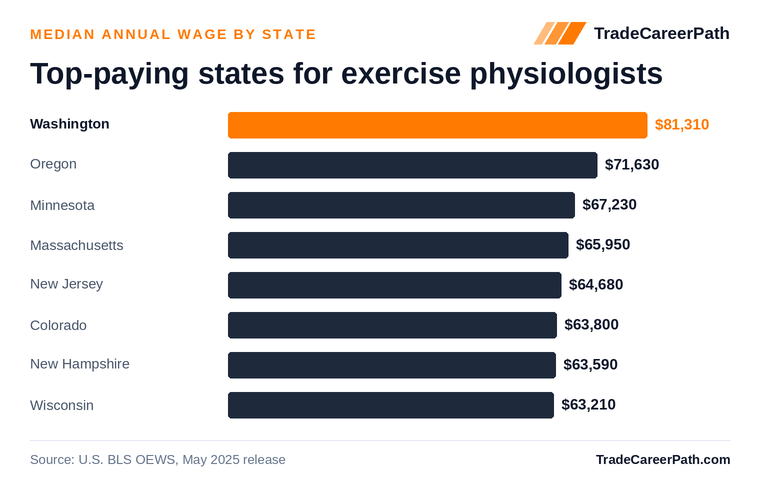
This is a small occupation - 8,560 jobs nationwide in the OEWS count - so where you live matters more than in bigger fields. The best-paying states cluster in the West and Northeast, led by Washington at a median of $81,310 (BLS OEWS, May 2025).
| State | Median annual wage | Employment |
|---|---|---|
| Washington | $81,310 | 160 |
| Oregon | $71,630 | 80 |
| Minnesota | $67,230 | 250 |
| Massachusetts | $65,950 | 180 |
| New Jersey | $64,680 | 130 |
Pay and job density do not line up here the way they do in most careers. The deepest markets are California and Pennsylvania (640 jobs each) and Michigan (570) - and in Michigan, exercise physiologists are more than twice as concentrated as in the average state labor market (location quotient 2.34), with Pennsylvania close behind at 1.9. Those hospital systems hire the most, but Pennsylvania’s median is only $48,040. Minnesota is the sweet spot: strong concentration (1.51), 250 jobs, and a $67,230 median. Washington and Oregon pay best but carry below-average concentration, so openings there are scarcer and worth moving on quickly when they post.
How to Become an Exercise Physiologist
1. Keep training clients
Coaching experience counts - clinical employers want people who can actually cue movement and manage a session. Keep your training book (or gym job) running while you study: it pays for the degree, keeps the coaching skills sharp, and “five years of client-facing experience” is the line that separates you from graduates who have never handled a frightened, deconditioned adult.
2. Earn the bachelor’s degree
Exercise science or kinesiology - either name works, and online and hybrid programs are common. What matters is the content: clinical coursework (exercise testing, ECG, pathophysiology) and a supervised practicum, ideally in cardiac or pulmonary rehab. CAAHEP-accredited programs are the safe pick because they are built around those requirements. Get a written transfer evaluation before enrolling - prior college credit, military training, and sometimes fitness certifications can shave real time off the 120 credit hours.
3. Certify with ACSM
The ACSM-EP (Exercise Physiologist) credential is the recognized standard, and it requires the bachelor’s. For hospital-based work, the ACSM-CEP (Clinical Exercise Physiologist) is the stronger card - it demands supervised clinical hours, and it is the certification cardiac rehab managers actually search resumes for. Plan your practicum hours during the degree so you exit school already eligible.
4. Start in cardiac or pulmonary rehab
Hospitals and rehab clinics are the core employers, and cardiac rehab is the classic first job - it is where the monitored-exercise skill set gets built. Stress-testing labs, cardiology practices, and hospital wellness programs are the other common doors in. Former trainers interview well here because the job is half clinical monitoring, half getting patients to actually show up and work - and the second half cannot be taught in a classroom.
5. Advance
The ladder runs through program responsibility: senior or lead exercise physiologist, then cardiac/pulmonary rehab coordinator or manager. The other route is using the degree as a launchpad - exercise science graduates are a major feeder pool for physical therapy (DPT) and physician assistant programs, which move you into a different pay bracket entirely. Decide early: PA and PT prerequisites are easiest to fold in while you are still enrolled.
Career Ladder: Titles and Realistic Pay
The BLS wage percentiles map onto how clinical exercise careers actually progress. Use this as a sanity check on offers, not a guarantee:
| Stage | Typical titles | Years in | Realistic pay (BLS OEWS, May 2025) |
|---|---|---|---|
| Entry level | Exercise physiologist I, cardiac rehab exercise specialist, stress-lab technologist | 0-3 | ~$42,760-$49,620 (10th-25th pct) |
| Mid-career | Clinical exercise physiologist (ACSM-CEP) | 3-8 | ~$59,460 (median) |
| Senior | Senior/lead exercise physiologist | 8-15 | ~$67,230 (75th pct) |
| Program leadership | Cardiac/pulmonary rehab coordinator or program manager | 12+ | $80,560+ (90th pct) |
Two notes for career changers. First, trainer experience compresses the bottom of this ladder: candidates with years of hands-on coaching are routinely hired above the entry floor because they only need supervision on the clinical side of the job. Second, the ceiling here is a management ceiling - the 90th-percentile band is largely coordinators and managers, which is why many people use this occupation as a well-paid staging point for PA or DPT school rather than a 30-year terminal role.
Do You Need a License?
Mostly no - and this is one of the friendlier credential paths on this site. Only a small number of states license exercise physiologists; in the rest, the field is regulated by employers rather than a state board. What functions as the license in practice is the certification stack:
- ACSM-EP: the baseline professional credential; requires the bachelor’s degree.
- ACSM-CEP: the clinical credential, requiring supervised clinical hours - effectively mandatory for hospital cardiac and pulmonary rehab roles.
- BLS/CPR (and often ACLS): hospitals require current emergency-response certification because monitored exercise sessions occasionally work as emergencies.
Check your own state’s rules before enrolling - where licensure does exist, it typically layers a state application on top of the same degree-plus-ACSM requirements. The state pages below list the specifics.
Why an Online Degree Works for This Career
Personal trainers are the direct feeders: same movement science, clinical setting instead of gym floor. Online kinesiology and exercise science bachelor’s programs (with local practicum placement) are the standard route, capped by ACSM’s clinical certifications. The model fits training work unusually well - client sessions cluster at mornings and evenings, leaving the midday block open for coursework, and the practicum can often be arranged at a hospital in your own city. Nearly all hospital systems offer tuition assistance, so trainers hired into an entry clinical role partway through the degree often finish it on the employer’s dime.
Job Outlook for 2026 and Beyond
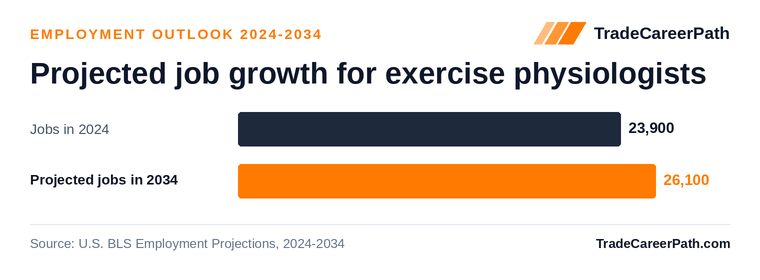
BLS projects employment of exercise physiologists to grow +12.8% from 2025 to 2035 - from 21,200 to 23,900 jobs in the projections base, which counts self-employed practitioners the OEWS survey does not - with about 1,400 openings per year once retirements and occupation changes are counted (BLS Employment Projections, 2025-35). Wages are moving the right direction too: the projections-era median of $58,160 (2024) rose to $59,460 in the May 2025 OEWS data.
The demand drivers are demographic and durable: an aging population with more cardiac and metabolic disease, hospital systems expanding rehab programs because they measurably cut readmissions, and insurers covering more rehab-based exercise services. The caveat is scale - 1,400 openings a year is a small national market, so treat the state concentration data above as part of your plan. In a Michigan, Pennsylvania, or Minnesota hospital market you can build a career locally; in a low-concentration state, expect to compete harder or relocate for the first clinical job.
Cost and Time to Complete the Degree
For exercise physiologists, the credential is: Bachelor’s in exercise science or kinesiology. A bachelor’s degree is typically 120 credit hours: four years full-time, and commonly five to six years part-time while working. Transfer credit is the other lever: prior college, military training, apprenticeship coursework, and industry certifications can be worth meaningful credit at transfer-friendly schools, so get a written transfer evaluation before enrolling anywhere. Costs vary widely by school type; in-state public online programs are usually the value benchmark, and employer tuition assistance is common for working adults in this field.
Pros and Cons of Training as an Exercise Physiologist
Pros
- Median pay of $59,460 nationally (BLS OEWS, May 2025)
- BLS projects +12.8% employment growth through 2035
- Field experience from the trades is a genuine hiring advantage
- Accredited online and hybrid degree paths exist for working adults
Cons
- Requires a 4-year degree (typically 120 credit hours)
- Entry-level pay starts near $42,760 at the 10th percentile
- Licensing hurdle: Licensure only in some states; ACSM certification is the field standard
Frequently Asked Questions
Is exercise physiology a step up from personal training?
Yes - it moves the same skill set into salaried clinical settings; BLS projects solid growth for the occupation, and the bachelor's plus ACSM certification is the entry requirement.
How much do exercise physiologists make?
The national median annual wage for exercise physiologists is $59,460 (BLS OEWS, May 2025). The top 10% earn $80,560 or more, while entry-level pay starts around $42,760.
What is the job outlook for exercise physiologists?
BLS projects employment of exercise physiologists to change by +12.8% from 2025 to 2035 (BLS Employment Projections, 2025-35).
How long does exercise physiologist training take?
The bachelor's in exercise science or kinesiology is 120 credit hours: four years full-time, commonly five to six years part-time while working. Personal-training certifications and prior college credit can shorten it at transfer-friendly schools, and the ACSM exam adds only weeks of prep after graduation.
Is exercise physiology hard?
The degree is science-heavy - anatomy, physiology, biomechanics, and exercise testing coursework - but working trainers usually find it easier than fresh high-school graduates do, because they already understand movement, cueing, and client behavior. The genuinely new material is the clinical side: ECG interpretation, risk stratification, and documentation.
Should I get an exercise science or kinesiology degree?
Either works - clinical employers and ACSM accept both. Pick the program with a built-in clinical practicum (cardiac or pulmonary rehab hours), since supervised clinical experience is what hospital hiring managers screen for, not the exact name on the diploma. CAAHEP-accredited programs are the safest bet.
Can you train as an exercise physiologist without a degree?
Not in clinical settings - hospitals and rehab programs require the bachelor's, and ACSM's clinical certifications assume it. Without the degree, the ceiling is personal training and group fitness. Trainer experience shortens the path and strengthens the application, but does not replace the degree.
Do exercise physiologists need a license?
Only in a small number of states - most regulate the field through employer requirements instead. What nearly every clinical employer does require is the bachelor's plus ACSM certification (ACSM-EP, or ACSM-CEP for clinical roles), and usually BLS/CPR credentials.
Exercise Physiologist Salary and Requirements by State
Alabama · Arizona · Arkansas · California · Colorado · Connecticut · Delaware · Florida · Georgia · Idaho · Illinois · Indiana · Iowa · Kansas · Kentucky · Louisiana · Maryland · Massachusetts · Michigan · Minnesota · Mississippi · Missouri · Nevada · New Hampshire · New Jersey · New York · North Carolina · North Dakota · Ohio · Oklahoma · Oregon · Pennsylvania · South Carolina · South Dakota · Tennessee · Texas · Utah · Virginia · Washington · West Virginia · Wisconsin
Related Careers and Degree Paths
- Personal Trainer - the direct feeder trade this page is built around
- Physical Therapy Aide - the rehab-clinic entry point on the therapy side
- Respiratory Therapist - the pulmonary counterpart in the same hospital departments
- Registered Nurse - the broader clinical degree path with a higher ceiling
- All trade careers that require a 4-year degree
Sources
- U.S. Bureau of Labor Statistics, Occupational Employment and Wage Statistics (OEWS), May 2025 - Exercise Physiologists (SOC 29-1128)
- U.S. Bureau of Labor Statistics, Employment Projections, 2025-35
- U.S. Bureau of Labor Statistics, Occupational Outlook Handbook - education and licensing requirements
Exercise Physiologist Salary by State
About this guide: Researched and written by the TradeCareerPath Editorial Team. Our editorial team researches and sources every trade school and career guide using federal labor and education data, including BLS OEWS and Employment Projections, DOL apprenticeship records, IPEDS, College Scorecard, and state licensing boards. We follow the editorial standards documented at /editorial-policy/.
Data sources
Figures on this page are sourced from the federal and state datasets below. Methodology: how we rank and source data.
| Data | Provider | Vintage |
|---|---|---|
| Occupational Employment and Wage Statistics (OEWS) | U.S. Bureau of Labor Statistics | May 2025 |
| Employment Projections | U.S. Bureau of Labor Statistics | 2025-2035 |
| Integrated Postsecondary Education Data System | National Center for Education Statistics (IPEDS) | 2024 |
| College Scorecard (school-level outcomes) | U.S. Department of Education | latest release |
| College Scorecard (field-of-study earnings) | U.S. Department of Education | latest release (updated 2026-06-12) |
| Occupational licensing requirements | CareerOneStop (U.S. Department of Labor) | latest release (updated 2026-02-22) |
| Registered apprenticeship programs | CareerOneStop / Apprenticeship.gov (U.S. Department of Labor) | latest release (updated 2025-10-25) |
| O*NET occupation profiles (skills, tasks, tools, job zones) | U.S. Department of Labor (O*NET / Employment & Training Admin.) | O*NET 31.0 (updated 2026-10-14) |