
How to Become a Facilities Manager in 2026
Is Facilities Manager Right for You?
The U.S. Department of Labor's O*NET profile for Facilities Managers (SOC 11-3013) describes the work this way: Plan, direct, or coordinate operations and functionalities of facilities and buildings. May include surrounding grounds or multiple facilities of an organization's campus.
What the work involves
- Monitor the facility to ensure that it remains safe, secure, and well-maintained.
- Oversee the maintenance and repair of machinery, equipment, and electrical and mechanical systems.
- Oversee construction and renovation projects to improve efficiency and to ensure that facilities meet environmental, health, and security standards, and comply with government regulations.
- Plan, administer, and control budgets for contracts, equipment, and supplies.
- Participate in architectural and engineering planning and design, including space and installation management.
Skills and knowledge that matter
Skills: Speaking, Reading Comprehension, Active Listening, Critical Thinking, Monitoring, Social Perceptiveness.
Knowledge: Customer and Personal Service, Administration and Management, English Language, Public Safety and Security.
Tools and technology you may use
Technology: Document management software, Desktop publishing software, Human resources software, Adobe Acrobat, Autodesk AutoCAD, Autodesk Revit.
Typical preparation
O*NET Job Zone Three (Medium Preparation Needed). Most occupations in this zone require training in vocational schools, related on-the-job experience, or an associate's degree. Employees in these occupations usually need one or two years of training involving both on-the-job experience and informal training with experienced workers. A recognized apprenticeship program may be associated with these occupations.
Interest fit
O*NET interest profile: Enterprising, Conventional, Realistic. People who enjoy starting projects, leading others, and making decisions often find this occupation a good fit.
Source: O*NET 31.0 (updated 2026-10-14)
Quick answer: Training as a facilities manager requires a 4-year degree - typically a Bachelor’s in facility management, engineering technology, or business. The national median pay is $106,660 per year, and BLS projects +4.6% employment change from 2025 to 2035 (BLS OEWS, May 2025; BLS Employment Projections, 2025-35).
Facilities Manager at a Glance
| Metric | Detail | Source |
|---|---|---|
| Median annual wage | $106,660 | BLS OEWS, May 2025 |
| Typical wage range | $64,480 (10th pct) - $176,120 (90th pct) | BLS OEWS, May 2025 |
| Employment | 156,180 nationwide | BLS OEWS, May 2025 |
| Projected growth (2025-35) | +4.6%, about 14,200 openings per year | BLS Employment Projections, 2025-35 |
| Typical education | Bachelor’s in facility management, engineering technology, or business | BLS Occupational Outlook Handbook |
| License / certification | No license; CFM/FMP (IFMA) certifications valued | None for most roles |
What Does a Facilities Manager Do?
Facilities managers run buildings: maintenance programs, mechanical systems, contractor management, budgets, safety, and space planning for campuses, hospitals, and commercial portfolios - the office the maintenance crew reports to.
The daily work depends on the portfolio. A single-site manager at a hospital or manufacturing plant lives in the preventive-maintenance schedule: prioritizing work orders, keeping chillers, boilers, and air handlers inside compliance windows, and deciding what the in-house crew handles versus what goes out to contract. A commercial property or corporate FM spends more time on the money side - negotiating service contracts, building the annual operating budget, planning capital projects like roof replacements and chiller swaps, and defending those numbers to ownership. In institutional settings (universities, school districts, government), space planning, code compliance, life-safety inspections, and energy management take a bigger share of the week. Across all of them, the job is fundamentally translation: turning what the building needs into what the budget and the vendors will actually deliver.
If you are coming from maintenance or HVAC, the shortest way to say it: the technician fixes the equipment; the facilities manager decides the maintenance strategy, owns the budget that pays for it, and answers for the building when something fails. That is exactly why employers prefer candidates who have turned the wrenches: you can read a contractor’s quote, spot a padded scope, and know when “it needs replacing” really means “it needs a $400 part.”
Skills That Make a Great Facilities Manager
- Building systems (HVAC, electrical, plumbing, fire/life safety)
- Vendor and contract management
- Capital and operating budgets
- Preventive maintenance programs and CMMS software
- Space planning and code compliance
- Energy management and utility cost control
- People management: scheduling, hiring, and holding crews and contractors accountable
- Writing: budget justifications, capital requests, and incident reports carry the job
Facilities Manager Salary
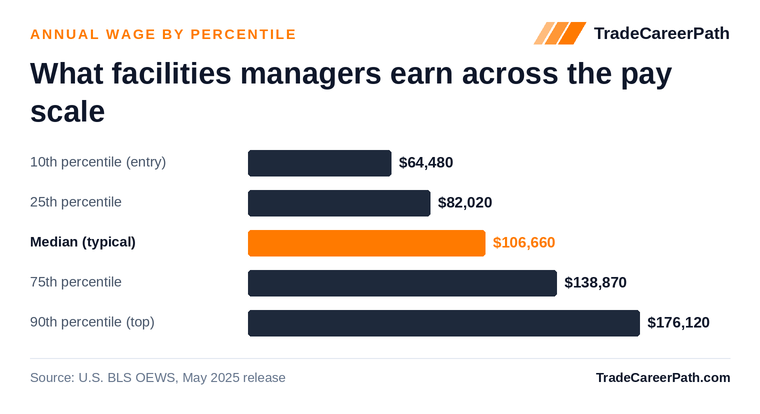
Facilities management is one of the most direct six-figure paths out of the maintenance trades. The national median is $106,660 per year, and the 25th percentile - roughly where a first-time single-site manager lands - is $82,020, already above what most senior technicians earn. The 90th percentile reaches $176,120, which is director and regional-portfolio territory (BLS OEWS, May 2025).
Where the Jobs and the Money Are
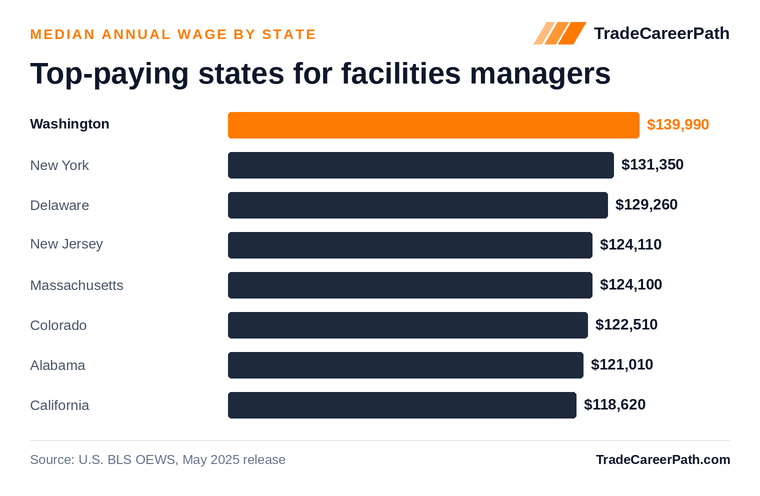
Unlike careers tied to one industry, facilities management goes wherever there are buildings - which means jobs in all 50 states and DC with wage data. The biggest markets are the biggest economies: California leads with 20,550 facilities managers at a $118,620 median, followed by Texas with 13,140 at $99,430 and New York with 9,580 at $131,350 (BLS OEWS, May 2025).
| State | Median annual wage | Employment |
|---|---|---|
| Washington | $139,990 | 2,790 |
| New York | $131,350 | 9,580 |
| Delaware | $129,260 | 240 |
| New Jersey | $124,110 | 5,690 |
| Massachusetts | $124,100 | 6,070 |
The Northeast corridor is the real hub: New Jersey and Massachusetts pair top-five pay with above-average concentration - facilities managers are noticeably more common there than in the typical state labor market, thanks to dense corporate real estate, universities, and hospital systems. Washington pays the most of any state but the role is less concentrated there than average, so those jobs cluster around the Seattle metro. Delaware’s high median comes with a very small market - 240 jobs statewide - a footnote rather than a destination.
How to Become a Facilities Manager
1. Build systems experience
Maintenance, HVAC, or building-trades work is the standard foundation - and it is the part you cannot shortcut. Hiring managers want someone who has actually maintained chillers, switchgear, or plumbing risers, because the core of the job is judging the condition of equipment and the honesty of the people quoting to fix it. If you are already a few years into a maintenance or HVAC career, this step is done.
2. Earn a bachelor’s degree
Facility management, engineering technology, or business administration. The dedicated facility-management degree maps most directly to the work and to IFMA’s credential path; the business degree is the more flexible fallback and often has the most online options. Either way, get a written transfer evaluation first - prior college credits, military training, and apprenticeship coursework can reduce the 120 credit hours at transfer-friendly schools.
3. Move into supervision
Lead tech and maintenance-supervisor roles bridge to management, and this move can happen while you are still in school. Supervision proves the two things a degree cannot: that you can run a crew and be accountable for a schedule and a budget line. Chief engineer titles in commercial real estate are the classic stepping stone - they put you in the room for vendor meetings and capital planning before you hold the manager title.
4. Add IFMA credentials
FMP then CFM are the field’s recognized certifications. The Facility Management Professional (FMP) is coursework-based and achievable early; the Certified Facility Manager (CFM) is the experience-gated capstone that shows up in director-level postings. None of these are legally required - but in a field with no license, they are how employers sort candidates on paper.
5. Advance
Facilities director, regional portfolio management, or corporate real estate. The fork comes after a few years running a single site: go deeper into one demanding vertical (hospitals and data centers pay premiums for uptime-critical experience), or go wider into multi-site and regional roles where the job becomes budgets, standards, and the managers who report to you. Both tracks are covered in the career ladder below.
Career Ladder: Titles and Realistic Pay
The BLS wage percentiles map cleanly onto how facilities careers actually progress. Use this as a sanity check on offers, not a guarantee:
| Stage | Typical titles | Years in | Realistic pay (BLS OEWS, May 2025) |
|---|---|---|---|
| Entry level | Assistant facilities manager, maintenance supervisor, building engineer supervisor | 0-3 | ~$64,480-$82,020 (10th-25th pct) |
| Mid-career | Facilities manager (single site), property operations manager | 3-10 | ~$106,660 (median) |
| Senior | Senior facilities manager, multi-site FM, chief engineer over portfolio | 10-15 | ~$138,870 (75th pct) |
| Director / portfolio | Facilities director, regional FM, corporate real estate operations | 15+ | $176,120+ (90th pct) |
Two notes for career changers. First, trade experience compresses this ladder: a technician with ten years on building systems who finishes the degree does not start at the bottom of the entry band - maintenance-supervisor experience typically counts as time served, and many land at or near single-site manager pay on the first management job. Second, the bands vary hard by building type - data centers, hospitals, and Class A corporate portfolios pay toward the top of each band, while school districts and small commercial buildings sit toward the bottom, sometimes below it.
Do You Need a License?
No. Facilities management has no state licensing requirement - it is a management occupation, and no exam or state board stands between you and the title. What replaces the license is a certification ladder that employers use to screen:
- IFMA FMP and CFM: the Facility Management Professional is the accessible first credential; the Certified Facility Manager is the experience-gated one that carries weight in director-level hiring.
- BOMA designations: the recognized equivalents on the commercial property side.
- Trade credentials you already hold: an HVAC or electrical license, or safety certifications from your trade years, are not required for the role but signal exactly the systems fluency employers want.
Why an Online Degree Works for This Career
Maintenance technicians and HVAC techs already know the systems; the bachelor’s adds the budgeting, contracts, and management layer that the title requires. Online facility-management and business programs serve exactly this working-technician audience - the coursework is readings, spreadsheets, and projects rather than labs, so it fits around a maintenance schedule, and many employers with facilities departments offer tuition assistance. You keep your job, your seniority, and your systems knowledge current while the degree closes the only gap on your resume.
Job Outlook for 2026 and Beyond
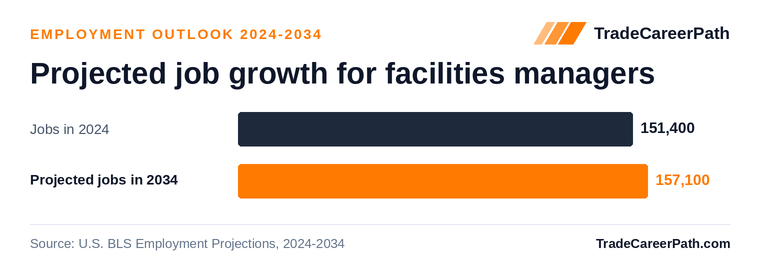
BLS projects facilities management employment to grow +4.6% from 2025 to 2035 - from 165,900 to 173,500 jobs - with about 14,200 openings per year once retirements and occupation changes are counted (BLS Employment Projections, 2025-35). That openings number is the figure that matters for career changers: in a 156,180-person occupation, 14,200 seats a year means constant hiring, driven mostly by an aging management cohort retiring out.
The latest wage data (OEWS, May 2025) puts the median at $106,660, up from the 2024 figure of $104,690 - steady growth in a field where pay is anchored by the cost of the buildings, not the headcount. The demand drivers are structural: buildings do not stop needing to run, deferred-maintenance backlogs at campuses and hospitals keep growing, and energy-cost and compliance pressure keeps pushing owners to hire managers who can actually control operating budgets. Growth is modest, but this is about as recession-resistant as management careers get.
Cost and Time to Complete the Degree
For facilities managers, the credential is: Bachelor’s in facility management, engineering technology, or business. A bachelor’s degree is typically 120 credit hours: four years full-time, and commonly five to six years part-time while working. Transfer credit is the other lever: prior college, military training, apprenticeship coursework, and industry certifications can be worth meaningful credit at transfer-friendly schools, so get a written transfer evaluation before enrolling anywhere. Costs vary widely by school type; in-state public online programs are usually the value benchmark, and employer tuition assistance is common for working adults in this field.
Pros and Cons of Training as a Facilities Manager
Pros
- Median pay of $106,660 nationally (BLS OEWS, May 2025)
- About 14,200 openings per year - steady hiring in every state (BLS Employment Projections, 2025-35)
- Field experience from the trades is a genuine hiring advantage
- Accredited online and hybrid degree paths exist for working adults
- No license required - certifications and experience are the only gates
Cons
- Requires a 4-year degree (typically 120 credit hours) for most senior roles
- Entry-level pay starts near $64,480 at the 10th percentile
- Modest headline growth (+4.6% through 2035) - openings come from turnover, not expansion
- You inherit the 2 a.m. phone call: the building's failures work as your accountability
Frequently Asked Questions
Is facilities management a good step up from maintenance?
It is the natural one - BLS median pay for the occupation is six figures, and employers hire preferentially from candidates who have run the systems they'll now budget for.
How much do facilities managers make?
The national median annual wage for facilities managers is $106,660 (BLS OEWS, May 2025). The top 10% earn $176,120 or more, while entry-level pay starts around $64,480.
What is the job outlook for facilities managers?
BLS projects employment of facilities managers to change by +4.6% from 2025 to 2035 (BLS Employment Projections, 2025-35).
How long does facilities manager training take?
The bachelor's is 120 credit hours: four years full-time, commonly five to six years part-time while working. Most people layer it on top of several years of maintenance or trades experience, and transfer credit for prior college, military training, or apprenticeship coursework can meaningfully shorten it.
Is facilities management hard?
The technical side is the easy part for a tradesperson - you already know the systems. The learning curve is budgets, contracts, and people: capital planning, vendor negotiation, and managing a crew plus tenant expectations. The degree coursework is business-heavy rather than math-heavy.
Should I get a facility management or business degree?
Either works. A dedicated facility-management degree maps directly to the job and pairs well with IFMA credentials; a business administration degree keeps more doors open outside the field. For a working technician, pick whichever accredited online program fits your schedule and transfers the most credit - employers care most about the systems experience plus any bachelor's.
Can you train as a facilities manager without a degree?
Sometimes - smaller buildings and some employers promote strong maintenance supervisors without one. But most corporate, healthcare, and campus postings screen for a bachelor's, and the six-figure roles at the median of $106,660 and above increasingly require it. Experience plus the degree is the reliable path; experience alone caps out earlier.
Do facilities managers need a license?
No state license is required for the role itself. The credentials that matter are industry certifications - IFMA's FMP and CFM are the recognized ladder, and BOMA designations carry weight in commercial real estate. Trade licenses you already hold (HVAC, electrical) remain useful but are not required for the manager title.
Facilities Manager Salary and Requirements by State
Alabama · Alaska · Arizona · Arkansas · California · Colorado · Connecticut · Delaware · District of Columbia · Florida · Georgia · Hawaii · Idaho · Illinois · Indiana · Iowa · Kansas · Kentucky · Louisiana · Maine · Maryland · Massachusetts · Michigan · Minnesota · Mississippi · Missouri · Montana · Nebraska · Nevada · New Hampshire · New Jersey · New Mexico · New York · North Carolina · North Dakota · Ohio · Oklahoma · Oregon · Pennsylvania · Rhode Island · South Carolina · South Dakota · Tennessee · Texas · Utah · Vermont · Virginia · Washington · West Virginia · Wisconsin · Wyoming
Related Careers and Degree Paths
- Maintenance Technician - the trade this career most commonly promotes from
- HVAC Technician - the other classic feeder trade into building operations
- Construction Manager - the build-side counterpart with a similar degree path
- Industrial Production Manager - the plant-floor equivalent for manufacturing settings
- All trade careers that require a 4-year degree
Degree and Program Guides
- Online Industrial Technology Degrees - the applied degree for maintenance and facilities leadership
Sources
- U.S. Bureau of Labor Statistics, Occupational Employment and Wage Statistics (OEWS), May 2025 - Facilities Managers (SOC 11-3013)
- U.S. Bureau of Labor Statistics, Employment Projections, 2025-35
- U.S. Bureau of Labor Statistics, Occupational Outlook Handbook - education and licensing requirements
Facilities Manager Salary by State
About this guide: Researched and written by the TradeCareerPath Editorial Team. Our editorial team researches and sources every trade school and career guide using federal labor and education data, including BLS OEWS and Employment Projections, DOL apprenticeship records, IPEDS, College Scorecard, and state licensing boards. We follow the editorial standards documented at /editorial-policy/.
Data sources
Figures on this page are sourced from the federal and state datasets below. Methodology: how we rank and source data.
| Data | Provider | Vintage |
|---|---|---|
| Occupational Employment and Wage Statistics (OEWS) | U.S. Bureau of Labor Statistics | May 2025 |
| Employment Projections | U.S. Bureau of Labor Statistics | 2025-2035 |
| Integrated Postsecondary Education Data System | National Center for Education Statistics (IPEDS) | 2024 |
| College Scorecard (school-level outcomes) | U.S. Department of Education | latest release |
| College Scorecard (field-of-study earnings) | U.S. Department of Education | latest release (updated 2026-06-12) |
| Occupational licensing requirements | CareerOneStop (U.S. Department of Labor) | latest release (updated 2026-02-22) |
| Registered apprenticeship programs | CareerOneStop / Apprenticeship.gov (U.S. Department of Labor) | latest release (updated 2025-10-25) |
| O*NET occupation profiles (skills, tasks, tools, job zones) | U.S. Department of Labor (O*NET / Employment & Training Admin.) | O*NET 31.0 (updated 2026-10-14) |