
How to Become a Firefighter in 2026
Is Firefighter Right for You?
The U.S. Department of Labor's O*NET profile for Firefighters (SOC 33-2011) describes the work this way: Control and extinguish fires or respond to emergency situations where life, property, or the environment is at risk. Duties may include fire prevention, emergency medical service, hazardous material response, search and rescue, and disaster assistance.
What the work involves
- Rescue survivors from burning buildings, accident sites, and water hazards.
- Dress with equipment such as fire-resistant clothing and breathing apparatus.
- Assess fires and situations and report conditions to superiors to receive instructions, using two-way radios.
- Move toward the source of a fire, using knowledge of types of fires, construction design, building materials, and physical layout of properties.
- Respond to fire alarms and other calls for assistance, such as automobile and industrial accidents.
Skills and knowledge that matter
Skills: Critical Thinking, Service Orientation, Judgment and Decision Making, Coordination, Speaking, Monitoring.
Knowledge: Public Safety and Security, Customer and Personal Service, Education and Training, Building and Construction.
Tools and technology you may use
Tools: Adjustable wrenches, Aerial lifting apparatus, Aerial trucks, Air bag lifting systems, Air chisels, Air purifying respirators.
Technology: Data base user interface and query software, Office suite software, Electronic mail software, Microsoft Access, Microsoft Excel, Microsoft Office software.
Typical preparation
O*NET Job Zone Three (Medium Preparation Needed). Most occupations in this zone require training in vocational schools, related on-the-job experience, or an associate's degree. Employees in these occupations usually need one or two years of training involving both on-the-job experience and informal training with experienced workers. A recognized apprenticeship program may be associated with these occupations.
Interest fit
O*NET interest profile: Realistic, Conventional, Social. People who enjoy hands-on, practical work with tools, machines, plants, or materials often find this occupation a good fit.
Source: O*NET 29.1 (updated 2026-06-13)
Ever wanted a career where you can make a difference every day?
Firefighters protect lives, property, and communities through courage, training, and teamwork.
Firefighters respond to emergencies including fires, medical calls, vehicle accidents, and natural disasters.
They work under challenging conditions and rely on both physical ability and quick decision-making skills.
If you’re disciplined, strong, and driven to serve, firefighting offers a rewarding and respected public safety career.
Quick answers
What do firefighters do? Firefighters respond to emergencies including fires, medical calls, vehicle accidents, and natural disasters. They also help prevent fires through education and safety inspections.
What education do you need to start? Start with a high school diploma or GED. Then complete a certified fire academy or fire science training program.
How long does firefighter training take? It typically takes 1-4 years, including fire academy training and certification.
What certifications are commonly required? Most states require Firefighter I and II certifications and basic EMT training. Additional certifications may include hazmat or rescue operations.
How much does training cost? Program cost is listed as varies by school, format and location depending on state and certifications, and certification fees vary by state and level of qualification.
What does the application process include? Applicants typically complete written exams, physical ability tests, interviews, and background checks before being hired by a department.
At a glance
- Entry education: High school diploma or GED
- Typical timeline: 1-4 years (including fire academy and EMT training)
- Training paths: Fire academy (6-12 months) or a 2-year fire science degree
- Common certifications: Firefighter I/II and EMT
- Hiring process: written exam, physical test, interview, background check
- Typical program cost: varies by school, format and location (certification fees vary)
Quick Facts: Firefighter Training and Outlook
What Firefighters Do
Firefighters respond to emergencies and prevent fires through education and safety inspections.
They operate rescue equipment, administer first aid, and work as part of coordinated fire and emergency teams.
Typical Responsibilities
- Extinguish fires and rescue individuals from danger
- Operate fire trucks, hoses, and emergency equipment
- Provide emergency medical care and CPR
- Conduct building inspections and fire safety education
- Maintain physical fitness and readiness for emergencies
Firefighters are trained professionals who serve their communities during moments of greatest need.
Key Skills and Traits for Success
- Physical fitness and endurance
- Teamwork and communication skills
- Ability to remain calm under pressure
- Mechanical and technical aptitude
- Integrity, courage, and community focus
Work Settings for Firefighters
Firefighters work in:
- Municipal and regional fire departments
- Airport and industrial fire protection services
- Forest and wildland fire agencies
- Emergency medical or rescue units
- Military and federal fire services
How to Become a Firefighter (5 Steps)
Training as a firefighter typically takes 1-4 years, including fire academy training and certification.
1. Earn a High School Diploma or GED
Focus on physical education, science, and communication. These skills build a foundation for emergency training.
2. Complete Firefighter or Fire Science Training
Enroll in a certified fire academy or community college program offering fire science courses. You'll learn fire behavior, rescue operations, and safety procedures.
3. Obtain Certifications
Most states require completion of Firefighter I and II certifications and basic EMT training. Additional certifications may include hazmat or rescue operations.
4. Pass the Fire Department Application Process
Applicants typically complete written exams, physical ability tests, interviews, and background checks before being hired by a department.
5. Continue Training and Advance
Once hired, firefighters undergo ongoing training to maintain certification and can advance to engineer, captain, or chief roles with experience.
Education and Training Paths
| Pathway | Typical Duration | Outcome |
|---|---|---|
| Fire Academy | 6-12 months | Basic firefighter certification (Firefighter I/II) |
| Associate Degree in Fire Science | 2 years | Broader knowledge of fire behavior and safety |
| EMT Certification | 6 months | Emergency medical skills for first response |
| Continuing Education | Ongoing | Leadership and specialized training |
Career Growth and Advancement
Firefighters can advance to:
- Fire Engineer - operates vehicles and pumps
- Fire Captain or Battalion Chief - leads firehouse crews
- Fire Investigator or Inspector - focuses on fire prevention and safety
- Fire Chief or Training Officer - oversees department operations and leadership
Cost and Duration of Training
- Program Cost: varies by school, format and location depending on state and certifications
- Duration: 1-4 years including fire academy and EMT training
- Certification Fees: vary by state and level of qualification
Firefighting is a calling for those committed to service, teamwork, and community safety. The work is demanding but deeply meaningful.
Pros and Cons
✅ Pros
- Public service and community impact
- Strong teamwork and camaraderie
- Varied and challenging work environment
- Ongoing training and skill development
⚠️ Cons
- Physically and emotionally demanding
- Shift work including nights and weekends
- Exposure to hazardous conditions
Industry Organizations & Certifying Bodies
These are the recognized national organizations, unions, certifying bodies, and regulatory authorities that shape this trade. They issue the credentials, sponsor the apprenticeships, publish the codes, and represent workers and employers.
- International Association of Fire Fighters (IAFF) Largest firefighter union.
- National Fire Protection Association (NFPA) Publishes NFPA 1001 (Fire Fighter Professional Qualifications) and other firefighter standards.
- Pro Board Fire Service Professional Qualifications Accredits state firefighter certification systems.
- International Fire Service Accreditation Congress (IFSAC) Accredits firefighter training and certification programs.
Wage and Employment Charts
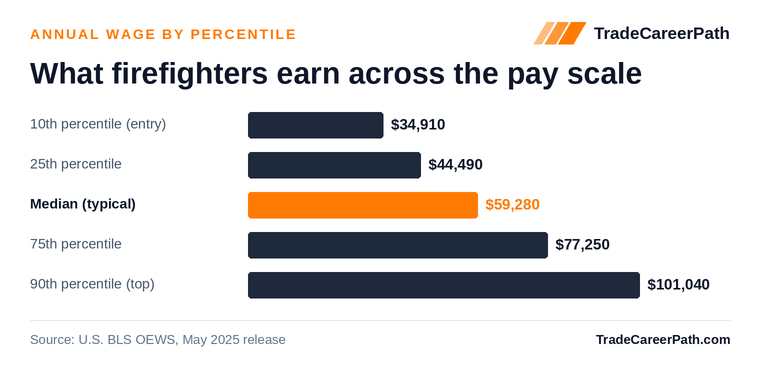
| Percentile | Annual wage |
|---|---|
| 10th | $34,910 |
| 25th | $44,490 |
| 50th (median) | $59,280 |
| 75th | $77,250 |
| 90th | $101,040 |
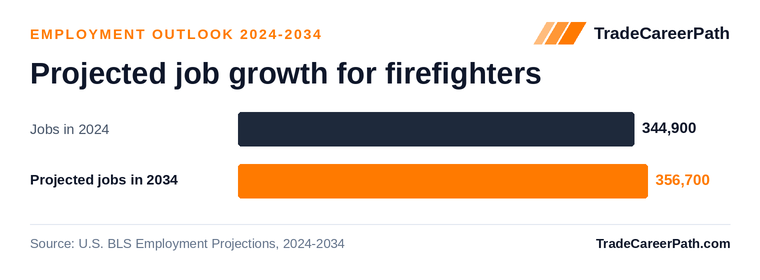
| Year | Employment |
|---|---|
| 2024 | 344,900 |
| 2034 projected | 356,700 |
| Percent change | +3.4% |
Firefighter Salary and Requirements by State
Select your state for local wage data, training options, and requirements:
Alabama · Alaska · Arizona · Arkansas · California · Colorado · Connecticut · Delaware · District of Columbia · Florida · Georgia · Hawaii · Idaho · Illinois · Indiana · Iowa · Kansas · Kentucky · Louisiana · Maine · Maryland · Massachusetts · Michigan · Minnesota · Mississippi · Missouri · Montana · Nebraska · Nevada · New Hampshire · New Jersey · New Mexico · New York · North Carolina · North Dakota · Ohio · Oklahoma · Oregon · Pennsylvania · Rhode Island · South Carolina · South Dakota · Tennessee · Texas · Utah · Vermont · Virginia · Washington · West Virginia · Wisconsin · Wyoming
Workplace Safety Snapshot
BLS Survey of Occupational Injuries and Illnesses data (2023-2024) report approximately 134.2 days-away, restricted, or transfer cases per 10,000 full-time-equivalent workers in firefighters (about 1.34 per 100 FTE). Source: BLS Survey of Occupational Injuries and Illnesses, Table R98.
Frequently Asked Questions
How long does firefighter training take?
It typically takes typically 6 months to 2 years of training. The most common entry path is through a certificate or associate degree program. A high school diploma or GED is generally required to get started.
How much do firefighters make?
The median annual salary for firefighters is $59,280 according to the Bureau of Labor Statistics (May 2025). Entry-level workers earn around $34,910, while those in the 90th percentile earn over $101,040. Pay varies by state, experience, and specialization.
What is the job outlook for firefighters?
The Bureau of Labor Statistics projects 3.4% employment growth for this occupation from 2024 to 2034, which is roughly on pace with the overall economy. Approximately 27,100 job openings are expected each year due to growth, retirements, and workers leaving the field.
Do you need a college degree to work as a firefighter?
No. A college degree is not required to work as a firefighter. Most people enter the field through a certificate or associate degree program. A high school diploma or GED is typically the only educational prerequisite.
Which states pay firefighters the most?
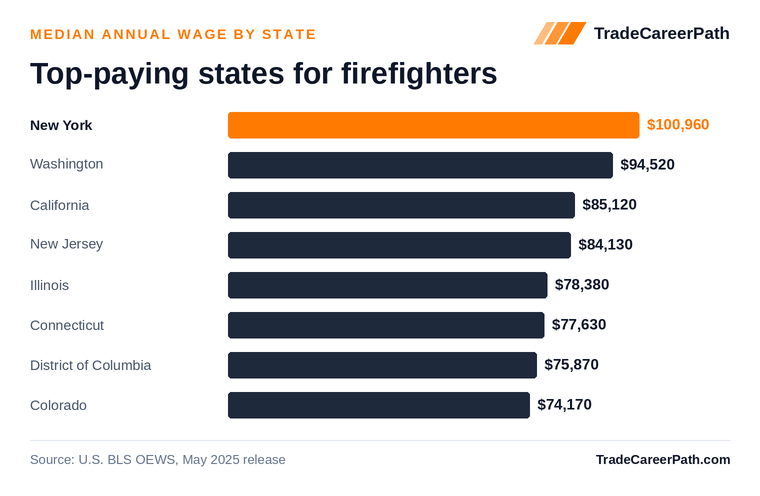
According to the U.S. Bureau of Labor Statistics (May 2025 OEWS), the highest-paying states for firefighters are New York, Washington, and California. Median annual wages: New York ($100,960); Washington ($94,520); California ($85,120).
Which states employ the most firefighters?
BLS reports the largest concentrations of firefighters in California, Texas, and Florida. Employment levels: California (31,470 workers); Texas (28,170 workers); Florida (24,570 workers) (May 2025).
How much do experienced firefighters earn?
The top 10% of firefighters earn more than $101,040 per year, according to BLS Occupational Employment and Wage Statistics (May 2025). Experienced workers in this band typically hold senior credentials, supervisory roles, or specialty certifications.
What is entry-level pay for firefighters?
BLS reports the bottom 10% of firefighters earn under $34,910 per year. New workers often start near this level and see pay rise as they accumulate experience and credentials.
How many firefighters work in the United States?
BLS reports approximately 345,990 firefighters employed nationwide as of May 2025.
How many job openings are expected for firefighters each year?
BLS projects approximately 27,100 openings per year for firefighters from 2024 through 2034, including new positions, retirements, and workers transitioning out. The occupation is projected to grow 3.4% from 2024 to 2034, classified as about as fast as average growth.
How much do firefighters make per hour?
The median hourly wage for firefighters is $28.50, according to BLS (May 2025). Hourly pay ranges from about $16.79 (bottom 10%) to $48.58 (top 10%).
How Firefighter Pay Compares to Similar Trades
Side-by-side comparison of Firefighter and the closest related careers, based on U.S. Bureau of Labor Statistics data (May 2025 OEWS + 2024-2034 Employment Projections).
| Career | Median Pay | 10-Year Growth | Annual Openings |
|---|---|---|---|
| Firefighter this guide | $59,280 | +3.4% | 27,100 |
| Emt | $44,470 | +5.1% | 14,100 |
| Paramedic | $60,600 | +5.0% | 4,900 |
Source: BLS Occupational Employment and Wage Statistics + BLS Employment Projections.
Sources
- U.S. Bureau of Labor Statistics, Occupational Employment and Wage Statistics (May 2025)
- U.S. Bureau of Labor Statistics, Employment Projections 2024-2034
- U.S. Bureau of Labor Statistics, Survey of Occupational Injuries and Illnesses (2023-2024, Table R98)
- U.S. Department of Labor, Wage and Hour Division, Davis-Bacon General Wage Determinations (2026)
Firefighter Salary by State
About this guide: Researched and written by the TradeCareerPath Editorial Team. Our editorial team researches and sources every trade school and career guide using federal labor and education data, including BLS OEWS and Employment Projections, DOL apprenticeship records, IPEDS, College Scorecard, and state licensing boards. We follow the editorial standards documented at /editorial-policy/.
Data sources
Figures on this page are sourced from the federal and state datasets below. Methodology: how we rank and source data.
| Data | Provider | Vintage |
|---|---|---|
| Occupational Employment and Wage Statistics (OEWS) | U.S. Bureau of Labor Statistics | May 2025 |
| Employment Projections | U.S. Bureau of Labor Statistics | 2024-2034 |
| Integrated Postsecondary Education Data System | National Center for Education Statistics (IPEDS) | 2024 |
| College Scorecard (school-level outcomes) | U.S. Department of Education | latest release |
| College Scorecard (field-of-study earnings) | U.S. Department of Education | latest release (updated 2026-06-12) |
| Occupational licensing requirements | CareerOneStop (U.S. Department of Labor) | latest release (updated 2026-02-22) |
| Registered apprenticeship programs | CareerOneStop / Apprenticeship.gov (U.S. Department of Labor) | latest release (updated 2025-10-25) |
| O*NET occupation profiles (skills, tasks, tools, job zones) | U.S. Department of Labor (O*NET / Employment & Training Admin.) | O*NET 29.1 (updated 2026-06-13) |