
How to Become a Flooring Installer in 2026
Is Flooring Installer Right for You?
The U.S. Department of Labor's O*NET profile for Floor Layers, Except Carpet, Wood, and Hard Tiles (SOC 47-2042) describes the work this way: Apply blocks, strips, or sheets of shock-absorbing, sound-deadening, or decorative coverings to floors.
What the work involves
- Sweep, scrape, sand, or chip dirt and irregularities to clean base surfaces, correcting imperfections that may show through the covering.
- Cut flooring material to fit around obstructions.
- Inspect surface to be covered to ensure that it is firm and dry.
- Trim excess covering materials, tack edges, and join sections of covering material to form tight joint.
- Form a smooth foundation by stapling plywood or Masonite over the floor or by brushing waterproof compound onto surface and filling cracks with plaster, putty, or grout to seal pores.
Skills and knowledge that matter
Skills: Speaking, Active Listening, Time Management, Social Perceptiveness, Monitoring, Judgment and Decision Making.
Knowledge: Building and Construction, Customer and Personal Service, Mathematics, Mechanical.
Tools and technology you may use
Tools: Adhesive spreaders, Adhesive syringes, Adjustable wedges, Appliance sliders, Automatic plasma arc welding machines, Aviation snips.
Technology: Data base user interface and query software, Project management software, Web page creation and editing software, Facebook, Microsoft Office software.
Typical preparation
O*NET Job Zone Two (Some Preparation Needed). These occupations usually require a high school diploma. Employees in these occupations need anywhere from a few months to one year of working with experienced employees. A recognized apprenticeship program may be associated with these occupations.
Interest fit
O*NET interest profile: Realistic, Conventional, Artistic. People who enjoy hands-on, practical work with tools, machines, plants, or materials often find this occupation a good fit.
Source: O*NET 29.1 (updated 2026-06-13)
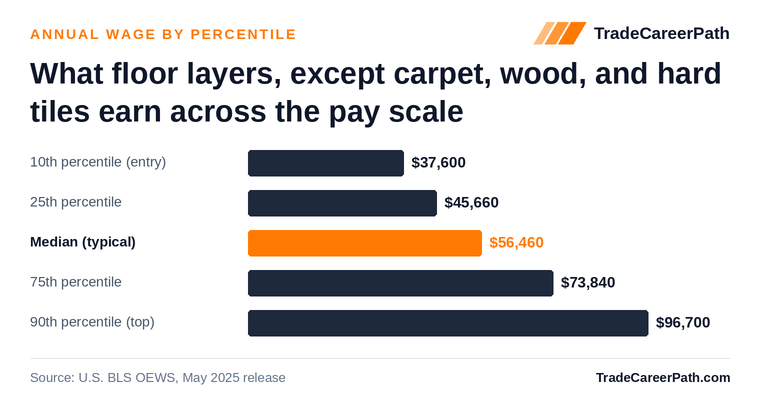
Quick answer: Training as a flooring installer usually takes about 6 months to 2 years to reach job-ready skill, though a full apprenticeship can run longer. You learn the trade through hands-on work, a trade school program, or an apprenticeship such as INSTALL, build experience across hardwood, tile, vinyl, and laminate, and can earn an optional certification from the International Certified Flooring Installers Association (CFI). Most installers do not need a college degree, and a high school diploma or GED is the usual starting point. The median flooring installer salary is $56,460 per year ($27.15/hour), with about 2,700 openings nationwide each year (BLS, May 2025).
Flooring installers measure, cut, and lay materials like hardwood, tile, vinyl, laminate, and carpet in homes and commercial buildings. If you like precise, physical work and seeing a finished result at the end of each job, this is a hands-on trade you can enter without a four-year degree.
How to Become a Flooring Installer
Most people reach a working skill level in about six months to two years, depending on whether they learn on the job, attend a trade program, or join an apprenticeship. There is no single national license to pass. You build the career through training, hands-on experience, and an optional certification.
1. Earn a high school diploma or GED
A high school diploma or GED is the baseline for most flooring jobs and nearly every apprenticeship. Before you start, build the skills the trade leans on. Comfort with basic math, fractions, and measurement matters every day, because you constantly calculate square footage, figure out cut lines, and plan material layout to limit waste. Shop, woodworking, or any hands-on technical class is good practice for working with tools and reading plans. Physical stamina helps too, since the work involves a lot of kneeling, lifting, and bending. If you are switching careers and already have a diploma, you can move straight to training. Many strong installers come from other physical or construction backgrounds and pick up flooring quickly because they already know jobsite safety and how to handle tools.
2. Get hands-on training or enroll in a trade program
You can learn flooring through a trade school program or by starting as a helper with a flooring contractor. Training, whether in a classroom or on the job, generally covers the same core skills: identifying flooring materials, inspecting and preparing subfloors, measuring and marking layouts, cutting accurately, and working safely with adhesives, underlayment, and power tools. You also learn how different materials behave, since installing hardwood is not the same as setting tile or rolling out vinyl. Trade school tool and tuition costs are usually modest compared with many other trades, though exact prices vary by program and school. Hands-on practice is the most important part. The faster you get comfortable on real floors, the sooner you work as productive and valuable to an employer.
3. Start an apprenticeship
An apprenticeship is one of the most reliable ways to learn flooring because you earn a paycheck while building skill under experienced installers. Many contractors run their own paid on-the-job training, and the International Standards and Training Alliance (INSTALL) offers a union apprenticeship that pairs supervised field hours with structured classroom instruction in flooring systems and safety. Over the program you rotate through different materials and jobsite conditions, learning the standards employers expect for both residential and commercial work. Apprenticeships also connect you to a network of journeymen and contractors, which makes finding steady work easier once you finish. Expect the full path to take longer than a short certificate, but you avoid taking on training debt because you are paid throughout.
4. Build experience across flooring types
The more materials you can install well, the more jobs you can take. Aim to get comfortable with hardwood, engineered wood, laminate, luxury vinyl, sheet vinyl, and tile, since each has its own subfloor prep, layout, and finishing requirements. Commercial projects often demand specific products and tighter tolerances, so experience there opens higher-paying work. As you build range, pay attention to detail work like transitions, stair treads, and pattern matching, which separate skilled installers from beginners. Keep track of the jobs you complete and the materials you have mastered. That record helps when you apply for better positions, bid your own work, or pursue certification.
5. Earn optional certification
Certification is usually optional rather than legally required, but it can set you apart, especially for commercial and specification-driven work. The International Certified Flooring Installers Association (CFI) offers an industry-standard credential that verifies your installation skills across flooring types. Earning it signals to general contractors and building owners that your work meets recognized standards, which can help you win bids and command better pay. Some states and specialties have their own licensing or contractor rules, so check local requirements before you take on independent jobs. If you go the union route, the INSTALL apprenticeship builds toward recognized credentials as well, so you can come out of training already prepared for certified-level work.
6. Find a job and advance your career
Flooring contractors, remodeling companies, home builders, and commercial construction firms all hire installers, and big-box retailers and flooring stores often use installer crews too. Start by applying with local contractors or through a union hall if you trained with INSTALL, and lean on the connections you made during your apprenticeship. As you gain experience, you can move into lead installer, estimator, or crew supervisor roles. Many experienced installers eventually start their own flooring business, where strong references, certification, and a track record across material types help you win residential and commercial contracts.
What Does a Flooring Installer Do?
Flooring installers measure, cut, and install a wide variety of flooring materials, from hardwood and tile to carpet, laminate, and vinyl.
They often:
- Inspect and prepare subfloors
- Measure and cut materials accurately
- Install and secure different flooring types
- Work with adhesives, finishes, and tools safely
- Repair and replace damaged floors
Skilled installers combine craftsmanship with practical problem-solving to deliver professional, durable results.
Skills That Make Great Flooring Installers
- Precision and attention to detail
- Good physical fitness and balance
- Math and measuring skills
- Ability to read blueprints and layouts
- Problem-solving and time management
Flooring installation is part craft, part planning. Each project rewards careful measurement and patience.
Education and Certification Paths
| Pathway | Typical Duration | Outcome |
|---|---|---|
| On-the-job training | Months to a year | Entry-level installer skills |
| Trade school certificate | 6 to 12 months | Foundational installation skills |
| Apprenticeship (INSTALL or contractor) | Several years, paid | Well-rounded, recognized training |
| CFI certification | Add-on credential | Verifies skills for commercial work |
Career Growth and Advancement
With experience, flooring installers may move into roles such as:
- Lead Installer who runs a crew on larger jobs
- Estimator who measures jobs and prepares bids
- Crew Supervisor or Foreman who manages multiple projects
- Business Owner who runs an independent flooring company
Cost and Duration of Training
- Program cost: varies by program and school; trade school and tool costs are generally modest, and union apprenticeships pay you while you train
- Time to complete: about six months to two years to reach job-ready skill, with apprenticeships running longer
- Certification: optional CFI certification can be added once you have experience
Many installers learn primarily through paid on-the-job training and apprenticeships, which keeps upfront costs low.
Pros and Cons of the Flooring Trade
Pros
- Steady demand in construction and remodeling
- Rewarding, visible results from every project
- Strong potential for self-employment
- Relatively low entry cost for tools and training
Cons
- Physically demanding work with kneeling, lifting, and bending
- Seasonal or project-based workload in some areas
- Requires constant safety awareness and attention to detail
Start Your Flooring Career
From luxury homes to commercial spaces, flooring installers are part of every build and renovation. If you are precise, patient, and like physical work, it is a trade you can enter without a four-year degree.

Quick Facts: Flooring Installer Salary, Education, and Outlook
Industry Organizations & Certifying Bodies
These are the recognized national organizations, unions, certifying bodies, and regulatory authorities that shape this trade. They issue the credentials, sponsor the apprenticeships, publish the codes, and represent workers and employers.
- International Certified Flooring Installers Association (CFI) Industry-standard flooring installer certification.
- International Standards and Training Alliance (INSTALL) Union flooring installer training and apprenticeship organization.
Wage and Employment Charts
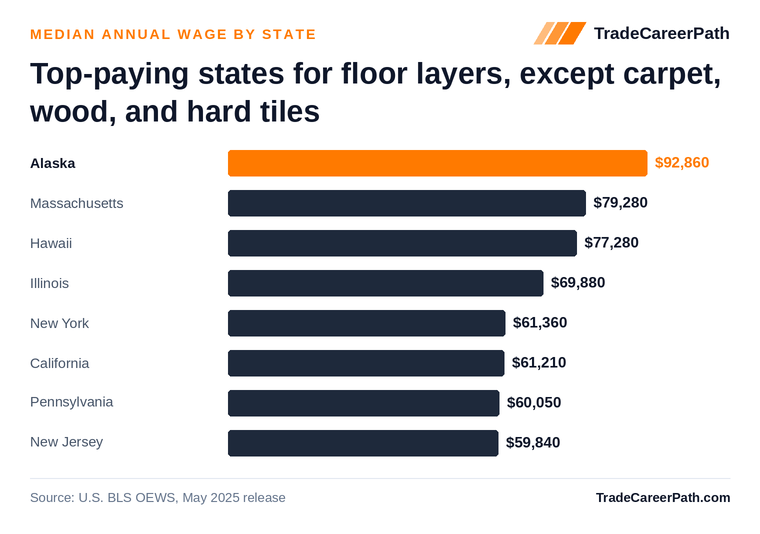
Floor Installer Salary and Requirements by State
Select your state for local wage data, training options, and requirements:
Alabama · Alaska · Arizona · Arkansas · California · Colorado · Connecticut · Delaware · District of Columbia · Florida · Georgia · Hawaii · Idaho · Illinois · Indiana · Iowa · Kansas · Kentucky · Louisiana · Maine · Maryland · Massachusetts · Michigan · Minnesota · Mississippi · Missouri · Montana · Nebraska · Nevada · New Hampshire · New Jersey · New Mexico · New York · North Carolina · North Dakota · Ohio · Oklahoma · Oregon · Pennsylvania · Rhode Island · South Carolina · South Dakota · Tennessee · Texas · Utah · Vermont · Virginia · Washington · West Virginia · Wisconsin · Wyoming
Workplace Safety Snapshot
BLS Survey of Occupational Injuries and Illnesses data (2023-2024) report approximately 79.5 days-away, restricted, or transfer cases per 10,000 full-time-equivalent workers in floor layers, except carpet, wood, and hard tiles (about 0.80 per 100 FTE). Source: BLS Survey of Occupational Injuries and Illnesses, Table R98.
Frequently Asked Questions
How long does flooring installer training take?
It typically takes about 6 months to 2 years to work as job ready. Many installers start with a short certificate program or learn directly on the job, while a full apprenticeship can run several years. A high school diploma or GED is generally required to get started.
Do you need a college degree to work as a flooring installer?
No. A college degree is not required to work as a flooring installer. Most people enter the field through on-the-job training, a trade school certificate, or an apprenticeship. A high school diploma or GED is typically the only educational prerequisite.
How much does flooring installer training cost?
Training costs vary by program and school. Tool and trade school costs are generally on the lower end compared with many other trades, and union apprenticeships through INSTALL combine paid work with classroom instruction so you earn while you learn.
Is certification required to be a flooring installer?
Certification is usually optional rather than legally required. Credentials such as the International Certified Flooring Installers Association (CFI) certification can strengthen your resume and help you qualify for commercial work. Some states and specialties have their own licensing rules, so check local requirements.
How many flooring installers work in the United States?
BLS reports approximately 23,640 floor layers (except carpet, wood, and hard tiles) employed nationwide as of May 2025.
Is flooring installer a growing career?
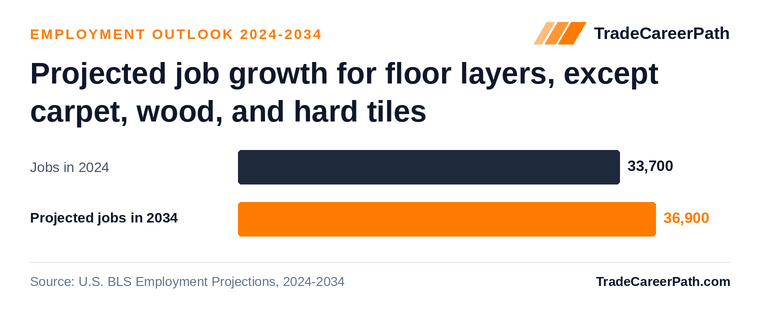
Yes. BLS projects 9.5% employment growth for floor layers between 2024 and 2034, faster than the average for all occupations, with about 2,700 openings projected each year.
Can you train to be a flooring installer through an apprenticeship?
Yes. Apprenticeships are a common path. Union programs such as the International Standards and Training Alliance (INSTALL) pair paid on-the-job hours with classroom instruction, and many contractors run their own training for new installers.
How Flooring Installer Pay Compares to Similar Trades
Side-by-side comparison of Flooring Installer and the closest related careers, based on U.S. Bureau of Labor Statistics data (May 2025 OEWS + 2024-2034 Employment Projections).
| Career | Median Pay | 10-Year Growth | Annual Openings |
|---|---|---|---|
| Flooring Installer this guide | $56,460 | +9.5% | 2,700 |
| Carpentry | $60,580 | +4.5% | 74,100 |
| Construction Worker | $47,120 | +7.3% | 129,400 |
| Home Inspector | $74,690 | -0.8% | 14,800 |
Source: BLS Occupational Employment and Wage Statistics + BLS Employment Projections.
Sources
- U.S. Bureau of Labor Statistics, Occupational Employment and Wage Statistics (May 2025)
- U.S. Bureau of Labor Statistics, Employment Projections 2024-2034
- U.S. Bureau of Labor Statistics, Survey of Occupational Injuries and Illnesses (2023-2024, Table R98)
- U.S. Department of Labor, Wage and Hour Division, Davis-Bacon General Wage Determinations (2026)
Flooring Installer Salary by State
About this guide: Researched and written by the TradeCareerPath Editorial Team. Our editorial team researches and sources every trade school and career guide using federal labor and education data, including BLS OEWS and Employment Projections, DOL apprenticeship records, IPEDS, College Scorecard, and state licensing boards. We follow the editorial standards documented at /editorial-policy/.
Data sources
Figures on this page are sourced from the federal and state datasets below. Methodology: how we rank and source data.
| Data | Provider | Vintage |
|---|---|---|
| Occupational Employment and Wage Statistics (OEWS) | U.S. Bureau of Labor Statistics | May 2025 |
| Employment Projections | U.S. Bureau of Labor Statistics | 2024-2034 |
| Integrated Postsecondary Education Data System | National Center for Education Statistics (IPEDS) | 2024 |
| College Scorecard (school-level outcomes) | U.S. Department of Education | latest release |
| College Scorecard (field-of-study earnings) | U.S. Department of Education | latest release (updated 2026-06-12) |
| Occupational licensing requirements | CareerOneStop (U.S. Department of Labor) | latest release (updated 2026-02-22) |
| Registered apprenticeship programs | CareerOneStop / Apprenticeship.gov (U.S. Department of Labor) | latest release (updated 2025-10-25) |
| O*NET occupation profiles (skills, tasks, tools, job zones) | U.S. Department of Labor (O*NET / Employment & Training Admin.) | O*NET 29.1 (updated 2026-06-13) |