
How to Become a Floral Designer in 2026
Is Floral Designer Right for You?
The U.S. Department of Labor's O*NET profile for Floral Designers (SOC 27-1023) describes the work this way: Design, cut, and arrange live, dried, or artificial flowers and foliage.
What the work involves
- Confer with clients regarding price and type of arrangement desired and the date, time, and place of delivery.
- Select flora and foliage for arrangements, working with numerous combinations to synthesize and develop new creations.
- Order and purchase flowers and supplies from wholesalers and growers.
- Deliver arrangements to customers, or oversee employees responsible for deliveries.
- Plan arrangement according to client's requirements, using knowledge of design and properties of materials, or select appropriate standard design pattern.
Skills and knowledge that matter
Skills: Active Listening, Speaking, Social Perceptiveness, Service Orientation, Time Management, Critical Thinking.
Knowledge: Customer and Personal Service, Production and Processing, Sales and Marketing, Design.
Tools and technology you may use
Tools: Artists' paint brushes, Box cutters, Bunch cutters, Bypass pruners, Candle cups, Digital calculators.
Technology: Web page creation and editing software, Inventory management software, Spreadsheet software, Facebook, Microsoft Excel, Microsoft Office software.
Typical preparation
O*NET Job Zone Two (Some Preparation Needed). These occupations usually require a high school diploma. Employees in these occupations need anywhere from a few months to one year of working with experienced employees. A recognized apprenticeship program may be associated with these occupations.
Interest fit
O*NET interest profile: Realistic, Artistic, Conventional. People who enjoy hands-on, practical work with tools, machines, plants, or materials often find this occupation a good fit.
Source: O*NET 29.1 (updated 2026-06-13)
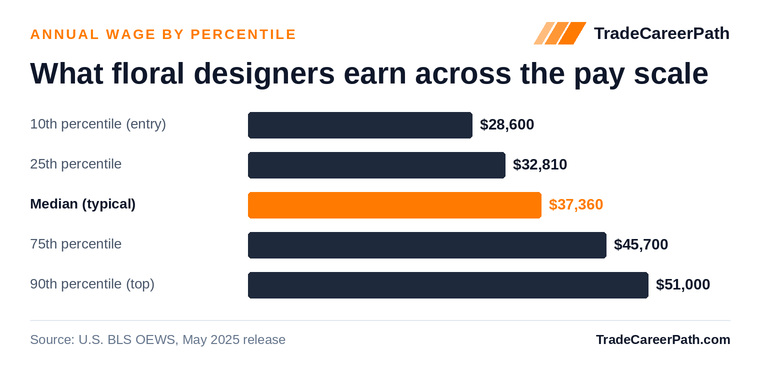
Quick answer: Training as a floral designer usually takes 6 months to 2 years. You complete a floral design certificate ($1,000 to $6,000) or an associate degree, build speed through hands-on shop experience, and can earn an optional credential such as the AIFD Certified Floral Designer (CFD). Most states do not require a license. The median floral designer salary is $37,360 per year ($17.96/hour), and there are about 5,100 openings nationwide each year (BLS, May 2025).
Floral designers create arrangements for weddings, events, holidays, and everyday orders. The work blends an eye for color and design with plant care and customer service, and you can enter the field through a short certificate, an associate degree, or hands-on training in a flower shop.
How to Become a Floral Designer
Most people enter the field in 6 months to 2 years, depending on the path they choose. There is no required license or single exam. You build the career through training, hands-on experience, and an optional certification.
1. Earn a high school diploma or GED
A high school diploma or GED is the baseline for most floral design programs and shop jobs, and a few flower shops will hire and train motivated beginners who are still finishing school. Before you enroll or apply, the most useful preparation is anything that sharpens your eye and your business sense. Art and design classes help you understand color, balance, and proportion, which are the core of good arrangements. A basic business or math class prepares you for pricing, ordering, and running a register, since many designers eventually handle sales or manage a shop. Comfort with computers also helps, because retail floristry runs on point-of-sale systems and online order platforms. If you are changing careers and already hold a diploma or degree, you can move straight to training. Many strong designers come from retail, hospitality, or art backgrounds and bring transferable skills in customer service and creativity.
2. Complete a floral design program
Formal training is the fastest way to build technique. You have a few formats to choose from:
- Certificate programs take roughly 6 to 12 months and focus tightly on hands-on design skills.
- Associate degrees in floral design or horticulture take about 2 years and add broader plant science and business coursework.
- Short workshops and shop apprenticeships suit people who want to learn mainly on the job.
Typical coursework covers color theory, plant and flower identification, conditioning and care, wiring and taping, wedding and event work, and the mechanics behind bouquets, corsages, and large installations. Many schools offer courses online or in a hybrid format with practice kits, though most of the skill is tactile, so plan to arrange real flowers as much as possible. When comparing programs, ask how much bench time you get and whether instructors hold credentials such as the AIFD designation.
3. Gain hands-on shop experience
Coursework gives you the fundamentals, but employers want to see speed and consistency. Starting as a floral assistant or apprentice is the best way to build both. In a working shop you will process and condition flowers, fill daily orders, build arrangements to a price point, and learn the rhythm of busy holidays like Valentine’s Day and Mother’s Day. You also pick up the business side, including inventory, ordering from wholesalers, delivery logistics, and customer consultations. Save photos of your strongest pieces as you go, because a visual record of real work is what convinces clients and employers. Event and wedding studios are a good place to stretch into large-scale design, while grocery and retail floral departments offer steady volume that sharpens your speed.
4. Consider AIFD certification
Certification is voluntary in floral design, but it signals a professional level of skill. The most recognized credential is the Certified Floral Designer (CFD) from the American Institute of Floral Designers (AIFD), which is the major U.S. credentialing organization for the field. Earning it generally involves an assessment of your design ability rather than a simple written test, so candidates usually prepare through coursework and practice. Joining a national group such as the Society of American Florists (SAF), the industry’s trade association, is another way to access education, trends, and networking. Exam and assessment fees for floral certifications often range from about $150 to $500. Certification is not required to get hired, but it can help you stand out for event work, teaching, or competition.
5. Build a portfolio and client base
Whether you want a shop job or your own business, your portfolio sells you. Photograph your best arrangements in good light and organize them into an online gallery or social media page that shows range, from simple bouquets to full event setups. If you plan to freelance or open a studio, you will also need to register a business and handle pricing, sourcing, and delivery. Word of mouth, wedding vendors, and event planners are major sources of clients, so build relationships with photographers, venues, and planners in your area. Many designers grow from a shop role into a lead designer or manager, and some go on to open their own studio.
What Floral Designers Do
Floral designers create arrangements for occasions ranging from simple everyday bouquets to elaborate event displays. They work with live, dried, or silk flowers, designing pieces that fit a client’s taste, budget, and theme. The job mixes creative design with steady hands-on production and a fair amount of customer service.
Typical Responsibilities
- Design floral arrangements for events and customers
- Select, process, and prepare flowers and greenery
- Maintain inventory and care for live plants
- Consult with clients about colors, themes, and styles
- Manage sales, orders, and delivery logistics
- Track seasonal trends and flower availability
A successful floral designer balances artistry with time management and customer service.
Key Skills for Floral Designers
- Creativity and a strong sense of style
- Knowledge of flowers and plant care
- Color coordination and visual composition
- Customer service and communication
- Manual dexterity and attention to detail
- The stamina to work under deadlines during peak seasons
Where Floral Designers Work
- Flower shops and floral boutiques
- Grocery store floral departments
- Event planning and wedding services
- Hotels, resorts, and cruise ships
- Self-employed or home-based floral studios
Education and Certification Paths
| Pathway | Typical Duration | Outcome |
|---|---|---|
| Floral Design Certificate | 6 to 12 months | Entry-level floral designer |
| Associate in Horticulture or Design | 2 years | Broader horticultural knowledge |
| AIFD Certified Floral Designer (CFD) | Variable | Professional credential |
| Shop Apprenticeship | 1 to 2 years | Practical design experience |
The AIFD CFD credential is a voluntary professional certification, not a license to practice.
Career Growth and Advancement
Floral designers can advance into roles such as:
- Lead Designer or Shop Manager
- Event Floral Coordinator
- Wedding Floral Specialist
- Studio or Business Owner
Some floral designers expand into related fields like event planning, horticulture, or landscape design.
Cost and Duration of Training
- Program cost: about varies by school, format and location depending on school and location
- Duration: 6 months to 2 years
- Certification fees: AIFD or similar certification fees often range from about $150 to $500
Pros and Cons
Pros
- Creative and hands-on work
- Flexible work opportunities
- High job satisfaction through artistic expression
- Opportunities for entrepreneurship
Cons
- Seasonal demand fluctuations
- Physical labor and long hours during holidays or events
- Limited pay growth without specialization or ownership
State Licensing and Requirements
Most states do not require a license to work as a floral designer, but you generally need to register a business to operate independently. The AIFD CFD credential is voluntary and can support professionalism and career advancement, though it is not legally required.
Quick Facts: Floral Designer Salary, Education, and Outlook
Industry Organizations & Certifying Bodies
These are the recognized national organizations, unions, certifying bodies, and regulatory authorities that shape this trade. They issue the credentials, sponsor the apprenticeships, publish the codes, and represent workers and employers.
- American Institute of Floral Designers (AIFD) Major U.S. professional credentialing organization for floral designers.
- Society of American Florists (SAF) National floral industry trade association.
Wage and Employment Charts
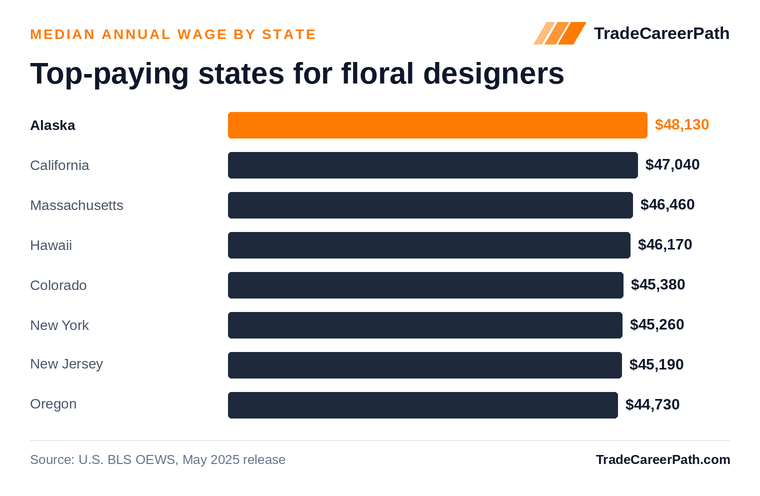
Floral Designer Salary and Requirements by State
Select your state for local wage data, training options, and requirements:
Alabama · Alaska · Arizona · Arkansas · California · Colorado · Connecticut · Delaware · District of Columbia · Florida · Georgia · Hawaii · Idaho · Illinois · Indiana · Iowa · Kansas · Kentucky · Louisiana · Maine · Maryland · Massachusetts · Michigan · Minnesota · Mississippi · Missouri · Montana · Nebraska · Nevada · New Hampshire · New Jersey · New Mexico · New York · North Carolina · North Dakota · Ohio · Oklahoma · Oregon · Pennsylvania · Rhode Island · South Carolina · South Dakota · Tennessee · Texas · Utah · Vermont · Virginia · Washington · West Virginia · Wisconsin · Wyoming
Find Floral Design Courses Near You
Workplace Safety Snapshot
BLS Survey of Occupational Injuries and Illnesses data (2023-2024) report approximately 55.9 days-away, restricted, or transfer cases per 10,000 full-time-equivalent workers in floral designers (about 0.56 per 100 FTE). Source: BLS Survey of Occupational Injuries and Illnesses, Table R98.
Frequently Asked Questions
How long does floral designer training take?
Most people train for 6 months to 2 years. A floral design certificate usually takes 6 to 12 months, while an associate degree in floral design or horticulture takes about 2 years. A high school diploma or GED is generally enough to get started, and some designers learn mainly through on-the-job training in a flower shop.
Do you need a college degree to work as a floral designer?
No. A college degree is not required to work as a floral designer. Most people enter the field through a certificate program, an associate degree, or hands-on training in a shop. A high school diploma or GED is typically the only educational prerequisite.
How much does floral design training cost?
Floral design programs typically cost about $1,000 to $6,000 depending on the format, length, and school. Certificate programs generally cost less than associate degrees. The optional AIFD Certified Floral Designer credential and similar certifications add exam and assessment fees that often range from about $150 to $500.
Do floral designers need a license or certification?
Most states do not require a license to work as a floral designer, although you usually need to register a business if you work for yourself. Certification is voluntary. The Certified Floral Designer (CFD) credential from the American Institute of Floral Designers (AIFD) is the most recognized professional certification and can help you stand out.
Is it hard to train as a floral designer?
Entry is relatively accessible since there is no required license or exam, and many designers start with on-the-job training. The work itself takes real skill, including an eye for color and design, knowledge of plant care, manual dexterity, and the stamina to handle busy holidays and events.
Can you learn floral design online?
Yes. Many schools offer floral design courses and certificate programs online or in a hybrid format that combines video lessons with hands-on practice kits. Because so much of the work is tactile, most designers still build speed and technique by arranging flowers in a real shop.
How much do floral designers earn?
The median floral designer wage is $37,360 per year, or about $17.96 per hour (BLS, May 2025). Pay varies with experience, location, and whether you work in retail, events, or run your own studio.
How Floral Design Pay Compares to Similar Trades
Side-by-side comparison of Floral Designer and the closest related careers, based on U.S. Bureau of Labor Statistics data (May 2025 OEWS + 2024-2034 Employment Projections).
| Career | Median Pay | 10-Year Growth | Annual Openings |
|---|---|---|---|
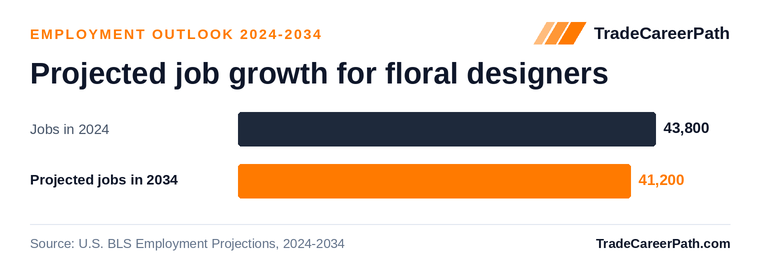
| Floral Designer this guide | $37,360 | -5.9% | 5,100 |
| Interior Designer | $67,190 | +3.2% | 7,800 |
| Jewelry Design and Repair | $52,540 | -5.5% | 4,000 |
| Beauty & Cosmetology | $35,790 | +5.6% | 75,800 |
| Beauty & Cosmetology | $35,790 | +5.6% | 75,800 |
Source: BLS Occupational Employment and Wage Statistics + BLS Employment Projections.
Sources
- U.S. Bureau of Labor Statistics, Occupational Employment and Wage Statistics (May 2025)
- U.S. Bureau of Labor Statistics, Employment Projections 2024-2034
- U.S. Bureau of Labor Statistics, Survey of Occupational Injuries and Illnesses (2023-2024, Table R98)
- U.S. Department of Labor, Wage and Hour Division, Davis-Bacon General Wage Determinations (2026)
Floral Design Salary by State
About this guide: Researched and written by the TradeCareerPath Editorial Team. Our editorial team researches and sources every trade school and career guide using federal labor and education data, including BLS OEWS and Employment Projections, DOL apprenticeship records, IPEDS, College Scorecard, and state licensing boards. We follow the editorial standards documented at /editorial-policy/.
Data sources
Figures on this page are sourced from the federal and state datasets below. Methodology: how we rank and source data.
| Data | Provider | Vintage |
|---|---|---|
| Occupational Employment and Wage Statistics (OEWS) | U.S. Bureau of Labor Statistics | May 2025 |
| Employment Projections | U.S. Bureau of Labor Statistics | 2024-2034 |
| Integrated Postsecondary Education Data System | National Center for Education Statistics (IPEDS) | 2024 |
| College Scorecard (school-level outcomes) | U.S. Department of Education | latest release |
| College Scorecard (field-of-study earnings) | U.S. Department of Education | latest release (updated 2026-06-12) |
| Occupational licensing requirements | CareerOneStop (U.S. Department of Labor) | latest release (updated 2026-02-22) |
| Registered apprenticeship programs | CareerOneStop / Apprenticeship.gov (U.S. Department of Labor) | latest release (updated 2025-10-25) |
| O*NET occupation profiles (skills, tasks, tools, job zones) | U.S. Department of Labor (O*NET / Employment & Training Admin.) | O*NET 29.1 (updated 2026-06-13) |