
How to Become a Food Scientist in 2026
Is Food Scientist Right for You?
The U.S. Department of Labor's O*NET profile for Food Scientists and Technologists (SOC 19-1012) describes the work this way: Use chemistry, microbiology, engineering, and other sciences to study the principles underlying the processing and deterioration of foods; analyze food content to determine levels of vitamins, fat, sugar, and protein; discover new food sources; research ways to make processed foods safe, palatable, and healthful; and apply food science knowledge to determine best ways to process, package, preserve, store, and distribute food.
What the work involves
- Inspect food processing areas to ensure compliance with government regulations and standards for sanitation, safety, quality, and waste management.
- Check raw ingredients for maturity or stability for processing, and finished products for safety, quality, and nutritional value.
- Study methods to improve aspects of foods, such as chemical composition, flavor, color, texture, nutritional value, and convenience.
- Develop food standards and production specifications, safety and sanitary regulations, and waste management and water supply specifications.
- Stay up to date on new regulations and current events regarding food science by reviewing scientific literature.
Skills and knowledge that matter
Skills: Reading Comprehension, Critical Thinking, Active Learning, Active Listening, Writing, Speaking.
Knowledge: Production and Processing, Food Production, Chemistry, English Language.
Tools and technology you may use
Technology: Analytical or scientific software, Sales and marketing software, Web platform development software, HubSpot software, Hypertext markup language HTML, Marketo Marketing Automation.
Typical preparation
O*NET Job Zone Four (Considerable Preparation Needed). Most of these occupations require a four-year bachelor's degree, but some do not. Employees in these occupations usually need several years of work-related experience, on-the-job training, and/or vocational training.
Interest fit
O*NET interest profile: Investigative, Realistic, Conventional. People who enjoy working with ideas, searching for facts, and figuring out problems often find this occupation a good fit.
Source: O*NET 31.0 (updated 2026-10-14)
Quick answer: Training as a food scientist requires a 4-year degree - typically a Bachelor’s in food science or food technology. The national median pay is $88,720 per year, and BLS projects +6.2% employment change from 2025 to 2035 (BLS OEWS, May 2025; BLS Employment Projections, 2025-35).
Food Scientist at a Glance
| Metric | Detail | Source |
|---|---|---|
| Median annual wage | $88,720 | BLS OEWS, May 2025 |
| Typical wage range | $52,920 (10th pct) - $145,280 (90th pct) | BLS OEWS, May 2025 |
| Employment | 13,060 nationwide | BLS OEWS, May 2025 |
| Projected growth (2025-35) | +6.2%, about 1,000 openings per year | BLS Employment Projections, 2025-35 |
| Typical education | Bachelor’s in food science or food technology | BLS Occupational Outlook Handbook |
| License / certification | No license; IFT Certified Food Scientist credential valued | None for most roles |
What Does a Food Scientist Do?
Food scientists develop the products and processes behind everything on a grocery shelf - formulation, shelf-life and safety testing, HACCP systems, and scaling a recipe from a test kitchen batch to a production line running thousands of units an hour.
Day to day, the work splits by specialty. A product development scientist builds and iterates formulations: adjusting a sauce so it survives retort processing without breaking, reformulating around an ingredient cost spike, or hitting a “clean label” target without losing texture. A food safety and quality scientist owns the plant’s HACCP plan, runs micro testing, manages SQF or BRC audits, and makes the hold-or-release call when a lot looks questionable. A process or pilot-plant scientist works out how a formula behaves in real equipment - heat exchangers, extruders, spray dryers - and troubleshoots when the scaled batch does not match the bench sample. Sensory scientists design taste panels and turn “tastes off” into measurable data. Nearly all of it is documented against FDA or USDA regulatory frameworks, because in this industry a mistake is a recall, not a bad review.
If you are coming from a professional kitchen, the shortest way to say it: the chef solves flavor and texture problems one plate at a time; the food scientist solves the same problems once, in a way that holds up for a million units, twelve months of shelf life, and a federal audit. Your palate, your feel for how emulsions and doughs behave, and your instinct for what a customer will accept are genuinely scarce on R&D teams full of people who learned food from a textbook. The degree adds the chemistry and microbiology that turn that instinct into decisions you can defend on paper.
Skills That Make a Great Food Scientist
- Food chemistry - emulsions, Maillard reactions, water activity, pH
- Food microbiology and pathogen control
- HACCP, SQF/BRC, and FDA/USDA regulatory compliance
- Sensory evaluation and taste-panel design
- Pilot-plant scale-up and process troubleshooting
- Statistics and designed experiments for formulation work
- Writing: specs, HACCP plans, and audit documentation carry the job
Food Scientist Salary
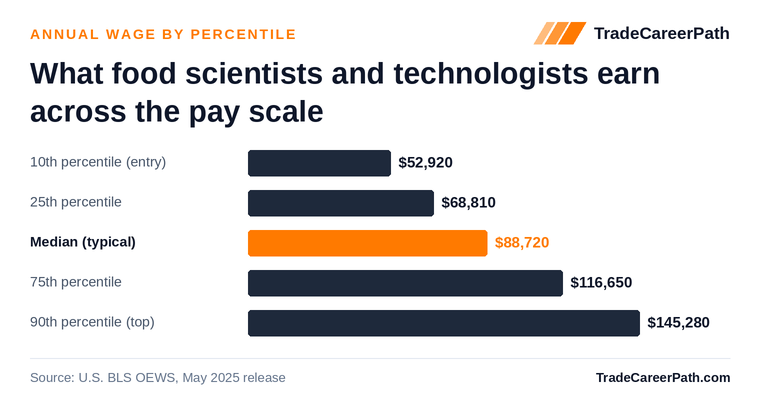
Food science pays professional wages for work that is recognizably about food. The national median is $88,720 per year - roughly double what most line and sous chef jobs pay - and the 10th percentile, about where new graduates start, is $52,920, already competitive with mid-level kitchen management. The 75th percentile reaches $116,650, and the top 10% earn $145,280 or more, typically in R&D leadership at large manufacturers (BLS OEWS, May 2025).
Where the Jobs and the Money Are
This is a small, concentrated occupation - 13,060 jobs nationwide - and it clusters where food manufacturing headquarters and processing plants cluster (BLS OEWS, May 2025). The largest single pool is California, with 2,210 food scientists at a median of $93,950, followed by Texas (840 jobs, $90,610) and Illinois (780 jobs, $94,340) - the Chicago area’s packaged-food giants make Illinois one of the densest markets in the country, with about 1.5 times the national concentration of food scientists.
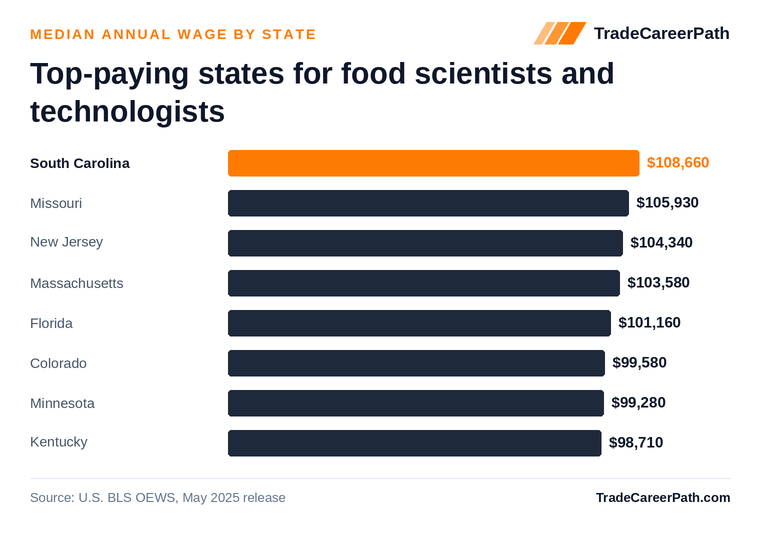
| State | Median annual wage | Employment |
|---|---|---|
| South Carolina | $108,660 | 90 |
| Missouri | $105,930 | 390 |
| New Jersey | $104,340 | 630 |
| Massachusetts | $103,580 | 420 |
| Florida | $101,160 | 170 |
Among the top-paying states, New Jersey and Missouri are the ones that combine pay with real depth: food scientists are 1.76 times as concentrated in New Jersey (flavor houses and CPG R&D centers) and 1.59 times in Missouri (St. Louis agribusiness and pet food) as in the average state labor market. That density means you can change employers without moving. South Carolina tops the pay table at $108,660, but with only 90 jobs it is a thin market - fine if a specific employer recruits you, risky as a relocation bet.
How to Become a Food Scientist
1. Use kitchen experience
Culinary skill translates directly to product development and pilot-plant work - and unlike most career changes, you should lead with it rather than bury it. On applications, years on a line or in a bakery read as proof you understand ingredient functionality, food cost, and what consumers actually eat. Document what you know: cuisines, techniques, scaling recipes for banquets, managing food safety in a working kitchen. All of it maps to R&D interview questions.
2. Earn the bachelor’s degree
Food science or food technology, and an IFT-approved curriculum is the benchmark employers and the Certified Food Scientist credential both recognize. Several land-grant universities run these programs online for working adults, which matters when you are still pulling kitchen shifts. Get a written transfer evaluation before enrolling anywhere - culinary school coursework, prior college, and military food-service training can all be worth credit at transfer-friendly schools.
3. Start in product development or QA
Food manufacturers hire at the bachelor’s level into R&D and quality roles, and both doors are open to career changers. Product development is the natural fit for cooks - it is bench-top formulation and pilot-plant runs. Quality assurance is the higher-volume entry point: every plant needs QA staff, the hours are more predictable than R&D deadlines, and QA experience feeds directly into food-safety management later. Internships and co-ops during the degree convert to offers at high rates in this industry.
4. Learn the safety systems
HACCP, SQF, and the FDA/USDA regulatory frameworks are the professional toolkit - the food-industry equivalent of code books. Get HACCP-certified early (it is a short course, often employer-paid), and add PCQI (Preventive Controls Qualified Individual) once you are working under FSMA rules. These certifications are cheap relative to the doors they open, and holding them before graduation makes a resume stand out.
5. Advance
Senior food scientist, R&D manager, or plant quality leadership. The fork comes around the ten-year mark: deepen as a technical specialist - the formulation expert a whole category depends on - or take the management track running an R&D team or a plant’s quality organization. The IFT Certified Food Scientist credential and a track record of successful product launches are what move you up either path. Both are mapped in the career ladder below.
Career Ladder: Titles and Realistic Pay
The BLS wage percentiles map cleanly onto how food-industry careers actually progress. Use this as a sanity check on offers, not a guarantee:
| Stage | Typical titles | Years in | Realistic pay (BLS OEWS, May 2025) |
|---|---|---|---|
| Entry level | Food technologist, QA specialist, associate scientist | 0-3 | ~$52,920-$68,810 (10th-25th pct) |
| Mid-career | Food scientist, product developer, food safety specialist | 3-10 | ~$88,720 (median) |
| Senior | Senior food scientist, R&D team lead, quality manager | 10-15 | ~$116,650 (75th pct) |
| Principal / leadership | Principal scientist, R&D manager, director of quality | 15+ | $145,280+ (90th pct) |
Two notes for career changers. First, real kitchen experience compresses this ladder: former chefs are routinely hired above the bottom of the entry band into product development, because they need no training in how food is supposed to taste and behave. Second, the upper bands understate total compensation at large CPG companies, where bonus and equity ride on top of the base-wage data shown here - and plant quality leadership often carries pay premiums the national numbers blur.
Do You Need a License?
No. Food science has no state licensing requirement - there is no exam board standing between you and the job the way there is for engineers or nurses. What the industry uses instead is a stack of voluntary and regulatory credentials:
- IFT Certified Food Scientist (CFS): the profession’s flagship credential from the Institute of Food Technologists. Not required to work, but it is the recognized mark of a serious practitioner and helps at promotion time.
- HACCP certification and PCQI: practical food-safety credentials most plants expect. PCQI status is tied to FDA’s FSMA preventive-controls rules, and many facilities must have a qualified individual on staff - holding it makes you more valuable immediately.
- SQF Practitioner and similar audit-scheme roles: earned on the job, these make you the person a plant cannot pass its customer audits without.
The practical takeaway: the degree can get you in the door, and the certifications are cheap, fast add-ons you collect as you go - a very different licensing picture from the multi-year exam gauntlets in other degree careers.
Why an Online Degree Works for This Career
For chefs and pastry professionals, food science is the industry side of the craft: same flavor and texture problems, solved at factory scale with a salary and benefits. Kitchen experience is a genuine advantage in product development, and online food science bachelor’s programs exist at several land-grant universities.
Job Outlook for 2026 and Beyond
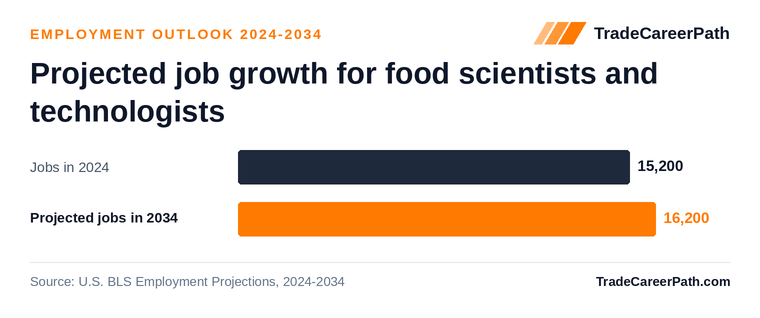
BLS projects employment of food scientists and technologists to grow +6.2% from 2025 to 2035 - from 14,100 to 14,900 jobs - with about 1,000 openings per year once retirements and occupation changes are counted (BLS Employment Projections, 2025-35). The latest wage data (OEWS, May 2025) puts the median at $88,720, up from the 2024 figure of $85,310 - real wage movement in a single year, which is more than many degree careers can say.
The demand drivers are durable: people do not stop buying food in recessions, reformulation work (sodium, sugar, clean-label, allergen management) is continuous, and FSMA-era regulation keeps expanding the food-safety headcount every plant must carry. For career changers, the honest caveat is scale - 1,000 openings a year in a 13,060-person occupation means steady but not massive hiring, so the candidates who pair the degree with real food-industry experience have a meaningful edge. That is exactly the edge a kitchen background provides.
Cost and Time to Complete the Degree
For food scientists and technologists, the credential is: Bachelor’s in food science or food technology. A bachelor’s degree is typically 120 credit hours: four years full-time, and commonly five to six years part-time while working. Transfer credit is the other lever: prior college, military training, apprenticeship coursework, and industry certifications can be worth meaningful credit at transfer-friendly schools, so get a written transfer evaluation before enrolling anywhere. Costs vary widely by school type; in-state public online programs are usually the value benchmark, and employer tuition assistance is common for working adults in this field.
Pros and Cons of Training as a Food Scientist
Pros
- Median pay of $88,720 nationally (BLS OEWS, May 2025)
- BLS projects +6.2% employment growth through 2035, about 1,000 openings a year
- Field experience from the trades is a genuine hiring advantage
- No state license required - voluntary certifications only
- Accredited online and hybrid degree paths exist for working adults
Cons
- Requires a 4-year degree (typically 120 credit hours)
- Entry-level pay starts near $52,920 at the 10th percentile
- Small occupation (13,060 jobs) concentrated in specific manufacturing hubs
Frequently Asked Questions
Can a chef work as a food scientist?
Yes - product development teams value culinary backgrounds, and the food science bachelor's supplies the chemistry, microbiology, and processing science the role requires.
How much do food scientists and technologists make?
The national median annual wage for food scientists and technologists is $88,720 (BLS OEWS, May 2025). The top 10% earn $145,280 or more, while entry-level pay starts around $52,920.
What is the job outlook for food scientists and technologists?
BLS projects employment of food scientists and technologists to change by +6.2% from 2025 to 2035 (BLS Employment Projections, 2025-35).
How long does food scientist training take?
The bachelor's in food science is 120 credit hours: four years full-time, commonly five to six years part-time while working. Culinary school credit, prior college, and military training can transfer and meaningfully shorten the degree at transfer-friendly schools.
Is food science hard?
The degree leans on chemistry, microbiology, and statistics rather than heavy math. Cooks and bakers usually find the applied courses - product development, sensory evaluation, processing - intuitive, because they already understand how heat, water, fat, and time change food. The lab science is the new part.
Should I get a food science or culinary degree?
If you already work in kitchens, get the food science degree - it is what food manufacturers screen for in R&D and quality roles, and your culinary experience covers the ground a culinary degree would. An IFT-approved food science curriculum is the industry benchmark.
Can you train as a food scientist without a degree?
Not usually with the scientist title - manufacturers hire food scientists at the bachelor's level. Without the degree, the realistic ceiling is lab technician, sensory panelist, or QA technician roles. Kitchen experience shortens the path but does not replace the degree.
Do food scientists need a license?
No state license is required. The credentials that matter are voluntary and industry-based: the IFT Certified Food Scientist (CFS) designation, plus HACCP and PCQI food-safety certifications that most plants expect you to hold or earn on the job.
Food Scientist Salary and Requirements by State
Alabama · Arizona · Arkansas · California · Colorado · Florida · Georgia · Idaho · Illinois · Indiana · Iowa · Kansas · Kentucky · Maine · Maryland · Massachusetts · Michigan · Minnesota · Missouri · Montana · Nebraska · Nevada · New Jersey · New Mexico · New York · North Carolina · Ohio · Oklahoma · Oregon · Pennsylvania · Rhode Island · South Carolina · South Dakota · Tennessee · Texas · Utah · Virginia · Washington · Wisconsin
Related Careers and Degree Paths
- Culinary Chef - the feeder trade this degree builds on
- Pastry Chef - baking science is a core food science specialty
- Chemist - the adjacent lab career with a broader industry spread
- Agricultural Engineer - the equipment and processing side of the same supply chain
- All trade careers that require a 4-year degree
Sources
- U.S. Bureau of Labor Statistics, Occupational Employment and Wage Statistics (OEWS), May 2025 - Food Scientists and Technologists (SOC 19-1012)
- U.S. Bureau of Labor Statistics, Employment Projections, 2025-35
- U.S. Bureau of Labor Statistics, Occupational Outlook Handbook - education and licensing requirements
Food Scientist Salary by State
About this guide: Researched and written by the TradeCareerPath Editorial Team. Our editorial team researches and sources every trade school and career guide using federal labor and education data, including BLS OEWS and Employment Projections, DOL apprenticeship records, IPEDS, College Scorecard, and state licensing boards. We follow the editorial standards documented at /editorial-policy/.
Data sources
Figures on this page are sourced from the federal and state datasets below. Methodology: how we rank and source data.
| Data | Provider | Vintage |
|---|---|---|
| Occupational Employment and Wage Statistics (OEWS) | U.S. Bureau of Labor Statistics | May 2025 |
| Employment Projections | U.S. Bureau of Labor Statistics | 2025-2035 |
| Integrated Postsecondary Education Data System | National Center for Education Statistics (IPEDS) | 2024 |
| College Scorecard (school-level outcomes) | U.S. Department of Education | latest release |
| College Scorecard (field-of-study earnings) | U.S. Department of Education | latest release (updated 2026-06-12) |
| Occupational licensing requirements | CareerOneStop (U.S. Department of Labor) | latest release (updated 2026-02-22) |
| Registered apprenticeship programs | CareerOneStop / Apprenticeship.gov (U.S. Department of Labor) | latest release (updated 2025-10-25) |
| O*NET occupation profiles (skills, tasks, tools, job zones) | U.S. Department of Labor (O*NET / Employment & Training Admin.) | O*NET 31.0 (updated 2026-10-14) |