
How to Become a Freight Broker (Career Guide)
Is Freight Broker Right for You?
The U.S. Department of Labor's O*NET profile for Logisticians (SOC 13-1081) describes the work this way: Analyze and coordinate the ongoing logistical functions of a firm or organization. Responsible for the entire life cycle of a product, including acquisition, distribution, internal allocation, delivery, and final disposal of resources.
What the work involves
- Maintain and develop positive business relationships with a customer's key personnel involved in, or directly relevant to, a logistics activity.
- Develop an understanding of customers' needs and take actions to ensure that such needs are met.
- Manage subcontractor activities, reviewing proposals, developing performance specifications, and serving as liaisons between subcontractors and organizations.
- Develop proposals that include documentation for estimates.
- Review logistics performance with customers against targets, benchmarks, and service agreements.
Skills and knowledge that matter
Skills: Critical Thinking, Speaking, Reading Comprehension, Monitoring, Coordination, Active Listening.
Knowledge: Transportation, English Language, Administration and Management, Customer and Personal Service.
Tools and technology you may use
Tools: Desktop computers, Laptop computers, Liquid crystal display LCD video projectors, Personal computer platforms, Personal computers, Teradyne Catalyst.
Technology: Computer aided design CAD software, Customer relationship management CRM software, Enterprise resource planning ERP software, Autodesk AutoCAD, Intuit QuickBooks, Microsoft Access.
Typical preparation
O*NET Job Zone Four (Considerable Preparation Needed). Most of these occupations require a four-year bachelor's degree, but some do not. Employees in these occupations usually need several years of work-related experience, on-the-job training, and/or vocational training.
Interest fit
O*NET interest profile: Conventional, Enterprising, Investigative. People who enjoy structured, detail-oriented work with clear procedures and data often find this occupation a good fit.
Source: O*NET 29.1 (updated 2026-06-13)
Ever wondered who keeps America’s supply chain moving?
Freight brokers connect shippers with carriers, ensuring that goods get from point A to point B efficiently.
Freight brokers are the logistics professionals who negotiate shipments, manage carriers, and coordinate transportation. This career offers independence, commission-based income, and the flexibility to work remotely or start your own brokerage business.
Quick answers
At a glance
- Role: Connects shippers with carriers and coordinates freight transportation.
- Typical work: Negotiating rates, tracking loads, handling paperwork, and managing compliance.
- Work settings: Logistics companies, independent brokerage owners, and remote work.
- Training and setup: 1-3 months of training, plus 4-6 weeks for setup.
- Key requirement: FMCSA broker authority (MC number) and a $75,000 surety bond for independent brokers.
Q and A
- What does a freight broker do? A freight broker acts as the middle point between shippers and carriers to coordinate transportation and keep shipments moving smoothly.
- How do freight brokers earn money? This career offers commission-based income.
- Can freight brokers work remotely? Yes. The page notes remote flexibility; brokers also use tools like load boards, CRMs, and digital freight platforms.
- What do you need to operate as an independent broker? Independent brokers apply for FMCSA broker authority (MC number) and secure a $75,000 surety bond.
- How long does it take to get started? The page describes 1-3 months of training, plus 4-6 weeks for business setup and registration.
What Freight Brokers Do
Freight brokers act as the middle point between shippers and carriers. They coordinate freight transportation, manage logistics, and ensure shipments move smoothly and profitably.
Typical Responsibilities
- Find and negotiate with shipping carriers
- Manage rates, routes, and load tracking
- Handle shipping paperwork and contracts
- Ensure FMCSA compliance and insurance coverage
- Build long-term relationships with clients
A successful freight broker combines sales skills with logistics know-how and customer service excellence.
Key Skills and Traits for Success
- Strong communication and negotiation skills
- Business and sales acumen
- Knowledge of logistics and transportation
- Attention to detail and organization
- Comfort with CRM and freight management software
Work Settings for Freight Brokers
Freight brokers may work:
- For logistics and transportation companies
- Independently as licensed business owners
- Within manufacturing or shipping departments
- For freight agent networks or brokerages
How to Become a Freight Broker (5 Steps)
1. Gain Industry Knowledge
Start by understanding the freight and logistics industry. Many brokers begin as dispatchers, truck drivers, or logistics coordinators.
2. Complete a Freight Broker Training Program
Training covers topics like load management, carrier vetting, and transportation law. Programs are available online and typically last 1-3 months.
3. Register Your Business
Set up your business entity (LLC or corporation) and apply for a USDOT number from the Federal Motor Carrier Safety Administration (FMCSA).
4. Obtain Your Broker Authority
Apply for your Broker Authority (MC Number) through the FMCSA and secure a Surety Bond ($75,000 minimum) as required by federal law. Broker authority is the legal authorization to operate as a freight broker.
5. Build Your Network and Grow
Use load boards, CRMs, and digital freight platforms to find clients. Strong communication and reliability lead to repeat business and higher commissions.
Education and Licensing Requirements
For a full breakdown of what is legally required versus optional - broker authority, the surety bond, training certificates, and the CTB credential - see our Freight Broker Certification Guide.
| Pathway | Typical Duration | Outcome |
|---|---|---|
| Freight Broker Training Course | 1-3 months | Basic knowledge and prep for licensing |
| FMCSA Registration | 1-2 weeks | Legal authorization to operate |
| Surety Bond & BOC-3 Filing | 2-4 weeks | Compliance for independent brokers |
| On-the-Job Experience | Ongoing | Growth through relationships and clients |
Career Growth and Advancement
Freight brokers can expand into:
- Agency Owner / Independent Broker - Run your own brokerage
- Logistics Manager - Oversee larger transportation operations
- Freight Agent Trainer - Teach or mentor other brokers
- Dispatch Service Owner - Coordinate carrier operations
Cost and Duration of Training
- Training Cost: varies by provider - courses are optional, not a licensing requirement
- Licensing Fees: FMCSA registration fee (see the FMCSA’s current schedule) + $75,000 surety bond, a federal requirement
- Duration: 1-3 months training + 4-6 weeks for setup
Many successful brokers start part-time, gradually growing into full-time independent operations.
Pros and Cons
Pros
- High earning potential with commissions
- Low startup cost for a business
- Work from home or remote flexibility
Cons
- Highly competitive industry
- Requires self-discipline and networking
- Income may vary seasonally
Take the First Step Toward a Freight Broker Career
Freight brokers are the link that keeps America’s goods in motion. Whether you want to work for a logistics company or start your own brokerage, training is the first step.
Start Your Freight Broker Training Today
Quick Facts: Freight Broker Salary, Education, and Outlook
Industry Organizations & Certifying Bodies
These are the recognized national organizations, unions, certifying bodies, and regulatory authorities that shape this trade. They issue the credentials, sponsor the apprenticeships, publish the codes, and represent workers and employers.
- Federal Motor Carrier Safety Administration (FMCSA) Federal regulator; freight brokers must obtain FMCSA Operating Authority and a $75,000 surety bond.
- Transportation Intermediaries Association (TIA) Industry association; offers the Certified Transportation Broker (CTB) credential.
Wage and Employment Charts
| Percentile | Annual wage |
|---|---|
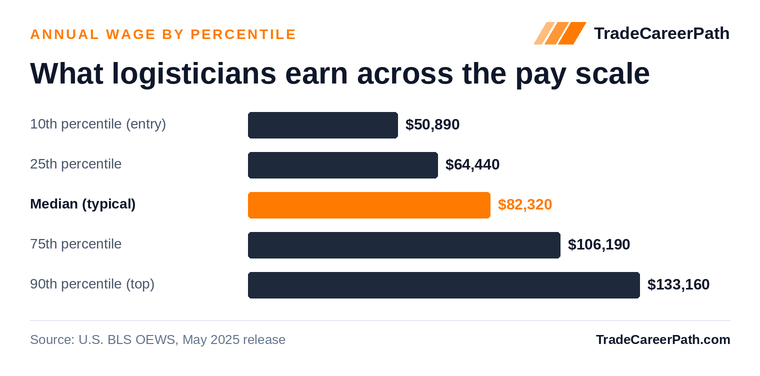
| 10th | $50,890 |
| 25th | $64,440 |
| 50th (median) | $82,320 |
| 75th | $106,190 |
| 90th | $133,160 |
| Year | Employment |
|---|---|
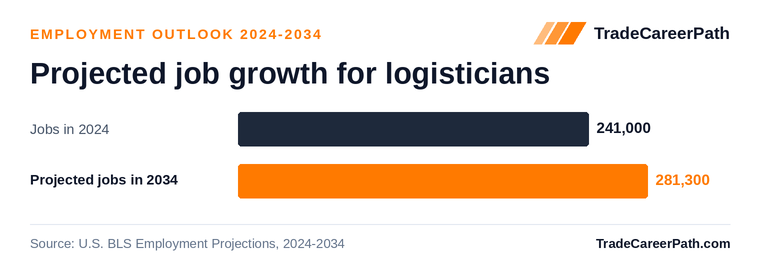
| 2024 | 241,000 |
| 2034 projected | 281,300 |
| Percent change | +16.7% |
Freight Broker Salary and Requirements by State
Select your state for local wage data, training options, and requirements:
Alabama · Alaska · Arizona · Arkansas · California · Colorado · Connecticut · Delaware · District of Columbia · Florida · Georgia · Hawaii · Idaho · Illinois · Indiana · Iowa · Kansas · Kentucky · Louisiana · Maine · Maryland · Massachusetts · Michigan · Minnesota · Mississippi · Missouri · Montana · Nebraska · Nevada · New Hampshire · New Jersey · New Mexico · New York · North Carolina · North Dakota · Ohio · Oklahoma · Oregon · Pennsylvania · Rhode Island · South Carolina · South Dakota · Tennessee · Texas · Utah · Vermont · Virginia · Washington · West Virginia · Wisconsin · Wyoming
Workplace Safety Snapshot
BLS Survey of Occupational Injuries and Illnesses data (2023-2024) report approximately 10.5 days-away, restricted, or transfer cases per 10,000 full-time-equivalent workers in logisticians (about 0.10 per 100 FTE). Source: BLS Survey of Occupational Injuries and Illnesses, Table R98.
Frequently Asked Questions
How long does freight broker training take?
It typically takes typically 6 months to 2 years of training. The most common entry path is through a certificate or associate degree program. A high school diploma or GED is generally required to get started.
How much do freight brokers make?
The median annual salary for freight brokers is $82,320 according to the Bureau of Labor Statistics (May 2025). Entry-level workers earn around $50,890, while those in the 90th percentile earn over $133,160. Pay varies by state, experience, and specialization.
What is the job outlook for freight brokers?
The Bureau of Labor Statistics projects 8.5% employment growth for this occupation from 2024 to 2034, which is faster than average. Approximately 8,800 job openings are expected each year due to growth, retirements, and workers leaving the field.
Do you need a college degree to work as a freight broker?
No. A college degree is not required to work as a freight broker. Most people enter the field through a certificate or associate degree program. A high school diploma or GED is typically the only educational prerequisite.
Which states pay freight brokers the most?
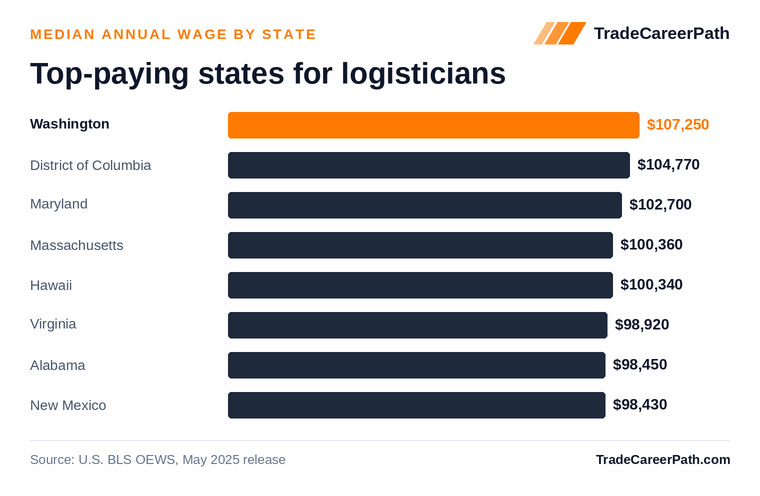
According to the U.S. Bureau of Labor Statistics (May 2025 OEWS), the highest-paying states for freight brokers are Washington, District of Columbia, and Maryland. Median annual wages: Washington ($107,250); District of Columbia ($104,770); Maryland ($102,700).
Which states employ the most freight brokers?
BLS reports the largest concentrations of freight brokers in California, Texas, and Florida. Employment levels: California (32,940 workers); Texas (21,030 workers); Florida (15,020 workers) (May 2025).
How much do experienced freight brokers earn?
The top 10% of freight brokers earn more than $133,160 per year, according to BLS Occupational Employment and Wage Statistics (May 2025). Experienced workers in this band typically hold senior credentials, supervisory roles, or specialty certifications.
What is entry-level pay for freight brokers?
BLS reports the bottom 10% of freight brokers earn under $50,890 per year. New workers often start near this level and see pay rise as they accumulate experience and credentials.
How many freight brokers work in the United States?
BLS reports approximately 251,040 freight brokers employed nationwide as of May 2025.
How many job openings are expected for freight brokers each year?
BLS projects approximately 26,400 openings per year for freight brokers from 2024 through 2034, including new positions, retirements, and workers transitioning out. The occupation is projected to grow 16.7% from 2024 to 2034, classified as much faster than average growth.
Is freight broker a growing career?
Yes. BLS projects 16.7% employment growth for freight brokers between 2024 and 2034, classified as much faster than average. Employment is projected to rise from approximately 241,000 jobs in 2024 to 281,300 in 2034.
How much do freight brokers make per hour?
The median hourly wage for freight brokers is $39.58, according to BLS (May 2025). Hourly pay ranges from about $24.47 (bottom 10%) to $64.02 (top 10%).
Sources
- U.S. Bureau of Labor Statistics, Occupational Employment and Wage Statistics (May 2025)
- U.S. Bureau of Labor Statistics, Employment Projections 2024-2034
- U.S. Bureau of Labor Statistics, Survey of Occupational Injuries and Illnesses (2023-2024, Table R98)
- U.S. Department of Labor, Wage and Hour Division, Davis-Bacon General Wage Determinations (2026)
Freight Broker Salary by State
About this guide: Researched and written by the TradeCareerPath Editorial Team. Our editorial team researches and sources every trade school and career guide using federal labor and education data, including BLS OEWS and Employment Projections, DOL apprenticeship records, IPEDS, College Scorecard, and state licensing boards. We follow the editorial standards documented at /editorial-policy/.
Data sources
Figures on this page are sourced from the federal and state datasets below. Methodology: how we rank and source data.
| Data | Provider | Vintage |
|---|---|---|
| Occupational Employment and Wage Statistics (OEWS) | U.S. Bureau of Labor Statistics | May 2025 |
| Employment Projections | U.S. Bureau of Labor Statistics | 2024-2034 |
| Integrated Postsecondary Education Data System | National Center for Education Statistics (IPEDS) | 2024 |
| College Scorecard (school-level outcomes) | U.S. Department of Education | latest release |
| College Scorecard (field-of-study earnings) | U.S. Department of Education | latest release (updated 2026-06-12) |
| Occupational licensing requirements | CareerOneStop (U.S. Department of Labor) | latest release (updated 2026-02-22) |
| Registered apprenticeship programs | CareerOneStop / Apprenticeship.gov (U.S. Department of Labor) | latest release (updated 2025-10-25) |
| O*NET occupation profiles (skills, tasks, tools, job zones) | U.S. Department of Labor (O*NET / Employment & Training Admin.) | O*NET 29.1 (updated 2026-06-13) |