
How to Become a Geoscientist in 2026
Is Geoscientist Right for You?
The U.S. Department of Labor's O*NET profile for Geoscientists, Except Hydrologists and Geographers (SOC 19-2042) describes the work this way: Study the composition, structure, and other physical aspects of the Earth. May use geological, physics, and mathematics knowledge in exploration for oil, gas, minerals, or underground water; or in waste disposal, land reclamation, or other environmental problems. May study the Earth's internal composition, atmospheres, and oceans, and its magnetic, electrical, and gravitational forces. Includes mineralogists, paleontologists, stratigraphers, geodesists, and seismologists.
What the work involves
- Plan or conduct geological, geochemical, or geophysical field studies or surveys, sample collection, or drilling and testing programs used to collect data for research or application.
- Analyze and interpret geological data, using computer software.
- Investigate the composition, structure, or history of the Earth's crust through the collection, examination, measurement, or classification of soils, minerals, rocks, or fossil remains.
- Analyze and interpret geological, geochemical, or geophysical information from sources, such as survey data, well logs, bore holes, or aerial photos.
- Identify risks for natural disasters, such as mudslides, earthquakes, or volcanic eruptions.
Skills and knowledge that matter
Skills: Reading Comprehension, Speaking, Science, Critical Thinking, Writing, Judgment and Decision Making.
Knowledge: Geography, Mathematics, English Language, Chemistry.
Tools and technology you may use
Tools: Abney levels, Agitators, All terrain vehicles ATV, Alternating field demagnitizers, Altimeters, Analog map measurers.
Technology: Graphics or photo imaging software, Document management software, Analytical or scientific software, Adobe Acrobat, Adobe Photoshop, Autodesk AutoCAD.
Typical preparation
O*NET Job Zone Five (Extensive Preparation Needed). Most of these occupations require graduate school. For example, they may require a master's degree, and some require a Ph.D., M.D., or J.D. (law degree). Employees may need some on-the-job training, but most of these occupations assume that the person will already have the required skills, knowledge, work-related experience, and/or training.
Interest fit
O*NET interest profile: Investigative, Realistic, Conventional. People who enjoy working with ideas, searching for facts, and figuring out problems often find this occupation a good fit.
Source: O*NET 29.1 (updated 2026-06-13)
Quick answer: Training as a geoscientist requires a 4-year degree - typically a Bachelor’s in geology or geoscience (master’s preferred for some research roles). The national median pay is $101,920 per year, and BLS projects +3.2% employment change from 2024 to 2034 (BLS OEWS, May 2025; BLS Employment Projections, 2024-34).
Geoscientist at a Glance
| Metric | Detail | Source |
|---|---|---|
| Median annual wage | $101,920 | BLS OEWS, May 2025 |
| Typical wage range | $59,330 (10th pct) - $200,230 (90th pct) | BLS OEWS, May 2025 |
| Employment | 23,470 nationwide | BLS OEWS, May 2025 |
| Projected growth (2024-34) | +3.2%, about 2,000 openings per year | BLS Employment Projections, 2024-34 |
| Typical education | Bachelor’s in geology or geoscience (master’s preferred for some research roles) | BLS Occupational Outlook Handbook |
| License / certification | State PG (Professional Geologist) license for consulting sign-off in many states | State licensing boards |
What Does a Geoscientist Do?
Geoscientists study the structure and composition of the earth to find resources and assess sites - and they are the science role embedded with the drilling crews, mining operations, and environmental field teams that tradespeople already work on.
Day to day, the work depends on the sub-specialty. A wellsite or mud-logging geologist sits at the rig, examines cuttings under a microscope, calls formation tops, and tells the company man when the bit reaches the target zone. A petroleum geologist back in the office interprets well logs and seismic data to decide where the next well goes. A hydrogeologist designs monitoring-well networks, models how groundwater and contamination move, and writes the reports a cleanup depends on. An environmental or engineering geologist logs soil borings and assesses slope and seismic hazards for construction sites; mining geologists map ore bodies and run grade control. Across all of them the deliverable is the same: a defensible interpretation of what is underground, written so an engineer, regulator, or investor can act on it.
If you are coming off the rigs - driller, mud logger, roughneck, or environmental-drilling hand - the shortest way to say it: you have been making hole through these formations for years; the geologist names them, maps them, and decides where to drill next. You already know what a drilling break feels like from the floor. The degree teaches you what it means, and the career move is from turning to the right to calling the formation tops.
Skills That Make a Great Geoscientist
- Geologic mapping and logging
- Well-log interpretation and correlation
- Field sampling and core description
- GIS and subsurface software (ArcGIS, Petrel-class interpretation tools)
- Groundwater and contaminant fundamentals for environmental work
- Basic statistics and data handling for grade control and reservoir work
- Clear technical reporting - the maps and reports you sign are the product
Geoscientist Salary
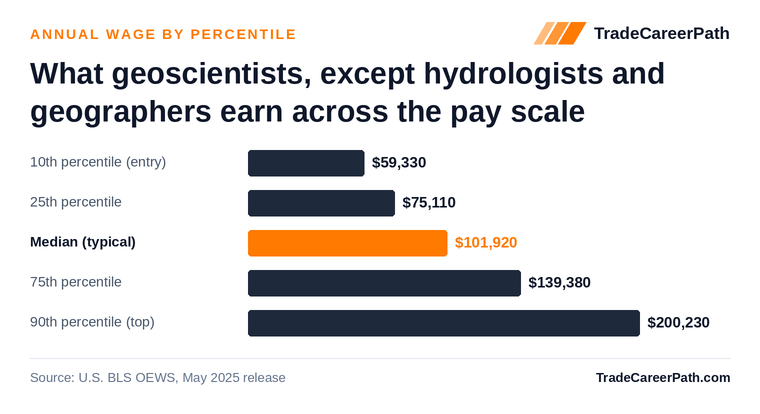
Geoscience pays well above the trades it draws from, with an unusually wide spread. The national median is $101,920 per year, but the 10th percentile - entry-level staff geologists and mud loggers - starts near $59,330, while the 90th percentile reaches $200,230, largely senior petroleum and exploration geologists (BLS OEWS, May 2025). The mean of $116,150 sitting well above the median tells you the same thing: the oil-and-gas end of this occupation pulls the top of the pay scale up hard. Which sector you enter matters as much as your title.
Where the Jobs and the Money Are
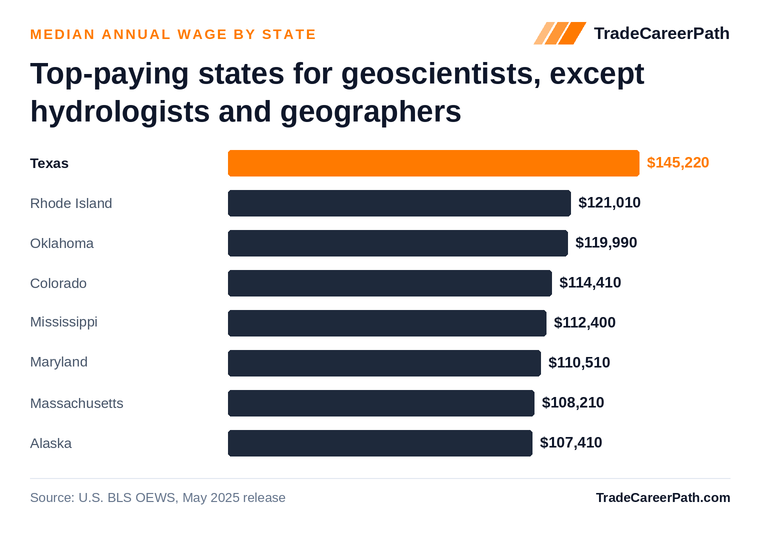
This is an energy-belt occupation. Texas alone employs about 4,900 geoscientists - more than a fifth of the national total of 23,470 - at a state median of $145,220, far above the national figure. California is the second-largest market at 3,350, driven by environmental and engineering geology rather than oil (BLS OEWS, May 2025).
| State | Median annual wage | Employment |
|---|---|---|
| Texas | $145,220 | 4,900 |
| Rhode Island | $121,010 | n/a |
| Oklahoma | $119,990 | 770 |
| Colorado | $114,410 | 1,480 |
| Mississippi | $112,400 | 250 |
The concentration numbers are the real story for anyone planning a move. In Colorado, geoscientists are about 3.4 times as common in the workforce as the national average; Oklahoma runs about 3 times, and Texas about 2.3 times. Those are deep markets where you can change employers - operator to consultancy to service company - without relocating. Elsewhere the work skews toward environmental consulting and government surveys, at pay closer to the national median.
How to Become a Geoscientist
1. Earn a geology bachelor’s
Geology or geoscience is the standard major, and the summer field camp is the capstone employers and licensing boards both look for. If PG licensure is in your future - and for consulting it should be - check your state board’s required course list before you pick a program, because “earth science” and environmental-studies degrees sometimes fall short on geology credit hours. Online and hybrid programs exist for working adults, with field camp done in a summer block.
2. Use field experience
Rig, mining, or environmental-drilling time reads as field competence employers otherwise have to train. Say so explicitly on applications: a hand who has tripped pipe, run a core barrel, or installed monitoring wells understands drilling programs, sample handling, and site logistics in a way new graduates simply do not. Raise it with admissions offices too - prior college, military training, and industry coursework can be worth meaningful credit at transfer-friendly schools.
3. Start as a wellsite or staff geologist
Energy, mining, environmental consulting, and government surveys all hire at the bachelor’s level. Mud logging and wellsite geology are the classic rig-adjacent entry points - rotational, well paid for entry work, and a direct continuation of oilfield life. Staff geologist at an environmental consultancy is the steadier alternative: logging borings, sampling wells, and building the supervised experience the PG license requires.
4. Pursue PG licensure
Many states require a Professional Geologist license to sign geological reports offered to the public. The path runs through the ASBOG exams - Fundamentals of Geology, which you can take near graduation, then Practice of Geology after several years of supervised experience, with exact requirements set by each state board. In consulting and environmental work the PG is effectively the ceiling-remover; in-house petroleum and mining geologists often practice without it, but taking the Fundamentals exam early keeps the option open.
5. Specialize
Petroleum, hydrogeology, environmental, or mining geology. The fork usually comes a few years in: petroleum pays the most and rides the commodity cycle; hydrogeology and environmental work are steadier and PG-driven; mining splits the difference and often involves remote sites. Your trade background biases the choice - ex-oilfield hands slot naturally into petroleum, while environmental-drilling experience feeds straight into hydrogeology.
Career Ladder: Titles and Realistic Pay
The BLS wage percentiles map onto how geoscience careers actually progress. Use this as a sanity check on offers, not a guarantee:
| Stage | Typical titles | Years in | Realistic pay (BLS OEWS, May 2025) |
|---|---|---|---|
| Entry level | Mud logger, wellsite geologist, staff geologist | 0-3 | ~$59,330-$75,110 (10th-25th pct) |
| Mid-career | Project geologist, operations geologist, hydrogeologist | 3-10 | ~$101,920 (median) |
| Senior | Senior geologist (PG), exploration geologist, project manager | 10-15 | ~$139,380 (75th pct) |
| Principal / leadership | Principal geologist, chief geologist, exploration manager | 15+ | $200,230+ (90th pct) |
Two notes for career changers. First, real field experience compresses this ladder: former drillers and mud loggers are routinely trusted with wellsite responsibility faster than office-trained graduates, because employers do not have to teach them how a rig works. Second, the upper bands are sector-dependent - the 90th-percentile figures are dominated by oil and gas, where bonuses and overrides can push total compensation past the base-wage data shown here, while environmental and government tracks top out lower but ride out commodity downturns.
Do You Need a PG License?
It depends on where you practice - both the state and the sector. Many states license geologists, and in those states a Professional Geologist (PG) stamp is required to sign geological reports offered to the public: environmental site assessments, groundwater studies, geologic hazard reports. If you want a consulting career, treat the PG as mandatory.
The standard path: a qualifying geology degree, the ASBOG Fundamentals of Geology exam (sit for it as a senior or new graduate, while the coursework is fresh), several years of supervised professional experience, then the ASBOG Practice of Geology exam, per your state board’s rules. Requirements vary by state, so verify the specifics with your board.
The major exception is industry: petroleum and mining geologists working in-house for a single employer generally are not required to hold a PG, and many senior oil-and-gas geologists never license. Even so, taking the Fundamentals exam early is cheap insurance if the commodity cycle turns.
Why an Online Degree Works for This Career
Drillers, mud loggers, and oilfield hands work alongside geoscientists daily. The geology bachelor’s (online programs exist, with field camps in summer blocks) moves you from turning to the right to calling the formation tops. The rotation schedules common in the oilfield actually help here - days off in blocks are well suited to online coursework, and energy and consulting employers commonly offer tuition assistance, so many hands complete the degree without giving up the paycheck or the field time that will anchor their resume.
Job Outlook for 2026 and Beyond
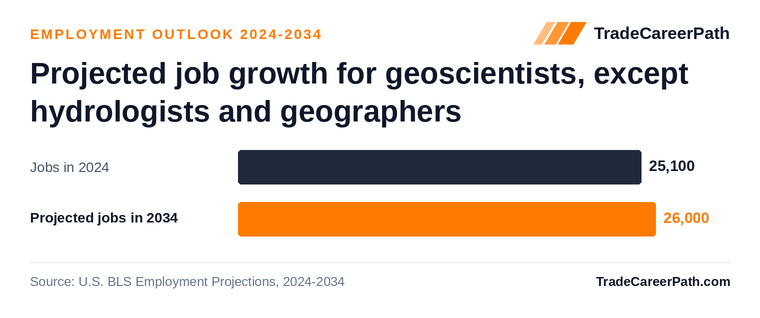
BLS projects employment of geoscientists to grow +3.2% from 2024 to 2034 - from 25,100 to 26,000 jobs - with about 2,000 openings per year once retirements and occupation changes are counted (BLS Employment Projections, 2024-34). The latest wage data (OEWS, May 2025) puts the median at $101,920, up from the 2024 figure of $99,240 - pay is rising even though headline growth is modest.
Read those numbers together and the picture is favorable for career changers: 2,000 openings a year in a 23,470-person occupation is a high replacement rate, driven by an aging cohort of geologists retiring out of energy and consulting. Demand splits across sectors - oil and gas hiring follows commodity prices, while environmental work, groundwater supply, and the minerals needed for the energy transition (copper, lithium, rare earths) provide the steadier floor. Candidates who combine the degree with genuine field experience are exactly what the retiring generation is leaving behind.
Cost and Time to Complete the Degree
For geoscientists, the credential is: Bachelor’s in geology or geoscience (master’s preferred for some research roles). A bachelor’s degree is typically 120 credit hours: four years full-time, and commonly five to six years part-time while working. Transfer credit is the other lever: prior college, military training, apprenticeship coursework, and industry certifications can be worth meaningful credit at transfer-friendly schools, so get a written transfer evaluation before enrolling anywhere. Costs vary widely by school type; in-state public online programs are usually the value benchmark, and employer tuition assistance is common for working adults in this field.
Pros and Cons of Training as a Geoscientist
Pros
- Median pay of $101,920 nationally (BLS OEWS, May 2025)
- BLS projects +3.2% employment growth through 2034, with about 2,000 openings per year
- Field experience from the rigs and drill sites is a genuine hiring advantage
- Accredited online and hybrid degree paths exist for working adults
Cons
- Requires a 4-year degree (typically 120 credit hours) plus field camp
- Entry-level pay starts near $59,330 at the 10th percentile
- Licensing hurdle: State PG (Professional Geologist) license for consulting sign-off in many states
- The best-paid sector, oil and gas, hires and lays off with the commodity cycle
Frequently Asked Questions
Can oilfield workers work as geologists?
Yes - wellsite familiarity is directly relevant to mud logging and wellsite geology, the standard entry roles, and the bachelor's in geology is the credential requirement.
How much do geoscientists make?
The national median annual wage for geoscientists, except hydrologists and geographers is $101,920 (BLS OEWS, May 2025). The top 10% earn $200,230 or more, while entry-level pay starts around $59,330.
What is the job outlook for geoscientists?
BLS projects employment of geoscientists, except hydrologists and geographers to change by +3.2% from 2024 to 2034 (BLS Employment Projections, 2024-34).
How long does geoscientist training take?
The geology bachelor's is 120 credit hours: four years full-time, commonly five to six years part-time while working, plus a summer field camp. Transfer credit from prior college or military training can meaningfully shorten it at transfer-friendly schools. PG licensure adds several years of supervised experience after graduation.
Is a geology degree hard?
It is science-heavy - chemistry, physics, calculus, mineralogy, and structural geology are core - but far less math-intensive than an engineering degree. Workers coming off rigs and drill sites usually find the applied courses (well logs, stratigraphy, field methods) intuitive, because they have already seen the formations come up in cuttings.
Should I get a geology or environmental science degree?
For this career, geology. A geology or geoscience bachelor's satisfies the coursework requirements for the Professional Geologist license and is what energy, mining, and consulting employers screen for. Environmental science is broader but often lacks the required geology credit hours - check your state board's course list before enrolling.
Can you train as a geoscientist without a degree?
Not with the geologist title - the bachelor's is the hiring floor, and PG licensure requires it. Without the degree, the ceiling is mud logger, core-lab technician, or environmental sampling technician. Field experience shortens the path and strengthens the resume, but it does not replace the degree.
Do geoscientists need a license?
It depends on the sector. Many states require a Professional Geologist (PG) license - ASBOG exams plus supervised experience - to sign geological reports for the public, so consulting and environmental work effectively require it. Petroleum and mining geologists working in-house for one employer often practice without a license.
Geoscientist Salary and Requirements by State
Alabama · Alaska · Arizona · Arkansas · California · Colorado · Connecticut · Delaware · Florida · Georgia · Hawaii · Idaho · Illinois · Indiana · Iowa · Kansas · Kentucky · Louisiana · Maine · Maryland · Massachusetts · Michigan · Minnesota · Mississippi · Missouri · Montana · Nebraska · Nevada · New Hampshire · New Jersey · New Mexico · New York · North Carolina · North Dakota · Ohio · Oklahoma · Oregon · Pennsylvania · Rhode Island · South Carolina · South Dakota · Tennessee · Texas · Utah · Vermont · Virginia · Washington · West Virginia · Wisconsin · Wyoming
Related Careers and Degree Paths
- Petroleum Engineer - the engineering side of the same drilling operations
- Mining Engineer - the parallel path for hands coming out of mining
- Environmental Scientist - the adjacent science role in consulting and remediation
- Surveyor - another licensed field-to-office career built on mapping the ground
- All trade careers that require a 4-year degree
Sources
- U.S. Bureau of Labor Statistics, Occupational Employment and Wage Statistics (OEWS), May 2025 - Geoscientists, Except Hydrologists and Geographers (SOC 19-2042)
- U.S. Bureau of Labor Statistics, Employment Projections, 2024-34
- U.S. Bureau of Labor Statistics, Occupational Outlook Handbook - education and licensing requirements
Geoscientist Salary by State
About this guide: Researched and written by the TradeCareerPath Editorial Team. Our editorial team researches and sources every trade school and career guide using federal labor and education data, including BLS OEWS and Employment Projections, DOL apprenticeship records, IPEDS, College Scorecard, and state licensing boards. We follow the editorial standards documented at /editorial-policy/.
Data sources
Figures on this page are sourced from the federal and state datasets below. Methodology: how we rank and source data.
| Data | Provider | Vintage |
|---|---|---|
| Occupational Employment and Wage Statistics (OEWS) | U.S. Bureau of Labor Statistics | May 2025 |
| Employment Projections | U.S. Bureau of Labor Statistics | 2024-2034 |
| Integrated Postsecondary Education Data System | National Center for Education Statistics (IPEDS) | 2024 |
| College Scorecard (school-level outcomes) | U.S. Department of Education | latest release |
| College Scorecard (field-of-study earnings) | U.S. Department of Education | latest release (updated 2026-06-12) |
| Occupational licensing requirements | CareerOneStop (U.S. Department of Labor) | latest release (updated 2026-02-22) |
| Registered apprenticeship programs | CareerOneStop / Apprenticeship.gov (U.S. Department of Labor) | latest release (updated 2025-10-25) |
| O*NET occupation profiles (skills, tasks, tools, job zones) | U.S. Department of Labor (O*NET / Employment & Training Admin.) | O*NET 29.1 (updated 2026-06-13) |