
How to Become a Graphic Designer in 2026
Is Graphic Designer Right for You?
The U.S. Department of Labor's O*NET profile for Graphic Designers (SOC 27-1024) describes the work this way: Design or create graphics to meet specific commercial or promotional needs, such as packaging, displays, or logos. May use a variety of mediums to achieve artistic or decorative effects.
What the work involves
- Key information into computer equipment to create layouts for client or supervisor.
- Review final layouts and suggest improvements, as needed.
- Determine size and arrangement of illustrative material and copy, and select style and size of type.
- Develop graphics and layouts for product illustrations, company logos, and Web sites.
- Create designs, concepts, and sample layouts, based on knowledge of layout principles and esthetic design concepts.
Skills and knowledge that matter
Skills: Active Listening, Speaking, Writing, Critical Thinking, Active Learning, Time Management.
Knowledge: Design, Fine Arts, Computers and Electronics, Communications and Media.
Tools and technology you may use
Tools: 35 millimeter cameras, Computer laser printers, Computer scanners, Desktop computers, Digital cameras, Graphics tablets.
Technology: Document management software, Development environment software, Video creation and editing software, Adobe Acrobat, Adobe After Effects, Adobe Creative Cloud software.
Typical preparation
O*NET Job Zone Four (Considerable Preparation Needed). Most of these occupations require a four-year bachelor's degree, but some do not. Employees in these occupations usually need several years of work-related experience, on-the-job training, and/or vocational training.
Interest fit
O*NET interest profile: Artistic, Conventional, Enterprising. People who enjoy creative work, self-expression, and designing or making things without a rigid set of rules often find this occupation a good fit.
Source: O*NET 29.1 (updated 2026-06-13)
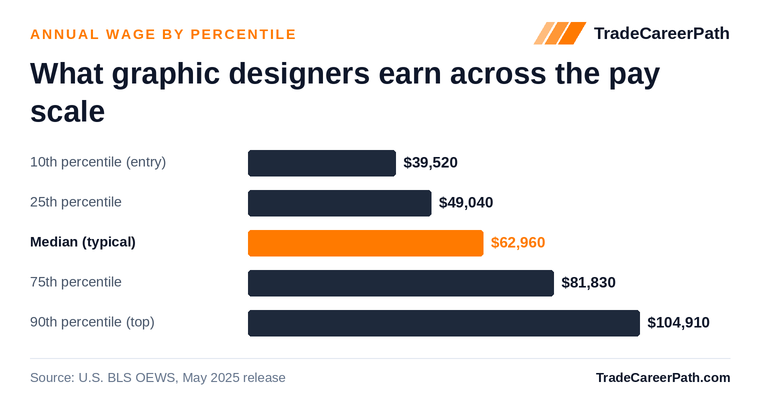
Quick answer: Training as a graphic designer usually takes 6 months to 4 years, depending on whether you choose a certificate, associate, or bachelor’s program (typically $3,000 to $25,000). You learn design software and fundamentals, build a portfolio, and gain experience through internships or freelance work. No state license is required, and certification such as the Adobe Certified Professional is optional. The median graphic designer salary is $62,960 per year ($30.27/hour), and employers post about 20,000 openings nationwide each year (BLS, May 2025).
Graphic designers use typography, color, and layout to turn ideas into visuals people understand at a glance. They create logos, ads, websites, packaging, and digital content for agencies, in-house teams, and freelance clients. The path into the field is shorter than many careers, and a strong portfolio matters more than any single degree.
How to Become a Graphic Designer
Most people enter the field in about six months to four years, depending on the education path they choose. There is no license to earn or exam you must pass. Instead, you build the career through training, a strong portfolio, hands-on experience, and an optional certification.
1. Earn a high school diploma or GED
A high school diploma or GED is the baseline for nearly every graphic design program. Before you enroll, it helps to build the skills the work depends on. Art and studio classes develop your eye for composition and color, while computer graphics courses introduce the digital tools you will use daily. Communication and writing classes matter more than people expect, because designers constantly explain their choices to clients and teams and write copy that lives inside a layout. If your school offers electives in photography, drawing, or web design, take them. Comfort with computers is essential, since the whole field runs on software. If you are changing careers and already hold a diploma or a degree in another field, you can move straight to formal design training. Many strong designers come from unrelated backgrounds and bring useful skills in marketing, writing, or project management that set their work apart.
2. Complete a graphic design program
This is the core of your training, and you have several formats to choose from. Certificate programs take roughly 6 to 12 months and suit people who want to move into design quickly or already hold a degree. Associate degrees take about 2 years and combine general education with design coursework. Bachelor’s degrees take about 4 years and can help with senior or art-director roles. Typical coursework covers typography, color theory, layout and composition, digital illustration, image editing, and production for both print and web. You will spend significant time in industry-standard software such as Adobe Photoshop, Illustrator, and InDesign, and increasingly in Figma for interface work. When comparing schools, look for accreditation by the National Association of Schools of Art and Design (NASAD), which signals the program meets recognized standards. Many certificate and degree programs are available fully online, so confirm accreditation before you enroll.
3. Build a strong portfolio
Coursework prepares you, but employers and clients hire based on what they can see. Your portfolio is the single most important asset in this field. Pull together your strongest projects across a range of work: branding and logo systems, posters and print layouts, social media graphics, digital ads, and any web or app interface design you have done. For each piece, show the result and, where it helps, a short note on the problem you solved. Quality beats quantity, so include only work you are proud of and remove weaker pieces as you grow. Build a clean personal website to host it, since a polished site doubles as proof of your design skills. If you lack real projects early on, create them: redesign a brand you admire, take on volunteer work for a nonprofit, or invent client briefs to practice against. A well-organized portfolio is what lands interviews and freelance clients.
4. Gain real-world experience
Real projects teach what classrooms cannot, especially client feedback, revisions, and production deadlines. Look for an internship at an agency, marketing department, or print shop, where you can work alongside experienced designers and see how files move from concept to final delivery. Freelance projects are another fast way to build experience and earn references, even small jobs like a local business logo or event flyer. Junior or production-artist roles let you learn an in-house workflow, brand guidelines, and how design fits into a larger marketing team. As you work, keep updating your portfolio with the strongest pieces and save kind words from clients or supervisors as testimonials. Experience also tells you which direction you enjoy most, whether that is branding, packaging, motion, or interface design, which helps you focus your next steps.
5. Consider certification and apply for jobs
Certification is optional in graphic design, since no license is required, but a credential can help validate your skills in a crowded market. The Adobe Certified Professional credential demonstrates command of Adobe Creative Cloud tools that most design jobs expect. When you are ready to apply, tailor your portfolio and resume to the type of work you want, whether that is agency, in-house, or freelance, and lead with the projects most relevant to each role. Networking is one of the fastest ways to hear about openings, and joining a professional group such as AIGA, the Professional Association for Design, gives you access to events, job boards, and a community of designers. Once you land a role, on-the-job experience and any certifications you hold can open the door to senior designer, art director, and creative director positions over time.
What Graphic Designers Do
Graphic designers create visual concepts to communicate ideas and information. They work on branding, advertising, websites, digital content, and product packaging, using both digital tools and traditional design techniques. Their job is to make a message clear, memorable, and consistent across everywhere it appears.
Typical Responsibilities
- Create logos, layouts, and visual branding
- Develop marketing and promotional materials
- Design interfaces for apps and websites
- Collaborate with clients and marketing teams
- Use software like Adobe Photoshop, Illustrator, and InDesign
- Prepare artwork and files for digital or print production
The best designers combine creativity with technical precision and clear communication.
Key Skills and Traits for Success
- Creativity and visual storytelling
- Strong sense of color, typography, and composition
- Proficiency in Adobe Creative Suite or Figma
- Time management and attention to detail
- Communication and teamwork
- Understanding of marketing and UX principles
Common Work Settings
- Marketing and advertising agencies
- In-house design departments
- Print shops and publishers
- Freelance or self-employed design studios
- Web design and digital media companies
Education and Certification Paths
| Pathway | Typical Duration | Outcome |
|---|---|---|
| Certificate in Graphic Design | 6 to 12 months | Entry-level designer |
| Associate Degree | 2 years | Junior designer or production artist |
| Bachelor’s Degree | 4 years | Professional designer or art director |
| Adobe Certified Professional | 3 to 6 months | Skill specialization and validation |
Career Growth and Advancement
Graphic designers can advance into roles such as:
- Senior Graphic Designer or Art Director
- Brand Strategist or Creative Director
- Web or UX/UI Designer
- Freelance Studio Owner
Designers who master digital tools, motion design, or UX/UI often see the fastest career growth.
Cost and Duration of Training
- Program cost: about varies by school, format and location depending on program and degree level
- Duration: six months to four years
- Certification exam fees: typically $150 to $400
Many graphic design programs are available online, which helps students learn at a flexible pace.
Pros and Cons
Pros
- Creative and expressive profession
- High flexibility with remote and freelance work
- Strong demand for digital design skills
- Opportunities across many industries
Cons
- Competitive field requiring constant skill updates
- Occasional tight deadlines and revisions
- Variable pay for freelance designers
State Licensing and Requirements
Graphic designers do not need a state license. Employers and clients care most about your portfolio and your command of design software. An optional credential like the Adobe Certified Professional can validate your tool skills and help you stand out in a competitive market.
Find Graphic Design Schools Near You
Quick Facts: Graphic Designer Salary, Education, and Outlook
Industry Organizations & Certifying Bodies
These are the recognized national organizations, unions, certifying bodies, and regulatory authorities that shape this trade. They issue the credentials, sponsor the apprenticeships, publish the codes, and represent workers and employers.
- AIGA, the Professional Association for Design Largest U.S. professional association for graphic designers.
- National Association of Schools of Art and Design (NASAD) Accredits art and design degree programs.
- Adobe Certified Professional Industry-recognized credential for Adobe Creative Cloud tools.
Wage and Employment Charts
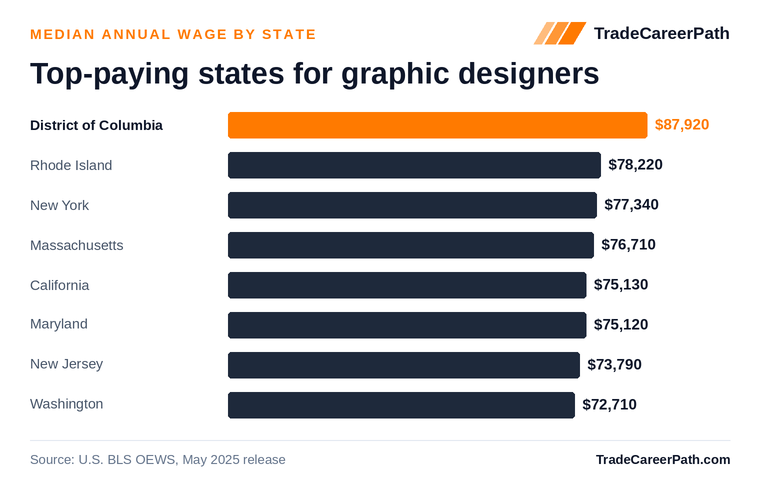
Graphic Designer Salary and Requirements by State
Select your state for local wage data, training options, and requirements:
Alabama · Alaska · Arizona · Arkansas · California · Colorado · Connecticut · Delaware · District of Columbia · Florida · Georgia · Hawaii · Idaho · Illinois · Indiana · Iowa · Kansas · Kentucky · Louisiana · Maine · Maryland · Massachusetts · Michigan · Minnesota · Mississippi · Missouri · Montana · Nebraska · Nevada · New Hampshire · New Jersey · New Mexico · New York · North Carolina · North Dakota · Ohio · Oklahoma · Oregon · Pennsylvania · Rhode Island · South Carolina · South Dakota · Tennessee · Texas · Utah · Vermont · Virginia · Washington · West Virginia · Wisconsin · Wyoming
Workplace Safety Snapshot
BLS Survey of Occupational Injuries and Illnesses data (2023-2024) report approximately 9.6 days-away, restricted, or transfer cases per 10,000 full-time-equivalent workers in graphic designers (about 0.10 per 100 FTE). Source: BLS Survey of Occupational Injuries and Illnesses, Table R98.
Frequently Asked Questions
How long does graphic designer training take?
It typically takes about 6 months to 4 years of training. A certificate can take 6 to 12 months, an associate degree about 2 years, and a bachelor's degree about 4 years. A high school diploma or GED is generally required to get started.
Do you need a college degree to work as a graphic designer?
No. A college degree is not strictly required to work as a graphic designer, and many designers enter the field through a certificate or associate degree program. A strong portfolio often carries as much weight with employers as a specific credential.
How much does graphic design training cost?
Costs vary widely by program, format, and degree level. On this page we list a typical range of about $3,000 to $25,000 depending on the path you choose, with certificate programs generally costing less than full degree programs. Optional certification exams usually add a fee of roughly $150 to $400.
Is certification required to be a graphic designer?
No. Graphic designers do not need a state license, and certification is voluntary. A credential such as the Adobe Certified Professional can help validate your software skills and stand out in a competitive job market, but employers weigh your portfolio most heavily.
Is it hard to train as a graphic designer?
Entry is fairly accessible because there is no license or exam to pass, and many people finish training in 6 months to 2 years. The field is competitive, though, and you are expected to keep building your portfolio and learning new tools throughout your career.
Can you study graphic design online?
Yes. Many schools offer graphic design certificate and degree programs fully online, which lets working students learn at a flexible pace. Before enrolling, check the program's accreditation, including whether the school carries accreditation from the National Association of Schools of Art and Design.
How many graphic designers work in the United States?
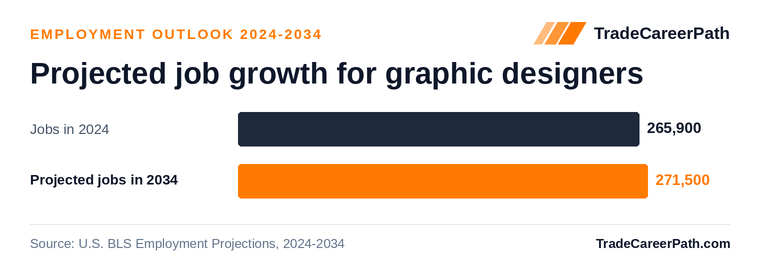
BLS reports approximately 197,830 graphic designers employed nationwide as of May 2025, with about 20,000 openings projected each year over the 2024 to 2034 period.
Sources
- U.S. Bureau of Labor Statistics, Occupational Employment and Wage Statistics (May 2025)
- U.S. Bureau of Labor Statistics, Employment Projections 2024-2034
- U.S. Bureau of Labor Statistics, Survey of Occupational Injuries and Illnesses (2023-2024, Table R98)
- U.S. Department of Labor, Wage and Hour Division, Davis-Bacon General Wage Determinations (2026)
Graphic Design Salary by State
About this guide: Researched and written by the TradeCareerPath Editorial Team. Our editorial team researches and sources every trade school and career guide using federal labor and education data, including BLS OEWS and Employment Projections, DOL apprenticeship records, IPEDS, College Scorecard, and state licensing boards. We follow the editorial standards documented at /editorial-policy/.
Data sources
Figures on this page are sourced from the federal and state datasets below. Methodology: how we rank and source data.
| Data | Provider | Vintage |
|---|---|---|
| Occupational Employment and Wage Statistics (OEWS) | U.S. Bureau of Labor Statistics | May 2025 |
| Employment Projections | U.S. Bureau of Labor Statistics | 2024-2034 |
| Integrated Postsecondary Education Data System | National Center for Education Statistics (IPEDS) | 2024 |
| College Scorecard (school-level outcomes) | U.S. Department of Education | latest release |
| College Scorecard (field-of-study earnings) | U.S. Department of Education | latest release (updated 2026-06-12) |
| Occupational licensing requirements | CareerOneStop (U.S. Department of Labor) | latest release (updated 2026-02-22) |
| Registered apprenticeship programs | CareerOneStop / Apprenticeship.gov (U.S. Department of Labor) | latest release (updated 2025-10-25) |
| O*NET occupation profiles (skills, tasks, tools, job zones) | U.S. Department of Labor (O*NET / Employment & Training Admin.) | O*NET 29.1 (updated 2026-06-13) |