
How to Become a Health and Safety Engineer in 2026
Is Health and Safety Engineer Right for You?
The U.S. Department of Labor's O*NET profile for Health and Safety Engineers, Except Mining Safety Engineers and Inspectors (SOC 17-2111) describes the work this way: Promote worksite or product safety by applying knowledge of industrial processes, mechanics, chemistry, psychology, and industrial health and safety laws. Includes industrial product safety engineers.
What the work involves
- Investigate industrial accidents, injuries, or occupational diseases to determine causes and preventive measures.
- Conduct research to evaluate safety levels for products.
- Evaluate product designs for safety.
- Conduct or coordinate worker training in areas such as safety laws and regulations, hazardous condition monitoring, and use of safety equipment.
- Maintain and apply knowledge of current policies, regulations, and industrial processes.
Skills and knowledge that matter
Skills: Reading Comprehension, Active Listening, Writing, Critical Thinking, Speaking, Complex Problem Solving.
Knowledge: English Language, Engineering and Technology, Administration and Management, Customer and Personal Service.
Tools and technology you may use
Technology: Data base user interface and query software, Computer aided design CAD software, Analytical or scientific software, Autodesk AutoCAD, C++, Eclipse IDE.
Typical preparation
O*NET Job Zone Four (Considerable Preparation Needed). Most of these occupations require a four-year bachelor's degree, but some do not. Employees in these occupations usually need several years of work-related experience, on-the-job training, and/or vocational training.
Interest fit
O*NET interest profile: Investigative, Realistic, Conventional. People who enjoy working with ideas, searching for facts, and figuring out problems often find this occupation a good fit.
Source: O*NET 31.0 (updated 2026-10-14)
Quick answer: Training as a health and safety engineer requires a 4-year degree - typically a Bachelor’s in safety engineering, industrial engineering, or occupational safety. The national median pay is $115,160 per year, and BLS projects +5.4% employment change from 2025 to 2035 (BLS OEWS, May 2025; BLS Employment Projections, 2025-35).
Health and Safety Engineer at a Glance
| Metric | Detail | Source |
|---|---|---|
| Median annual wage | $115,160 | BLS OEWS, May 2025 |
| Typical wage range | $68,420 (10th pct) - $171,250 (90th pct) | BLS OEWS, May 2025 |
| Employment | 21,450 nationwide | BLS OEWS, May 2025 |
| Projected growth (2025-35) | +5.4%, about 1,200 openings per year | BLS Employment Projections, 2025-35 |
| Typical education | Bachelor’s in safety engineering, industrial engineering, or occupational safety | BLS Occupational Outlook Handbook |
| License / certification | CSP certification valued; PE license for some engineering roles | State licensing boards |
What Does a Health and Safety Engineer Do?
Health and safety engineers design the systems, procedures, and physical safeguards that keep people from getting hurt at work - and they carry the authority to stop work when something is wrong. You read the same OSHA standards a compliance officer reads, but your job is preventing the citation, not writing it.
Day to day, the work varies by sub-specialty. A construction safety engineer walks active sites, reviews fall-protection and excavation plans before work starts, runs job hazard analyses with foremen, and investigates near-misses before they work as recordables. A process safety engineer at a manufacturer or chemical plant runs HAZOP studies, designs machine guarding and lockout/tagout programs, and models what happens when a relief valve or interlock fails. A fire protection engineer reviews building and equipment designs against NFPA and OSHA requirements before anything is built, and loss-control engineers at insurers run the same analysis from the other side - auditing client facilities and pricing the risk. Across all of it, the deliverables are written: hazard assessments, investigation reports, training programs, and the safety sections of project plans.
If you are the tradesperson or site supervisor who already runs the toolbox talks and gets pulled into every incident review - this is that role, made official and paid like an engineer. Your edge over a safety graduate with no field time is real: you know how work actually gets done, which shortcuts crews take, and how to deliver a correction without losing the room. The degree adds the regulatory depth, analysis methods, and title; the credibility you already have.
Skills That Make a Great Health and Safety Engineer
- Hazard analysis (JHA/HAZOP)
- OSHA regulatory fluency (1910 general industry and 1926 construction)
- Incident investigation and root cause analysis
- Safety training delivery - teaching crews without talking down to them
- Risk assessment and hierarchy-of-controls design
- Industrial hygiene basics: noise, air sampling, exposure limits
- Data skills: OSHA recordkeeping, TRIR/DART tracking, trend reporting
- Writing: hazard assessments, investigation reports, and program documents carry the job
Health and Safety Engineer Salary
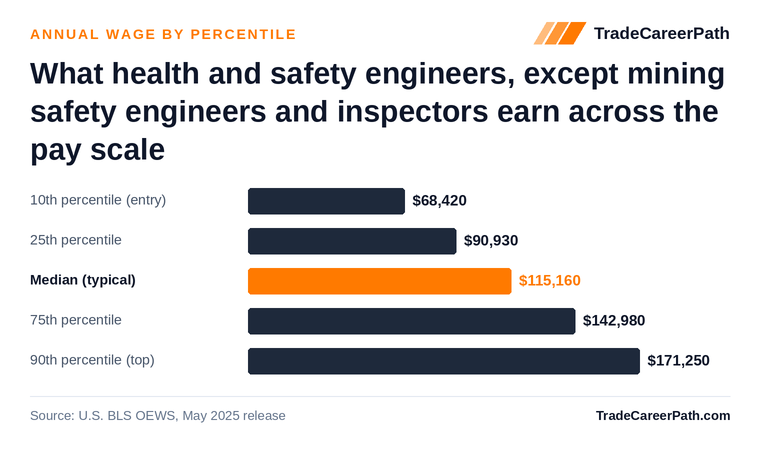
Safety is one of the highest-paying destinations for a construction or industrial background. The national median is $115,160 per year, and the 10th percentile - roughly where degree-holding entry hires start - is $68,420, in line with journeyman pay in many trades but with a far higher ceiling. The 75th percentile is $142,980, and the top 10% earn $171,250 or more (BLS OEWS, May 2025).
Where the Jobs and the Money Are
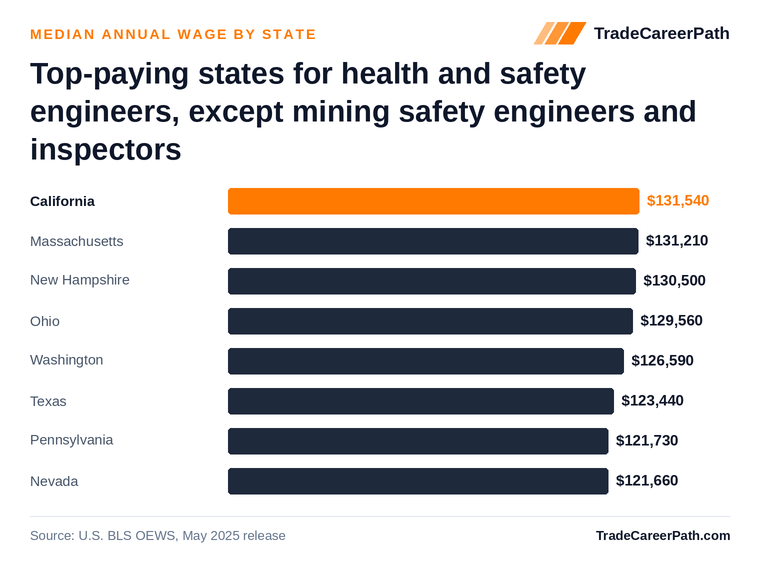
This is a smaller occupation than most engineering fields - 21,450 jobs nationwide - but it spans every industry that can hurt people. The biggest cluster by far is Texas, with 4,320 jobs at a $123,440 median; safety engineers are more than twice as concentrated there as in the average state labor market (location quotient 2.23), driven by oil, gas, chemicals, and heavy construction (BLS OEWS, May 2025).
| State | Median annual wage | Employment |
|---|---|---|
| California | $131,540 | 2,470 |
| Massachusetts | $131,210 | 750 |
| New Hampshire | $130,500 | 80 |
| Ohio | $129,560 | 650 |
| Washington | $126,590 | 420 |
California pairs the top median with the second-largest job base (2,470 jobs), and Massachusetts stands out for concentration - safety engineers are 1.5 times as common there as in the average state market. New York rounds out the big-employment states with 1,570 jobs at a $101,300 median. The practical takeaway: Texas offers the deepest market to change employers without moving; California and Massachusetts pay the most for the same credential.
How to Become a Health and Safety Engineer
1. Earn a bachelor’s degree
Safety engineering, occupational safety and health, or industrial engineering. For working tradespeople, occupational safety and health is usually the most practical route: it is widely offered online, built around exactly this career, and satisfies the degree requirement for the CSP credential. Industrial engineering is the broader, more math-heavy alternative that also keeps manufacturing and operations roles open. Whichever you choose, favor programs BCSP recognizes as Qualified Academic Programs - graduates get a head start on certification.
2. Learn the regulatory landscape
OSHA 30 is the floor, and many tradespeople already hold it. From there, build depth in the standards that govern your target industry - 29 CFR 1926 for construction, 1910 for general industry - plus the consensus standards (NFPA, ANSI) that regulators lean on. Stack recognized certificates as you go: OSHA 500-series trainer courses, HAZWOPER if you are near environmental work. Each is a resume line that pays off before the degree is finished.
3. Start as a safety specialist or engineer
Construction firms, manufacturers, and insurers all hire at the bachelor’s level, and many hire experienced tradespeople into safety coordinator roles while the degree is still in progress. Site safety roles at general contractors are the classic entry point for construction backgrounds; loss-control at insurers and EHS specialist roles at manufacturers are the other main doors.
4. Earn the CSP
The Certified Safety Professional, administered by BCSP, is the field’s benchmark credential - many senior postings require it outright. The standard path is a qualifying bachelor’s degree, several years of professional safety experience, and a comprehensive exam; the Associate Safety Professional (ASP) is the common stepping-stone exam taken earlier. The CSP is what separates the highest-paid safety careers from the ones that plateau.
5. Advance
Corporate safety director, risk management, or consulting. The fork comes at the senior level: stay technical as a principal safety engineer or industrial hygiene specialist, move up the management track toward EHS director, or take the CSP and experience into consulting. Multi-site and corporate roles are where pay pushes toward the top of the wage distribution.
Career Ladder: Titles and Realistic Pay
The BLS wage percentiles map cleanly onto how safety careers actually progress. Use this as a sanity check on offers, not a guarantee:
| Stage | Typical titles | Years in | Realistic pay (BLS OEWS, May 2025) |
|---|---|---|---|
| Entry level | Safety specialist, EHS coordinator, junior safety engineer | 0-3 | ~$68,420-$90,930 (10th-25th pct) |
| Mid-career | Safety engineer, site safety manager, CSP holder | 3-10 | ~$115,160 (median) |
| Senior | Senior safety engineer, regional EHS manager | 10-15 | ~$142,980 (75th pct) |
| Principal / leadership | Corporate safety director, principal consultant | 15+ | $171,250+ (90th pct) |
Two notes for career changers. First, trade experience compresses this ladder: a former foreman with a fresh safety degree is routinely hired above the bottom of the entry band, because employers know crews will actually listen to them. Second, the top-band figures are base wages - corporate EHS director and consulting roles commonly add bonuses and billable upside the BLS wage data does not capture.
Do You Need a License? CSP, PE, and the Real Credential Path
For most health and safety engineers, the answer is no state license - but a clear certification ladder. The credential that actually gates senior jobs is the Certified Safety Professional (CSP): a qualifying degree, professional safety experience, and an exam, with the ASP as the usual interim step. Industrial hygiene work has its own parallel benchmark, the CIH.
The PE license is optional here. Safety engineers at construction firms, manufacturers, and insurers work under the industrial exemption - the company holds design responsibility, so individual licensure is not required. The PE matters mainly in fire protection engineering, forensic work, and consulting that signs off on engineered designs; if you want that door open, the path is the standard one - ABET-accredited degree, the Fundamentals of Engineering (FE) exam, four years of qualifying experience, then the PE exam per your state board’s rules. For everyone else, CSP first - it is the credential hiring managers screen for.
Why an Online Degree Works for This Career
This is the classic degree jump for experienced tradespeople and site supervisors who work as the safety lead on their crew. Online occupational safety bachelor’s programs are common and directly target working construction and industrial professionals - the coursework is regulation- and writing-heavy rather than lab-bound, so it translates to online delivery better than most engineering fields. Employer tuition assistance is common at contractors, manufacturers, and insurers, and many students move into paid safety coordinator roles before graduating.
Job Outlook for 2026 and Beyond
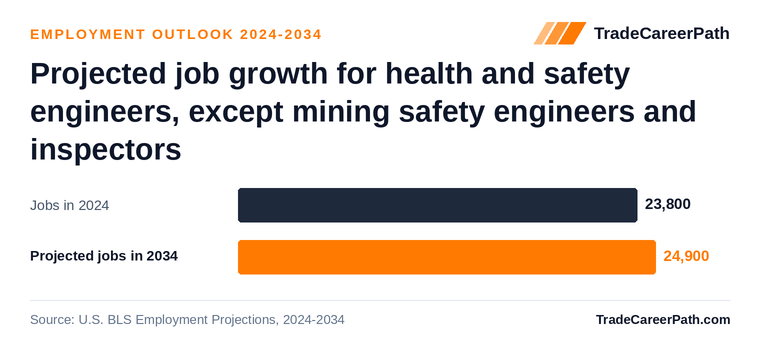
BLS projects employment of health and safety engineers to grow +5.4% from 2025 to 2035 - from 22,300 to 23,500 jobs - with about 1,200 openings per year once retirements and occupation changes are counted (BLS Employment Projections, 2025-35). Wages are moving faster than headcount: the median climbed from $109,660 in the 2024 projections data to $115,160 in the May 2025 OEWS release.
Growth is modest but the demand floor is structural: OSHA compliance is not optional, workers’ compensation costs keep pushing employers toward prevention, and insurers increasingly require credentialed safety staff on large projects. In a 21,450-person occupation, 1,200 openings a year is a steady replacement market - and because employers prefer candidates who pair the degree with real field experience, career changers from the trades compete from the front of the line.
Cost and Time to Complete the Degree
For health and safety engineers, the credential is: Bachelor’s in safety engineering, industrial engineering, or occupational safety. A bachelor’s degree is typically 120 credit hours: four years full-time, and commonly five to six years part-time while working. Transfer credit is the other lever: prior college, military training, apprenticeship coursework, and industry certifications can be worth meaningful credit at transfer-friendly schools, so get a written transfer evaluation before enrolling anywhere. Costs vary widely by school type; in-state public online programs are usually the value benchmark, and employer tuition assistance is common for working adults in this field.
Pros and Cons of Training as a Health and Safety Engineer
Pros
- Median pay of $115,160 nationally (BLS OEWS, May 2025)
- BLS projects +5.4% employment growth through 2035, about 1,200 openings per year
- Field experience from the trades is a genuine hiring advantage
- Accredited online and hybrid degree paths exist for working adults
Cons
- Requires a 4-year degree (typically 120 credit hours)
- Entry-level pay starts near $68,420 at the 10th percentile
- Small occupation (21,450 jobs nationwide) - fewer openings outside industrial hubs
- Licensing hurdle: CSP certification valued; PE license for some engineering roles
Frequently Asked Questions
Is safety a good move for an experienced tradesperson?
Yes - site experience is the most credible foundation for safety leadership, and the bachelor's degree is what unlocks the engineer/manager titles and BLS six-figure median pay.
How much do health and safety engineers make?
The national median annual wage for health and safety engineers, except mining safety engineers and inspectors is $115,160 (BLS OEWS, May 2025). The top 10% earn $171,250 or more, while entry-level pay starts around $68,420.
What is the job outlook for health and safety engineers?
BLS projects employment of health and safety engineers, except mining safety engineers and inspectors to change by +5.4% from 2025 to 2035 (BLS Employment Projections, 2025-35).
How long does health and safety engineer training take?
The bachelor's degree is 120 credit hours: four years full-time, commonly five to six years part-time while working. Transfer credit for prior college, military training, apprenticeship coursework, and certifications like OSHA 30 can meaningfully shorten it at transfer-friendly schools.
Is training as a health and safety engineer hard?
It is less math-intensive than most engineering degrees - the load is regulations, industrial hygiene, ergonomics, and risk analysis rather than differential equations. Tradespeople usually find the hazard-recognition and site-operations material easy; the writing-heavy coursework and regulatory detail are where the study time goes.
Should I get an occupational safety degree or an industrial engineering degree?
For a working tradesperson targeting safety roles, occupational safety and health is the more direct buy: more accredited online options built for working adults, and it satisfies the education requirement for the CSP. Industrial engineering is broader and keeps more doors open, but has fewer online programs and more math prerequisites.
Can you train as a health and safety engineer without a degree?
You can work in safety without one - site safety technician and coordinator roles hire on experience plus OSHA cards. But the engineer and manager titles that carry the $115,160 median generally require the bachelor's, and the CSP credential requires a qualifying degree plus experience.
Do health and safety engineers need a license?
No state license is required for most safety roles. The field's benchmark credential is the Certified Safety Professional (CSP) from BCSP - degree plus experience plus exam. A PE license matters only in a minority of roles, such as fire protection engineering or consulting sign-off, and most safety engineers at employers work under the industrial exemption.
Health and Safety Engineer Salary and Requirements by State
Alabama · Alaska · Arizona · Arkansas · California · Colorado · Connecticut · Delaware · Florida · Georgia · Hawaii · Idaho · Illinois · Indiana · Iowa · Kansas · Kentucky · Louisiana · Maine · Maryland · Massachusetts · Michigan · Minnesota · Mississippi · Missouri · Montana · Nebraska · Nevada · New Hampshire · New Jersey · New Mexico · New York · North Carolina · Ohio · Oklahoma · Oregon · Pennsylvania · Rhode Island · South Carolina · Texas · Utah · Virginia · Washington · West Virginia · Wisconsin
Related Careers and Degree Paths
- Construction Manager - the other degree jump for site supervisors, running the whole project instead of its safety program
- Industrial Engineer - the broader efficiency-and-systems degree that overlaps heavily with plant safety work
- Environmental Engineer - the environmental half of EHS, for those drawn to air, water, and remediation work
- Civil Engineer - the design-side engineering path for construction backgrounds
- Online Engineering Degrees for Tradespeople - how to pick an accredited program that fits a work schedule
Degree and Program Guides
- Online Occupational Safety Degrees - the BCSP credential path and safety degree options
Sources
- U.S. Bureau of Labor Statistics, Occupational Employment and Wage Statistics (OEWS), May 2025 - Health and Safety Engineers, Except Mining Safety Engineers and Inspectors (SOC 17-2111)
- U.S. Bureau of Labor Statistics, Employment Projections, 2025-35
- U.S. Bureau of Labor Statistics, Occupational Outlook Handbook - education and licensing requirements
Health Safety Engineer Salary by State
About this guide: Researched and written by the TradeCareerPath Editorial Team. Our editorial team researches and sources every trade school and career guide using federal labor and education data, including BLS OEWS and Employment Projections, DOL apprenticeship records, IPEDS, College Scorecard, and state licensing boards. We follow the editorial standards documented at /editorial-policy/.
Data sources
Figures on this page are sourced from the federal and state datasets below. Methodology: how we rank and source data.
| Data | Provider | Vintage |
|---|---|---|
| Occupational Employment and Wage Statistics (OEWS) | U.S. Bureau of Labor Statistics | May 2025 |
| Employment Projections | U.S. Bureau of Labor Statistics | 2025-2035 |
| Integrated Postsecondary Education Data System | National Center for Education Statistics (IPEDS) | 2024 |
| College Scorecard (school-level outcomes) | U.S. Department of Education | latest release |
| College Scorecard (field-of-study earnings) | U.S. Department of Education | latest release (updated 2026-06-12) |
| Occupational licensing requirements | CareerOneStop (U.S. Department of Labor) | latest release (updated 2026-02-22) |
| Registered apprenticeship programs | CareerOneStop / Apprenticeship.gov (U.S. Department of Labor) | latest release (updated 2025-10-25) |
| O*NET occupation profiles (skills, tasks, tools, job zones) | U.S. Department of Labor (O*NET / Employment & Training Admin.) | O*NET 31.0 (updated 2026-10-14) |