
How to Become a Heavy Equipment Operator in 2026: Training, Certs, Salary
Is Heavy Equipment Operator Right for You?
The U.S. Department of Labor's O*NET profile for Operating Engineers and Other Construction Equipment Operators (SOC 47-2073) describes the work this way: Operate one or several types of power construction equipment, such as motor graders, bulldozers, scrapers, compressors, pumps, derricks, shovels, tractors, or front-end loaders to excavate, move, and grade earth, erect structures, or pour concrete or other hard surface pavement. May repair and maintain equipment in addition to other duties.
What the work involves
- Learn and follow safety regulations.
- Take actions to avoid potential hazards or obstructions, such as utility lines, other equipment, other workers, or falling objects.
- Start engines, move throttles, switches, or levers, or depress pedals to operate machines, such as bulldozers, trench excavators, road graders, or backhoes.
- Coordinate machine actions with other activities, positioning or moving loads in response to hand or audio signals from crew members.
- Align machines, cutterheads, or depth gauge makers with reference stakes and guidelines or ground or position equipment, following hand signals of other workers.
Skills and knowledge that matter
Skills: Operation and Control, Operations Monitoring, Equipment Maintenance, Monitoring, Active Listening, Troubleshooting.
Knowledge: Mechanical, English Language, Public Safety and Security, Mathematics.
Tools and technology you may use
Technology: Facilities management software, Spreadsheet software, Office suite software, Microsoft Excel, Microsoft Office software, Microsoft Outlook.
Typical preparation
O*NET Job Zone 1-2 (Very Little to Some Preparation Needed). Usually requires a high school diploma or GED, though some occupations may not. Ranges from a few days to one year of on-the-job training.
Interest fit
O*NET interest profile: Realistic, Conventional, Investigative. People who enjoy hands-on, practical work with tools, machines, plants, or materials often find this occupation a good fit.
Source: O*NET 31.0 (updated 2026-10-14)
Want to work as a heavy equipment operator? Training programs and apprenticeships can last 6-12 months through a trade school, apprenticeship, or union program. This guide covers the steps, certifications, and skills to get started.
If you enjoy big machines, outdoor work, and skilled trades, this might be the career for you.
Heavy equipment operators support construction, mining, road building, and infrastructure projects.
Quick answers
What does a heavy equipment operator do? Heavy equipment operators use machines to move earth, gravel, or demolition debris, prepare job sites, and perform safety and maintenance checks.
What machines do heavy equipment operators use? Common equipment includes excavators, bulldozers, graders, backhoes, and cranes.
How to become a heavy equipment operator? Earn a high school diploma or GED, complete training or an apprenticeship, build hands-on hours, and pursue any required certification or licensing before applying for jobs.
How long does training take? Training programs or union apprenticeships can last 6-12 months and include classroom and machine training.
Which certifications can help you get hired? Credentials like NCCER Heavy Equipment Certification, NCCCO Crane Operator License, OSHA 10/30, a CDL, and First Aid/CPR can improve hireability.
Do you need a CDL or license? Certification or licensing may be required for certain equipment, and a CDL is for moving machines on public roads.
At a glance
- Work includes moving earth/debris, trenching, leveling surfaces, and safety inspections
- Common equipment: excavators, bulldozers, graders, backhoes, cranes
- Training paths: trade school, union apprenticeship (IUOE), employer training, military transition programs
- Credentials mentioned: NCCER, NCCCO, OSHA 10/30, CDL, First Aid/CPR
- Key skills: hand-eye coordination, safety awareness, blueprint reading, stamina—
What Do Heavy Equipment Operators Do?
Heavy equipment operators use powerful machines to:
- Move earth, gravel, or demolition debris
- Operate excavators, bulldozers, graders, backhoes, and cranes
- Prepare job sites, dig trenches, and level surfaces
- Follow blueprints and site layouts
- Perform maintenance checks and safety inspections
“If you like working outside, operating high-powered gear, and seeing your work change the landscape, this trade delivers.” - Brad Fishbein, Skilled Trades Educator
How to Become a Heavy Equipment Operator (5 Steps)
Here’s your path to getting started:
Finish high school or earn a GED
Most employers and schools require this.Attend a training program or union apprenticeship
Lasts 6-12 months and includes classroom and machine training.Complete hands-on operating hours
Practice with real excavators, loaders, or cranes.Get certified or licensed (as required)
Especially important for crane operators or CDL equipment.Apply for jobs with contractors, municipalities, or unions
Many employers offer on-the-job advancement.
Certifications That Improve Hireability
These credentials improve your chances and increase your pay:
- NCCER Heavy Equipment Certification
- NCCCO Crane Operator License
- OSHA 10 or OSHA 30 (safety certifications)
- CDL (Commercial Driver’s License) - For moving machines on public roads
- First Aid/CPR Certification
Tip: Some states require certification for specific machines (e.g. tower cranes). Always check local requirements.
Training Options
- Trade Schools: Fast programs with hands-on simulators and machines
- Union Apprenticeships (IUOE): Paid training with benefits and advancement
- Employer Training Programs: Some construction companies train you from scratch
- Military Transition Programs: Great path for veterans
Some unions and employers offer no-tuition training tied to an employment commitment; availability and terms vary by location and program.
Skills That Make Great Equipment Operators
- Comfort with large machinery and outdoor work
- Strong hand-eye coordination
- Attention to site safety and surroundings
- Reading blueprints and understanding grade stakes
- Physical strength and stamina
Heavy Equipment Operator Salary Snapshot
U.S.39,200 openings/yr
Pros & Cons of the Career
Pros:
- High earning potential without a college degree
- Job stability across multiple industries
- Pride in seeing your work impact cities and landscapes
- Room for specialization: cranes, finish grading, pipeline, etc.
Cons:
- Work can be weather-dependent
- Exposure to dust, noise, and vibration
- Irregular hours or long shifts
- Requires a strong safety mindset
Start Your Career Operating Big Machines
Pick a training path that fits your goals, then build hands-on operating hours and focus on job site safety. Certifications and licensing requirements vary by machine and location, so confirm what applies where you plan to work.
Industry Organizations & Certifying Bodies
These are the recognized national organizations, unions, certifying bodies, and regulatory authorities that shape this trade. They issue the credentials, sponsor the apprenticeships, publish the codes, and represent workers and employers.
- International Union of Operating Engineers (IUOE) Primary heavy equipment operator union; sponsors registered apprenticeships.
- Associated Equipment Distributors (AED) Industry foundation supporting technician and operator workforce development.
- National Commission for the Certification of Crane Operators (NCCCO) OSHA-accredited crane operator certification.
Federal Prevailing Wages by State
The U.S. Department of Labor sets Davis-Bacon prevailing wages that contractors must pay on federally funded construction projects. These are minimum hourly rates, not averages - actual market pay can be higher. Across 30 states with active 2026 determinations, the average total compensation (base + fringe) for heavy equipment operators is $62.82/hour. New Jersey pays the highest rate ($99.22/hr total), while Minnesota reports the lowest active determination ($24.50/hr total).
| State | Base Hourly | Fringe Hourly | Total Hourly | Annualized* |
|---|---|---|---|---|
| New Jersey | $61.72 | $37.50 | $99.22 | $206,378 |
| Massachusetts | $57.83 | $33.70 | $91.53 | $190,382 |
| Nevada | $55.94 | $34.15 | $90.09 | $187,387 |
| Wisconsin | $55.21 | $28.55 | $83.76 | $174,221 |
| Alaska | $53.23 | $29.50 | $82.73 | $172,078 |
| Hawaii | $50.90 | $30.75 | $81.65 | $169,832 |
| Delaware | $48.73 | $32.23 | $80.96 | $168,397 |
| Rhode Island | $46.45 | $29.95 | $76.40 | $158,912 |
| New York | $41.26 | $34.85 | $76.11 | $158,309 |
| Indiana | $36.15 | $38.65 | $74.80 | $155,584 |
| Illinois | $40.71 | $28.75 | $69.46 | $144,477 |
| West Virginia | $46.56 | $22.05 | $68.61 | $142,709 |
| Missouri | $45.48 | $22.42 | $67.90 | $141,232 |
| Pennsylvania | $41.69 | $24.05 | $65.74 | $136,739 |
| Washington | $38.17 | $23.40 | $61.57 | $128,066 |
| Iowa | $36.93 | $21.94 | $58.87 | $122,450 |
| Oklahoma | $38.09 | $19.05 | $57.14 | $118,851 |
| Virginia | $38.79 | $18.05 | $56.84 | $118,227 |
| Florida | $39.01 | $16.85 | $55.86 | $116,189 |
| Kentucky | $34.99 | $19.60 | $54.59 | $113,547 |
| South Dakota | $34.38 | $18.71 | $53.09 | $110,427 |
| Arkansas | $34.25 | $15.00 | $49.25 | $102,440 |
| Ohio | $28.87 | $19.66 | $48.53 | $100,942 |
| Tennessee | $33.23 | $13.40 | $46.63 | $96,990 |
| Alabama | $32.57 | $14.05 | $46.62 | $96,970 |
| Maryland | $33.00 | $13.55 | $46.55 | $96,824 |
| Arizona | $33.41 | $12.57 | $45.98 | $95,638 |
| Wyoming | $30.68 | $7.61 | $38.29 | $79,643 |
| New Mexico | $26.75 | $4.65 | $31.40 | $65,312 |
| Minnesota | $20.00 | $4.50 | $24.50 | $50,960 |
* Annualized total = total hourly × 2,080 hours (40-hour week, 52 weeks). Actual annual pay varies with overtime, project length, and benefits utilization.
Source: U.S. Department of Labor, Wage and Hour Division - Davis-Bacon General Wage Determinations, 2026. Rates reflect the lowest base rate within each statewide determination for heavy equipment operator classifications.
Wage and Employment Charts
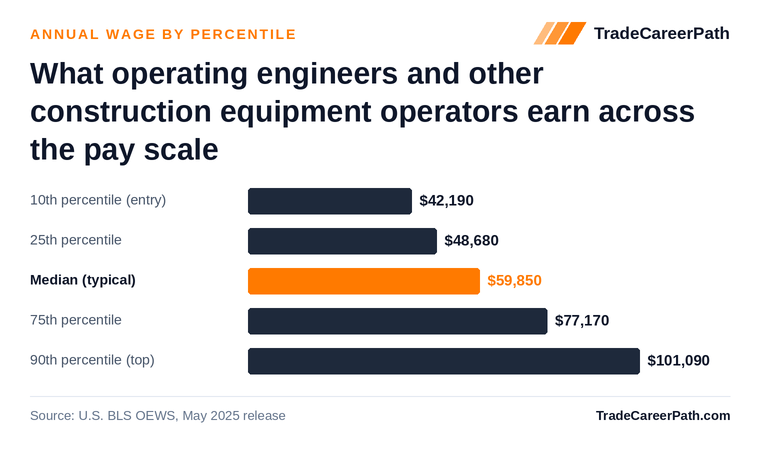
| Percentile | Annual wage |
|---|---|
| 10th | $42,190 |
| 25th | $48,680 |
| 50th (median) | $59,850 |
| 75th | $77,170 |
| 90th | $101,090 |
| Year | Employment |
|---|---|
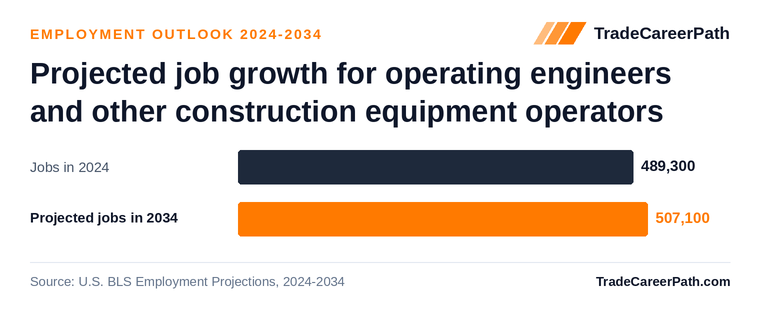
| 2025 | 489,500 |
| 2035 projected | 511,800 |
| Percent change | +4.6% |
Heavy Equipment Operator Salary and Requirements by State
Select your state for local wage data, training options, and requirements:
Alabama · Alaska · Arizona · Arkansas · California · Colorado · Connecticut · Delaware · District of Columbia · Florida · Georgia · Hawaii · Idaho · Illinois · Indiana · Iowa · Kansas · Kentucky · Louisiana · Maine · Maryland · Massachusetts · Michigan · Minnesota · Mississippi · Missouri · Montana · Nebraska · Nevada · New Hampshire · New Jersey · New Mexico · New York · North Carolina · North Dakota · Ohio · Oklahoma · Oregon · Pennsylvania · Rhode Island · South Carolina · South Dakota · Tennessee · Texas · Utah · Vermont · Virginia · Washington · West Virginia · Wisconsin · Wyoming
Workplace Safety Snapshot
BLS Survey of Occupational Injuries and Illnesses data (2023-2024) report approximately 107.5 days-away, restricted, or transfer cases per 10,000 full-time-equivalent workers in operating engineers and other construction equipment operators (about 1.07 per 100 FTE). Source: BLS Survey of Occupational Injuries and Illnesses, Table R98.
Frequently Asked Questions
How long does heavy equipment operator training take?
It typically takes a few weeks to 1 year of training. The most common entry path is through equipment operator training program or union apprenticeship. A high school diploma or GED is generally required to get started.
How much do heavy equipment operators make?
The median annual salary for heavy equipment operators is $59,850 according to the Bureau of Labor Statistics (May 2025). Entry-level workers earn around $42,190, while those in the 90th percentile earn over $101,090. Pay varies by state, experience, and specialization.
What is the job outlook for heavy equipment operators?
The Bureau of Labor Statistics projects 4.6% employment growth for this occupation from 2025 to 2035, which is roughly on pace with the overall economy. Approximately 39,200 job openings are expected each year due to growth, retirements, and workers leaving the field.
Do you need a college degree to work as a heavy equipment operator?
No. A college degree is not required to work as a heavy equipment operator. Most people enter the field through equipment operator training program or union apprenticeship. A high school diploma or GED is typically the only educational prerequisite.
Which states pay heavy equipment operators the most?
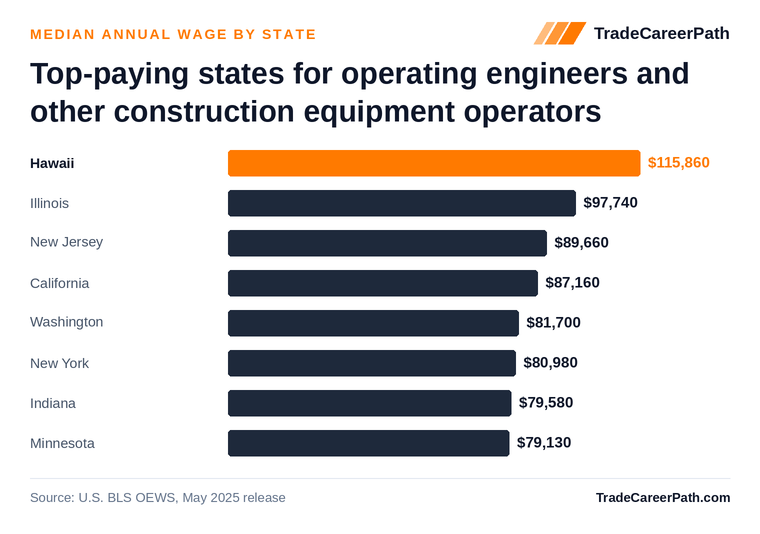
According to the U.S. Bureau of Labor Statistics (May 2025 OEWS), the highest-paying states for heavy equipment operators are Hawaii, Illinois, and New Jersey. Median annual wages: Hawaii ($115,860); Illinois ($97,740); New Jersey ($89,660).
Which states employ the most heavy equipment operators?
BLS reports the largest concentrations of heavy equipment operators in Texas, California, and Florida. Employment levels: Texas (55,540 workers); California (36,020 workers); Florida (27,510 workers) (May 2025).
How much do experienced heavy equipment operators earn?
The top 10% of heavy equipment operators earn more than $101,090 per year, according to BLS Occupational Employment and Wage Statistics (May 2025). Experienced workers in this band typically hold senior credentials, supervisory roles, or specialty certifications.
What is entry-level pay for heavy equipment operators?
BLS reports the bottom 10% of heavy equipment operators earn under $42,190 per year. New workers often start near this level and see pay rise as they accumulate experience and credentials.
How many heavy equipment operators work in the United States?
BLS reports approximately 478,090 heavy equipment operators employed nationwide as of May 2025.
How many job openings are expected for heavy equipment operators each year?
BLS projects approximately 39,200 openings per year for heavy equipment operators from 2025 through 2035, including new positions, retirements, and workers transitioning out. The occupation is projected to grow 4.6% from 2025 to 2035, classified as about as fast as average growth.
How much do heavy equipment operators make per hour?
The median hourly wage for heavy equipment operators is $28.78, according to BLS (May 2025). Hourly pay ranges from about $20.28 (bottom 10%) to $48.60 (top 10%).
How Heavy Equipment Operator Pay Compares to Similar Trades
Side-by-side comparison of Heavy Equipment Operator and the closest related careers, based on U.S. Bureau of Labor Statistics data (May 2025 OEWS + 2025-2035 Employment Projections).
| Career | Median Pay | 10-Year Growth | Annual Openings |
|---|---|---|---|
| Heavy Equipment Operator this guide | $59,850 | +4.6% | 39,200 |
| Diesel Mechanic | $61,770 | +3.6% | 24,400 |
| CDL & Truck Driver Training | $58,640 | +3.8% | 214,500 |
| Construction Worker | $47,120 | +7.3% | 120,000 |
| Construction Manager | $114,990 | +9.1% | 49,700 |
Source: BLS Occupational Employment and Wage Statistics + BLS Employment Projections.
Sources
- U.S. Bureau of Labor Statistics, Occupational Employment and Wage Statistics (May 2025)
- U.S. Bureau of Labor Statistics, Employment Projections 2025-2035
- U.S. Bureau of Labor Statistics, Survey of Occupational Injuries and Illnesses (2023-2024, Table R98)
- U.S. Department of Labor, Wage and Hour Division, Davis-Bacon General Wage Determinations (2026)
Heavy Equipment Operator Salary by State
About this guide: Researched and written by the TradeCareerPath Editorial Team. Our editorial team researches and sources every trade school and career guide using federal labor and education data, including BLS OEWS and Employment Projections, DOL apprenticeship records, IPEDS, College Scorecard, and state licensing boards. We follow the editorial standards documented at /editorial-policy/.
Data sources
Figures on this page are sourced from the federal and state datasets below. Methodology: how we rank and source data.
| Data | Provider | Vintage |
|---|---|---|
| Occupational Employment and Wage Statistics (OEWS) | U.S. Bureau of Labor Statistics | May 2025 |
| Employment Projections | U.S. Bureau of Labor Statistics | 2025-2035 |
| Integrated Postsecondary Education Data System | National Center for Education Statistics (IPEDS) | 2024 |
| College Scorecard (school-level outcomes) | U.S. Department of Education | latest release |
| College Scorecard (field-of-study earnings) | U.S. Department of Education | latest release (updated 2026-06-12) |
| Occupational licensing requirements | CareerOneStop (U.S. Department of Labor) | latest release (updated 2026-02-22) |
| Registered apprenticeship programs | CareerOneStop / Apprenticeship.gov (U.S. Department of Labor) | latest release (updated 2025-10-25) |
| O*NET occupation profiles (skills, tasks, tools, job zones) | U.S. Department of Labor (O*NET / Employment & Training Admin.) | O*NET 31.0 (updated 2026-10-14) |