
How to Become a Hemodialysis Technician in 2026
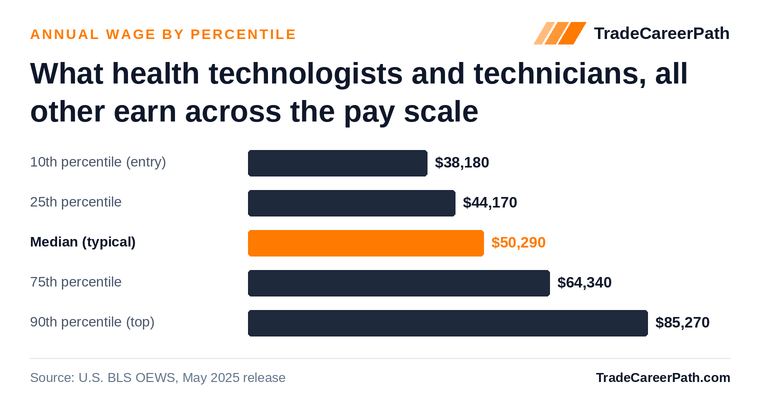
Quick answer: Training as a hemodialysis technician usually takes 12 to 18 months through a certificate program, or about 2 years through an associate degree. Programs commonly run $4,000 to $10,000, and you complete supervised clinical hours on real equipment before earning national certification, which is required in most states. The two main credentials are the CCHT (NNCC) and the CHT (BONENT). The median hemodialysis technician salary is $50,290 per year ($24.18/hour), and there are about 12,400 openings nationwide each year (BLS, May 2025).
Hemodialysis technicians operate the machines that filter waste and excess fluid from the blood of patients whose kidneys have failed. They monitor each treatment, maintain the equipment, and work alongside nurses and physicians to keep patients safe. It is a hands-on healthcare career you can enter without a nursing degree.
How to Become a Hemodialysis Technician
Most people enter the field in about 12 to 18 months, depending on whether they choose a certificate or an associate degree. There is no single national exam that licenses you. Instead, you build the career through training, supervised clinical hours, and a national certification that most states require.
1. Earn a high school diploma or GED
A high school diploma or GED is the minimum requirement for every hemodialysis technician program and for almost every entry-level job in a dialysis unit. Before you enroll, it helps to build the skills the work depends on. Biology and human anatomy classes make the renal and circulatory coursework easier to follow, and chemistry helps you understand how dialysate solutions balance a patient's blood. Basic math is important because technicians calculate fluid removal and track vital signs throughout a treatment. Comfort with computers also matters, since modern dialysis machines and patient records are electronic. If you are changing careers and already hold a diploma or a degree in another field, you can move straight to a training program. Many strong technicians come from caregiving, customer service, or other healthcare support roles and bring useful skills in communication, patience, and staying organized under pressure.
2. Complete a hemodialysis technician program
This is the core credential. Certificate programs, offered through technical schools and community colleges, typically take about 12 to 18 months, while an associate degree route takes roughly 2 years and adds broader healthcare coursework. Coursework usually covers renal anatomy and physiology, the principles of dialysis, how to set up and operate the equipment, water treatment and dialysate preparation, infection control, and patient communication and care. When comparing schools, confirm the program is accredited and that it includes supervised clinical placement, since hands-on hours are required for certification. Program costs vary by school and location, but they are commonly listed in the range of $4,000 to $10,000. Some classroom material can be completed online, but the clinical portion must be done in person on real dialysis equipment, so check how each program arranges its clinical rotations before you commit.
3. Gain supervised clinical experience
Coursework prepares you, but employers and certifying bodies want documented hands-on time. Most programs build in clinical rotations where you assist with real patient treatments under the supervision of nurses and experienced technicians. During this stage you practice cannulating access sites, setting up and priming machines, monitoring patients during a session, and disinfecting equipment between treatments. If you start working before you certify, many dialysis providers offer paid on-the-job training and let you accumulate the clinical hours and experience that certification exams require. Keep a record of your supervised hours and the procedures you have performed, because both the NNCC and BONENT credentials set minimum experience requirements before you can sit for the exam. This stage is also where you decide whether you prefer the steady pace of an outpatient clinic or the higher acuity of a hospital unit.
4. Earn national certification
Certification is required in most states, and employers generally expect you to pass an exam within a set window after you start. The two main credentials are:
- CCHT, the Certified Clinical Hemodialysis Technician credential from the Nephrology Nursing Certification Commission (NNCC)
- CHT, the Certified Hemodialysis Technician credential from the Board of Nephrology Examiners Nursing and Technology (BONENT)
- CCHT-A, an advanced NNCC credential for experienced technicians
Each exam tests your knowledge of dialysis principles, patient care, water treatment, infection control, and safety. Eligibility usually depends on a combination of completed training and documented clinical hours. Certification exam fees are commonly listed at about $225 to $250 per exam, and many employers reimburse the cost. Credentials must be renewed periodically through continuing education.
5. Apply for hemodialysis technician jobs
Dialysis centers, hospitals, outpatient clinics, and home dialysis programs are the top employers. Tailor your resume to highlight your certification, your documented clinical hours, and any specific equipment you have trained on. Large dialysis providers often hire in cohorts and train new technicians together, which can be a good entry point. Once you are working, on-the-job experience and your certification can open the door to lead technician, clinical coordinator, or biomedical equipment technician roles, and some technicians later study to work as licensed practical nurses. Joining a professional community and keeping your certification current help you stay competitive as the field grows.
What Hemodialysis Technicians Do
Hemodialysis technicians operate the equipment that performs life-sustaining dialysis treatment for patients with kidney failure. They work closely with nurses and physicians to monitor each session and keep patients safe and comfortable.
Common Responsibilities
- Prepare and operate dialysis machines
- Record patient vital signs before, during, and after treatment
- Mix and monitor dialysate solutions
- Clean and disinfect equipment between sessions
- Educate patients on treatment plans and home care
- Respond quickly to medical complications during dialysis
Every day, these technicians help patients manage chronic kidney disease with precision and compassion.
Skills and Traits for Success
- Attention to detail and accuracy
- Empathy and patient-centered care
- Technical and mechanical aptitude
- Strong communication skills
- Stamina and focus during long shifts
- Ability to remain calm in medical emergencies
Where Hemodialysis Technicians Work
- Hospitals and dialysis centers
- Outpatient treatment clinics
- Nursing and rehabilitation facilities
- Home dialysis programs
- Specialized nephrology clinics
Education and Certification Paths
| Pathway | Typical Duration | Outcome |
|---|---|---|
| Certificate Program | 12 to 18 months | Entry-level employment |
| Associate Degree | 2 years | Broader healthcare knowledge and advancement potential |
| National Certification | After graduation | Required by most employers and states |
Career Growth and Advancement
Experienced dialysis technicians may advance into roles such as:
- Lead Dialysis Technician
- Clinical Coordinator
- Biomedical Equipment Technician
- Licensed Practical Nurse (LPN) with further study
Cost and Duration of Training
- Program cost: commonly varies by school, format and location depending on location and format
- Time to complete: 12 to 18 months for a certificate, about 2 years for an associate degree
- Certification exam fees: commonly around $225 to $250 per exam
Many employers reimburse certification or continuing education costs.
Pros and Cons
Pros
- Rewarding, patient-focused work
- Growing healthcare field
- Short training time
- Strong demand nationwide
Cons
- Physically and emotionally demanding
- Requires certification and ongoing training
- Possible exposure to bodily fluids
Licensing and Requirements
Most states require hemodialysis technicians to be certified, and many also require registration with the state health department. National certification through NNCC (CCHT) or BONENT (CHT) is accepted in nearly all states. Check your state’s specific rules before you begin work, since timelines for passing the exam after hire can vary.
Quick Facts: Hemodialysis Technician Salary, Education, and Outlook

Industry Organizations & Certifying Bodies
These are the recognized national organizations, unions, certifying bodies, and regulatory authorities that shape this trade. They issue the credentials, sponsor the apprenticeships, publish the codes, and represent workers and employers.
- Board of Nephrology Examiners Nursing and Technology (BONENT) Issues the Certified Hemodialysis Technician (CHT) credential.
- Nephrology Nursing Certification Commission (NNCC) Issues the Certified Clinical Hemodialysis Technician (CCHT) credential.
Wage and Employment Charts
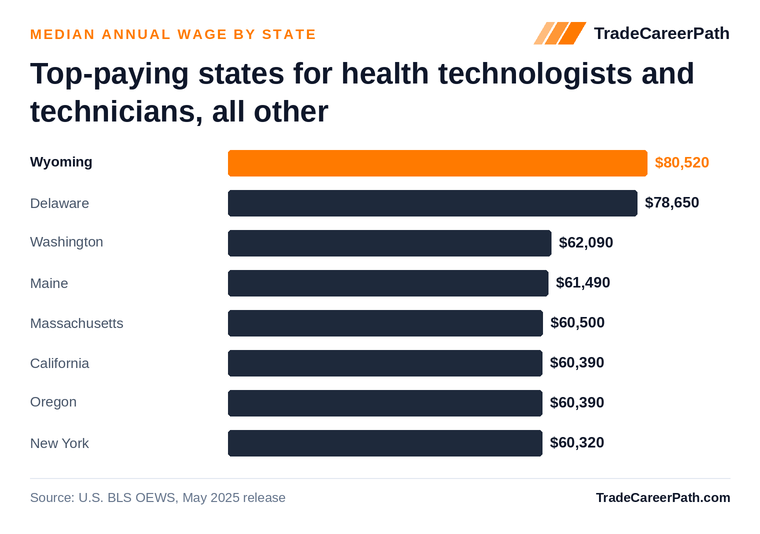
Hemodialysis Technician Salary and Requirements by State
Select your state for local wage data, training options, and requirements:
Alabama · Alaska · Arizona · Arkansas · California · Colorado · Connecticut · Delaware · District of Columbia · Florida · Georgia · Hawaii · Idaho · Illinois · Indiana · Iowa · Kansas · Kentucky · Louisiana · Maine · Maryland · Massachusetts · Michigan · Minnesota · Mississippi · Missouri · Montana · Nebraska · Nevada · New Hampshire · New Jersey · New Mexico · New York · North Carolina · North Dakota · Ohio · Oklahoma · Oregon · Pennsylvania · Rhode Island · South Carolina · South Dakota · Tennessee · Texas · Utah · Vermont · Virginia · Washington · West Virginia · Wisconsin · Wyoming
Find Hemodialysis Technician Programs Near You
Frequently Asked Questions
How long does hemodialysis technician training take?
Most people finish a certificate program in about 12 to 18 months, while an associate degree path takes roughly 2 years. A high school diploma or GED is generally required to get started.
Do you need a college degree to work as a hemodialysis technician?
No. A college degree is not required. Most people enter the field through a certificate or associate degree program. A high school diploma or GED is typically the only educational prerequisite before training.
How much does hemodialysis technician training cost?
Costs vary by program and school. Programs are commonly listed in the range of $4,000 to $10,000 depending on location and format. Certification exam fees are commonly listed at about $225 to $250 per exam.
Is certification required to work as a hemodialysis technician?
Certification is required in most states. The two main credentials are the Certified Clinical Hemodialysis Technician (CCHT) from the Nephrology Nursing Certification Commission (NNCC) and the Certified Hemodialysis Technician (CHT) from the Board of Nephrology Examiners Nursing and Technology (BONENT).
Is it hard to train as a hemodialysis technician?
Training is relatively accessible, with no nursing degree required and most people finishing in 12 to 18 months. The work itself is demanding, with long shifts, hands-on machine operation, and a need to stay calm and precise during patient treatments.
How many hemodialysis technicians work in the United States?
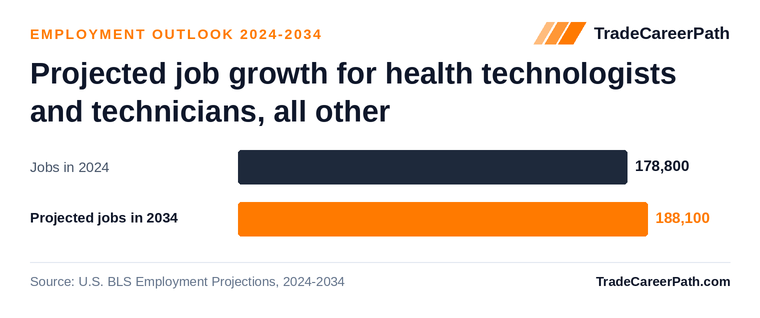
BLS reports about 182,610 workers in this occupation group as of May 2025, and projects 5.9% employment growth from 2025 to 2035, with roughly 13,600 openings nationwide each year.
Can you train as a hemodialysis technician online?
Some classroom coursework can be completed online, but you must also finish supervised clinical hours on real dialysis equipment. Confirm a program's accreditation and clinical placement before you enroll.
How Hemodialysis Technician Pay Compares to Similar Trades
Side-by-side comparison of Hemodialysis Technician and the closest related careers, based on U.S. Bureau of Labor Statistics data (May 2025 OEWS + 2025-2035 Employment Projections).
| Career | Median Pay | 10-Year Growth | Annual Openings |
|---|---|---|---|
| Hemodialysis Technician this guide | $50,290 | +5.9% | 12,400 |
| Phlebotomy Technician | $45,230 | +6.8% | 18,000 |
| Patient Care Technician | $42,260 | +2.6% | 196,200 |
| Medical Assistant | $45,690 | +12.9% | 109,700 |
| Certified Nursing Assistant (CNA) | $42,260 | +2.6% | 196,200 |
Source: BLS Occupational Employment and Wage Statistics + BLS Employment Projections.
Sources
- U.S. Bureau of Labor Statistics, Occupational Employment and Wage Statistics (May 2025)
- U.S. Bureau of Labor Statistics, Employment Projections 2025-2035
- U.S. Bureau of Labor Statistics, Survey of Occupational Injuries and Illnesses (2023-2024, Table R98)
- U.S. Department of Labor, Wage and Hour Division, Davis-Bacon General Wage Determinations (2026)
Hemodialysis Technician Salary by State
About this guide: Researched and written by the TradeCareerPath Editorial Team. Our editorial team researches and sources every trade school and career guide using federal labor and education data, including BLS OEWS and Employment Projections, DOL apprenticeship records, IPEDS, College Scorecard, and state licensing boards. We follow the editorial standards documented at /editorial-policy/.
Data sources
Figures on this page are sourced from the federal and state datasets below. Methodology: how we rank and source data.
| Data | Provider | Vintage |
|---|---|---|
| Occupational Employment and Wage Statistics (OEWS) | U.S. Bureau of Labor Statistics | May 2025 |
| Employment Projections | U.S. Bureau of Labor Statistics | 2025-2035 |
| Integrated Postsecondary Education Data System | National Center for Education Statistics (IPEDS) | 2024 |
| College Scorecard (school-level outcomes) | U.S. Department of Education | latest release |
| College Scorecard (field-of-study earnings) | U.S. Department of Education | latest release (updated 2026-06-12) |
| Occupational licensing requirements | CareerOneStop (U.S. Department of Labor) | latest release (updated 2026-02-22) |
| Registered apprenticeship programs | CareerOneStop / Apprenticeship.gov (U.S. Department of Labor) | latest release (updated 2025-10-25) |
| O*NET occupation profiles (skills, tasks, tools, job zones) | U.S. Department of Labor (O*NET / Employment & Training Admin.) | O*NET 31.0 (updated 2026-10-14) |