
How to Become a Home and Building Inspector in 2026
Is Home and Building Inspector Right for You?
The U.S. Department of Labor's O*NET profile for Construction and Building Inspectors (SOC 47-4011) describes the work this way: Inspect structures using engineering skills to determine structural soundness and compliance with specifications, building codes, and other regulations. Inspections may be general in nature or may be limited to a specific area, such as electrical systems or plumbing.
What the work involves
- Approve building plans that meet required specifications.
- Review and interpret plans, blueprints, site layouts, specifications, or construction methods to ensure compliance to legal requirements and safety regulations.
- Issue permits for construction, relocation, demolition, or occupancy.
- Inspect bridges, dams, highways, buildings, wiring, plumbing, electrical circuits, sewers, heating systems, or foundations during and after construction for structural quality, general safety, or conformance to specifications and codes.
- Monitor installation of plumbing, wiring, equipment, or appliances to ensure that installation is performed properly and is in compliance with applicable regulations.
Skills and knowledge that matter
Skills: Reading Comprehension, Critical Thinking, Speaking, Active Listening, Judgment and Decision Making, Complex Problem Solving.
Knowledge: Building and Construction, Public Safety and Security, English Language, Customer and Personal Service.
Tools and technology you may use
Tools: 10-key calculators, Adjustable widemouth pliers, Adjustable wrenches, Air sampling devices, Air sampling pumps, Air velocity and temperature meters.
Technology: Computer aided design CAD software, Compliance software, Calendar and scheduling software, Autodesk AutoCAD, Intuit QuickBooks, Microsoft Excel.
Typical preparation
O*NET Job Zone Three (Medium Preparation Needed). Most occupations in this zone require training in vocational schools, related on-the-job experience, or an associate's degree. Employees in these occupations usually need one or two years of training involving both on-the-job experience and informal training with experienced workers. A recognized apprenticeship program may be associated with these occupations.
Interest fit
O*NET interest profile: Realistic, Conventional, Investigative. People who enjoy hands-on, practical work with tools, machines, plants, or materials often find this occupation a good fit.
Source: O*NET 29.1 (updated 2026-06-13)
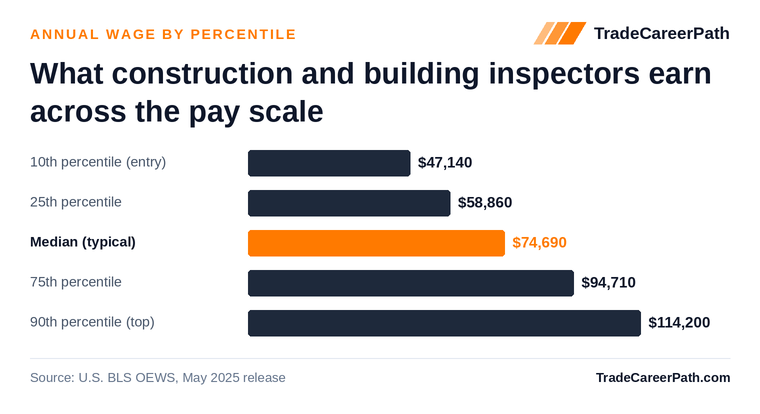
Quick answer: Training as a home and building inspector usually takes 6 months to 2 years. You complete a certificate or associate degree program, build hands-on construction or trades experience, and earn certification from a group like the International Code Council (ICC), ASHI, or InterNACHI. Licensing rules vary by state, and some states also require a passing exam. The median pay is $74,690 per year ($35.91/hour), and projections point to about 14,800 openings nationwide each year (BLS, May 2025).
Home and building inspectors check that houses, apartments, and commercial buildings are built correctly, meet code, and are safe to occupy. They examine wiring, roofing, plumbing, HVAC, foundations, and structure, then write clear reports for buyers, owners, contractors, and local governments. If you have an eye for detail and like solving real-world problems, this is a steady path into the construction field without a four-year degree.
How to Become a Home and Building Inspector
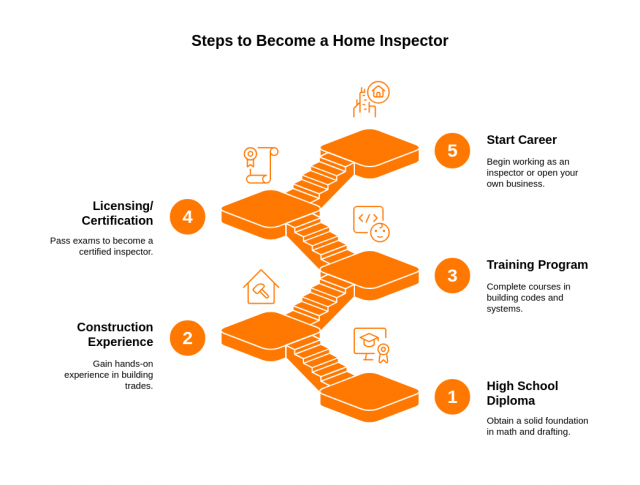
Most people move into inspection work in about six months to two years, depending on their starting point and the path they choose. You build the career through education, hands-on construction knowledge, certification, and, in many states, a license.
1. Earn a high school diploma or GED
A high school diploma or GED is the minimum requirement for inspection programs and most entry-level construction jobs. Before you enroll, it helps to build the skills the work depends on. Math gets used constantly, from reading measurements to checking load and slope, and a basic grasp of geometry and algebra goes a long way. Drafting and blueprint-reading classes teach you to interpret construction plans, which is a core part of the job. Shop, electrical, and any hands-on technical courses give you a feel for how building systems work and fail. Strong writing skills matter too, because inspectors live and die by the quality of their reports. If you are changing careers and already have a diploma or a degree in another field, you can move straight to gaining trades experience and training. Comfort with computers and mobile apps also helps, since most inspectors now write and deliver reports digitally.
2. Build construction or trades experience
Inspection is one of those careers where field experience is worth as much as classroom time. Many inspectors come up through the building trades first, working as electricians, plumbers, carpenters, HVAC technicians, or general contractors. That background teaches you how a house is actually assembled, what good workmanship looks like, and the common shortcuts and defects you will later flag. If you are starting fresh, look for any role that puts you on job sites or in buildings under construction, even as a helper or laborer. Time spent watching framing go up, watching rough-in plumbing and wiring get installed, and seeing how roofs and foundations are built gives you a mental library you can draw on during every inspection. Employers and clients trust inspectors who clearly understand construction, so this experience pays off directly when you start looking for work or signing your first clients.
3. Complete an inspection training program
Formal training ties your field knowledge to current codes and inspection standards. Technical schools and community colleges offer certificate and associate degree programs built for this work. Typical coursework covers building codes, structural analysis, electrical and plumbing systems, HVAC, roofing, moisture and foundation issues, safety compliance, and report writing. Certificate programs run shorter and suit people who already have construction experience and want to switch into inspection quickly. Associate degree programs take about two years and add broader coursework. Many programs offer the classroom portion online, which lets working students study at a flexible pace, while the hands-on field portion is practiced in person or under supervision. As you train, pay close attention to the codes your state and local jurisdictions follow, since those are exactly what you will be checking against. Good training can also prepare you for the certification and licensing exams covered in the next step.
4. Earn certification and any required license
Credentials prove you know the codes and standards, and in many states they are mandatory. The most widely recognized organizations are the International Code Council (ICC), which issues building, electrical, plumbing, and mechanical inspector certifications; the American Society of Home Inspectors (ASHI); and the International Association of Certified Home Inspectors (InterNACHI). ICC certifications are common for inspectors working with local governments, while ASHI and InterNACHI are widely held by home inspectors who serve buyers and sellers. On top of certification, many states require a license, which can mean passing a state exam, completing a set number of supervised inspections, or both. Because requirements differ so much from state to state, check with your state licensing board before you invest in a specific exam or program. Even where no license is required, certification builds trust with clients and is often what gets you hired.
5. Start your career or open your own business
With training and credentials in hand, you can pursue several routes. Some inspectors join local municipalities and building departments, where they inspect construction for code compliance. Others work for home inspection firms, insurance companies, or engineering firms. Many home inspectors run their own independent practices, setting their own schedules and rates. When you are starting out, working under an experienced inspector is one of the best ways to sharpen your judgment and learn how to communicate findings without alarming or misleading clients. As you gain experience, you can add specialties such as energy efficiency, mold, radon, or commercial inspection, and pursue advanced certifications that let you charge more and take on a wider range of work.
What Does a Home and Building Inspector Do?
Building inspectors understand how every part of a structure fits together: wiring, roofing, plumbing, HVAC, foundation, and framing. They evaluate new and existing properties for code compliance, safety, and quality of workmanship, then explain what they find in plain terms.
A Typical Day Might Include
- Inspecting residential and commercial buildings
- Identifying structural, electrical, or plumbing issues
- Reviewing blueprints or construction plans
- Writing detailed inspection reports
- Communicating with contractors, realtors, and homeowners
You are part inspector, part teacher, helping people understand how a building really works and what it will take to keep it safe.
Skills That Make a Great Inspector
- A sharp eye for detail
- Strong understanding of building systems and codes
- Clear, honest communication
- Problem-solving mindset
- Integrity, because people rely on your judgment
Education and Certification Paths
| Pathway | Typical Duration | Outcome |
|---|---|---|
| Certificate | 6 to 12 months | Entry level preparation |
| Associate Degree | About 2 years | Broader credential and common route |
| ICC, ASHI, or InterNACHI certification | Varies | Recognized professional credential |
| State license (where required) | Varies | Authorization to inspect in your state |
Career Growth and Advancement
With experience, inspectors can move into roles such as:
- Senior or chief inspector who reviews work and trains newer staff
- Plan reviewer who checks construction documents before work begins
- Specialty inspector for energy efficiency, radon, mold, or commercial buildings
- Independent business owner running an inspection practice
Cost and Duration of Training
- Program cost: varies by program, school, and format; compare options before enrolling
- Time to complete: six months to two years
- Certification and license fees: vary by organization and state
Many inspection programs offer online coursework, which helps students learn at a flexible pace, with hands-on practice done in the field.
Pros and Cons
Pros
- Flexible work, often self-employed
- Steady demand and good job stability
- Satisfying, real-world problem solving
- Room to specialize in areas like HVAC, plumbing, or energy efficiency
Cons
- Exposure to dust, heights, and crawlspaces
- Requires ongoing code education
- Some clients can be tense during high-stakes transactions
Licensing and Certification Requirements
Every state is different. Some require a state license and exam, while others rely on professional certification. The most common credentials come from:
- American Society of Home Inspectors (ASHI)
- International Association of Certified Home Inspectors (InterNACHI)
- International Code Council (ICC)
Even where your state does not require a license, certification builds trust with clients and is often what employers look for.
Quick Facts: Home Inspector Salary, Education, and Outlook
Industry Organizations & Certifying Bodies
These are the recognized national organizations, unions, certifying bodies, and regulatory authorities that shape this trade. They issue the credentials, sponsor the apprenticeships, publish the codes, and represent workers and employers.
- International Code Council (ICC) Issues building, electrical, plumbing, and mechanical inspector certifications.
- American Society of Home Inspectors (ASHI) Major home inspector professional association and certification.
- International Association of Certified Home Inspectors (InterNACHI) Large home inspector association with certification and training.
Wage and Employment Charts
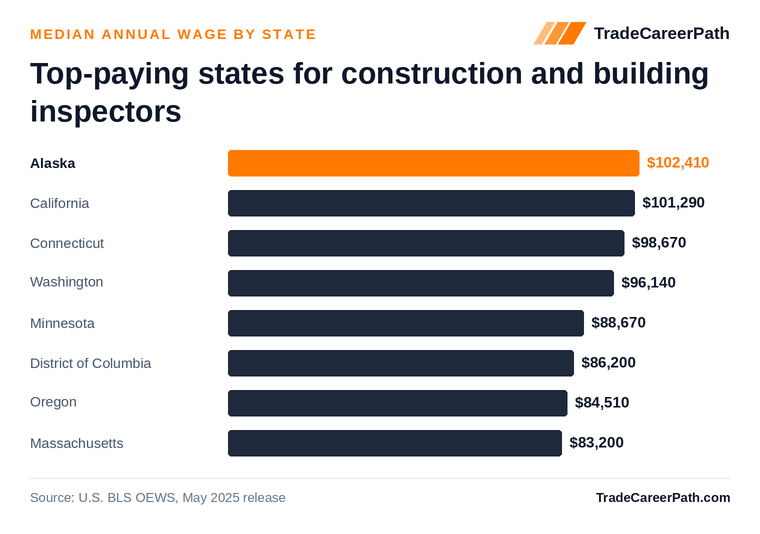
Home Inspector Salary and Requirements by State
Select your state for local wage data, training options, and requirements:
Alabama · Alaska · Arizona · Arkansas · California · Colorado · Connecticut · Delaware · District of Columbia · Florida · Georgia · Hawaii · Idaho · Illinois · Indiana · Iowa · Kansas · Kentucky · Louisiana · Maine · Maryland · Massachusetts · Michigan · Minnesota · Mississippi · Missouri · Montana · Nebraska · Nevada · New Hampshire · New Jersey · New Mexico · New York · North Carolina · North Dakota · Ohio · Oklahoma · Oregon · Pennsylvania · Rhode Island · South Carolina · South Dakota · Tennessee · Texas · Utah · Vermont · Virginia · Washington · West Virginia · Wisconsin · Wyoming
Workplace Safety Snapshot
BLS Survey of Occupational Injuries and Illnesses data (2023-2024) report approximately 63.1 days-away, restricted, or transfer cases per 10,000 full-time-equivalent workers in construction and building inspectors (about 0.63 per 100 FTE). Source: BLS Survey of Occupational Injuries and Illnesses, Table R98.
Frequently Asked Questions
How long does home and building inspector training take?
Most people are ready for entry-level inspection work in about 6 months to 2 years. A certificate program can take roughly 6 to 12 months, while an associate degree takes about 2 years. A high school diploma or GED is generally required to get started, and many states add an exam or supervised inspection requirement before you can work on your own.
Do you need a college degree to work as a home and building inspector?
No. A college degree is not required. Most people enter the field through a certificate or associate degree program, and a high school diploma or GED is typically the only educational prerequisite. Hands-on construction experience and the right certifications often matter more to employers than a degree.
Is a license or certification required to be a home inspector?
It depends on your state. Some states require a license and a passing exam, while others rely on professional certification. Widely recognized credentials come from the International Code Council (ICC), the American Society of Home Inspectors (ASHI), and the International Association of Certified Home Inspectors (InterNACHI). Check your state's rules before you start working.
How much does home inspector training cost?
Training costs vary by program, format, and school, so compare a few options before you enroll. Costs depend on whether you choose a short certificate course, an associate degree, or an exam-prep package, and whether you study online or in person.
Is it hard to train as a home and building inspector?
Entry is fairly accessible because no four-year degree is required, and most people finish training in 6 months to 2 years. The work itself is detail heavy. You need to know building codes across many systems, including electrical, plumbing, HVAC, roofing, and structure, and you have to write clear, accurate reports that clients and contractors rely on.
How many home and building inspectors work in the United States?
The U.S. Bureau of Labor Statistics reports about 146,720 construction and building inspectors employed nationwide as of May 2025, with a median wage of $74,690 per year ($35.91 per hour).
Can you train as a home inspector online?
Yes. Many schools offer home and building inspection coursework online, including code study and exam preparation. The classroom portion works well remotely, but the field portion, where you practice inspecting real properties, is hands-on and usually done in person or under supervision.
How Home Building Inspector Pay Compares to Similar Trades
Side-by-side comparison of Home Inspector and the closest related careers, based on U.S. Bureau of Labor Statistics data (May 2025 OEWS + 2024-2034 Employment Projections).
| Career | Median Pay | 10-Year Growth | Annual Openings |
|---|---|---|---|
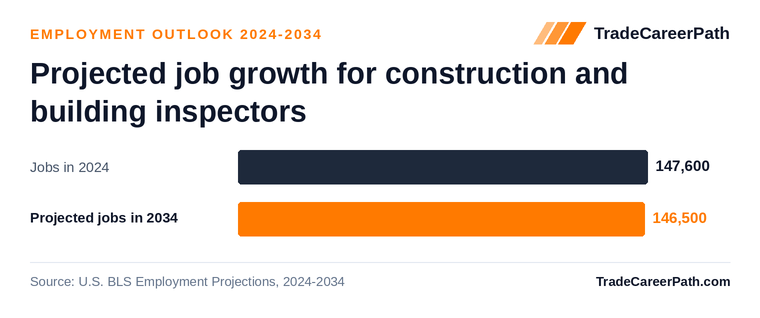
| Home Inspector this guide | $74,690 | -0.8% | 14,800 |
| HVAC Technician | $61,010 | +8.1% | 40,100 |
| Electrician | $63,190 | +9.5% | 81,000 |
| Plumbing | $63,800 | +4.5% | 44,000 |
| Carpentry | $60,580 | +4.5% | 74,100 |
Source: BLS Occupational Employment and Wage Statistics + BLS Employment Projections.
Sources
- U.S. Bureau of Labor Statistics, Occupational Employment and Wage Statistics (May 2025)
- U.S. Bureau of Labor Statistics, Employment Projections 2024-2034
- U.S. Bureau of Labor Statistics, Survey of Occupational Injuries and Illnesses (2023-2024, Table R98)
- U.S. Department of Labor, Wage and Hour Division, Davis-Bacon General Wage Determinations (2026)
Home Building Inspector Salary by State

Meet the author: Brad Fishbein is a Florida Licensed Mold Assessor and council-certified Microbial Investigator. He is the founder of TradeCareerPath.com and has completed over 5,000 mold inspections since 2009. Brad helps homeowners and tradespeople make informed decisions about mold, licensing, and skilled career paths.
Data sources
Figures on this page are sourced from the federal and state datasets below. Methodology: how we rank and source data.
| Data | Provider | Vintage |
|---|---|---|
| Occupational Employment and Wage Statistics (OEWS) | U.S. Bureau of Labor Statistics | May 2025 |
| Employment Projections | U.S. Bureau of Labor Statistics | 2024-2034 |
| Integrated Postsecondary Education Data System | National Center for Education Statistics (IPEDS) | 2024 |
| College Scorecard (school-level outcomes) | U.S. Department of Education | latest release |
| College Scorecard (field-of-study earnings) | U.S. Department of Education | latest release (updated 2026-06-12) |
| Occupational licensing requirements | CareerOneStop (U.S. Department of Labor) | latest release (updated 2026-02-22) |
| Registered apprenticeship programs | CareerOneStop / Apprenticeship.gov (U.S. Department of Labor) | latest release (updated 2025-10-25) |
| O*NET occupation profiles (skills, tasks, tools, job zones) | U.S. Department of Labor (O*NET / Employment & Training Admin.) | O*NET 29.1 (updated 2026-06-13) |