
How to Become a Home Security Technician (2026)
Is Home Security Technician Right for You?
The U.S. Department of Labor's O*NET profile for Security and Fire Alarm Systems Installers (SOC 49-2098) describes the work this way: Install, program, maintain, and repair security and fire alarm wiring and equipment. Ensure that work is in accordance with relevant codes.
What the work involves
- Install, maintain, or repair security systems, alarm devices, or related equipment, following blueprints of electrical layouts and building plans.
- Mount and fasten control panels, door and window contacts, sensors, or video cameras, and attach electrical and telephone wiring to connect components.
- Demonstrate systems for customers and explain details, such as the causes and consequences of false alarms.
- Test and repair circuits and sensors, following wiring and system specifications.
- Feed cables through access holes, roof spaces, or cavity walls to reach fixture outlets, positioning and terminating cables, wires, or strapping.
Skills and knowledge that matter
Skills: Speaking, Installation, Critical Thinking, Active Listening, Reading Comprehension, Quality Control Analysis.
Knowledge: Public Safety and Security, Computers and Electronics, Customer and Personal Service, Telecommunications.
Tools and technology you may use
Tools: Adjustable widemouth pliers, Battery analyzers, Bayonet Neill-Concelman BNC cable strippers, Bayonet Neill-Concelman BNC crimpers, Bubble levels, Butane soldering irons.
Technology: Computer aided design CAD software, Video creation and editing software, Spreadsheet software, Autodesk AutoCAD, Microsoft Excel, Microsoft Office software.
Typical preparation
O*NET Job Zone Three (Medium Preparation Needed). Most occupations in this zone require training in vocational schools, related on-the-job experience, or an associate's degree. Employees in these occupations usually need one or two years of training involving both on-the-job experience and informal training with experienced workers. A recognized apprenticeship program may be associated with these occupations.
Interest fit
O*NET interest profile: Realistic, Conventional, Investigative. People who enjoy hands-on, practical work with tools, machines, plants, or materials often find this occupation a good fit.
Source: O*NET 29.1 (updated 2026-06-13)
Ever wanted to work with the latest smart home and security technology?
Home security technicians help protect homes and businesses through installation and maintenance of advanced systems.
Home security technicians install and service alarm systems, smart locks, surveillance cameras, and integrated home automation networks.
This trade combines electrical wiring, networking, and technology installation skills.
Quick answers
What does a home security technician do? They install, maintain, and repair security and smart home systems for homes and businesses.
What systems do they work with? Common systems include alarms, sensors, surveillance cameras, smart locks, and integrated home automation controls.
How long does it take to work as one? It typically takes 6-18 months to complete training and certification to work as a security systems technician.
What training paths are common? Many technicians start with a certificate or diploma program, then build skills through on-the-job training or an apprenticeship.
Is licensing or certification required? Some states require security or alarm installer licensing, and optional certifications (like ESA or BICSI) can help build credibility.
At a glance
- Core work: install, program, and troubleshoot security and smart home systems.
- Common skills: low-voltage wiring, networking basics, troubleshooting, and customer communication.
- Where you can work: installation companies, low-voltage contractors, smart home providers, monitoring firms, or self-employed.
- Typical training and certification: 6-18 months.
- Costs: program tuition varies by school and format; certification fees typically under $300.
If you’re detail-oriented and enjoy hands-on technical work, this trade combines installation, troubleshooting, and customer education.
What Home Security Technicians Do
Home security technicians install, maintain, and repair systems that protect residential and commercial properties.
They handle wiring, programming, and integrating equipment like alarms, sensors, cameras, and smart home controls.
Typical Responsibilities
- Install and configure home or business alarm systems
- Wire and test security cameras, motion sensors, and smart locks
- Troubleshoot electrical or network connections
- Educate clients on system operation and maintenance
- Perform inspections and routine maintenance
Security technicians combine electrical know-how and customer service to keep homes and businesses secure.
Key Skills and Traits for Success
- Understanding of low-voltage electrical systems
- Knowledge of networking and smart home technologies
- Problem-solving and critical thinking
- Manual dexterity and attention to detail
- Strong communication and customer interaction skills
Work Settings for Home Security Technicians
Technicians work in various settings:
- Security system installation companies
- Electrical and low-voltage contractors
- Smart home technology providers
- Alarm monitoring firms
- Self-employed or independent service providers
How to Become a Home Security Technician (5 Steps)
It typically takes 6-18 months to complete training and certification to work as a security systems technician.
1. Earn a High School Diploma or GED
Take classes in electronics, math, and computer technology. These will help you understand wiring and network-based systems.
2. Complete a Security or Electrical Training Program
Trade schools offer programs that typically cover low-voltage wiring, alarm systems, and safety codes. Some community colleges include home automation courses.
3. Gain Hands-On Experience
Start as a trainee or apprentice under a licensed installer. On-the-job training builds skills in installation, troubleshooting, and system maintenance.
4. Obtain Licensing or Certification
Some states require security or alarm installer licensing. Optional certifications from organizations like ESA (Electronic Security Association) or BICSI can enhance credibility.
5. Build Experience and Advance
With experience, technicians may work as senior installers, service managers, or specialize in smart home integration and advanced networking systems.
Education and Training Paths
| Pathway | Typical Duration | Outcome |
|---|---|---|
| Certificate or Diploma | 6-12 months | Entry-level skills in alarm and smart home systems |
| Apprenticeship or On-the-Job Training | 1-2 years | Real-world installation and service experience |
| Associate Degree (Electronics or IT) | 2 years | Broader technical and networking knowledge |
| Licensing or Certification | Variable | Legal compliance and professional credentials |
Career Growth and Advancement
Home security technicians can progress into:
- Systems Integrator - installs and programs advanced automation networks
- Lead Installer or Supervisor - manages installation teams
- Smart Home Specialist - focuses on IoT and connected devices
- Independent Contractor - operates a licensed installation business
Cost and Duration of Training
- Program Cost: varies by school, format and location depending on program type and equipment used
- Duration: 6 months to 2 years
- Certification Fees: vary by state or organization, typically under $300
The home security field blends technology and trade skills. It’s ideal for those who enjoy hands-on electrical work and helping customers protect what matters most.
Pros and Cons
✅ Pros
- Growing demand for smart home and security systems
- Hands-on, technical, and client-focused work
- Opportunities for certification and specialization
- Potential for independent contracting
⚠️ Cons
- Work may involve travel and outdoor installation
- Requires attention to safety and electrical codes
- Licensing or background checks needed in many states
Take the First Step Toward a Home Security Career
If you enjoy working with technology and electrical systems, training as a home security technician offers a technical, service-oriented trade with steady demand.
Quick Facts: Home Security Technician Training and Outlook

Industry Organizations & Certifying Bodies
These are the recognized national organizations, unions, certifying bodies, and regulatory authorities that shape this trade. They issue the credentials, sponsor the apprenticeships, publish the codes, and represent workers and employers.
- Electronic Security Association (ESA) Industry trade association; offers Certified Alarm Technician (CAT) and other credentials.
Wage and Employment Charts
| Percentile | Annual wage |
|---|---|
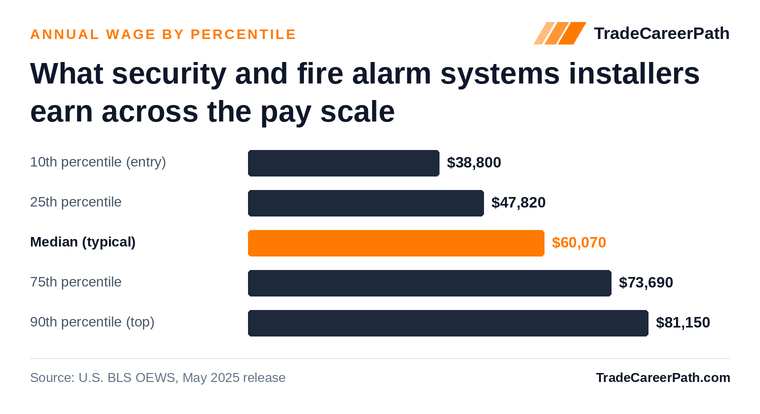
| 10th | $38,800 |
| 25th | $47,820 |
| 50th (median) | $60,070 |
| 75th | $73,690 |
| 90th | $81,150 |
| Year | Employment |
|---|---|
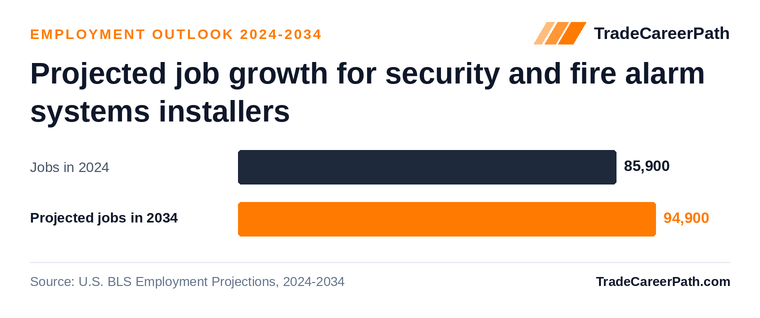
| 2024 | 85,900 |
| 2034 projected | 94,900 |
| Percent change | +10.4% |
Home Security Technician Salary and Requirements by State
Select your state for local wage data, training options, and requirements:
Alabama · Alaska · Arizona · Arkansas · California · Colorado · Connecticut · Delaware · District of Columbia · Florida · Georgia · Hawaii · Idaho · Illinois · Indiana · Iowa · Kansas · Kentucky · Louisiana · Maine · Maryland · Massachusetts · Michigan · Minnesota · Mississippi · Missouri · Montana · Nebraska · Nevada · New Hampshire · New Jersey · New Mexico · New York · North Carolina · North Dakota · Ohio · Oklahoma · Oregon · Pennsylvania · Rhode Island · South Carolina · South Dakota · Tennessee · Texas · Utah · Vermont · Virginia · Washington · West Virginia · Wisconsin · Wyoming
Workplace Safety Snapshot
BLS Survey of Occupational Injuries and Illnesses data (2023-2024) report approximately 185.4 days-away, restricted, or transfer cases per 10,000 full-time-equivalent workers in security and fire alarm systems installers (about 1.85 per 100 FTE). Source: BLS Survey of Occupational Injuries and Illnesses, Table R98.
Frequently Asked Questions
How long does home security technician training take?
It typically takes typically 6 months to 2 years of training. The most common entry path is through a certificate or associate degree program. A high school diploma or GED is generally required to get started.
How much do home security technicians make?
The median annual salary for home security technicians is $60,070 according to the Bureau of Labor Statistics (May 2025). Entry-level workers earn around $38,800, while those in the 90th percentile earn over $81,150. Pay varies by state, experience, and specialization.
What is the job outlook for home security technicians?
The Bureau of Labor Statistics projects 10.4% employment growth for this occupation from 2024 to 2034, which is faster than average. Approximately 9,400 job openings are expected each year due to growth, retirements, and workers leaving the field.
Do you need a college degree to work as a home security technician?
No. A college degree is not required to work as a home security technician. Most people enter the field through a certificate or associate degree program. A high school diploma or GED is typically the only educational prerequisite.
Which states pay home security technicians the most?
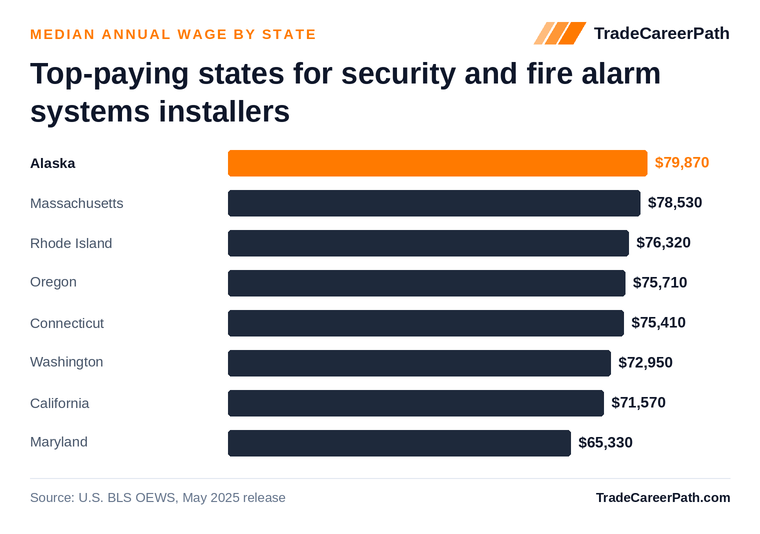
According to the U.S. Bureau of Labor Statistics (May 2025 OEWS), the highest-paying states for home security technicians are Alaska, Massachusetts, and Rhode Island. Median annual wages: Alaska ($79,870); Massachusetts ($78,530); Rhode Island ($76,320).
Which states employ the most home security technicians?
BLS reports the largest concentrations of home security technicians in Texas, Florida, and California. Employment levels: Texas (10,260 workers); Florida (8,320 workers); California (8,180 workers) (May 2025).
How much do experienced home security technicians earn?
The top 10% of home security technicians earn more than $81,150 per year, according to BLS Occupational Employment and Wage Statistics (May 2025). Experienced workers in this band typically hold senior credentials, supervisory roles, or specialty certifications.
What is entry-level pay for home security technicians?
BLS reports the bottom 10% of home security technicians earn under $38,800 per year. New workers often start near this level and see pay rise as they accumulate experience and credentials.
How many home security technicians work in the United States?
BLS reports approximately 86,340 home security technicians employed nationwide as of May 2025.
How many job openings are expected for home security technicians each year?
BLS projects approximately 9,400 openings per year for home security technicians from 2024 through 2034, including new positions, retirements, and workers transitioning out. The occupation is projected to grow 10.4% from 2024 to 2034, classified as much faster than average growth.
Is home security technician a growing career?
Yes. BLS projects 10.4% employment growth for home security technicians between 2024 and 2034, classified as much faster than average. Employment is projected to rise from approximately 85,900 jobs in 2024 to 94,900 in 2034.
How much do home security technicians make per hour?
The median hourly wage for home security technicians is $28.88, according to BLS (May 2025). Hourly pay ranges from about $18.65 (bottom 10%) to $39.01 (top 10%).
How Home Security Technician Pay Compares to Similar Trades
Side-by-side comparison of Home Security and Alarm Technician Listings and the closest related careers, based on U.S. Bureau of Labor Statistics data (May 2025 OEWS + 2024-2034 Employment Projections).
| Career | Median Pay | 10-Year Growth | Annual Openings |
|---|---|---|---|
| Home Security and Alarm Technician Listings this guide | $60,070 | +10.4% | 9,400 |
| Electrician | $63,190 | +9.5% | 81,000 |
| Appliance Repair Technician | $50,990 | +2.6% | 3,100 |
| HVAC Technician | $61,010 | +8.1% | 40,100 |
Source: BLS Occupational Employment and Wage Statistics + BLS Employment Projections.
Sources
- U.S. Bureau of Labor Statistics, Occupational Employment and Wage Statistics (May 2025)
- U.S. Bureau of Labor Statistics, Employment Projections 2024-2034
- U.S. Bureau of Labor Statistics, Survey of Occupational Injuries and Illnesses (2023-2024, Table R98)
- U.S. Department of Labor, Wage and Hour Division, Davis-Bacon General Wage Determinations (2026)
Home Security Technician Salary by State
About this guide: Researched and written by the TradeCareerPath Editorial Team. Our editorial team researches and sources every trade school and career guide using federal labor and education data, including BLS OEWS and Employment Projections, DOL apprenticeship records, IPEDS, College Scorecard, and state licensing boards. We follow the editorial standards documented at /editorial-policy/.
Data sources
Figures on this page are sourced from the federal and state datasets below. Methodology: how we rank and source data.
| Data | Provider | Vintage |
|---|---|---|
| Occupational Employment and Wage Statistics (OEWS) | U.S. Bureau of Labor Statistics | May 2025 |
| Employment Projections | U.S. Bureau of Labor Statistics | 2024-2034 |
| Integrated Postsecondary Education Data System | National Center for Education Statistics (IPEDS) | 2024 |
| College Scorecard (school-level outcomes) | U.S. Department of Education | latest release |
| College Scorecard (field-of-study earnings) | U.S. Department of Education | latest release (updated 2026-06-12) |
| Occupational licensing requirements | CareerOneStop (U.S. Department of Labor) | latest release (updated 2026-02-22) |
| Registered apprenticeship programs | CareerOneStop / Apprenticeship.gov (U.S. Department of Labor) | latest release (updated 2025-10-25) |
| O*NET occupation profiles (skills, tasks, tools, job zones) | U.S. Department of Labor (O*NET / Employment & Training Admin.) | O*NET 29.1 (updated 2026-06-13) |