
HVAC Tech to Mechanical Engineer: The Degree Path (2026)
Quick answer: Yes. An HVAC technician becomes a mechanical engineer by earning the accredited bachelor’s degree, usually part-time over five to six years while working, less with transfer credit. The national median moves from $61,010 (HVAC technician) to $104,110 (mechanical engineer), per BLS OEWS, May 2025, and your field experience is an asset the whole way.
The Numbers
| Role | National median pay | Source |
|---|---|---|
| HVAC Technician | $61,010 | BLS OEWS, May 2025 |
| Mechanical Engineer | $104,110 | BLS OEWS, May 2025 |
That is the median-to-median gap. The fuller picture is even more lopsided: the 10th percentile for mechanical engineers - roughly where new graduates start - is $73,990, already above the HVAC median, and the mean across all 296,810 mechanical engineers nationwide is $113,610 (BLS OEWS, May 2025). Full career details, percentiles, and state-by-state pay: Mechanical Engineer career guide.
What Your Experience Is Worth
Refrigeration cycles, psychrometrics, controls, and equipment behavior under real load: you already work daily with the exact thermal and fluid systems the mechanical engineering curriculum formalizes. When the thermodynamics professor draws a vapor-compression cycle on the board, you will be the one person in the room who has recovered charge from that cycle, diagnosed it with gauges, and knows what a flooded evaporator does to a compressor in practice.
That matters twice. It makes the hardest courses in the degree - thermo, fluids, heat transfer - concrete instead of abstract. And it makes you a different kind of hire at graduation: HVAC manufacturers, MEP consulting firms, and datacenter cooling design teams in particular prize engineers who have held the gauges and know why the field installation never matches the drawing.
What Transfers
HVAC program credits and EPA 608 era coursework may transfer to engineering technology programs; math is the usual gap, and most working techs start with a semester of algebra-through-calculus refreshers.
Ask every program for a written transfer-credit evaluation before enrolling; it is free, and the difference between schools can be a full year of your life.
What the Work Is Like on the Other Side
The short version: the tech fixes the system; the engineer decides what the system is. Day to day, mechanical engineering is less drawing and more disciplined decision-making with a paper trail.
If you land in HVAC-adjacent work - the natural first stop for a former tech - a typical week looks like this. You run load calculations and equipment selections for a building or a process, in software but sanity-checked by judgment. You size ductwork and piping, pick chillers and air handlers against a budget, and write the specifications a contractor will bid from. You sit in design reviews defending your selections, respond to RFIs when the field finds a conflict, and walk jobs during construction - which is where your field years pay off, because you can see the uninstallable detail on the drawing before it gets priced.
At a manufacturer, the flavor changes: you might own a component of a product line, run tests, analyze failures that come back from the field, and work with production on cost and manufacturability. Either way, expect more meetings, more writing, and more accountability than field work - your name goes on calculations that other people build from. The trade-offs run in your favor: conditioned office or hybrid work instead of attics in August, a predictable schedule instead of on-call rotations, and a body that is not the tool being consumed.
The Path, Step by Step
- Close the math gap first. Most working tradespeople start with algebra-to-calculus refreshers at a community college; cheap, online, and it de-risks the whole plan.
- Pick an accredited program built for working adults. ABET accreditation if you may ever want the PE license; evening, online, or hybrid formats.
- Submit everything for transfer credit. Apprenticeship records, certifications, military training, and old college credits.
- Keep working your trade. Your income funds the degree, and your daily work keeps compounding into exactly the experience employers want attached to the diploma.
- Move sideways before you graduate. Design-adjacent roles (drafting, field engineering, QA) often open to students partway through and convert to engineering titles at graduation.
What Mechanical Engineers Actually Earn
The BLS percentile bands map cleanly onto how the career actually progresses, and they are the honest way to set expectations - the median is a mid-career number, not a starting offer.
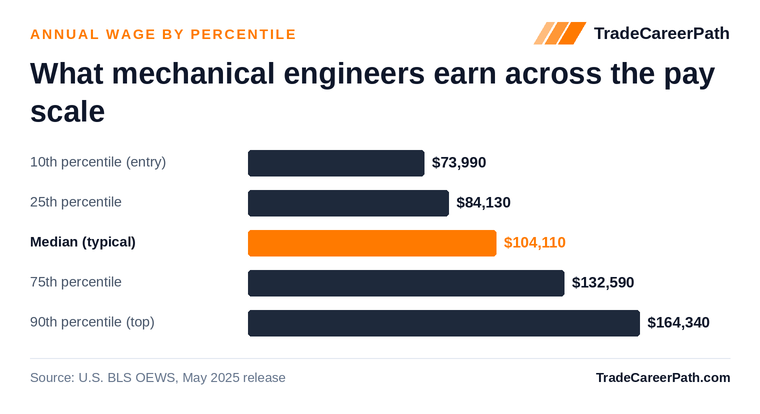
| Stage | Typical titles | Years in | Realistic pay (BLS OEWS, May 2025) |
|---|---|---|---|
| Entry level | Engineer I, design engineer, field engineer | 0-3 | ~$73,990-$84,130 (10th-25th pct) |
| Mid-career | Engineer II/III, project engineer | 3-10 | ~$104,110 (median) |
| Senior | Senior engineer, technical lead, project manager | 10-15 | ~$132,590 (75th pct) |
| Principal / leadership | Principal engineer, engineering manager | 15+ | $164,340+ (90th pct) |
Two notes for career changers. First, former HVAC techs are routinely hired above the bottom of the entry band - a graduate who needs no supervision around real equipment is worth more from day one. Second, even the entry band compares well against the trade: the 10th percentile for mechanical engineers, $73,990, beats the $61,010 HVAC median before your first promotion.
Where Mechanical Engineers Earn the Most
Pay varies widely by state, and the highest-paying markets are not always the biggest ones. New Mexico tops the list largely on national-lab and defense work; the deepest job markets are elsewhere - Michigan alone employs 34,630 mechanical engineers, and California 30,530 (BLS OEWS, May 2025).
| State | Median annual wage | Employment |
|---|---|---|
| New Mexico | $157,710 | 2,710 |
| District of Columbia | $133,300 | 510 |
| California | $130,900 | 30,530 |
| Delaware | $125,130 | 610 |
| Colorado | $124,430 | 7,190 |
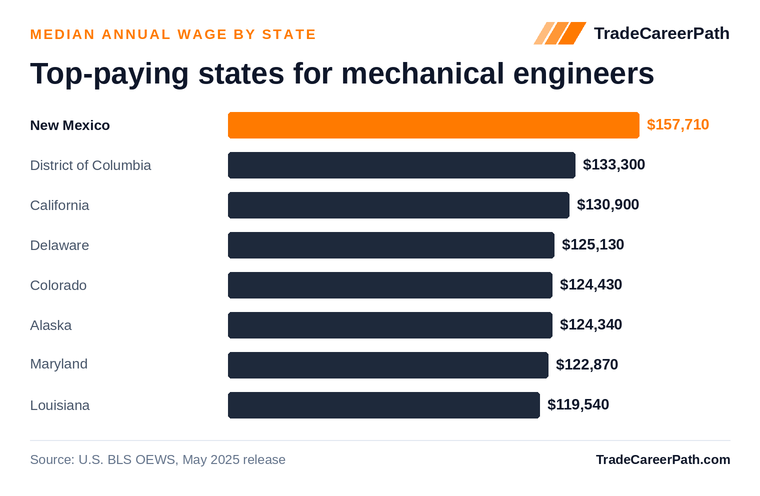
For an HVAC tech planning this move, the practical read: this occupation exists everywhere - BLS reports wage data in 51 states and territories - so unlike some engineering fields, you almost certainly do not need to relocate to convert the degree into a job. Texas ($112,410 median, 22,080 employed) and Michigan ($104,890 median) round out the largest markets.
Job Outlook Through 2034
The demand picture is one of the stronger ones among degree careers. BLS projects mechanical engineering employment to grow from 298,500 in 2024 to 332,000 in 2034 - a +11.2% change - with about 17,800 openings per year once retirements and occupation changes are counted (BLS Employment Projections, 2025-35).
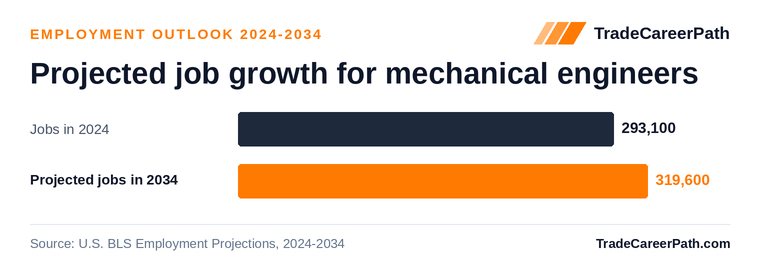
Two things make that number meaningful for a career changer on a five-to-six-year degree timeline. The openings figure is the one that matters: 17,800 seats a year is steady, broad-based hiring, not a boom that could evaporate before you graduate. And the growth is spread across the drivers that touch your background directly - electrification, heat pumps, datacenter cooling, and building decarbonization all need engineers who understand thermal systems. Pay has tracked upward too: the 2024 projections-base median of $102,320 was already surpassed by the May 2025 OEWS median of $104,110.
Do You Need a PE License?
Mostly no - and this is worth understanding before you pick a program. Most mechanical engineers work for manufacturers under the industrial exemption: the company, not the individual engineer, holds legal design responsibility, so the majority never license and lose nothing by it.
The exception is the corner of the profession closest to your trade. In HVAC/MEP consulting - designing building mechanical systems for architects and owners - construction documents must be stamped, so a PE on the team is a business requirement and PE-track engineers advance faster there. If that is where you are headed, the path is fixed and worth planning from day one:
- ABET-accredited degree - this is why accreditation is non-negotiable if licensure is even a maybe; some state boards add hurdles for non-ABET or technology degrees.
- FE exam - the Fundamentals of Engineering exam, which you can sit for as a senior while the coursework is fresh.
- Four years of qualifying experience under licensed engineers (state rules vary on the details).
- PE exam in mechanical engineering, through your state board.
No security clearance, no mandatory certifications otherwise - though ASHRAE involvement and certifications read well in the HVAC design world, they are optional.
If This Path Is Not Quite Right
Related jumps from the same starting point:
- Facilities Manager - runs the buildings and systems you already service, often without a full engineering degree
- Environmental Engineer - the sustainability and energy-systems side of the same skill set
- Industrial Engineer - process and efficiency work, lighter on the thermal-fluids math
- CTE Teacher (Shop Teacher) - teach the trade instead of leaving it
Or browse all trade careers that require a 4-year degree.
Frequently Asked Questions
Can an HVAC technician really work as a mechanical engineer?
Yes. The requirement is the accredited bachelor's degree; nothing about starting in the trade blocks the path, and employers consistently treat field experience as an advantage rather than a detour.
How long does it take while working full-time?
Typically five to six years part-time for the bachelor's, less with transfer credit. HVAC program credits and EPA 608 era coursework may transfer to engineering technology programs.
What is the pay difference?
The national median is $61,010 for HVAC technicians versus $104,110 for the degree role (BLS OEWS, May 2025), a difference of about $43,100 per year at the median.
Is the mechanical engineering degree hard for an HVAC tech?
The math is the hard part - calculus, differential equations, and physics are unavoidable. The thermodynamics, fluids, and heat-transfer courses are easier for working HVAC techs than for most students, because you have already run those systems under real load.
Should I get a mechanical engineering or mechanical engineering technology degree?
The BSME is the safer buy: it keeps every employer, graduate school, and the standard FE-then-PE licensing path open. A mechanical engineering technology (MET) degree is more hands-on and transfer-friendly for trade credits, but some employers and some state PE boards treat it differently - check both before enrolling.
Can you train as a mechanical engineer without a degree?
Not with the engineer title in practice - employers hiring mechanical engineers screen for the accredited bachelor's. Without it, the realistic ceiling is designer, engineering technician, or field-service roles. HVAC experience shortens the degree through transfer credit, but does not replace it.
Do mechanical engineers need a PE license?
Usually no. Most mechanical engineers at manufacturers work under the industrial exemption and never license. The PE matters for consulting, HVAC/MEP building design, and public sign-off - the path is an ABET degree, the FE exam, four years of experience, then the PE exam.
What is the job outlook for mechanical engineers?
BLS projects employment to grow from 298,500 in 2024 to 332,000 in 2034, a +11.2% change, with about 17,800 openings per year on average (BLS Employment Projections, 2025-35).
Mechanical Engineer Salary and Requirements by State
State-level pay, employment, and licensing details live on the destination career’s state pages - start from the Mechanical Engineer career guide or jump straight to a big market: California · Texas · Michigan · Colorado · New Mexico
Degree and Program Guides
- Online Mechanical Engineering Degrees - accredited program options for this path
Sources
- U.S. Bureau of Labor Statistics, Occupational Employment and Wage Statistics (OEWS), May 2025 - Mechanical Engineers (SOC 17-2141)
- U.S. Bureau of Labor Statistics, Employment Projections, 2025-35
- U.S. Bureau of Labor Statistics, Occupational Outlook Handbook - education and licensing requirements
Hvac to Mechanical Engineer Salary by State
About this guide: Researched and written by the TradeCareerPath Editorial Team. Our editorial team researches and sources every trade school and career guide using federal labor and education data, including BLS OEWS and Employment Projections, DOL apprenticeship records, IPEDS, College Scorecard, and state licensing boards. We follow the editorial standards documented at /editorial-policy/.
Data sources
Figures on this page are sourced from the federal and state datasets below. Methodology: how we rank and source data.
| Data | Provider | Vintage |
|---|---|---|
| Occupational Employment and Wage Statistics (OEWS) | U.S. Bureau of Labor Statistics | May 2025 |
| Employment Projections | U.S. Bureau of Labor Statistics | 2025-2035 |
| Integrated Postsecondary Education Data System | National Center for Education Statistics (IPEDS) | 2024 |
| College Scorecard (school-level outcomes) | U.S. Department of Education | latest release |
| College Scorecard (field-of-study earnings) | U.S. Department of Education | latest release (updated 2026-06-12) |
| Occupational licensing requirements | CareerOneStop (U.S. Department of Labor) | latest release (updated 2026-02-22) |
| Registered apprenticeship programs | CareerOneStop / Apprenticeship.gov (U.S. Department of Labor) | latest release (updated 2025-10-25) |
| O*NET occupation profiles (skills, tasks, tools, job zones) | U.S. Department of Labor (O*NET / Employment & Training Admin.) | O*NET 31.0 (updated 2026-10-14) |