
How to Become an Industrial Engineer in 2026
Is Industrial Engineer Right for You?
The U.S. Department of Labor's O*NET profile for Industrial Engineers (SOC 17-2112) describes the work this way: Design, develop, test, and evaluate integrated systems for managing industrial production processes, including human work factors, quality control, inventory control, logistics and material flow, cost analysis, and production coordination.
What the work involves
- Estimate production costs, cost saving methods, and the effects of product design changes on expenditures for management review, action, and control.
- Plan and establish sequence of operations to fabricate and assemble parts or products and to promote efficient utilization.
- Analyze statistical data and product specifications to determine standards and establish quality and reliability objectives of finished product.
- Confer with clients, vendors, staff, and management personnel regarding purchases, product and production specifications, manufacturing capabilities, or project status.
- Communicate with management and user personnel to develop production and design standards.
Skills and knowledge that matter
Skills: Reading Comprehension, Active Listening, Critical Thinking, Speaking, Complex Problem Solving, Writing.
Knowledge: Engineering and Technology, Production and Processing, Mechanical, Design.
Tools and technology you may use
Technology: Analytical or scientific software, Industrial control software, Computer aided design CAD software, Autodesk AutoCAD, Bentley MicroStation, C++.
Typical preparation
O*NET Job Zone Four (Considerable Preparation Needed). Most of these occupations require a four-year bachelor's degree, but some do not. Employees in these occupations usually need several years of work-related experience, on-the-job training, and/or vocational training.
Interest fit
O*NET interest profile: Conventional, Investigative, Realistic. People who enjoy structured, detail-oriented work with clear procedures and data often find this occupation a good fit.
Source: O*NET 31.0 (updated 2026-10-14)
Quick answer: Training as an industrial engineer requires a 4-year degree - typically an ABET-accredited bachelor’s in industrial or manufacturing engineering. The national median pay is $102,440 per year, and BLS projects +12.4% employment change from 2025 to 2035 (BLS OEWS, May 2025; BLS Employment Projections, 2025-35).
Industrial Engineer at a Glance
| Metric | Detail | Source |
|---|---|---|
| Median annual wage | $102,440 | BLS OEWS, May 2025 |
| Typical wage range | $74,370 (10th pct) - $159,860 (90th pct) | BLS OEWS, May 2025 |
| Employment | 365,740 nationwide | BLS OEWS, May 2025 |
| Projected growth (2025-35) | +12.4%, about 23,100 openings per year | BLS Employment Projections, 2025-35 |
| Typical education | ABET-accredited bachelor’s in industrial or manufacturing engineering | BLS Occupational Outlook Handbook |
| License / certification | PE license optional; Six Sigma / lean certifications valued | State licensing boards |
What Does an Industrial Engineer Do?
Industrial engineers design and optimize the systems that make things: factory layouts, workflows, staffing models, quality systems, and automation. They are the engineers machinists and maintenance techs work alongside every day - the people deciding how the line runs, why the cell is laid out the way it is, and what the takt time should be.
Day to day, the work splits by sub-specialty. A process engineer walks the floor with a stopwatch and a spaghetti diagram, runs time studies, and redesigns a cell to cut travel and changeover time. A quality engineer builds control plans and SPC charts, chases the root cause of a scrap spike, and runs the corrective-action process. A continuous-improvement or lean engineer runs kaizen events, builds the business case for new equipment, and models proposed layouts in simulation software before anyone moves a machine. Outside manufacturing, the same toolkit runs hospital patient flow, warehouse slotting, and airline scheduling - the product is the system itself, and most of the job happens on the floor rather than at a desk.
If you are coming from CNC machining, maintenance, or a production-lead role, the shortest way to say it: today you execute the process and flag what is broken about it; as an industrial engineer, you own the process. The cell layout you have been quietly cursing, the changeover procedure everyone works around, the standard that never matched reality - fixing those becomes your actual job description, and your floor time is exactly what most freshly graduated IEs are missing.
Skills That Make a Great Industrial Engineer
- Lean and Six Sigma methods
- Process mapping, time studies, and work measurement
- Production simulation tools (FlexSim, Arena, or similar)
- Statistical data analysis - SPC, designed experiments, Excel and increasingly Python
- Facility layout and material-flow design
- Cost justification: building the business case for equipment and layout changes
- Change leadership on the floor - improvements fail without operator buy-in
Industrial Engineer Salary
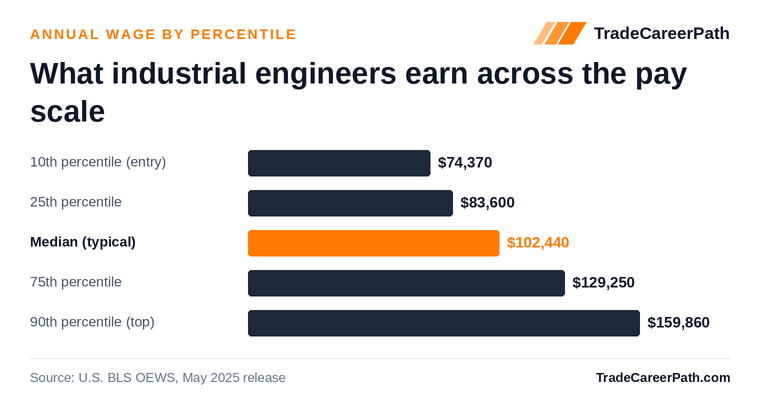
Industrial engineering pays a solid step above nearly every production-floor role that feeds into it. The national median is $102,440 per year, and the 10th percentile - roughly where new graduates start - is $74,370, already above the median for most skilled trades. The 75th percentile is $129,250, and the top 10% earn $159,860 or more (BLS OEWS, May 2025). The mean of $109,900 sits above the median - the top of the field, where IEs cross into operations leadership, pulls the average up.
Where the Jobs and the Money Are
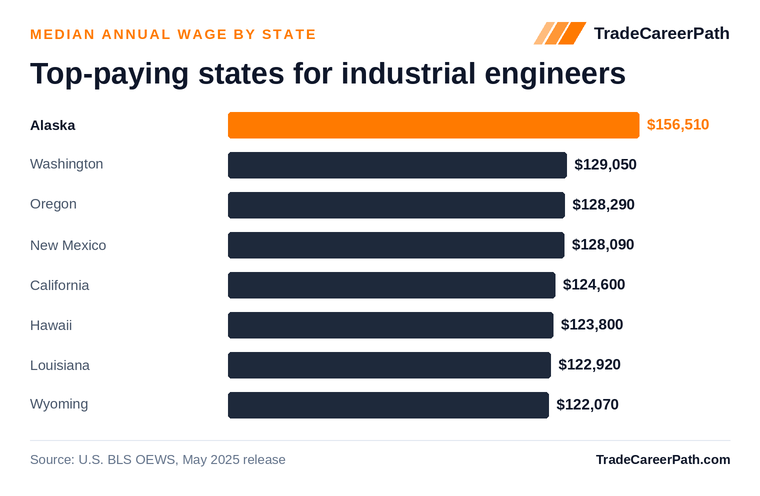
Industrial engineering is not locked to a few hubs - 51 states and territories report IE employment - but pay and density are far from even.
| State | Median annual wage | Employment |
|---|---|---|
| Alaska | $156,510 | 220 |
| Washington | $129,050 | 6,130 |
| Oregon | $128,290 | 5,810 |
| New Mexico | $128,090 | 1,140 |
| California | $124,600 | 32,680 |
Read that table with the employment column in mind: Alaska tops the pay list but has only 220 IE jobs - a small, specialized pocket, not a market you relocate for. Oregon is the interesting one: high pay plus a location quotient of 1.26, meaning IEs are more concentrated there than nationally, driven by semiconductor and advanced manufacturing.
The volume story is different. California leads with 32,680 jobs, followed closely by Michigan at 30,990 and Texas at 30,980. Michigan is the standout hub: with a location quotient of 2.99, IEs are roughly three times as common there as in the average state - the auto industry runs on them - so you can change employers without changing your address. Michigan’s median of $101,680 and Texas’s $104,560 sit right around the national median: in those states the advantage is depth of market, not a pay premium.
How to Become an Industrial Engineer
1. Earn a bachelor’s degree
Industrial, manufacturing, or systems engineering - ABET accreditation preferred. Accreditation matters because employers screen for it and the FE/PE licensure path assumes it. IE is also the engineering field with the most online options genuinely built for working adults; if you are already in a plant, favor programs that grant transfer credit for apprenticeship coursework and industry certifications.
2. Learn the improvement toolkit
Lean, Six Sigma, time studies, and simulation software are the daily tools - and you can start acquiring them before the degree is done. Many employers will fund a Six Sigma Green Belt for a machinist or tech who asks, and leading a kaizen event or 5S rollout on your current line is exactly the resume line that separates you from a graduate who has only seen lean in a textbook.
3. Start in process or quality engineering
Manufacturers hire IEs at the bachelor’s level into process, quality, and continuous-improvement roles - no graduate degree, no license, no long credentialing runway. For former machinists and techs, process engineering in your own industry is the natural first seat: you already know the machines, the failure modes, and the operators. Internal promotion is common; plenty of IEs earn the degree online and step into the engineering office of the same plant.
4. Stack certifications
Six Sigma Green Belt, then Black Belt, plus lean credentials accelerate advancement - in industry these carry more day-to-day weight than the PE. A Black Belt with documented project savings is the standard ticket into continuous-improvement leadership. Project management credentials help once you start owning capital projects, and APICS/ASCM certifications matter if you drift toward the supply-chain side of the field.
5. Advance
Senior IE, operations manager, or plant management. This is the quiet advantage of the field: industrial engineering is the classic on-ramp to running operations, because the job is the business - cost, throughput, quality, and people. The mid-career fork - stay technical or take the leadership track - is mapped against real wage data in the career ladder below.
Career Ladder: Titles and Realistic Pay
The BLS wage percentiles map cleanly onto how IE careers actually progress. Use this as a sanity check on offers, not a guarantee:
| Stage | Typical titles | Years in | Realistic pay (BLS OEWS, May 2025) |
|---|---|---|---|
| Entry level | Process engineer, quality engineer, IE I | 0-3 | ~$74,370-$83,600 (10th-25th pct) |
| Mid-career | Industrial engineer II/III, CI engineer, lean leader | 3-10 | ~$102,440 (median) |
| Senior | Senior IE, Six Sigma Black Belt, engineering supervisor | 10-15 | ~$129,250 (75th pct) |
| Principal / leadership | Principal IE, operations manager, plant manager track | 15+ | $159,860+ (90th pct) |
Two notes for career changers. First, prior trade experience compresses this ladder: a former machinist or maintenance tech is routinely hired above the bottom of the entry band because they need no introduction to the floor, and internal candidates who finish the degree often skip the entry title entirely. Second, the 90th-percentile figure understates the ceiling - IEs who cross into operations or plant management move onto management pay scales with bonus structures that the engineering wage data shown here does not capture.
Do You Need a PE License?
Mostly no. Industrial engineers at manufacturers work under the “industrial exemption” - the company, not the individual engineer, holds design responsibility, so the large majority of IEs never license. What actually gates advancement in this field is the certification stack: Six Sigma Green and Black Belts, lean credentials, and a documented record of project savings.
If you want the PE anyway - it helps in consulting, government, and safety-adjacent roles - the path is the standard one: ABET-accredited degree, pass the Fundamentals of Engineering (FE) exam (you can sit for it as a senior), four years of qualifying experience, then the PE exam in industrial and systems engineering, per your state board’s rules. A legitimate differentiator, just an optional one.
Why an Online Degree Works for This Career
For CNC machinists, maintenance technicians, and production leads, industrial engineering is the straightest engineering path: you already understand the machines and the flow. Online IE and manufacturing-engineering bachelor’s programs are built for exactly this working-shop-floor audience, and the degree’s math load - statistics and operations research rather than heavy differential equations - is the most manageable of the engineering disciplines for someone studying nights after a shift. Employer tuition assistance is common at manufacturers, and finishing the degree while staying at your plant often converts directly into an internal engineering promotion.
Job Outlook for 2026 and Beyond
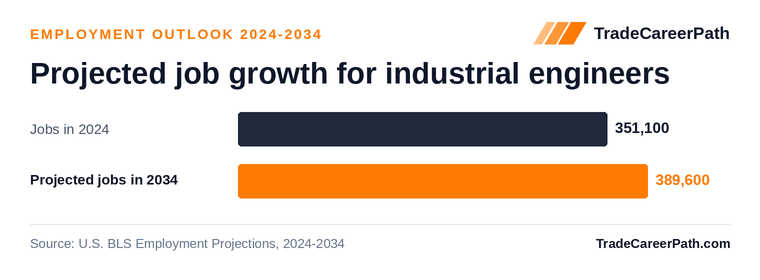
BLS projects industrial engineering employment to grow +12.4% from 2025 to 2035 - from 365,100 to 410,600 jobs - with about 23,100 openings per year once retirements and occupation changes are counted (BLS Employment Projections, 2025-35). That growth rate is well above the all-occupation average, and the openings number is the one that matters for career changers: 23,100 seats a year in a 365,740-person occupation means constant hiring, in nearly every state.
Wages are moving too: the latest data (OEWS, May 2025) puts the median at $102,440, up from the 2024 figure of $101,140. The demand drivers are structural - reshoring, new plant construction, and warehouse and logistics automation. When manufacturers automate, they need more industrial engineers, not fewer; someone has to design, justify, and debug the automated line.
Cost and Time to Complete the Degree
For industrial engineers, the credential is: ABET-accredited bachelor’s in industrial or manufacturing engineering. A bachelor’s degree is typically 120 credit hours: four years full-time, and commonly five to six years part-time while working. Transfer credit is the other lever: prior college, military training, apprenticeship coursework, and industry certifications can be worth meaningful credit at transfer-friendly schools, so get a written transfer evaluation before enrolling anywhere. Costs vary widely by school type; in-state public online programs are usually the value benchmark, and employer tuition assistance is common for working adults in this field.
Pros and Cons of Training as an Industrial Engineer
Pros
- Median pay of $102,440 nationally (BLS OEWS, May 2025)
- BLS projects +12.4% employment growth through 2035, about 23,100 openings per year
- Field experience from the trades is a genuine hiring advantage
- Accredited online and hybrid degree paths exist for working adults
- Natural on-ramp to operations and plant management
Cons
- Requires a 4-year degree (typically 120 credit hours)
- Entry-level pay starts near $74,370 at the 10th percentile
- Licensing hurdle: PE license optional; Six Sigma / lean certifications valued
- The job is change management - expect pushback on the floor you used to work
Frequently Asked Questions
Can a machinist work as an industrial engineer?
Yes - shop-floor experience is a genuine edge in a field that is entirely about production. The requirement is the bachelor's degree; online programs let you keep working while you earn it.
How much do industrial engineers make?
The national median annual wage for industrial engineers is $102,440 (BLS OEWS, May 2025). The top 10% earn $159,860 or more, while entry-level pay starts around $74,370.
What is the job outlook for industrial engineers?
BLS projects employment of industrial engineers to change by +12.4% from 2025 to 2035 (BLS Employment Projections, 2025-35).
How long does industrial engineer training take?
The bachelor's degree is typically 120 credit hours: four years full-time, commonly five to six years part-time while working. Transfer credit from prior college, military training, or apprenticeship coursework can meaningfully shorten it at transfer-friendly schools.
Is industrial engineering hard?
It is the least math-punishing of the major engineering degrees - statistics, operations research, and simulation rather than heavy differential equations. Working machinists and maintenance techs usually find the manufacturing and process courses straightforward because they describe work they have already done.
Should I get an industrial or mechanical engineering degree?
If you want to run and improve production systems, industrial engineering is the direct fit and often has more online options built for working adults. Mechanical engineering keeps the door open to design roles but adds heavier math. Manufacturers hire both into process and continuous-improvement jobs.
Can you train as an industrial engineer without a degree?
Not with the engineer title - employers require the bachelor's. Without it, the ceiling is continuous-improvement technician, quality technician, or lead roles. Six Sigma belts and lean experience strengthen a resume but do not replace the degree.
Do industrial engineers need a PE license?
Usually no - most work for manufacturers under the industrial exemption, so the company holds design responsibility. The PE helps in consulting and public-sector work; in industry, Six Sigma Black Belt and lean certifications carry more weight.
Industrial Engineer Salary and Requirements by State
Alabama · Alaska · Arizona · Arkansas · California · Colorado · Connecticut · Delaware · District of Columbia · Florida · Georgia · Hawaii · Idaho · Illinois · Indiana · Iowa · Kansas · Kentucky · Louisiana · Maine · Maryland · Massachusetts · Michigan · Minnesota · Mississippi · Missouri · Montana · Nebraska · Nevada · New Hampshire · New Jersey · New Mexico · New York · North Carolina · North Dakota · Ohio · Oklahoma · Oregon · Pennsylvania · Rhode Island · South Carolina · South Dakota · Tennessee · Texas · Utah · Vermont · Virginia · Washington · West Virginia · Wisconsin · Wyoming
Related Careers and Degree Paths
- Machinist to Industrial Engineer - the step-by-step bridge path from the shop floor
- Mechanical Engineer - the design-side alternative with heavier math and broader hardware roles
- Logistician - the supply-chain neighbor of industrial engineering, often without the engineering degree
- Online Engineering Degrees for Tradespeople - how to pick an ABET program that fits a work schedule
- All trade careers that require a 4-year degree
Degree and Program Guides
- Online Industrial Engineering Degrees - the most transfer-friendly engineering degree for manufacturing
Sources
- U.S. Bureau of Labor Statistics, Occupational Employment and Wage Statistics (OEWS), May 2025 - Industrial Engineers (SOC 17-2112)
- U.S. Bureau of Labor Statistics, Employment Projections, 2025-35
- U.S. Bureau of Labor Statistics, Occupational Outlook Handbook - education and licensing requirements
Industrial Engineer Salary by State
About this guide: Researched and written by the TradeCareerPath Editorial Team. Our editorial team researches and sources every trade school and career guide using federal labor and education data, including BLS OEWS and Employment Projections, DOL apprenticeship records, IPEDS, College Scorecard, and state licensing boards. We follow the editorial standards documented at /editorial-policy/.
Data sources
Figures on this page are sourced from the federal and state datasets below. Methodology: how we rank and source data.
| Data | Provider | Vintage |
|---|---|---|
| Occupational Employment and Wage Statistics (OEWS) | U.S. Bureau of Labor Statistics | May 2025 |
| Employment Projections | U.S. Bureau of Labor Statistics | 2025-2035 |
| Integrated Postsecondary Education Data System | National Center for Education Statistics (IPEDS) | 2024 |
| College Scorecard (school-level outcomes) | U.S. Department of Education | latest release |
| College Scorecard (field-of-study earnings) | U.S. Department of Education | latest release (updated 2026-06-12) |
| Occupational licensing requirements | CareerOneStop (U.S. Department of Labor) | latest release (updated 2026-02-22) |
| Registered apprenticeship programs | CareerOneStop / Apprenticeship.gov (U.S. Department of Labor) | latest release (updated 2025-10-25) |
| O*NET occupation profiles (skills, tasks, tools, job zones) | U.S. Department of Labor (O*NET / Employment & Training Admin.) | O*NET 31.0 (updated 2026-10-14) |