
How to Become an Industrial Production Manager in 2026
Is Industrial Production Manager Right for You?
The U.S. Department of Labor's O*NET profile for Industrial Production Managers (SOC 11-3051) describes the work this way: Plan, direct, or coordinate the work activities and resources necessary for manufacturing products in accordance with cost, quality, and quantity specifications.
What the work involves
- Set and monitor product standards, examining samples of raw products or directing testing during processing, to ensure finished products are of prescribed quality.
- Direct or coordinate production, processing, distribution, or marketing activities of industrial organizations.
- Review processing schedules or production orders to make decisions concerning inventory requirements, staffing requirements, work procedures, or duty assignments, considering budgetary limitations and time constraints.
- Review operations and confer with technical or administrative staff to resolve production or processing problems.
- Hire, train, evaluate, or discharge staff or resolve personnel grievances.
Skills and knowledge that matter
Skills: Speaking, Critical Thinking, Monitoring, Coordination, Judgment and Decision Making, Reading Comprehension.
Knowledge: Production and Processing, Administration and Management, Customer and Personal Service, Education and Training.
Tools and technology you may use
Technology: Facilities management software, Document management software, Video creation and editing software, Adobe Acrobat, Adobe After Effects, Adobe InDesign.
Typical preparation
O*NET Job Zone Four (Considerable Preparation Needed). Most of these occupations require a four-year bachelor's degree, but some do not. Employees in these occupations usually need several years of work-related experience, on-the-job training, and/or vocational training.
Interest fit
O*NET interest profile: Enterprising, Conventional, Realistic. People who enjoy starting projects, leading others, and making decisions often find this occupation a good fit.
Source: O*NET 31.0 (updated 2026-10-14)
Quick answer: Training as an industrial production manager requires a 4-year degree - typically a Bachelor’s in business, operations management, or industrial technology. The national median pay is $126,060 per year, and BLS projects +2.6% employment change from 2025 to 2035 (BLS OEWS, May 2025; BLS Employment Projections, 2025-35).
Industrial Production Manager at a Glance
| Metric | Detail | Source |
|---|---|---|
| Median annual wage | $126,060 | BLS OEWS, May 2025 |
| Typical wage range | $78,000 (10th pct) - $205,520 (90th pct) | BLS OEWS, May 2025 |
| Employment | 246,250 nationwide | BLS OEWS, May 2025 |
| Projected growth (2025-35) | +2.6%, about 17,000 openings per year | BLS Employment Projections, 2025-35 |
| Typical education | Bachelor’s in business, operations management, or industrial technology | BLS Occupational Outlook Handbook |
| License / certification | No license; APICS CPIM/CSCP and lean certifications valued | None for most roles |
What Does an Industrial Production Manager Do?
Industrial production managers - plant managers, in most shops - run the manufacturing operation: production schedules, staffing across shifts, quality, safety, maintenance priorities, and the budget that pays for all of it. It is the front office of the shop floor, and the job most experienced machinists, operators, and leads are already halfway qualified for.
Day to day, the work varies with the plant. In a high-volume operation - automotive, food, packaging - the manager lives in takt time, changeovers, scrap rates, and OEE dashboards, deciding hour by hour where to move people and which line gets the overtime. In a job shop or contract manufacturer, the job is more about sequencing: which orders run when, whether to quote the rush job, and how to keep the expensive machines loaded without blowing lead times. In process industries - chemicals, metals, paper - safety systems and regulatory compliance take a bigger share of the week. Across all of them, the constants are morning production meetings, root-cause reviews when quality or delivery slips, hiring and discipline decisions, capital requests for new equipment, and being the person the plant calls at 2 a.m. when a line goes down.
If you are coming up from the shop floor - machinist, operator, maintenance tech - the shortest way to say it: the supervisor makes today’s shift hit its number; the production manager decides what the numbers should be, owns the month and the quarter, and answers for them to corporate. Your floor experience is not a nice-to-have here - it is the reason your schedules will be realistic and your operators will take your standards seriously. What the role adds is scope: budgets, hiring plans, customer commitments, and trade-offs between cost, quality, and delivery that nobody on a single shift ever sees whole.
Skills That Make a Great Industrial Production Manager
- Production scheduling and capacity planning
- Budgeting and cost control - labor, material, scrap, overtime
- Quality systems (ISO 9001, SPC, root-cause analysis)
- Lean and continuous improvement (5S, kaizen, value-stream mapping)
- Team leadership across shifts, including hiring and discipline
- ERP/MES systems, plus solid spreadsheet skills for cost and capacity models
- Safety management - OSHA compliance and incident investigation
- Communication upward: presenting plant performance to executives and customers
Industrial Production Manager Salary
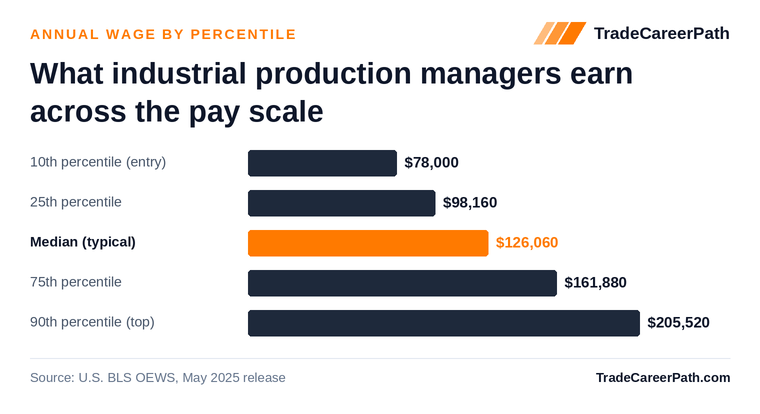
Production management is one of the highest-paying destinations for a manufacturing trade background. The national median is $126,060 per year, and the 75th percentile - roughly where experienced plant managers at mid-size operations sit - is $161,880. The 10th percentile, about where a first production-manager title at a small plant starts, is $78,000, and the 90th percentile reaches $205,520 (BLS OEWS, May 2025). The spread is wide because plant size drives pay: managing 30 people at a small fabricator and 400 at an automotive supplier carry the same SOC code and very different paychecks.
Where the Jobs and the Money Are
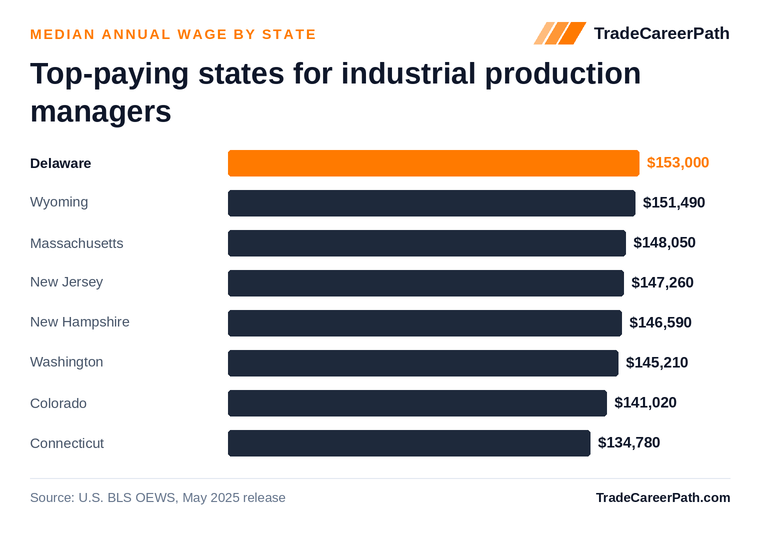
The top-paying states are not the biggest manufacturing states - they are smaller markets where the plants that do exist skew toward high-value industries like pharmaceuticals and chemicals:
| State | Median annual wage | Employment |
|---|---|---|
| Delaware | $153,000 | 370 |
| Wyoming | $151,490 | 390 |
| Massachusetts | $148,050 | 4,470 |
| New Jersey | $147,260 | 6,780 |
| New Hampshire | $146,590 | 1,540 |
For sheer volume, look elsewhere: California employs 25,130 industrial production managers at a $132,620 median, Texas 21,200 at $130,890, and Michigan 14,320 at $120,660 (BLS OEWS, May 2025). Michigan is the standout for concentration - production managers are about twice as common there as in the average state labor market, which means a deep bench of plants to move between without relocating. New Hampshire pairs well-above-average pay with an above-average concentration of these jobs, making it a quietly strong market; Delaware and Wyoming pay top dollar but have few seats, so those medians reward the managers already there more than they signal open doors.
How to Become an Industrial Production Manager
1. Build production experience
Most plant managers rise from operator, machinist, or technician roles through shift leadership - this is one of the few highly paid management careers where starting on the floor is the normal path, not the exception. The experience that counts is the kind that teaches you how production really behaves: running equipment, hitting rate, seeing what scrap and downtime actually cost. If you are already a few years into a manufacturing trade, this step is done; the task now is making the rest of the resume catch up.
2. Earn a bachelor’s degree
Business administration, operations management, or industrial technology - and online programs are built for exactly this situation, fitting coursework around shift work. Operations management is usually the best match, because the curriculum (scheduling, quality, supply chain, lean) is the job. This is the gate: at most large manufacturers, the degree is what separates career supervisors from candidates for the plant-manager track. Get a written transfer evaluation first - prior college, military training, and apprenticeship coursework often convert to credit.
3. Move into supervision
Shift supervisor and production lead roles are the proving ground. This is where you learn the parts of the job no course teaches: holding people accountable who used to be your peers, running a shift short-handed, and owning a number every single day. Say yes to the unpopular assignments - second shift, the struggling line, the new product launch - because they generate the results and stories that get you promoted.
4. Add operations credentials
APICS CPIM or CSCP certification and lean manufacturing or Six Sigma credentials strengthen the case, especially when you are competing against candidates with more formal education. They signal that you speak the language of planning and continuous improvement, not just the language of the floor. Many employers reimburse the exam costs; ask before you pay.
5. Advance
Production manager, plant manager, then director of operations. The first title usually means owning one value stream or department; plant manager means owning the whole site’s P&L; director means multiple sites. Each jump rewards a track record you can quantify - on-time delivery, scrap reduction, safety record - so keep your numbers as you go.
Career Ladder: Titles and Realistic Pay
The BLS wage percentiles map cleanly onto how production-management careers actually progress. Use this as a sanity check on offers, not a guarantee:
| Stage | Typical titles | Years in | Realistic pay (BLS OEWS, May 2025) |
|---|---|---|---|
| Entry level | Production supervisor, area/value-stream manager | 0-3 in management | ~$78,000-$98,160 (10th-25th pct) |
| Mid-career | Production manager, operations manager | 3-10 | ~$126,060 (median) |
| Senior | Plant manager (mid-size or large site) | 10-15 | ~$161,880 (75th pct) |
| Executive track | Large-plant manager, director of operations | 15+ | $205,520+ (90th pct) |
Two notes for career changers. First, deep trade experience compresses this ladder: a machinist or maintenance tech with ten years on the floor and a fresh degree is not an entry-level manager - many are hired straight into production-manager roles because they already know how the plant actually runs. Second, the upper bands understate total compensation: plant managers commonly carry annual bonuses tied to site performance, and at larger manufacturers the bonus and incentive layer sits on top of the base-wage data shown here.
Do You Need a License?
No. There is no state license for industrial production managers - advancement runs on results, not credentials from a licensing board. What functions as the credential stack in this field:
- APICS CPIM / CSCP: the recognized certifications for production planning and supply chain management - the closest thing the field has to a standard professional credential.
- Lean / Six Sigma belts: widely expected at larger manufacturers, where continuous-improvement language is part of the interview.
- Safety credentials: OSHA training and a clean safety record matter more with every promotion, because the plant manager is accountable for every incident on site.
None of these are legally required, and none replace the degree plus floor experience - but they are cheap relative to their signaling value, and many employers pay for them.
Why an Online Degree Works for This Career
The shop-floor-to-plant-manager path runs through a bachelor’s degree: your production experience is the hard half, and an online operations-management or business degree is the credential that gets you considered for the title and the six-figure BLS median. Online programs fit this career unusually well because the target students are exactly people working rotating shifts, and employer tuition assistance is common at manufacturers - many supervisors finish the degree with most of the tuition covered, without giving up their seniority or their spot in line for the next promotion.
Job Outlook for 2026 and Beyond
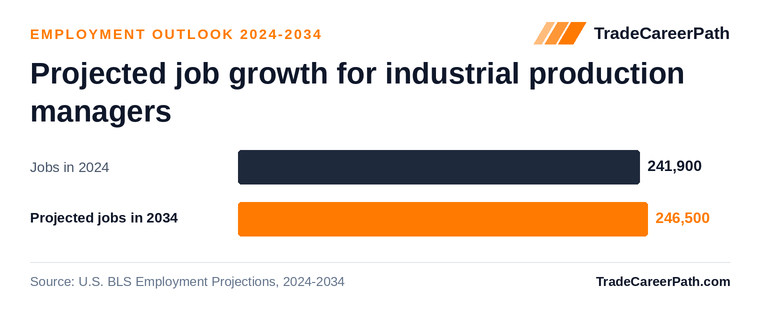
BLS projects employment of industrial production managers to grow +2.6% from 2025 to 2035 - from 252,100 to 258,600 jobs - with about 17,000 openings per year once retirements and occupation changes are counted (BLS Employment Projections, 2025-35). Read those two numbers together: headline growth is modest, but 17,000 annual openings in a 246,250-person occupation means a steady stream of seats, because this is an older-skewing management workforce with heavy retirement turnover. Wages are moving the right way too - the median rose from $121,440 in 2024 to $126,060 in the May 2025 data.
The structural driver favors the shop-floor candidate: as reshoring and automation reshape U.S. plants, manufacturers need managers who understand both the equipment and the systems layer. Every retiring plant manager opens a chair, and the people best positioned to fill it are supervisors who paired real floor experience with the degree.
Cost and Time to Complete the Degree
For industrial production managers, the credential is: Bachelor’s in business, operations management, or industrial technology. A bachelor’s degree is typically 120 credit hours: four years full-time, and commonly five to six years part-time while working. Transfer credit is the other lever: prior college, military training, apprenticeship coursework, and industry certifications can be worth meaningful credit at transfer-friendly schools, so get a written transfer evaluation before enrolling anywhere. Costs vary widely by school type; in-state public online programs are usually the value benchmark, and employer tuition assistance is common for working adults in this field.
Pros and Cons of Training as an Industrial Production Manager
Pros
- Median pay of $126,060 nationally (BLS OEWS, May 2025)
- About 17,000 openings per year - steady retirement-driven demand
- Field experience from the trades is a genuine hiring advantage
- No license required; accredited online degree paths fit shift work
Cons
- Requires a 4-year degree (typically 120 credit hours)
- Entry-level pay starts near $78,000 at the 10th percentile
- Slow headline growth (+2.6% over 2025-35) - openings come from turnover, not expansion
Frequently Asked Questions
Do plant managers need a degree?
BLS lists a bachelor's as the typical entry-level education for industrial production managers, and most large manufacturers require one for plant-manager roles - it is the standard gate between shift supervision and plant leadership.
How much do industrial production managers make?
The national median annual wage for industrial production managers is $126,060 (BLS OEWS, May 2025). The top 10% earn $205,520 or more, while entry-level pay starts around $78,000.
What is the job outlook for industrial production managers?
BLS projects employment of industrial production managers to change by +2.6% from 2025 to 2035 (BLS Employment Projections, 2025-35).
How long does industrial production manager training take?
The bachelor's degree is 120 credit hours: four years full-time, commonly five to six years part-time while working. Most people also put in several years as an operator, machinist, or shift supervisor first - but that experience runs in parallel with a part-time degree, not before it.
Is it hard to train as an industrial production manager?
The degree itself is one of the more manageable bachelor's paths - operations management and business coursework, not engineering math. The hard part is the job: owning schedule, quality, safety, and budget across shifts. Tradespeople who have led a crew usually find the coursework easier than the responsibility.
Operations management vs business administration - which degree is better?
For a shop-floor path, operations management (or industrial technology) is usually the better fit: the coursework - scheduling, quality systems, lean, supply chain - maps directly onto the plant-manager job. A general business administration degree works too and keeps doors open outside manufacturing; either clears the degree gate.
Can you train as an industrial production manager without a degree?
Sometimes - smaller plants do promote strong supervisors without one. But at larger manufacturers the bachelor's is the standard screen for production-manager and plant-manager titles, and without it the realistic ceiling is shift or area supervisor. With median pay at $126,060, the degree is what makes the title portable between employers.
Do industrial production managers need a license?
No state license is required. The credentials that matter are industry certifications - APICS CPIM/CSCP for planning and supply chain, Six Sigma or lean certifications for process improvement - plus a safety record and results you can point to.
Industrial Production Manager Salary and Requirements by State
Alabama · Alaska · Arizona · Arkansas · California · Colorado · Connecticut · Delaware · District of Columbia · Florida · Georgia · Hawaii · Idaho · Illinois · Indiana · Iowa · Kansas · Kentucky · Louisiana · Maine · Maryland · Massachusetts · Michigan · Minnesota · Mississippi · Missouri · Montana · Nebraska · Nevada · New Hampshire · New Jersey · New Mexico · New York · North Carolina · North Dakota · Ohio · Oklahoma · Oregon · Pennsylvania · Rhode Island · South Carolina · South Dakota · Tennessee · Texas · Utah · Vermont · Virginia · Washington · West Virginia · Wyoming
Related Careers and Degree Paths
- Industrial Engineer - the engineering-side counterpart that designs the processes plant managers run
- Machinist to Industrial Engineer - the bridge path from the same shop floor
- Engineering Manager - the parallel management ladder on the technical side
- Logistician - the supply-chain role that feeds and ships what the plant makes
- Construction Manager - the equivalent trades-to-management jump in construction
Degree and Program Guides
- Online Industrial Technology Degrees - the applied management degree for plant leadership
Sources
- U.S. Bureau of Labor Statistics, Occupational Employment and Wage Statistics (OEWS), May 2025 - Industrial Production Managers (SOC 11-3051)
- U.S. Bureau of Labor Statistics, Employment Projections, 2025-35
- U.S. Bureau of Labor Statistics, Occupational Outlook Handbook - education and licensing requirements
Industrial Production Manager Salary by State
About this guide: Researched and written by the TradeCareerPath Editorial Team. Our editorial team researches and sources every trade school and career guide using federal labor and education data, including BLS OEWS and Employment Projections, DOL apprenticeship records, IPEDS, College Scorecard, and state licensing boards. We follow the editorial standards documented at /editorial-policy/.
Data sources
Figures on this page are sourced from the federal and state datasets below. Methodology: how we rank and source data.
| Data | Provider | Vintage |
|---|---|---|
| Occupational Employment and Wage Statistics (OEWS) | U.S. Bureau of Labor Statistics | May 2025 |
| Employment Projections | U.S. Bureau of Labor Statistics | 2025-2035 |
| Integrated Postsecondary Education Data System | National Center for Education Statistics (IPEDS) | 2024 |
| College Scorecard (school-level outcomes) | U.S. Department of Education | latest release |
| College Scorecard (field-of-study earnings) | U.S. Department of Education | latest release (updated 2026-06-12) |
| Occupational licensing requirements | CareerOneStop (U.S. Department of Labor) | latest release (updated 2026-02-22) |
| Registered apprenticeship programs | CareerOneStop / Apprenticeship.gov (U.S. Department of Labor) | latest release (updated 2025-10-25) |
| O*NET occupation profiles (skills, tasks, tools, job zones) | U.S. Department of Labor (O*NET / Employment & Training Admin.) | O*NET 31.0 (updated 2026-10-14) |