
How to Become an Insulation Worker
Is Insulation Worker Right for You?
The U.S. Department of Labor's O*NET profile for Insulation Workers, Floor, Ceiling, and Wall (SOC 47-2131) describes the work this way: Line and cover structures with insulating materials. May work with batt, roll, or blown insulation materials.
What the work involves
- Measure and cut insulation for covering surfaces, using tape measures, handsaws, power saws, knives, or scissors.
- Fit, wrap, staple, or glue insulating materials to structures or surfaces, using hand tools or wires.
- Cover and line structures with blown or rolled forms of materials to insulate against cold, heat, or moisture, using saws, knives, rasps, trowels, blowers, or other tools and implements.
- Distribute insulating materials evenly into small spaces within floors, ceilings, or walls, using blowers and hose attachments, or cement mortars.
- Move controls, buttons, or levers to start blowers and regulate flow of materials through nozzles.
Skills and knowledge that matter
Skills: Speaking, Operation and Control, Critical Thinking, Active Listening, Operations Monitoring, Monitoring.
Knowledge: Building and Construction, Customer and Personal Service, Mechanical, English Language.
Tools and technology you may use
Tools: Adjustable widemouth pliers, Air compressors, Air filtering devices, Asbestos cutters, Batt knives, Blower machines.
Technology: Data base user interface and query software, Spreadsheet software, Office suite software, Microsoft Excel, Microsoft Office software, Microsoft Outlook.
Typical preparation
O*NET Job Zone Two (Some Preparation Needed). These occupations usually require a high school diploma. Employees in these occupations need anywhere from a few months to one year of working with experienced employees. A recognized apprenticeship program may be associated with these occupations.
Interest fit
O*NET interest profile: Realistic, Conventional, Investigative. People who enjoy hands-on, practical work with tools, machines, plants, or materials often find this occupation a good fit.
Source: O*NET 29.1 (updated 2026-06-13)
Seen a building wrapped in insulation and thought, “That looks interesting”?
Insulation workers turn that interest into a career.
Insulation workers, sometimes called insulators, install and replace materials used to insulate buildings and mechanical systems.
If you enjoy hands-on work and are comfortable in construction settings, this trade offers a solid path into construction and renovation.
Quick answers
At a glance
Also called: insulators
Main work: install and replace insulation in buildings and mechanical systems
Common materials: fiberglass, foam, and reflective insulation
Typical entry path: high school diploma or equivalent, plus on-the-job training or an apprenticeship
Certifications: optional (safety or specialty training such as OSHA)
What does an insulation worker do? Insulation workers, sometimes called insulators, install and replace materials used to insulate buildings and mechanical systems. Their work helps control temperature and improve energy efficiency.
Where do insulation workers work? Job sites include residential construction and renovations, commercial and industrial projects, HVAC and mechanical system installation, and weatherization work. Some tasks can be physically demanding in tight or hot environments.
Do you need trade school to start? Trade school or a technical program is optional. Many insulation workers learn through on-the-job training or an apprenticeship.
What skills matter most? The work relies on measuring and cutting accurately, reading plans, and using tools. Physical stamina, attention to detail, and a commitment to safety help in varied environments.
Are certifications required? Certifications are optional. Safety or specialty certifications, such as OSHA or specific insulation systems training, can enhance your qualifications.
How can insulation workers advance? With experience, insulation workers may move into lead installer, project coordinator, or supervisory roles, or even start their own contracting business.
Quick Facts: Insulation Worker Training and Outlook
What Insulation Workers Do
Insulation workers apply insulating materials to buildings and mechanical systems to control temperature and improve energy efficiency.
Typical Tasks
- Measure surfaces and cut insulation materials accurately
- Install materials such as fiberglass, foam, or reflective insulation
- Secure insulation around pipes, ducts, and framing
- Inspect existing insulation and replace or repair as needed
- Follow safety protocols and wear protective equipment
Key Skills and Traits for Success
- Good manual dexterity and comfort with tools
- Ability to read and interpret project plans and layouts
- Physical stamina and the ability to work in varied environments
- Attention to detail for accurate installation
- Commitment to safety and use of protective gear
Work Settings for Insulation Workers
Insulation workers are employed in a variety of environments, including:
- Residential construction and home renovation projects
- Commercial building and industrial construction
- Mechanical system installation for HVAC and manufacturing facilities
- Energy retrofitting and weatherization projects
- Independent contracting under construction firms
How to Become an Insulation Worker (5 Steps)
Here’s a typical path to get started in this trade.
1. Earn a High School Diploma or Equivalent
Take courses in mathematics, shop, and building construction to build foundational skills.
2. Complete a Trade School or Technical Program (Optional)
Some schools offer certificate or diploma programs in insulation or general construction trades. These can provide useful skills before starting on-the-job training.
3. Gain On-the-Job Training or Enter an Apprenticeship
Most insulation workers learn through hands-on experience with skilled crews, applying what they've learned while working on real projects.
4. Obtain Certifications or Endorsements (Optional)
Consider safety or specialty certifications, such as OSHA or specific insulation systems training, to enhance your qualifications.
5. Build Experience and Explore Advancement
As you gain experience, you may move into lead installer, project coordinator, or supervisory roles, or even start your own contracting business.
Education and Training Paths
| Pathway | Typical Duration | Outcome |
|---|---|---|
| Certificate or Diploma Program | 6-12 months | Basic instruction in insulation materials and installation techniques |
| On-the-Job Training | Up to 1 year | Practical experience under skilled workers |
| Apprenticeship or Formal Training Program | 1-2 years | Structured learning and hands-on experience for full proficiency |
Career Growth and Advancement
With experience, insulation workers may advance to:
- Crew leader or site supervisor
- Industrial insulation specialist
- Project estimator or materials coordinator
- Independent contractor or small business owner
Pros and Cons
✅ Pros
- Hands-on, practical work with visible results
- Variety of job sites and project types
- Pathways to specialization and self-employment
⚠️ Cons
- Physically demanding work in tight or hot environments
- Project-based or seasonal employment in some regions
- Strict safety requirements with protective gear
Take the First Step
If you’re considering this trade, start by comparing training options and entry paths. Many insulation workers begin with on-the-job training or an apprenticeship, with trade school as an optional foundation.
Industry Organizations & Certifying Bodies
These are the recognized national organizations, unions, certifying bodies, and regulatory authorities that shape this trade. They issue the credentials, sponsor the apprenticeships, publish the codes, and represent workers and employers.
- International Association of Heat and Frost Insulators and Allied Workers Primary insulation workers union; sponsors registered apprenticeships.
- National Insulation Association (NIA) Industry trade association.
Wage and Employment Charts
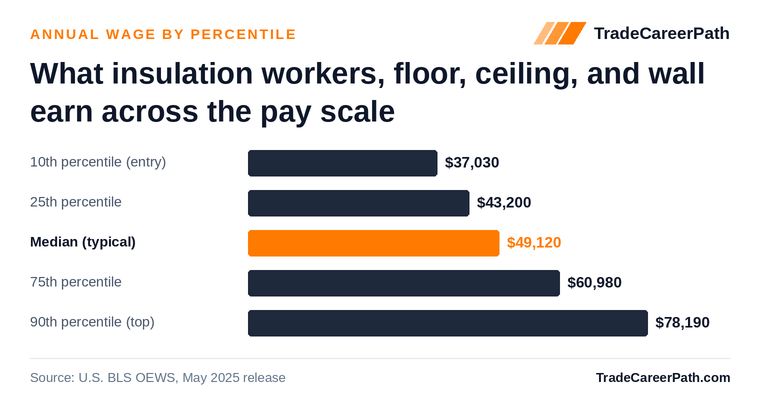
| Percentile | Annual wage |
|---|---|
| 10th | $37,030 |
| 25th | $43,200 |
| 50th (median) | $49,120 |
| 75th | $60,980 |
| 90th | $78,190 |
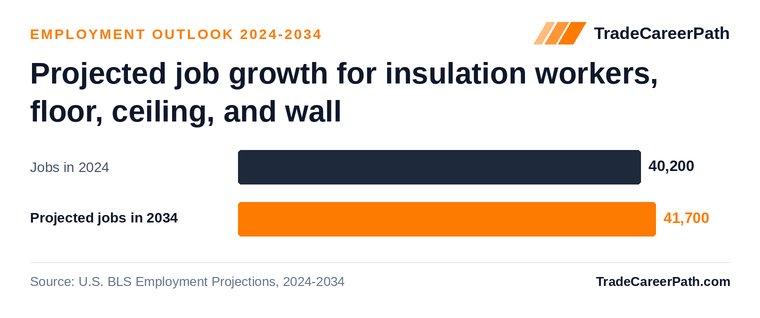
| Year | Employment |
|---|---|
| 2024 | 40,200 |
| 2034 projected | 41,700 |
| Percent change | +3.8% |
Insulation Worker Salary and Requirements by State
Select your state for local wage data, training options, and requirements:
Alabama · Alaska · Arizona · Arkansas · California · Colorado · Connecticut · Delaware · District of Columbia · Florida · Georgia · Hawaii · Idaho · Illinois · Indiana · Iowa · Kansas · Kentucky · Louisiana · Maine · Maryland · Massachusetts · Michigan · Minnesota · Mississippi · Missouri · Montana · Nebraska · Nevada · New Hampshire · New Jersey · New Mexico · New York · North Carolina · North Dakota · Ohio · Oklahoma · Oregon · Pennsylvania · Rhode Island · South Carolina · South Dakota · Tennessee · Texas · Utah · Vermont · Virginia · Washington · West Virginia · Wisconsin · Wyoming
Workplace Safety Snapshot
BLS Survey of Occupational Injuries and Illnesses data (2023-2024) report approximately 437.3 days-away, restricted, or transfer cases per 10,000 full-time-equivalent workers in insulation workers, floor, ceiling, and wall (about 4.37 per 100 FTE). Source: BLS Survey of Occupational Injuries and Illnesses, Table R98.
Frequently Asked Questions
How long does insulation worker training take?
It typically takes typically 6 months to 2 years of training. The most common entry path is through a certificate or associate degree program. A high school diploma or GED is generally required to get started.
How much do insulation workers make?
The median annual salary for insulation workers is $49,120 according to the Bureau of Labor Statistics (May 2025). Entry-level workers earn around $37,030, while those in the 90th percentile earn over $78,190. Pay varies by state, experience, and specialization.
What is the job outlook for insulation workers?
The Bureau of Labor Statistics projects 3.8% employment growth for this occupation from 2024 to 2034, which is roughly on pace with the overall economy. Approximately 3,400 job openings are expected each year due to growth, retirements, and workers leaving the field.
Do you need a college degree to work as an insulation worker?
No. A college degree is not required to work as an insulation worker. Most people enter the field through a certificate or associate degree program. A high school diploma or GED is typically the only educational prerequisite.
Which states pay insulation workers the most?
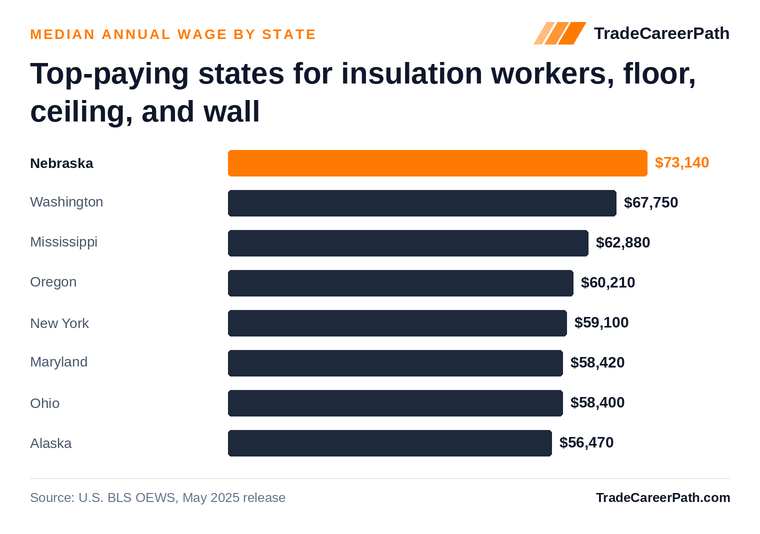
According to the U.S. Bureau of Labor Statistics (May 2025 OEWS), the highest-paying states for insulation workers are Nebraska, Washington, and Mississippi. Median annual wages: Nebraska ($73,140); Washington ($67,750); Mississippi ($62,880).
Which states employ the most insulation workers?
BLS reports the largest concentrations of insulation workers in Texas, California, and Florida. Employment levels: Texas (7,120 workers); California (3,080 workers); Florida (2,690 workers) (May 2025).
How much do experienced insulation workers earn?
The top 10% of insulation workers earn more than $78,190 per year, according to BLS Occupational Employment and Wage Statistics (May 2025). Experienced workers in this band typically hold senior credentials, supervisory roles, or specialty certifications.
What is entry-level pay for insulation workers?
BLS reports the bottom 10% of insulation workers earn under $37,030 per year. New workers often start near this level and see pay rise as they accumulate experience and credentials.
How many insulation workers work in the United States?
BLS reports approximately 44,440 insulation workers employed nationwide as of May 2025.
How many job openings are expected for insulation workers each year?
BLS projects approximately 3,400 openings per year for insulation workers from 2024 through 2034, including new positions, retirements, and workers transitioning out. The occupation is projected to grow 3.8% from 2024 to 2034, classified as about as fast as average growth.
How much do insulation workers make per hour?
The median hourly wage for insulation workers is $23.62, according to BLS (May 2025). Hourly pay ranges from about $17.80 (bottom 10%) to $37.59 (top 10%).
How Insulation Worker Pay Compares to Similar Trades
Side-by-side comparison of Construction & Insulation Listings and the closest related careers, based on U.S. Bureau of Labor Statistics data (May 2025 OEWS + 2024-2034 Employment Projections).
| Career | Median Pay | 10-Year Growth | Annual Openings |
|---|---|---|---|
| Construction & Insulation Listings this guide | $49,120 | +3.8% | 3,400 |
| HVAC Technician | $61,010 | +8.1% | 40,100 |
| Construction Worker | $47,120 | +7.3% | 129,400 |
| Carpentry | $60,580 | +4.5% | 74,100 |
| Flooring Installer | $56,460 | +9.5% | 2,700 |
Source: BLS Occupational Employment and Wage Statistics + BLS Employment Projections.
Sources
- U.S. Bureau of Labor Statistics, Occupational Employment and Wage Statistics (May 2025)
- U.S. Bureau of Labor Statistics, Employment Projections 2024-2034
- U.S. Bureau of Labor Statistics, Survey of Occupational Injuries and Illnesses (2023-2024, Table R98)
- U.S. Department of Labor, Wage and Hour Division, Davis-Bacon General Wage Determinations (2026)
Insulation Worker Salary by State
About this guide: Researched and written by the TradeCareerPath Editorial Team. Our editorial team researches and sources every trade school and career guide using federal labor and education data, including BLS OEWS and Employment Projections, DOL apprenticeship records, IPEDS, College Scorecard, and state licensing boards. We follow the editorial standards documented at /editorial-policy/.
Data sources
Figures on this page are sourced from the federal and state datasets below. Methodology: how we rank and source data.
| Data | Provider | Vintage |
|---|---|---|
| Occupational Employment and Wage Statistics (OEWS) | U.S. Bureau of Labor Statistics | May 2025 |
| Employment Projections | U.S. Bureau of Labor Statistics | 2024-2034 |
| Integrated Postsecondary Education Data System | National Center for Education Statistics (IPEDS) | 2024 |
| College Scorecard (school-level outcomes) | U.S. Department of Education | latest release |
| College Scorecard (field-of-study earnings) | U.S. Department of Education | latest release (updated 2026-06-12) |
| Occupational licensing requirements | CareerOneStop (U.S. Department of Labor) | latest release (updated 2026-02-22) |
| Registered apprenticeship programs | CareerOneStop / Apprenticeship.gov (U.S. Department of Labor) | latest release (updated 2025-10-25) |
| O*NET occupation profiles (skills, tasks, tools, job zones) | U.S. Department of Labor (O*NET / Employment & Training Admin.) | O*NET 29.1 (updated 2026-06-13) |