
How to Become an Interior Designer in 2026
Is Interior Designer Right for You?
The U.S. Department of Labor's O*NET profile for Interior Designers (SOC 27-1025) describes the work this way: Plan, design, and furnish the internal space of rooms or buildings. Design interior environments or create physical layouts that are practical, aesthetic, and conducive to the intended purposes. May specialize in a particular field, style, or phase of interior design.
What the work involves
- Design plans to be safe and to be compliant with the American Disabilities Act (ADA).
- Use computer-aided drafting (CAD) and related software to produce construction documents.
- Research health and safety code requirements to inform design.
- Confer with client to determine factors affecting planning of interior environments, such as budget, architectural preferences, purpose, and function.
- Advise client on interior design factors, such as space planning, layout and use of furnishings or equipment, and color coordination.
Skills and knowledge that matter
Skills: Speaking, Reading Comprehension, Critical Thinking, Active Listening, Social Perceptiveness, Service Orientation.
Knowledge: Design, Customer and Personal Service, Building and Construction, English Language.
Tools and technology you may use
Tools: Architects' scales, Computer aided design CAD multi-unit display graphics cards, Desktop computers, Digital camcorders, Digital cameras, Digital tape measures.
Technology: Computer aided design CAD software, Document management software, Graphics or photo imaging software, Adobe Acrobat, Adobe Creative Cloud software, Adobe Illustrator.
Typical preparation
O*NET Job Zone Four (Considerable Preparation Needed). Most of these occupations require a four-year bachelor's degree, but some do not. Employees in these occupations usually need several years of work-related experience, on-the-job training, and/or vocational training.
Interest fit
O*NET interest profile: Artistic, Realistic, Conventional. People who enjoy creative work, self-expression, and designing or making things without a rigid set of rules often find this occupation a good fit.
Source: O*NET 29.1 (updated 2026-06-13)
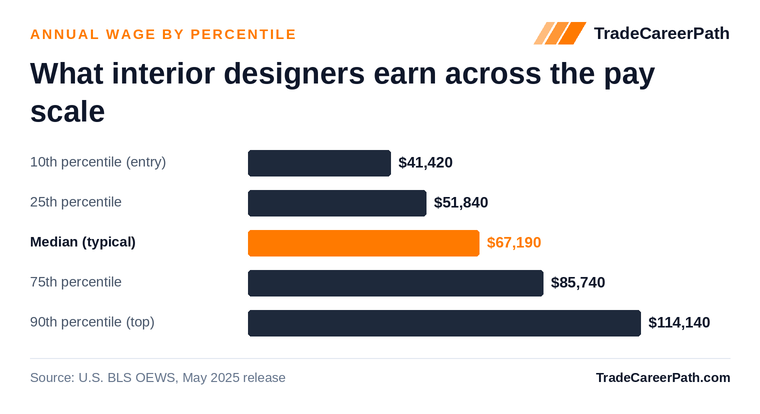
Quick answer: Training as an interior designer usually takes about 2 to 4 years of education. You complete an associate or bachelor’s degree (programs typically cost $6,000 to $25,000), build a strong portfolio, gain experience through internships or assistant roles, and can earn the optional NCIDQ Certified Interior Designer credential from CIDQ. Certification is voluntary in many states but required in some that regulate the title. The median interior designer salary is $67,190 per year ($32.31/hour), and employers post about 7,800 openings nationwide each year (BLS, May 2025).
Interior designers use color, lighting, materials, and furniture to make spaces both functional and visually appealing. They work on homes, offices, hotels, retail stores, and more, shaping how people experience the rooms they spend time in.
How to Become an Interior Designer
Most interior designers enter the field after about two to four years of education, depending on the degree level they choose. There is no single national license, though some states regulate the title and require certification. You build the career through education, a strong portfolio, hands-on experience, and an optional professional credential.
1. Earn a High School Diploma or GED
A high school diploma or GED is the starting point for nearly every interior design program. Before you enroll, build the skills the work depends on. Art and drawing classes develop your eye for proportion, color, and composition. Math, especially geometry, helps with scale drawings and space planning, while basic physics and building-science topics make later coursework on lighting and materials easier to follow. Computer-design or drafting electives are valuable because professional interior design runs on software, so any early exposure to tools like AutoCAD or SketchUp gives you a head start. Get comfortable with general computer and presentation software too, since you will spend a lot of time building mood boards, renderings, and client presentations. If you are changing careers and already hold a diploma or another degree, you can move straight to choosing a program. Many strong designers come from unrelated fields and bring useful skills in communication, budgeting, and project management.
2. Complete an Interior Design Program
This is the core of your training. An associate degree takes about two years and can lead to entry-level or assistant roles, while a bachelor's degree takes about four years and is the most common route into professional design positions. When comparing schools, look for accreditation by the Council for Interior Design Accreditation (CIDA), which reviews programs against recognized curriculum and faculty standards that many employers value. Typical coursework covers design fundamentals and color theory, space planning, computer-aided design and 3D modeling, lighting, textiles and materials, building codes, and accessibility standards. Many programs also build in studio projects so you graduate with real work to show. A growing number of certificate and degree programs are available online or in hybrid formats, which lets working students learn at a flexible pace. Whatever format you choose, confirm the program's accreditation before you enroll, since a CIDA-accredited degree also helps if you later pursue NCIDQ certification.
3. Build a Strong Portfolio
In interior design, your portfolio often matters as much as your degree. Employers and clients want to see what you can actually produce, so collect your best work as you go. Save studio projects, floor plans, mood boards, 3D renderings, and any real or volunteer projects you complete. Show range by including different room types and styles, and show technical skill by including CAD drawings and detailed material selections alongside finished visuals. If you have not had paid work yet, design concepts for friends, redesign a room in your own home, or take on small volunteer projects for community spaces to fill out the portfolio. Present it cleanly, both as a polished PDF and as a simple website, since hiring managers frequently review portfolios online. A well-organized portfolio that explains your design thinking, not just the final look, is one of the strongest ways to stand out in a competitive field.
4. Gain Work Experience
Coursework and a portfolio open the door, but real experience is what builds a career. Look for an internship while you are still in school, since many programs help place students with design firms, architecture offices, or furniture and staging companies. After graduation, entry-level and assistant designer roles let you practice the parts of the job that school cannot fully teach: coordinating with contractors and vendors, sourcing furniture and finishes within a budget, managing timelines, and working directly with clients. Pay attention to how senior designers handle client expectations and project changes, because client management is a major part of the work. Each project also gives you new pieces for your portfolio and references for future jobs. Over time, this experience is what qualifies you for the work hours that the NCIDQ certification requires and for more senior positions.
5. Consider NCIDQ Certification
The most recognized credential in the field is the NCIDQ Certified Interior Designer certification, issued by the National Council for Interior Design Qualification (NCIDQ / CIDQ). In many states it is voluntary, but some states that regulate the interior design title or practice require it, so check your state's rules early. To qualify, you generally need a combination of interior design education and documented professional experience, then you pass the NCIDQ examination, which tests areas like building codes, construction standards, and professional practice. Even where it is optional, the credential signals expertise and can support higher pay and senior roles. Joining a professional association such as the American Society of Interior Designers (ASID) is also worth considering, since associations offer continuing education, networking, and job leads. Together, certification and a professional network help you move from entry-level work into established designer and leadership positions.
What Interior Designers Do
Interior designers plan and furnish residential, commercial, and industrial spaces. They create designs that are functional, safe, and visually appealing, often using computer-aided design (CAD) and 3D modeling software to develop and present their ideas.
Typical Responsibilities
- Meet with clients to discuss project goals, style, and budget
- Develop design concepts and mood boards
- Select color palettes, furniture, lighting, and materials
- Prepare drawings, blueprints, and presentations
- Coordinate with architects, contractors, and vendors
- Ensure designs meet building codes and accessibility standards
The best interior designers combine creativity with strong technical and communication skills.
Key Skills and Traits for Success
- Strong sense of style and creativity
- Excellent spatial awareness and visualization
- Knowledge of design software (AutoCAD, Revit, SketchUp)
- Understanding of architecture and safety codes
- Good communication and project management
- Attention to detail and problem-solving ability
Common Work Settings
- Interior design firms
- Architecture and engineering offices
- Real estate and staging companies
- Furniture manufacturers
- Freelance and self-employed designers
Education and Certification Paths
| Pathway | Typical Duration | Outcome |
|---|---|---|
| Associate Degree | 2 years | Entry-level drafting or assistant roles |
| Bachelor’s Degree | 4 years | Professional interior designer |
| NCIDQ Certification | After degree + experience | Advanced credential |
| Master’s in Interior Architecture | 2 years | Specialization or teaching roles |
Career Growth and Advancement
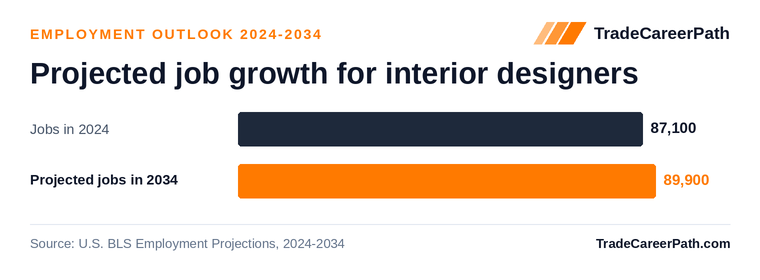
Experienced interior designers can move into roles such as:
- Design Director or Senior Designer
- Commercial Space Planner
- Project Manager
- Furniture or Lighting Designer
- Design Firm Owner / Freelancer
Designers with strong digital visualization and sustainability skills are in especially high demand.
Cost and Duration of Training
- Program Cost: varies by school, format and location depending on degree and school
- Duration: 2 to 4 years
- Certification Exam: NCIDQ, typically $400 to $700
Pros and Cons
Pros
- Creative and rewarding work
- High flexibility and freelance options
- Strong demand in commercial and sustainable design
- Potential for higher earnings with experience
Cons
- Competitive industry
- Irregular hours and tight deadlines
- Initial certification costs
Interior Designer Salary by State
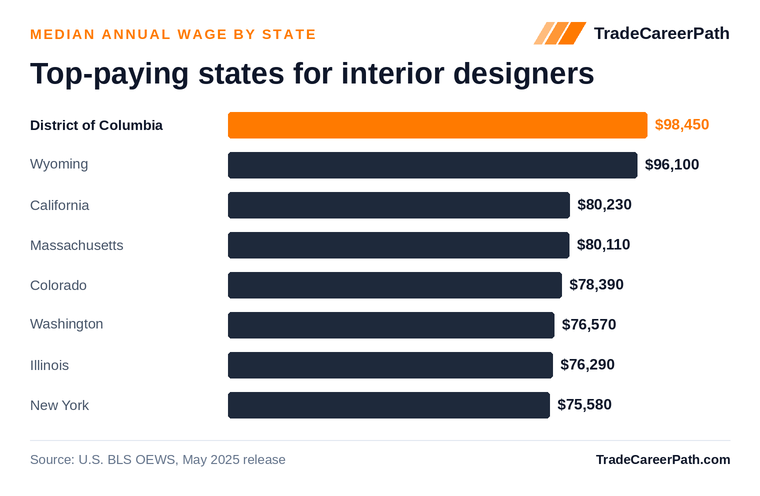
Top salaries often go to designers specializing in luxury residential, hospitality, or corporate interiors.
Quick Facts: Interior Designer Salary, Education, and Outlook
Industry Organizations & Certifying Bodies
These are the recognized national organizations, unions, certifying bodies, and regulatory authorities that shape this trade. They issue the credentials, sponsor the apprenticeships, publish the codes, and represent workers and employers.
- National Council for Interior Design Qualification (NCIDQ / CIDQ) Issues the NCIDQ Certified Interior Designer credential used in most states with regulation.
- American Society of Interior Designers (ASID) Major U.S. interior design professional association.
- Council for Interior Design Accreditation (CIDA) Accredits interior design degree programs.
Wage and Employment Charts
Interior Designer Salary and Requirements by State
Select your state for local wage data, training options, and requirements:
Alabama · Alaska · Arizona · Arkansas · California · Colorado · Connecticut · Delaware · District of Columbia · Florida · Georgia · Hawaii · Idaho · Illinois · Indiana · Iowa · Kansas · Kentucky · Louisiana · Maine · Maryland · Massachusetts · Michigan · Minnesota · Mississippi · Missouri · Montana · Nebraska · Nevada · New Hampshire · New Jersey · New Mexico · New York · North Carolina · North Dakota · Ohio · Oklahoma · Oregon · Pennsylvania · Rhode Island · South Carolina · South Dakota · Tennessee · Texas · Utah · Vermont · Virginia · Washington · West Virginia · Wisconsin · Wyoming
Start Your Interior Design Career Today
Interior design is a career where art meets function. If you are passionate about creating spaces people love to live and work in, now is a good time to start your training.
Find Interior Design Schools Near You
Frequently Asked Questions
How long does interior designer training take?
Most people spend about 2 to 4 years on education, depending on whether they pursue an associate degree (about 2 years) or a bachelor's degree (about 4 years). After school, building a portfolio and gaining work experience continues over the first few years on the job.
Do you need a college degree to work as an interior designer?
Many employers prefer a degree in interior design or a related field, and a bachelor's degree is the most common path into professional roles. An associate degree can lead to entry-level or assistant positions. A high school diploma or GED is the baseline starting point.
How much does interior design training cost?
Program costs generally range from about varies by school, format and location depending on the degree level, school, and format. The optional NCIDQ certification exam typically adds a fee of roughly $400 to $700.
Is NCIDQ certification required to be an interior designer?
In many states certification is voluntary, but some states that regulate the title or practice require the NCIDQ Certified Interior Designer credential from CIDQ. Even where it is optional, NCIDQ certification can strengthen your resume and support higher pay. Check your state's rules before you plan your path.
Is it hard to train as an interior designer?
The field is competitive, and a strong portfolio matters as much as your degree. The work combines creativity with technical skills like CAD, space planning, and building codes, plus client communication and deadline management. Entry is accessible through education, but standing out takes practice and good sample work.
Can you study interior design online?
Yes. Many colleges offer interior design certificate and degree programs online or in hybrid formats, which helps working students learn at a flexible pace. Before enrolling, confirm the program's accreditation, ideally through the Council for Interior Design Accreditation (CIDA).
How many interior designers work in the United States?
BLS reports approximately 71,500 interior designers employed nationwide as of May 2025, with about 7,800 openings projected each year over the 2024 to 2034 period.
How Interior Designer Pay Compares to Similar Trades
Side-by-side comparison of Interior Designer and the closest related careers, based on U.S. Bureau of Labor Statistics data (May 2025 OEWS + 2024-2034 Employment Projections).
| Career | Median Pay | 10-Year Growth | Annual Openings |
|---|---|---|---|
| Interior Designer this guide | $67,190 | +3.2% | 7,800 |
| Floral Designer | $37,360 | -5.9% | 5,100 |
| Flooring Installer | $56,460 | +9.5% | 2,700 |
| Carpentry | $60,580 | +4.5% | 74,100 |
| Home Inspector | $74,690 | -0.8% | 14,800 |
Source: BLS Occupational Employment and Wage Statistics + BLS Employment Projections.
Advance Your Career with a Degree
Experienced Interior Designer professionals often step up into degree-track careers where field experience is a hiring advantage:
- Architect - median pay $99,280 (BLS OEWS, May 2025); requires a 4-year degree
- Landscape Architect - median pay $79,870 (BLS OEWS, May 2025); requires a 4-year degree
See all trade careers that require a 4-year degree.
Sources
- U.S. Bureau of Labor Statistics, Occupational Employment and Wage Statistics (May 2025)
- U.S. Bureau of Labor Statistics, Employment Projections 2024-2034
- U.S. Bureau of Labor Statistics, Survey of Occupational Injuries and Illnesses (2023-2024, Table R98)
- U.S. Department of Labor, Wage and Hour Division, Davis-Bacon General Wage Determinations (2026)
Interior Designer Salary by State
About this guide: Researched and written by the TradeCareerPath Editorial Team. Our editorial team researches and sources every trade school and career guide using federal labor and education data, including BLS OEWS and Employment Projections, DOL apprenticeship records, IPEDS, College Scorecard, and state licensing boards. We follow the editorial standards documented at /editorial-policy/.
Data sources
Figures on this page are sourced from the federal and state datasets below. Methodology: how we rank and source data.
| Data | Provider | Vintage |
|---|---|---|
| Occupational Employment and Wage Statistics (OEWS) | U.S. Bureau of Labor Statistics | May 2025 |
| Employment Projections | U.S. Bureau of Labor Statistics | 2024-2034 |
| Integrated Postsecondary Education Data System | National Center for Education Statistics (IPEDS) | 2024 |
| College Scorecard (school-level outcomes) | U.S. Department of Education | latest release |
| College Scorecard (field-of-study earnings) | U.S. Department of Education | latest release (updated 2026-06-12) |
| Occupational licensing requirements | CareerOneStop (U.S. Department of Labor) | latest release (updated 2026-02-22) |
| Registered apprenticeship programs | CareerOneStop / Apprenticeship.gov (U.S. Department of Labor) | latest release (updated 2025-10-25) |
| O*NET occupation profiles (skills, tasks, tools, job zones) | U.S. Department of Labor (O*NET / Employment & Training Admin.) | O*NET 29.1 (updated 2026-06-13) |