
How to Become an Ironworker
Is Ironworker Right for You?
The U.S. Department of Labor's O*NET profile for Structural Iron and Steel Workers (SOC 47-2221) describes the work this way: Raise, place, and unite iron or steel girders, columns, and other structural members to form completed structures or structural frameworks. May erect metal storage tanks and assemble prefabricated metal buildings.
What the work involves
- Read specifications or blueprints to determine the locations, quantities, or sizes of materials required.
- Connect columns, beams, and girders with bolts, following blueprints and instructions from supervisors.
- Bolt aligned structural steel members in position for permanent riveting, bolting, or welding into place.
- Fasten structural steel members to hoist cables, using chains, cables, or rope.
- Hoist steel beams, girders, or columns into place, using cranes or signaling hoisting equipment operators to lift and position structural steel members.
Skills and knowledge that matter
Skills: Operations Monitoring, Operation and Control, Coordination, Critical Thinking, Active Listening, Time Management.
Knowledge: Building and Construction, Mechanical, Mathematics, Public Safety and Security.
Tools and technology you may use
Tools: Adjustable widemouth pliers, Adjustable wrenches, Air compressors, Blow torches, Bolt cutters, Bull pins.
Technology: Computer aided design CAD software, Project management software, Inventory management software, Microsoft Outlook.
Typical preparation
O*NET Job Zone Two (Some Preparation Needed). These occupations usually require a high school diploma. Employees in these occupations need anywhere from a few months to one year of working with experienced employees. A recognized apprenticeship program may be associated with these occupations.
Interest fit
O*NET interest profile: Realistic, Conventional, Investigative. People who enjoy hands-on, practical work with tools, machines, plants, or materials often find this occupation a good fit.
Source: O*NET 29.1 (updated 2026-06-13)
Look up at any steel bridge, high-rise frame, or massive structure.
Ironworkers built it from the ground up.
Ironworkers assemble and install steel frameworks that support buildings, bridges, and industrial structures. They cut, weld, hoist, and bolt metal components into place with skill and precision.
If you enjoy working outdoors, have good balance, and take pride in physical work that shapes entire skylines, ironworking may be the right trade for you.
Quick answers
- What does an ironworker do? Ironworkers assemble and install steel frameworks that support buildings, bridges, and industrial structures. They cut, weld, hoist, and bolt metal components into place.
- What kinds of ironworkers are there? Common specializations include structural ironworkers, reinforcing ironworkers (rebar workers), and ornamental ironworkers.
- Do you need trade school to work as an ironworker? Trade or technical school is optional. Many ironworkers learn through apprenticeships or on-the-job training.
- How long does training take? A pre-apprenticeship or trade program typically takes 6-12 months, while an apprenticeship typically takes 3-4 years. On-the-job training varies.
- What certifications can help? Safety or welding certifications can enhance your skill set and prepare you for specialized tasks, including OSHA safety or welding certifications.
At a glance
- Work: assemble and install steel frameworks for buildings, bridges, and industrial structures
- Typical tasks: blueprint reading, rigging, hoisting, bolting or welding, and safety protocols at heights
- Training: pre-apprenticeship or trade program (optional), apprenticeship, or on-the-job training
- Specializations: structural, reinforcing (rebar), and ornamental ironwork
- Work settings: construction sites, industrial facilities, and large infrastructure projects
Quick Facts: Ironworker Training and Outlook
What Ironworkers Do
Ironworkers fabricate, position, and secure the steel and iron pieces that form the skeletons of buildings, bridges, and other large structures.
Typical Tasks
- Read blueprints and structural drawings
- Unload, position, and align steel beams and columns
- Use cranes and rigging equipment to lift materials into place
- Bolt or weld metal parts securely
- Follow strict safety protocols when working at heights
Key Skills and Traits for Success
- Strong balance and coordination for high-altitude work
- Mechanical aptitude and spatial awareness
- Ability to read and interpret construction drawings
- Knowledge of rigging, welding, and safety practices
- Physical stamina and teamwork
Work Settings for Ironworkers
Common specializations
Ironworkers can specialize in different types of work such as:
- Structural ironworkers who assemble the frameworks of buildings, bridges, and towers
- Reinforcing ironworkers (rebar workers) who place steel bars in concrete to reinforce foundations and walls
- Ornamental ironworkers who install decorative metal features like railings and staircases
Common job sites
They work in environments including construction sites, industrial facilities, and large infrastructure projects. The work can involve outdoor job sites and working at heights.
How to Become an Ironworker (5 Steps)
Here’s a standard path to entering the trade.
1. Earn a High School Diploma or Equivalent
Take courses in mathematics, shop, and blueprint reading to build a foundation for technical training.
2. Attend a Trade or Technical School (Optional)
Some schools offer pre-apprenticeship programs that typically teach basic construction math, welding, and safety practices.
3. Complete an Apprenticeship or On-the-Job Training
Most ironworkers learn through multi-year apprenticeships that include hands-on training and classroom instruction on rigging, welding, and safety.
4. Obtain Safety or Welding Certifications
Certifications in OSHA safety or welding can enhance your skill set and prepare you for specialized ironwork tasks.
5. Build Experience and Advance
With experience, ironworkers can work as crew leaders, foremen, or project supervisors. Some start their own steel fabrication or installation businesses.
Education and Training Paths
| Pathway | Typical Duration | Outcome |
|---|---|---|
| Pre-Apprenticeship or Trade Program | 6-12 months | Introduction to metalwork, blueprint reading, and safety basics |
| Apprenticeship | 3-4 years | Comprehensive training in structural, reinforcing, and ornamental ironwork |
| On-the-Job Training | Varies | Real-world experience under skilled supervisors |
Career Growth and Advancement
Ironworkers can progress into advanced roles such as:
- Site foreman or project supervisor
- Certified welding specialist
- Safety coordinator or inspector
- Independent contractor or small business owner
Pros and Cons
✅ Pros
- Work on major construction projects that shape cities
- Strong teamwork and trade community
- Opportunities to specialize in different ironwork areas
⚠️ Cons
- Physically demanding and high-risk work environments
- Exposure to outdoor weather and heights
- Requires ongoing attention to safety and certification
Industry Organizations & Certifying Bodies
These are the recognized national organizations, unions, certifying bodies, and regulatory authorities that shape this trade. They issue the credentials, sponsor the apprenticeships, publish the codes, and represent workers and employers.
- International Association of Bridge, Structural, Ornamental and Reinforcing Iron Workers Primary ironworkers union; sponsors registered apprenticeships.
- Ironworker Management Progressive Action Cooperative Trust (IMPACT) Joint labor-management trust supporting ironworker training and safety.
Federal Prevailing Wages by State
The U.S. Department of Labor sets Davis-Bacon prevailing wages that contractors must pay on federally funded construction projects. These are minimum hourly rates, not averages - actual market pay can be higher. Across 45 states with active 2026 determinations, the average total compensation (base + fringe) for ironworkers is $54.00/hour. Nevada pays the highest rate ($95.05/hr total), while Utah reports the lowest active determination ($15.00/hr total).
| State | Base Hourly | Fringe Hourly | Total Hourly | Annualized* |
|---|---|---|---|---|
| Nevada | $59.46 | $35.59 | $95.05 | $197,704 |
| Connecticut | $45.25 | $43.62 | $88.87 | $184,850 |
| Alaska | $46.98 | $39.48 | $86.46 | $179,837 |
| Oregon | $48.31 | $34.52 | $82.83 | $172,286 |
| Wisconsin | $47.52 | $33.67 | $81.19 | $168,875 |
| Minnesota | $44.85 | $35.72 | $80.57 | $167,586 |
| Massachusetts | $43.03 | $33.53 | $76.56 | $159,245 |
| Rhode Island | $43.03 | $33.53 | $76.56 | $159,245 |
| Washington | $43.40 | $32.77 | $76.17 | $158,434 |
| Idaho | $43.40 | $30.27 | $73.67 | $153,234 |
| Pennsylvania | $38.89 | $34.54 | $73.43 | $152,734 |
| California | $45.78 | $26.51 | $72.29 | $150,363 |
| North Dakota | $35.95 | $33.11 | $69.06 | $143,645 |
| Illinois | $36.20 | $31.35 | $67.55 | $140,504 |
| Ohio | $36.83 | $29.01 | $65.84 | $136,947 |
| Indiana | $39.76 | $25.00 | $64.76 | $134,701 |
| Nebraska | $39.00 | $22.30 | $61.30 | $127,504 |
| Montana | $32.08 | $29.06 | $61.14 | $127,171 |
| Vermont | $33.65 | $26.12 | $59.77 | $124,322 |
| District of Columbia | $31.88 | $23.78 | $55.66 | $115,773 |
| Arizona | $33.00 | $19.91 | $52.91 | $110,053 |
| Maryland | $29.20 | $23.57 | $52.77 | $109,762 |
| Delaware | $37.42 | $15.04 | $52.46 | $109,117 |
| Colorado | $39.21 | $12.50 | $51.71 | $107,557 |
| Mississippi | $30.00 | $19.58 | $49.58 | $103,126 |
| Oklahoma | $32.10 | $17.38 | $49.48 | $102,918 |
| Arkansas | $28.00 | $21.21 | $49.21 | $102,357 |
| North Carolina | $29.75 | $18.00 | $47.75 | $99,320 |
| Wyoming | $33.68 | $12.69 | $46.37 | $96,450 |
| South Dakota | $30.80 | $15.48 | $46.28 | $96,262 |
| Kentucky | $28.38 | $16.89 | $45.27 | $94,162 |
| Florida | $29.50 | $12.98 | $42.48 | $88,358 |
| New Hampshire | $29.89 | $10.70 | $40.59 | $84,427 |
| West Virginia | $26.01 | $12.18 | $38.19 | $79,435 |
| Kansas | $23.02 | $15.09 | $38.11 | $79,269 |
| Texas | $29.64 | $8.43 | $38.07 | $79,186 |
| Maine | $22.17 | $9.28 | $31.45 | $65,416 |
| Missouri | $21.02 | $9.49 | $30.51 | $63,461 |
| Alabama | $21.77 | $6.77 | $28.54 | $59,363 |
| New Mexico | $20.84 | $7.68 | $28.52 | $59,322 |
| Michigan | $18.48 | $7.93 | $26.41 | $54,933 |
| Iowa | $23.43 | $0.00 | $23.43 | $48,734 |
| Tennessee | $19.47 | $0.00 | $19.47 | $40,498 |
| Georgia | $16.75 | $0.00 | $16.75 | $34,840 |
| Utah | $15.00 | $0.00 | $15.00 | $31,200 |
* Annualized total = total hourly × 2,080 hours (40-hour week, 52 weeks). Actual annual pay varies with overtime, project length, and benefits utilization.
Source: U.S. Department of Labor, Wage and Hour Division - Davis-Bacon General Wage Determinations, 2026. Rates reflect the lowest base rate within each statewide determination for ironworker classifications.
Wage and Employment Charts
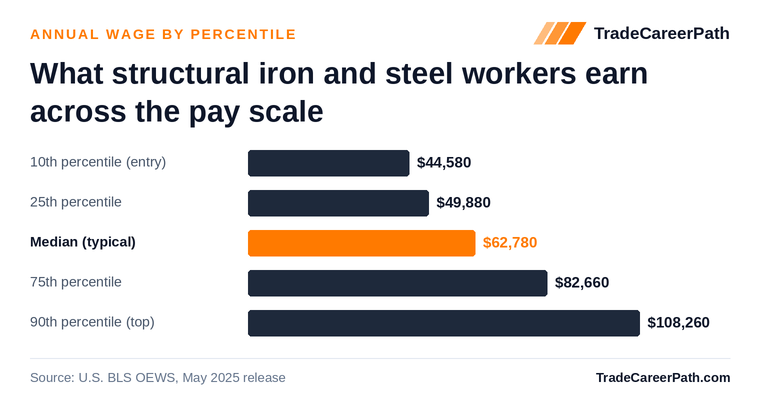
| Percentile | Annual wage |
|---|---|
| 10th | $44,580 |
| 25th | $49,880 |
| 50th (median) | $62,780 |
| 75th | $82,660 |
| 90th | $108,260 |
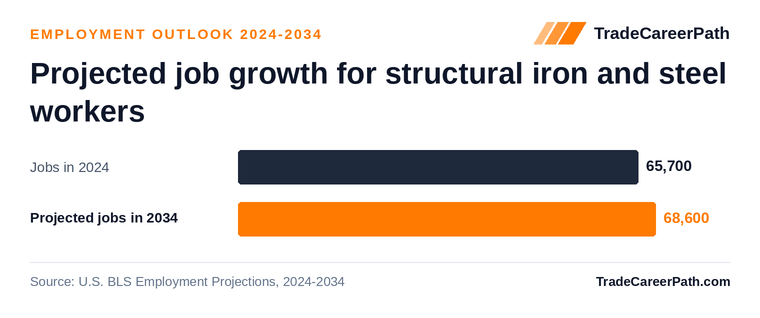
| Year | Employment |
|---|---|
| 2024 | 65,700 |
| 2034 projected | 68,600 |
| Percent change | +4.4% |
Ironworker Salary and Requirements by State
Select your state for local wage data, training options, and requirements:
Alabama · Alaska · Arizona · Arkansas · California · Colorado · Connecticut · Delaware · District of Columbia · Florida · Georgia · Hawaii · Idaho · Illinois · Indiana · Iowa · Kansas · Kentucky · Louisiana · Maine · Maryland · Massachusetts · Michigan · Minnesota · Mississippi · Missouri · Montana · Nebraska · Nevada · New Hampshire · New Jersey · New Mexico · New York · North Carolina · North Dakota · Ohio · Oklahoma · Oregon · Pennsylvania · Rhode Island · South Carolina · South Dakota · Tennessee · Texas · Utah · Vermont · Virginia · Washington · West Virginia · Wisconsin · Wyoming
Workplace Safety Snapshot
BLS Survey of Occupational Injuries and Illnesses data (2023-2024) report approximately 246.4 days-away, restricted, or transfer cases per 10,000 full-time-equivalent workers in structural iron and steel workers (about 2.46 per 100 FTE). Source: BLS Survey of Occupational Injuries and Illnesses, Table R98.
Frequently Asked Questions
How long does ironworker training take?
It typically takes typically 6 months to 2 years of training. The most common entry path is through a certificate or associate degree program. A high school diploma or GED is generally required to get started.
How much do ironworkers make?
The median annual salary for ironworkers is $62,780 according to the Bureau of Labor Statistics (May 2025). Entry-level workers earn around $44,580, while those in the 90th percentile earn over $108,260. Pay varies by state, experience, and specialization.
What is the job outlook for ironworkers?
The Bureau of Labor Statistics projects 4.6% employment growth for this occupation from 2024 to 2034, which is about as fast as average. Approximately 1,500 job openings are expected each year due to growth, retirements, and workers leaving the field.
Do you need a college degree to work as an ironworker?
No. A college degree is not required to work as an ironworker. Most people enter the field through a certificate or associate degree program. A high school diploma or GED is typically the only educational prerequisite.
Which states pay ironworkers the most?
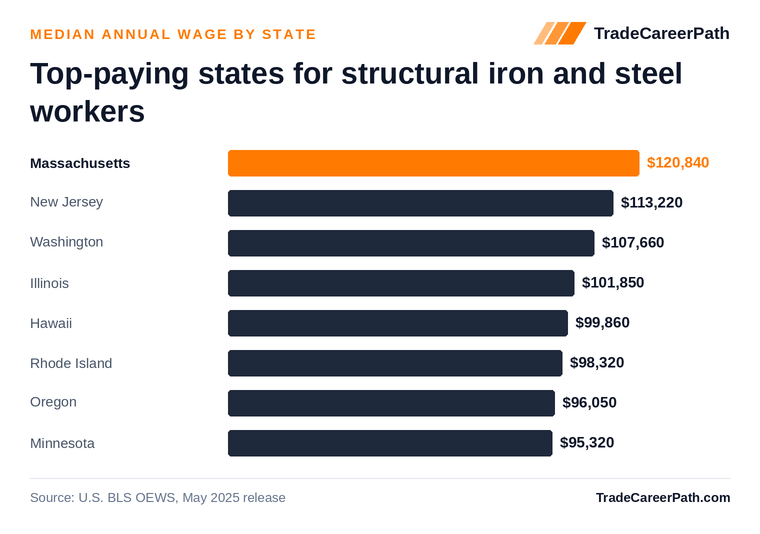
According to the U.S. Bureau of Labor Statistics (May 2025 OEWS), the highest-paying states for ironworkers are Massachusetts, New Jersey, and Washington. Median annual wages: Massachusetts ($120,840); New Jersey ($113,220); Washington ($107,660).
Which states employ the most ironworkers?
BLS reports the largest concentrations of ironworkers in Texas, California, and Arizona. Employment levels: Texas (9,700 workers); California (7,110 workers); Arizona (3,980 workers) (May 2025).
How much do experienced ironworkers earn?
The top 10% of ironworkers earn more than $108,260 per year, according to BLS Occupational Employment and Wage Statistics (May 2025). Experienced workers in this band typically hold senior credentials, supervisory roles, or specialty certifications.
What is entry-level pay for ironworkers?
BLS reports the bottom 10% of ironworkers earn under $44,580 per year. New workers often start near this level and see pay rise as they accumulate experience and credentials.
How many ironworkers work in the United States?
BLS reports approximately 68,380 ironworkers employed nationwide as of May 2025.
How many job openings are expected for ironworkers each year?
BLS projects approximately 5,500 openings per year for ironworkers from 2024 through 2034, including new positions, retirements, and workers transitioning out. The occupation is projected to grow 4.4% from 2024 to 2034, classified as about as fast as average growth.
How much do ironworkers make per hour?
The median hourly wage for ironworkers is $30.18, according to BLS (May 2025). Hourly pay ranges from about $21.43 (bottom 10%) to $52.05 (top 10%).
How Ironworker Pay Compares to Similar Trades
Side-by-side comparison of Ironworker and the closest related careers, based on U.S. Bureau of Labor Statistics data (May 2025 OEWS + 2024-2034 Employment Projections).
| Career | Median Pay | 10-Year Growth | Annual Openings |
|---|---|---|---|
| Ironworker this guide | $62,780 | +4.4% | 5,500 |
| Welding | $53,750 | +2.2% | 45,600 |
| Boilermaker | $76,410 | -2.4% | 800 |
| Construction Worker | $47,120 | +7.3% | 129,400 |
| Sheet Metal Worker | $61,800 | +2.4% | 10,600 |
Source: BLS Occupational Employment and Wage Statistics + BLS Employment Projections.
Sources
- U.S. Bureau of Labor Statistics, Occupational Employment and Wage Statistics (May 2025)
- U.S. Bureau of Labor Statistics, Employment Projections 2024-2034
- U.S. Bureau of Labor Statistics, Survey of Occupational Injuries and Illnesses (2023-2024, Table R98)
- U.S. Department of Labor, Wage and Hour Division, Davis-Bacon General Wage Determinations (2026)
Ironworker Salary by State
About this guide: Researched and written by the TradeCareerPath Editorial Team. Our editorial team researches and sources every trade school and career guide using federal labor and education data, including BLS OEWS and Employment Projections, DOL apprenticeship records, IPEDS, College Scorecard, and state licensing boards. We follow the editorial standards documented at /editorial-policy/.
Data sources
Figures on this page are sourced from the federal and state datasets below. Methodology: how we rank and source data.
| Data | Provider | Vintage |
|---|---|---|
| Occupational Employment and Wage Statistics (OEWS) | U.S. Bureau of Labor Statistics | May 2025 |
| Employment Projections | U.S. Bureau of Labor Statistics | 2024-2034 |
| Integrated Postsecondary Education Data System | National Center for Education Statistics (IPEDS) | 2024 |
| College Scorecard (school-level outcomes) | U.S. Department of Education | latest release |
| College Scorecard (field-of-study earnings) | U.S. Department of Education | latest release (updated 2026-06-12) |
| Occupational licensing requirements | CareerOneStop (U.S. Department of Labor) | latest release (updated 2026-02-22) |
| Registered apprenticeship programs | CareerOneStop / Apprenticeship.gov (U.S. Department of Labor) | latest release (updated 2025-10-25) |
| O*NET occupation profiles (skills, tasks, tools, job zones) | U.S. Department of Labor (O*NET / Employment & Training Admin.) | O*NET 29.1 (updated 2026-06-13) |