
How to Become a Jewelry Designer in 2026
Is Jewelry Designer Right for You?
The U.S. Department of Labor's O*NET profile for Jewelers and Precious Stone and Metal Workers (SOC 51-9071) describes the work this way: Design, fabricate, adjust, repair, or appraise jewelry, gold, silver, other precious metals, or gems.
What the work involves
- Position stones and metal pieces, and set, mount, and secure items in place, using setting and hand tools.
- Smooth soldered joints and rough spots, using hand files and emery paper, and polish smoothed areas with polishing wheels or buffing wire.
- Create jewelry from materials such as gold, silver, platinum, and precious or semiprecious stones.
- Make repairs, such as enlarging or reducing ring sizes, soldering pieces of jewelry together, and replacing broken clasps and mountings.
- Clean and polish metal items and jewelry pieces, using jewelers' tools, polishing wheels, and chemical baths.
Skills and knowledge that matter
Skills: Speaking, Critical Thinking, Active Listening, Time Management, Social Perceptiveness, Reading Comprehension.
Knowledge: Customer and Personal Service, Production and Processing, Design, Mechanical.
Tools and technology you may use
Tools: Adjustable bench vises, Air compressors, Automatic lathes, Awl sets, Bail pliers, Ball peen hammers.
Technology: Graphics or photo imaging software, Computer aided design CAD software, Customer relationship management CRM software, Adobe Illustrator, Adobe Photoshop, Intuit QuickBooks.
Typical preparation
O*NET Job Zone Three (Medium Preparation Needed). Most occupations in this zone require training in vocational schools, related on-the-job experience, or an associate's degree. Employees in these occupations usually need one or two years of training involving both on-the-job experience and informal training with experienced workers. A recognized apprenticeship program may be associated with these occupations.
Interest fit
O*NET interest profile: Realistic, Artistic, Conventional. People who enjoy hands-on, practical work with tools, machines, plants, or materials often find this occupation a good fit.
Source: O*NET 29.1 (updated 2026-06-13)
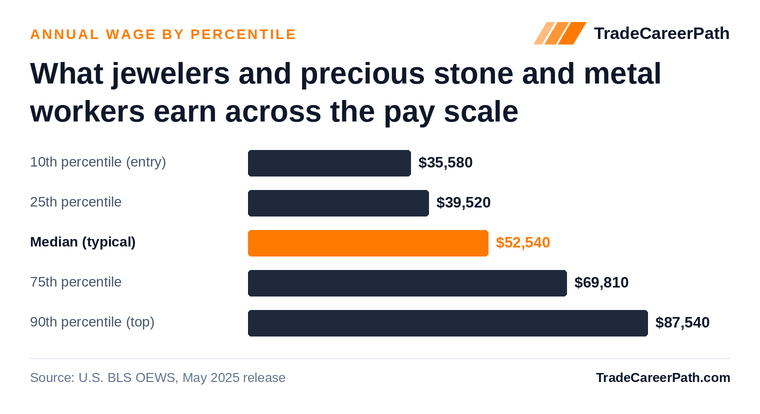
Quick answer: Training as a jewelry designer usually takes 6 months to 2 years. You complete a jewelry design certificate or associate degree ($3,000 to $15,000), build bench skills through workshops or an apprenticeship, and can earn an optional credential such as the GIA Graduate Gemologist diploma. No license is required to work as a jewelry designer. The median wage for jewelers and precious stone and metal workers is $52,540 per year ($25.26/hour), and there are about 4,000 openings nationwide each year (BLS, May 2025).
Jewelry designers turn ideas into wearable pieces, working with metals, gemstones, and modern materials to create rings, necklaces, and custom commissions. The work blends hand craftsmanship with digital design, and you can enter the field through short training programs rather than a four-year degree.
How to Become a Jewelry Designer
Most people enter the field in about six months to two years, depending on the training path they choose. There is no license to earn, so you build the career through education, hands-on bench experience, optional certification, and a strong portfolio.
1. Earn a high school diploma or GED
A high school diploma or GED is the baseline for most jewelry design certificate and associate programs. Before you enroll, it helps to develop the skills the craft depends on. Art and drawing classes train your eye for proportion, color, and composition, while basic geometry and measurement come into play constantly at the bench. If your school offers shop, metalworking, or computer-aided design courses, take them, since they preview the fabrication and CAD work you will do later. Comfort with computers matters too, because much of modern jewelry design happens in 3D modeling software before a piece is ever cast. If you already hold a diploma or a degree in another field, you can move directly to training. Career changers often bring valuable skills in business, marketing, or fine art that translate well into a design or studio career.
2. Complete a jewelry design program
This is the core of your training, and you have a few formats to choose from. Certificate programs run roughly 6 to 12 months and focus on practical bench and design skills, which suits people who want to start working quickly. Associate degree programs take about 2 years and add general education alongside the technical coursework. A bachelor’s degree in fine arts or industrial design takes about four years and can help with senior creative or managerial roles. Typical coursework covers gemology, metalworking and fabrication, stone setting, design theory, wax carving, and computer-aided design (CAD). For gemology specifically, the Gemological Institute of America (GIA) is the industry standard and offers both campus and distance programs. When comparing schools, weigh the lab and bench time they provide, since hands-on practice is what builds real skill. Costs typically range from about $3,000 to $15,000 depending on the program and school.
3. Gain hands-on experience
Coursework gives you the foundation, but employers and clients want to see that you can actually make jewelry. Look for workshops, internships, or an apprenticeship under an experienced jeweler, where you can practice fabrication, soldering, stone setting, casting, and repair on real pieces. If a formal placement is not available, an entry-level role in a jewelry shop or repair counter gets you inside the trade and lets you learn the daily workflow. As you go, save photos of your best work, because a visual record of finished pieces is the single most persuasive thing you can show. Repair and bench experience is especially valuable, since the BLS occupation covers jewelers and precious stone and metal workers, and steady demand exists for skilled hands who can size, fix, and restore jewelry.
4. Consider professional certification
Certification is voluntary for jewelry designers, but a recognized credential can build client trust and set you apart with employers. The most widely respected option is the Graduate Gemologist (GG) diploma from the Gemological Institute of America (GIA), which covers diamond and colored-stone grading and identification. GIA also offers a Jewelry Design and Technology program for design-focused training. Membership in the Manufacturing Jewelers and Suppliers of America (MJSA) connects you to industry resources, suppliers, and continuing education, which is useful whether you work for a studio or run your own bench. Certification exam fees typically run about $150 to $500 per credential. None of these are legally required, so choose the credential that matches your specialty, whether that is gemology, design, or production.
5. Build a portfolio and find work
A strong portfolio is the currency of the jewelry trade. Photograph your finished pieces in good lighting, show a range of techniques and materials, and include any custom or commission work that demonstrates your range. With a portfolio in hand, you can apply to jewelry manufacturers, design studios, custom shops, and repair counters, or you can market your own work directly through social media, craft markets, and online marketplaces like Etsy. Networking through groups such as MJSA and attending trade shows helps you find clients, suppliers, and openings. Over time, experience and a recognizable style can lead to lead designer, master jeweler, or studio-owner roles.
What Jewelry Designers Do
Jewelry designers conceptualize, craft, and repair pieces using a mix of handcrafting, 3D modeling, and metalworking. Some specialize in fine jewelry, while others focus on fashion pieces or custom design for individual clients. The BLS groups this work under “Jewelers and Precious Stone and Metal Workers,” which also covers bench jewelers who size, set, and repair pieces.
Typical Responsibilities
- Sketch, design, or model jewelry concepts
- Create prototypes using CAD software or traditional wax carving
- Select metals, gems, and materials
- Oversee production and finishing of jewelry pieces
- Work directly with clients on custom orders
- Repair or restore damaged jewelry
Successful designers balance artistry with precision craftsmanship and business sense.
Key Skills and Traits for Success
- Creativity and artistic vision
- Manual dexterity and attention to detail
- Knowledge of gems, metals, and materials
- CAD design and 3D modeling skills
- Patience and precision
- Business or marketing know-how for self-employed designers
Common Work Settings
- Jewelry manufacturers and design studios
- Independent jewelry boutiques
- Custom design and repair shops
- Online jewelry brands and e-commerce businesses
- Self-employed or freelance workshops
Education and Certification Paths
| Pathway | Typical Duration | Outcome |
|---|---|---|
| Jewelry Design Certificate | 6 to 12 months | Entry-level jeweler or assistant |
| Associate Degree in Jewelry Design | 2 years | Professional designer or technician |
| GIA Graduate Gemologist or Design Program | Variable | Industry-recognized credential |
| Bachelor’s in Fine Arts or Industrial Design | 4 years | Advanced creative or managerial roles |
Career Growth and Advancement
With experience, jewelry designers can advance into:
- Master Jeweler or Lead Designer
- CAD Modeler or Gemologist
- Jewelry Production Manager
- Studio Owner or Brand Founder
Designers who combine craftsmanship with digital modeling and marketing skills have the strongest earning potential.
Cost and Duration of Training
- Program cost: about varies by school, format and location depending on the school or certification
- Time to complete: six months to two years
- Certification exam fees: typically $150 to $500 per credential
Pros and Cons
Pros
- Creative and hands-on profession
- High potential for entrepreneurship
- Flexible work settings and styles
- Growing interest in custom and ethical jewelry
Cons
- Highly competitive market
- Requires precision and patience
- Income can fluctuate for freelancers
Find Jewelry Design Schools Near You
Quick Facts: Jewelry Designer Salary, Education, and Outlook
Industry Organizations & Certifying Bodies
These are the recognized national organizations, unions, certifying bodies, and regulatory authorities that shape this trade. They issue the credentials, sponsor the apprenticeships, publish the codes, and represent workers and employers.
- Gemological Institute of America (GIA) Industry-standard gemology and jewelry education and credentials.
- Manufacturing Jewelers and Suppliers of America (MJSA) Trade association for jewelry manufacturers and designers.
Wage and Employment Charts
Jewelry Designer Salary and Requirements by State
Select your state for local wage data, training options, and requirements:
Alabama · Alaska · Arizona · Arkansas · California · Colorado · Connecticut · Delaware · District of Columbia · Florida · Georgia · Hawaii · Idaho · Illinois · Indiana · Iowa · Kansas · Kentucky · Louisiana · Maine · Maryland · Massachusetts · Michigan · Minnesota · Mississippi · Missouri · Montana · Nebraska · Nevada · New Hampshire · New Jersey · New Mexico · New York · North Carolina · North Dakota · Ohio · Oklahoma · Oregon · Pennsylvania · Rhode Island · South Carolina · South Dakota · Tennessee · Texas · Utah · Vermont · Virginia · Washington · West Virginia · Wisconsin · Wyoming
Workplace Safety Snapshot
BLS Survey of Occupational Injuries and Illnesses data (2023-2024) report approximately 25.6 days-away, restricted, or transfer cases per 10,000 full-time-equivalent workers in jewelers and precious stone and metal workers (about 0.26 per 100 FTE). Source: BLS Survey of Occupational Injuries and Illnesses, Table R98.
Frequently Asked Questions
How long does jewelry designer training take?
It typically takes 6 months to 2 years of training. The most common entry path is a certificate program (6 to 12 months) or an associate degree (about 2 years). A high school diploma or GED is generally required to get started.
Do you need a college degree to work as a jewelry designer?
No. A college degree is not required to work as a jewelry designer. Most people enter the field through a certificate or associate degree program and build a portfolio. A high school diploma or GED is typically the only educational prerequisite.
How much does jewelry design training cost?
Programs typically cost about $3,000 to $15,000 depending on the format and school, with certificate programs generally costing less than degree programs. Optional certification exams usually add a fee of roughly $150 to $500 per credential.
Is certification required to work as a jewelry designer?
No. Certification is voluntary in most cases rather than legally required. Credentials such as the Graduate Gemologist diploma from the Gemological Institute of America (GIA) can strengthen your resume and help with client trust, but they are optional.
Is it hard to train as a jewelry designer?
Entry is fairly accessible since no license or degree is required, and most people finish training in 6 months to 2 years. The craft itself demands patience, manual dexterity, and an eye for detail, and the market can be competitive, especially for self-employed designers.
Can you study jewelry design online?
Some coursework, including design theory and CAD modeling, is available online, and the Gemological Institute of America (GIA) offers distance education in gemology. Hands-on metalworking and bench skills are usually learned in person through lab time, workshops, or an apprenticeship.
How much do jewelry designers earn?
The median wage for jewelers and precious stone and metal workers is $52,540 per year ($25.26 per hour), according to BLS (May 2025). Pay varies with skill, specialty, location, and whether you work for an employer or run your own studio.
How Jewelry Designer Pay Compares to Similar Trades
Side-by-side comparison of Jewelry Design and Repair and the closest related careers, based on U.S. Bureau of Labor Statistics data (May 2025 OEWS + 2024-2034 Employment Projections).
| Career | Median Pay | 10-Year Growth | Annual Openings |
|---|---|---|---|
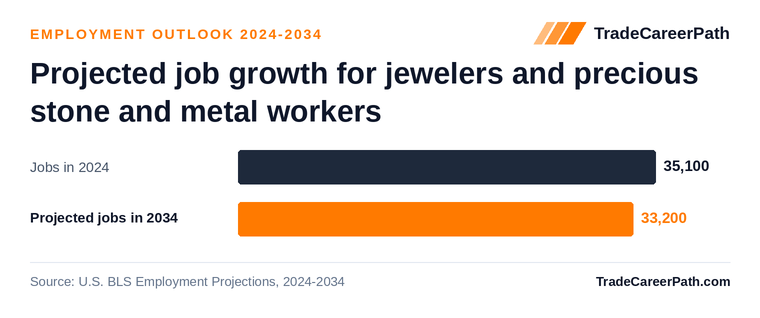
| Jewelry Design and Repair this guide | $52,540 | -5.5% | 4,000 |
| Interior Designer | $67,190 | +3.2% | 7,800 |
| Floral Designer | $37,360 | -5.9% | 5,100 |
| CNC Machinist | $58,750 | - | 29,500 |
| Welding | $53,750 | +2.2% | 45,600 |
Source: BLS Occupational Employment and Wage Statistics + BLS Employment Projections.
Sources
- U.S. Bureau of Labor Statistics, Occupational Employment and Wage Statistics (May 2025)
- U.S. Bureau of Labor Statistics, Employment Projections 2024-2034
- U.S. Bureau of Labor Statistics, Survey of Occupational Injuries and Illnesses (2023-2024, Table R98)
- U.S. Department of Labor, Wage and Hour Division, Davis-Bacon General Wage Determinations (2026)
Jewelry Designer Salary by State
About this guide: Researched and written by the TradeCareerPath Editorial Team. Our editorial team researches and sources every trade school and career guide using federal labor and education data, including BLS OEWS and Employment Projections, DOL apprenticeship records, IPEDS, College Scorecard, and state licensing boards. We follow the editorial standards documented at /editorial-policy/.
Data sources
Figures on this page are sourced from the federal and state datasets below. Methodology: how we rank and source data.
| Data | Provider | Vintage |
|---|---|---|
| Occupational Employment and Wage Statistics (OEWS) | U.S. Bureau of Labor Statistics | May 2025 |
| Employment Projections | U.S. Bureau of Labor Statistics | 2024-2034 |
| Integrated Postsecondary Education Data System | National Center for Education Statistics (IPEDS) | 2024 |
| College Scorecard (school-level outcomes) | U.S. Department of Education | latest release |
| College Scorecard (field-of-study earnings) | U.S. Department of Education | latest release (updated 2026-06-12) |
| Occupational licensing requirements | CareerOneStop (U.S. Department of Labor) | latest release (updated 2026-02-22) |
| Registered apprenticeship programs | CareerOneStop / Apprenticeship.gov (U.S. Department of Labor) | latest release (updated 2025-10-25) |
| O*NET occupation profiles (skills, tasks, tools, job zones) | U.S. Department of Labor (O*NET / Employment & Training Admin.) | O*NET 29.1 (updated 2026-06-13) |