
How to Become a Landscape Architect in 2026
Is Landscape Architect Right for You?
The U.S. Department of Labor's O*NET profile for Landscape Architects (SOC 17-1012) describes the work this way: Plan and design land areas for projects such as parks and other recreational facilities, airports, highways, hospitals, schools, land subdivisions, and commercial, industrial, and residential sites.
What the work involves
- Confer with clients, engineering personnel, or architects on landscape projects.
- Analyze data on conditions such as site location, drainage, or structure location for environmental reports or landscaping plans.
- Inspect landscape work to ensure compliance with specifications, evaluate quality of materials or work, or advise clients or construction personnel.
- Prepare site plans, specifications, or cost estimates for land development.
- Integrate existing land features or landscaping into designs.
Skills and knowledge that matter
Skills: Reading Comprehension, Active Listening, Speaking, Critical Thinking, Complex Problem Solving, Coordination.
Knowledge: Design, Building and Construction, Geography, Engineering and Technology.
Tools and technology you may use
Technology: Document management software, Graphics or photo imaging software, Desktop publishing software, Adobe Acrobat, Adobe Creative Cloud software, Adobe Illustrator.
Typical preparation
O*NET Job Zone Four (Considerable Preparation Needed). Most of these occupations require a four-year bachelor's degree, but some do not. Employees in these occupations usually need several years of work-related experience, on-the-job training, and/or vocational training.
Interest fit
O*NET interest profile: Realistic, Investigative, Artistic. People who enjoy hands-on, practical work with tools, machines, plants, or materials often find this occupation a good fit.
Source: O*NET 31.0 (updated 2026-10-14)
Quick answer: Training as a landscape architect requires a 4-year degree - typically a LAAB-accredited Bachelor of Landscape Architecture (BLA, 4-5 years). The national median pay is $79,870 per year, and BLS projects +4.4% employment change from 2025 to 2035 (BLS OEWS, May 2025; BLS Employment Projections, 2025-35).
Landscape Architect at a Glance
| Metric | Detail | Source |
|---|---|---|
| Median annual wage | $79,870 | BLS OEWS, May 2025 |
| Typical wage range | $54,770 (10th pct) - $130,190 (90th pct) | BLS OEWS, May 2025 |
| Employment | 19,600 nationwide | BLS OEWS, May 2025 |
| Projected growth (2025-35) | +4.4%, about 1,700 openings per year | BLS Employment Projections, 2025-35 |
| Typical education | LAAB-accredited Bachelor of Landscape Architecture (BLA, 4-5 years) | BLS Occupational Outlook Handbook |
| License / certification | State license via the LARE exam (required in every state) | State licensing boards |
What Does a Landscape Architect Do?
Landscape architects design outdoor spaces - site plans, grading and drainage, planting design, hardscapes, and stormwater systems - and produce the stamped construction documents that landscaping and hardscape crews build from. It is the design-and-liability side of the same work: instead of setting the pavers, you decide where the wall goes and how the site drains.
Day to day, the work splits by sub-specialty. A residential or design-build landscape architect meets clients, sketches concepts, and details patios, pools, walls, and planting plans a crew can price and build. A public-sector or planning-side landscape architect works on parks, streetscapes, campuses, and trails - much of it coordination with civil engineers, architects, and city review boards. A stormwater and site-development specialist lives in grading plans, detention calculations, and erosion-control details, because in most jurisdictions the landscape architect’s stamp carries the site plan through permitting. Across all of it, the routine mixes CAD and GIS documentation, plant and materials selection, cost checking, and construction observation - walking the site to verify the contractor built what the drawings say.
If you are coming from a landscaping or hardscape crew, the shortest way to say it: the crew leader executes the plan and makes it survive the first winter; the landscape architect decides what the plan is and signs for it. The grade stakes, the plant substitutions, the drainage problems you have fixed after someone else’s bad design - those decisions work as your call, and your stamp is what makes them legal.
Skills That Make a Great Landscape Architect
- Site design and master planning
- Grading, drainage, and stormwater design
- Plant science and regional planting knowledge
- Hardscape construction detailing - walls, paving, structures
- CAD and GIS documentation (AutoCAD, Civil 3D, GIS tools)
- Rendering and client presentation - concept sketches sell the work
- Construction-document production and specification writing
- Construction observation: verifying built work against the drawings
Landscape Architect Salary
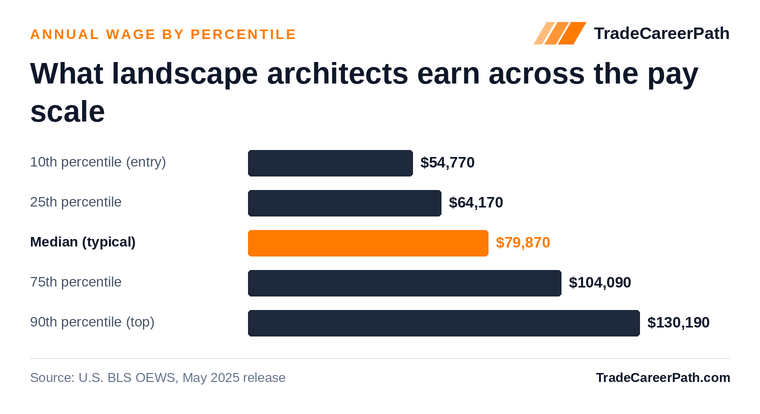
Landscape architecture pays professional wages for work that stays connected to the field. The national median is $79,870 per year, with the 10th percentile - roughly where new graduates start - at $54,770, close to what an experienced crew leader earns. The difference is the ceiling: the 75th percentile is $104,090 and the 90th percentile reaches $130,190 (BLS OEWS, May 2025) - territory hourly landscape work rarely touches.
Where the Jobs and the Money Are
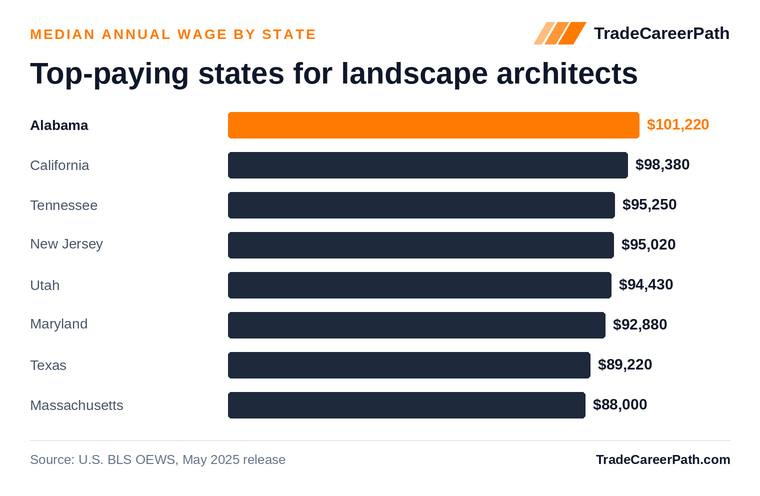
This is a small, distributed profession - 19,600 practitioners nationwide - and pay and employment do not line up the way you might expect. Alabama tops the median-wage table, while the employment clusters follow construction activity: California leads with 2,310 landscape architects, then Texas at 1,450 and Florida at 1,210 (BLS OEWS, May 2025).
| State | Median annual wage | Employment |
|---|---|---|
| Alabama | $101,220 | 230 |
| California | $98,380 | 2,310 |
| Tennessee | $95,250 | 260 |
| New Jersey | $95,020 | 360 |
| Utah | $94,430 | 90 |
California is the one state where high pay and a deep job market coincide - its concentration of landscape architects matches the national average exactly, on top of the largest headcount. The other high-wage states are thinner markets: Alabama, Tennessee, New Jersey, and Utah all employ landscape architects at below-average concentration, which is partly why the few who practice there command a premium. Florida is the opposite case - 1,210 jobs at near-average concentration, but a median of $79,650, right at the national figure. Follow the big construction states for employer options, or a thin market for scarcity pricing.
How to Become a Landscape Architect
1. Earn a LAAB-accredited degree
A 4-5-year Bachelor of Landscape Architecture, with accreditation from the Landscape Architectural Accreditation Board. Accreditation is the non-negotiable: most state boards require an LAAB degree to sit for the LARE, so an unaccredited “landscape design” program can leave you unable to license. If you already hold a bachelor’s in another field, the 2-3-year Master of Landscape Architecture (MLA) reaches the same license faster. Fully online LAAB programs are rare because of the studio requirement, but hybrid and low-residency formats exist - get a written transfer evaluation before enrolling anywhere.
2. Intern with a licensed firm
Most states require 1-4 years of supervised experience under a licensed landscape architect before you can complete licensure. Treat this as a paid apprenticeship in the office side of the trade: production drafting, planting plans, permit submittals, and site visits. If you are coming off a crew, say so in interviews - firms value candidates who can read a site, talk to contractors, and detail things that can actually be built.
3. Pass the LARE
The Landscape Architect Registration Examination is a four-section exam administered through CLARB covering project and construction management, inventory and analysis, design, and grading, drainage, and construction documentation. The construction-heavy sections reward field experience directly - the grading and drainage material is the job you have already watched go right and wrong. Sections can be taken one at a time and spread over a year or more.
4. Get your state license
Every state licenses the landscape architect title, and most license the practice as well - no license, no stamp, no title. Requirements vary by state in the education-experience mix, so check your board early, and establish a CLARB council record as you go for reciprocity between states.
5. Advance
The ladder runs from production designer to project landscape architect - running jobs and client relationships - to associate and principal. The other fork is ownership: a licensed landscape architect who came up through the trades is unusually well positioned to run a design-build firm, selling both the design fee and the construction contract. Public-sector roles with parks and transportation agencies are the stability play.
Career Ladder: Titles and Realistic Pay
The BLS wage percentiles map onto how landscape architecture careers actually progress. Use this as a sanity check on offers, not a guarantee:
| Stage | Typical titles | Years in | Realistic pay (BLS OEWS, May 2025) |
|---|---|---|---|
| Entry level | Landscape designer, production designer, intern landscape architect | 0-3 | ~$54,770-$64,170 (10th-25th pct) |
| Mid-career | Licensed landscape architect, project landscape architect | 3-10 | ~$79,870 (median) |
| Senior | Senior landscape architect, associate, studio lead | 10-15 | ~$104,090 (75th pct) |
| Principal / ownership | Principal, design director, design-build firm owner | 15+ | $130,190+ (90th pct) |
Two notes for career changers. First, trade experience compresses the entry band: former crew leaders are trusted with construction documents and site observation earlier than design-school graduates because they need less supervision around real construction. Second, the 90th-percentile figure understates the top of this field - principals and design-build owners earn project profit, not just salary, so ownership income can run well past the wage data shown here.
Do You Need a License?
Yes - licensure here is genuinely mandatory, not optional. Every state licenses the landscape architect title, and most regulate the practice itself: without a license you cannot use the title or stamp the site plans, grading plans, and construction documents that permitting requires. The standard path in most states is:
- LAAB-accredited degree - the BLA or MLA; a few states accept extended supervised experience in place of some education, but that route is slow and travels poorly.
- Supervised experience - 1 to 4 years under a licensed landscape architect, depending on the state.
- The LARE - the four-section national exam administered through CLARB.
Unlicensed practitioners can work as landscape designers - and many do good residential work - but the stamp is what unlocks public projects, permit submittals, and the fee levels that come with legal responsibility.
Why an Online Degree Works for This Career
Landscaping and hardscape crew leaders already know plants, grading, and what survives a freeze-thaw cycle. The LAAB-accredited degree plus the LARE exam converts that field knowledge into stamped drawings and design fees. Be realistic about format: fully online LAAB programs are scarce because studio courses resist it, but hybrid and low-residency options serve working adults, and the internship years can overlap a part-time degree. A design-build firm that wants a licensed landscape architect on staff has a direct business reason to fund yours - ask.
Job Outlook for 2026 and Beyond
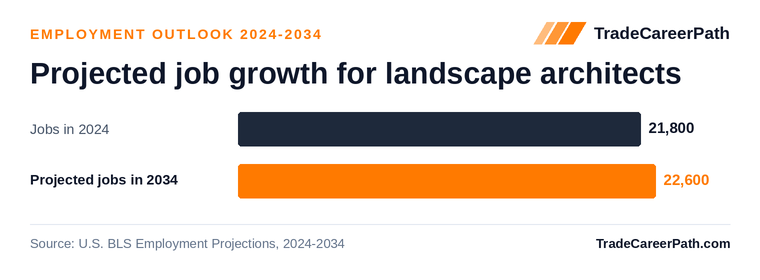
BLS projects landscape architect employment to grow +4.4% from 2025 to 2035 - from 23,500 to 24,500 jobs - with about 1,700 openings per year once retirements and occupation changes are counted (BLS Employment Projections, 2025-35). The latest wage data (OEWS, May 2025) puts the median at $79,870, essentially flat against the 2024 figure of $79,660 - steady rather than spiking.
The honest read: this is a small, stable profession, not a boom field. The number that matters for a career changer is the openings figure - 1,700 seats a year against 19,600 practitioners means real annual turnover, and the licensure wall keeps the candidate pool thin. Demand drivers are durable: stormwater regulation keeps pulling site plans toward the landscape architect’s stamp, municipalities keep funding parks and streetscapes, and climate-driven planting and water-management work is growing.
Cost and Time to Complete the Degree
For landscape architects, the credential is: LAAB-accredited Bachelor of Landscape Architecture (BLA, 4-5 years). The accredited BLA runs 4 to 5 years, followed by 1 to 4 years of supervised experience and the LARE exams before licensure - plan on 6 to 9 years from enrollment to license, though the experience years are paid work, not tuition. Transfer credit is the other lever: prior college, military training, and horticulture or construction coursework can be worth meaningful credit at transfer-friendly schools, so get a written transfer evaluation before enrolling anywhere. If you already hold any bachelor’s degree, price the 2-3-year MLA against a second bachelor’s - it is usually the faster buy. Costs vary widely by school type; in-state public programs are the value benchmark, and employer tuition assistance is worth negotiating at design-build firms.
Pros and Cons of Training as a Landscape Architect
Pros
- Median pay of $79,870 nationally, with the 90th percentile at $130,190 (BLS OEWS, May 2025)
- BLS projects +4.4% employment growth through 2035, about 1,700 openings per year
- Field experience from the trades is a genuine hiring advantage
- Licensure wall keeps competition thin; ownership and design-build paths add income beyond the wage data
Cons
- Requires a 4-5-year LAAB-accredited degree plus 1-4 years of supervised experience
- Entry-level pay starts near $54,770 at the 10th percentile
- Licensing hurdle: State license via the LARE exam (required in every state)
- Small profession - 19,600 jobs nationwide - so thin markets in some states
Frequently Asked Questions
Can a landscaper work as a landscape architect?
Yes - construction and horticulture experience is a real advantage in a licensure track that many students enter with neither. The path is the LAAB-accredited degree, supervised experience, and the LARE exam.
How much do landscape architects make?
The national median annual wage for landscape architects is $79,870 (BLS OEWS, May 2025). The top 10% earn $130,190 or more, while entry-level pay starts around $54,770.
What is the job outlook for landscape architects?
BLS projects employment of landscape architects to change by +4.4% from 2025 to 2035 (BLS Employment Projections, 2025-35).
How long does landscape architect training take?
The LAAB-accredited Bachelor of Landscape Architecture takes 4 to 5 years, followed by 1 to 4 years of supervised experience depending on the state, then the LARE exams. Plan on 6 to 9 years from enrollment to license - less if transfer credit from prior college or horticulture coursework shortens the degree.
Is landscape architecture hard?
The degree is studio-heavy rather than math-heavy: long design-project hours, grading and drainage calculations, plant science, and construction detailing. People coming from landscaping and hardscape work usually find the construction and plant courses the easy part - the adjustment is design critique and documentation standards.
Should I get a BLA or an MLA?
If you have no bachelor's degree, the LAAB-accredited BLA is the direct route. If you already hold a bachelor's in another field, the Master of Landscape Architecture (MLA, usually 2-3 years) reaches the same license faster than starting a second bachelor's. Both satisfy the education requirement in most states as long as the program is LAAB-accredited.
Can you train as a landscape architect without a degree?
In most states, no - the title is licensed, and the standard path requires an LAAB-accredited degree plus the LARE. A handful of states allow extended supervised experience to substitute for some education, but the experience-only route is slow and does not transfer well between states. Without a license you can still work as a landscape designer, but you cannot stamp drawings or use the title.
Do landscape architects need a license?
Yes - every state licenses the title, and most also license the practice. The sequence is the LAAB-accredited degree, 1 to 4 years of supervised experience, and the four-section LARE administered through CLARB. A CLARB council record makes the license portable between states.
Landscape Architect Salary and Requirements by State
Alabama · Arizona · Arkansas · California · Colorado · Connecticut · District of Columbia · Florida · Georgia · Idaho · Illinois · Indiana · Iowa · Kansas · Kentucky · Maine · Maryland · Massachusetts · Michigan · Missouri · Montana · Nebraska · Nevada · New Hampshire · New Jersey · New Mexico · New York · North Carolina · Ohio · Oklahoma · Oregon · Pennsylvania · Rhode Island · South Dakota · Tennessee · Texas · Utah · Vermont · Virginia · Washington · Wisconsin
Related Careers and Degree Paths
- Architect - the building-side license track; same studio-degree-exam-license structure
- Civil Engineer - the engineering partner on every site plan; grading and stormwater overlap heavily
- Surveyor - the other licensed site profession; boundary and topographic work feeds every landscape plan
- Construction Manager - the degree path that leads crew leaders to running the whole project instead of designing it
- Interior Designer - the indoor counterpart in design services
Degree and Program Guides
- Online Architecture Degrees - the related professional degree route
Sources
- U.S. Bureau of Labor Statistics, Occupational Employment and Wage Statistics (OEWS), May 2025 - Landscape Architects (SOC 17-1012)
- U.S. Bureau of Labor Statistics, Employment Projections, 2025-35
- U.S. Bureau of Labor Statistics, Occupational Outlook Handbook - education and licensing requirements
Landscape Architect Salary by State
About this guide: Researched and written by the TradeCareerPath Editorial Team. Our editorial team researches and sources every trade school and career guide using federal labor and education data, including BLS OEWS and Employment Projections, DOL apprenticeship records, IPEDS, College Scorecard, and state licensing boards. We follow the editorial standards documented at /editorial-policy/.
Data sources
Figures on this page are sourced from the federal and state datasets below. Methodology: how we rank and source data.
| Data | Provider | Vintage |
|---|---|---|
| Occupational Employment and Wage Statistics (OEWS) | U.S. Bureau of Labor Statistics | May 2025 |
| Employment Projections | U.S. Bureau of Labor Statistics | 2025-2035 |
| Integrated Postsecondary Education Data System | National Center for Education Statistics (IPEDS) | 2024 |
| College Scorecard (school-level outcomes) | U.S. Department of Education | latest release |
| College Scorecard (field-of-study earnings) | U.S. Department of Education | latest release (updated 2026-06-12) |
| Occupational licensing requirements | CareerOneStop (U.S. Department of Labor) | latest release (updated 2026-02-22) |
| Registered apprenticeship programs | CareerOneStop / Apprenticeship.gov (U.S. Department of Labor) | latest release (updated 2025-10-25) |
| O*NET occupation profiles (skills, tasks, tools, job zones) | U.S. Department of Labor (O*NET / Employment & Training Admin.) | O*NET 31.0 (updated 2026-10-14) |