
How to Become a Lineman / Lineworker (2026 Guide)
Is Lineman / Lineworker Right for You?
The U.S. Department of Labor's O*NET profile for Electrical Power-Line Installers and Repairers (SOC 49-9051) describes the work this way: Install or repair cables or wires used in electrical power or distribution systems. May erect poles and light or heavy duty transmission towers.
What the work involves
- Adhere to safety practices and procedures, such as checking equipment regularly and erecting barriers around work areas.
- Drive vehicles equipped with tools and materials to job sites.
- Open switches or attach grounding devices to remove electrical hazards from disturbed or fallen lines or to facilitate repairs.
- Climb poles or use truck-mounted buckets to access equipment.
- Install, maintain, and repair electrical distribution and transmission systems, including conduits, cables, wires, and related equipment, such as transformers, circuit breakers, and switches.
Skills and knowledge that matter
Skills: Troubleshooting, Active Listening, Operations Monitoring, Operation and Control, Monitoring, Systems Analysis.
Knowledge: Building and Construction, English Language, Education and Training, Public Safety and Security.
Tools and technology you may use
Tools: Air compressors, Air hammers, All terrain vehicles ATV, Allen wrenches, Ammeters, Arc suppression blankets.
Technology: Computer aided design CAD software, Electronic mail software, Geographic information system, Bentley MicroStation, Microsoft Excel, Microsoft Office software.
Typical preparation
O*NET Job Zone Two (Some Preparation Needed). These occupations usually require a high school diploma. Employees in these occupations need anywhere from a few months to one year of working with experienced employees. A recognized apprenticeship program may be associated with these occupations.
Interest fit
O*NET interest profile: Realistic, Conventional, Investigative. People who enjoy hands-on, practical work with tools, machines, plants, or materials often find this occupation a good fit.
Source: O*NET 29.1 (updated 2026-06-13)
Want to work as a lineworker? A lineworker apprenticeship is typically 3-4 years, and training programs can last 6-12 months. This guide covers job duties, training options, certifications, and safety expectations.
If you’re not afraid of heights, storms, or high-voltage lines, you might be the kind of person utilities rely on.
Lineworkers install, repair, and maintain the power grid. When the lights go out, they climb poles and string wires, often during storms, disasters, or extreme heat.
Quick answers
What does a lineworker do?
Lineworkers install, repair, and maintain the power grid. They respond to power outages and storm damage and work on overhead and underground lines, transformers, substations, and utility poles.
How long does lineworker training take?
A lineworker apprenticeship is typically 3-4 years of paid, hands-on training. Some people also attend a lineworker training program that lasts 6-12 months.
What training options are listed on this page?
This page lists pre-apprenticeship line schools, utility company programs, IBEW union apprenticeships, and community college electrical tech tracks.
What certifications are commonly required?
Certifications vary by employer, but this page lists OSHA 10/30, CPR/First Aid, pole top and bucket rescue training, NCCER, and a CDL (Class A or B). It also notes that many employers require drug testing before starting.
What is the job like day to day?
It is physical, safety-focused work that can include climbing poles, using bucket trucks, and working at height with harnesses. The page notes long hours and emergency storm call-outs can be part of the job.
At a glance
- Typical apprenticeship: 3-4 years of paid training
- Training program length (if you choose one): 6-12 months
- Common work: overhead and underground lines, transformers, substations, utility poles, and outage response
- Common requirements: OSHA safety training, CPR/First Aid, rescue training, and a CDL; drug testing may be required
- Work conditions: heights, storms, and emergency call-outs—
What Do Lineworkers Do?
Lineworkers (sometimes called linemen or electrical utility workers) keep power flowing across neighborhoods, cities, and entire regions.
They typically:
- Install and repair high-voltage overhead and underground lines
- Respond to power outages and storm damage
- Work with transformers, substations, and utility poles
- Operate bucket trucks, climb poles, and use safety harnesses
- Read blueprints and follow safety protocols
“Lineworkers are first responders for the electric grid. When everyone else runs from a storm, they head into it.” - Brad Fishbein, Skilled Trades Educator
How to Become a Lineworker (5 Steps)
Earn your high school diploma or GED
Basic math, physics, and electrical aptitude are essential.Attend a lineworker training program
Lasts 6-12 months and covers climbing, safety, and power systems.Apply for a lineworker apprenticeship
3-4 years of paid training with hands-on electrical grid work.Pass your climbing and safety assessments
These ensure you’re physically ready and know how to work at height.Earn your journeyman lineworker status
This certifies you as a skilled grid professional with broad job eligibility.
Lineworker Training Options
- Pre-Apprenticeship Line Schools: Great for beginners (NLC, SLTC, VVC, etc.)
- Utility Company Programs: Run by employers like PG&E, Duke Energy, or Oncor
- IBEW Union Apprenticeships: High standards, paid training, and benefits
- Community College Electrical Tech Tracks: Broader education for grid careers
Many employers require a CDL (Commercial Driver’s License) and drug testing before starting.
Required Certifications
Certifications vary by employer but often include:
- OSHA 10/30 for Construction Safety
- CPR/First Aid Certification
- Pole Top & Bucket Rescue Training
- NCCER Power Line Worker Certification
- CDL (Class A or B)
Physical fitness and fearlessness at 30-60 feet in the air are just as important as your credentials.
Skills That Make Great Lineworkers
- Physical endurance and balance
- Electrical and mechanical aptitude
- Ability to work under pressure or in extreme conditions
- Teamwork and communication skills
- Strict adherence to safety protocols
Lineworker Salary Snapshot
U.S.10,700 openings/yr
Pros & Cons of Being a Lineworker
Pros
- High pay without a college degree
- Travel and outdoor work opportunities
- Job security with power companies and contractors
- Clear path to journeyman and foreman roles
Cons
- Dangerous and physically demanding
- Long hours and emergency storm call-outs
- Requires travel and remote work at times
Start Your Lineworker Career
If you’re ready to climb poles, ride storms, and keep America’s grid alive, there is a power company that needs you.
Power up your future. Work as a lineworker.
Industry Organizations & Certifying Bodies
These are the recognized national organizations, unions, certifying bodies, and regulatory authorities that shape this trade. They issue the credentials, sponsor the apprenticeships, publish the codes, and represent workers and employers.
- International Brotherhood of Electrical Workers (IBEW) Represents most utility lineworkers; sponsors apprenticeships.
- Northwest Lineman College Major dedicated lineworker training institution.
- Edison Electric Institute (EEI) Investor-owned utility association with lineworker workforce programs.
- OSHA 1910.269 Standard Federal safety standard for electric power transmission and distribution work.
Federal Prevailing Wages by State
The U.S. Department of Labor sets Davis-Bacon prevailing wages that contractors must pay on federally funded construction projects. These are minimum hourly rates, not averages - actual market pay can be higher. Across 5 states with active 2026 determinations, the average total compensation (base + fringe) for lineworkers is $89.58/hour. Hawaii pays the highest rate ($97.28/hr total), while Nevada reports the lowest active determination ($78.53/hr total).
| State | Base Hourly | Fringe Hourly | Total Hourly | Annualized* |
|---|---|---|---|---|
| Hawaii | $63.90 | $33.38 | $97.28 | $202,342 |
| California | $70.16 | $24.71 | $94.87 | $197,330 |
| Pennsylvania | $54.38 | $34.25 | $88.63 | $184,350 |
| Massachusetts | $58.41 | $30.19 | $88.60 | $184,288 |
| Nevada | $55.17 | $23.36 | $78.53 | $163,342 |
* Annualized total = total hourly × 2,080 hours (40-hour week, 52 weeks). Actual annual pay varies with overtime, project length, and benefits utilization.
Source: U.S. Department of Labor, Wage and Hour Division - Davis-Bacon General Wage Determinations, 2026. Rates reflect the lowest base rate within each statewide determination for lineworker classifications.
Wage and Employment Charts
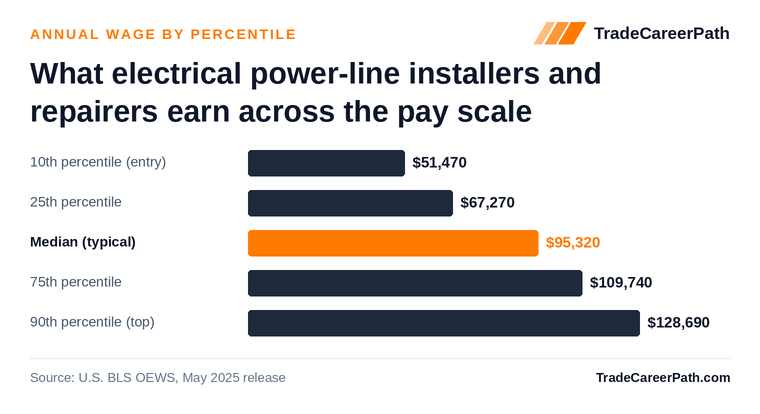
| Percentile | Annual wage |
|---|---|
| 10th | $51,470 |
| 25th | $67,270 |
| 50th (median) | $95,320 |
| 75th | $109,740 |
| 90th | $128,690 |
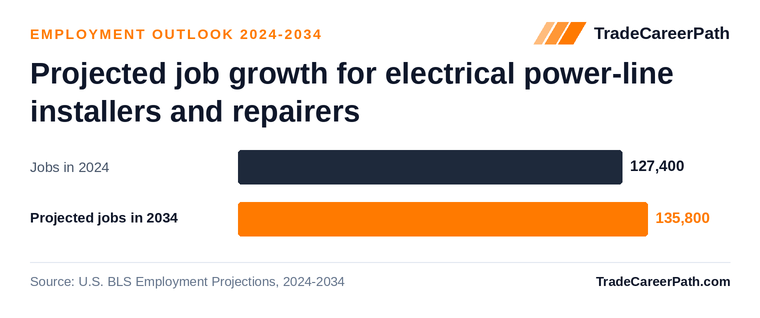
| Year | Employment |
|---|---|
| 2024 | 127,400 |
| 2034 projected | 135,800 |
| Percent change | +6.6% |
Lineworker Salary and Requirements by State
Select your state for local wage data, training options, and requirements:
Alabama · Alaska · Arizona · Arkansas · California · Colorado · Connecticut · Delaware · District of Columbia · Florida · Georgia · Hawaii · Idaho · Illinois · Indiana · Iowa · Kansas · Kentucky · Louisiana · Maine · Maryland · Massachusetts · Michigan · Minnesota · Mississippi · Missouri · Montana · Nebraska · Nevada · New Hampshire · New Jersey · New Mexico · New York · North Carolina · North Dakota · Ohio · Oklahoma · Oregon · Pennsylvania · Rhode Island · South Carolina · South Dakota · Tennessee · Texas · Utah · Vermont · Virginia · Washington · West Virginia · Wisconsin · Wyoming
Workplace Safety Snapshot
BLS Survey of Occupational Injuries and Illnesses data (2023-2024) report approximately 278.8 days-away, restricted, or transfer cases per 10,000 full-time-equivalent workers in electrical power-line installers and repairers (about 2.79 per 100 FTE). Source: BLS Survey of Occupational Injuries and Illnesses, Table R98.
Frequently Asked Questions
How long does lineworker training take?
It typically takes 7 months to 4 years combining line school and apprenticeship. The most common entry path is through lineworker training program followed by a utility apprenticeship. A high school diploma or GED is generally required to get started.
How much do lineworkers make?
The median annual salary for lineworkers is $95,320 according to the Bureau of Labor Statistics (May 2025). Entry-level workers earn around $51,470, while those in the 90th percentile earn over $128,690. Pay varies by state, experience, and specialization.
What is the job outlook for lineworkers?
The Bureau of Labor Statistics projects 6.6% employment growth for this occupation from 2024 to 2034, which is about as fast as average. Approximately 10,700 job openings are expected each year due to growth, retirements, and workers leaving the field.
Do you need a college degree to work as a lineworker?
No. A college degree is not required to work as a lineworker. Most people enter the field through lineworker training program followed by a utility apprenticeship. A high school diploma or GED is typically the only educational prerequisite.
Which states pay lineworkers the most?
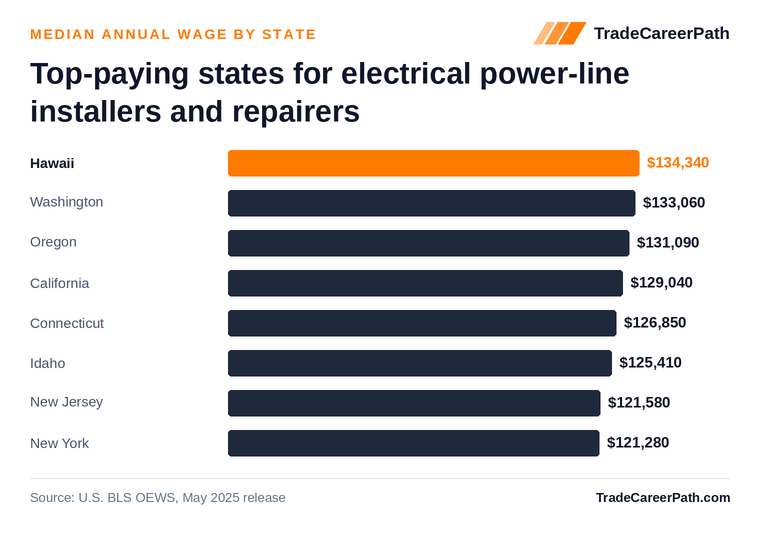
According to the U.S. Bureau of Labor Statistics (May 2025 OEWS), the highest-paying states for lineworkers are Hawaii, Washington, and Oregon. Median annual wages: Hawaii ($134,340); Washington ($133,060); Oregon ($131,090).
Which states employ the most lineworkers?
BLS reports the largest concentrations of lineworkers in Texas, California, and Florida. Employment levels: Texas (17,280 workers); California (8,930 workers); Florida (6,420 workers) (May 2025).
How much do experienced lineworkers earn?
The top 10% of lineworkers earn more than $128,690 per year, according to BLS Occupational Employment and Wage Statistics (May 2025). Experienced workers in this band typically hold senior credentials, supervisory roles, or specialty certifications.
What is entry-level pay for lineworkers?
BLS reports the bottom 10% of lineworkers earn under $51,470 per year. New workers often start near this level and see pay rise as they accumulate experience and credentials.
How many lineworkers work in the United States?
BLS reports approximately 131,070 lineworkers employed nationwide as of May 2025.
How many job openings are expected for lineworkers each year?
BLS projects approximately 10,700 openings per year for lineworkers from 2024 through 2034, including new positions, retirements, and workers transitioning out. The occupation is projected to grow 6.6% from 2024 to 2034, classified as faster than average growth.
Is lineworker a growing career?
Yes. BLS projects 6.6% employment growth for lineworkers between 2024 and 2034, classified as faster than average. Employment is projected to rise from approximately 127,400 jobs in 2024 to 135,800 in 2034.
How much do lineworkers make per hour?
The median hourly wage for lineworkers is $45.83, according to BLS (May 2025). Hourly pay ranges from about $24.74 (bottom 10%) to $61.87 (top 10%).
How Lineworker Pay Compares to Similar Trades
Side-by-side comparison of Lineworker and the closest related careers, based on U.S. Bureau of Labor Statistics data (May 2025 OEWS + 2024-2034 Employment Projections).
| Career | Median Pay | 10-Year Growth | Annual Openings |
|---|---|---|---|
| Lineworker this guide | $95,320 | +6.6% | 10,700 |
| Electrician | $63,190 | +9.5% | 81,000 |
| Tower Technician Training | $63,890 | -4.2% | 13,200 |
| Wind Turbine Technician | $64,120 | +49.9% | 2,300 |
| Solar Installation Professional | $53,140 | +42.1% | 4,100 |
Source: BLS Occupational Employment and Wage Statistics + BLS Employment Projections.
Sources
- U.S. Bureau of Labor Statistics, Occupational Employment and Wage Statistics (May 2025)
- U.S. Bureau of Labor Statistics, Employment Projections 2024-2034
- U.S. Bureau of Labor Statistics, Survey of Occupational Injuries and Illnesses (2023-2024, Table R98)
- U.S. Department of Labor, Wage and Hour Division, Davis-Bacon General Wage Determinations (2026)
Lineworker Salary by State
About this guide: Researched and written by the TradeCareerPath Editorial Team. Our editorial team researches and sources every trade school and career guide using federal labor and education data, including BLS OEWS and Employment Projections, DOL apprenticeship records, IPEDS, College Scorecard, and state licensing boards. We follow the editorial standards documented at /editorial-policy/.
Data sources
Figures on this page are sourced from the federal and state datasets below. Methodology: how we rank and source data.
| Data | Provider | Vintage |
|---|---|---|
| Occupational Employment and Wage Statistics (OEWS) | U.S. Bureau of Labor Statistics | May 2025 |
| Employment Projections | U.S. Bureau of Labor Statistics | 2024-2034 |
| Integrated Postsecondary Education Data System | National Center for Education Statistics (IPEDS) | 2024 |
| College Scorecard (school-level outcomes) | U.S. Department of Education | latest release |
| College Scorecard (field-of-study earnings) | U.S. Department of Education | latest release (updated 2026-06-12) |
| Occupational licensing requirements | CareerOneStop (U.S. Department of Labor) | latest release (updated 2026-02-22) |
| Registered apprenticeship programs | CareerOneStop / Apprenticeship.gov (U.S. Department of Labor) | latest release (updated 2025-10-25) |
| O*NET occupation profiles (skills, tasks, tools, job zones) | U.S. Department of Labor (O*NET / Employment & Training Admin.) | O*NET 29.1 (updated 2026-06-13) |