
How to Become a Locksmith
Is Locksmith Right for You?
The U.S. Department of Labor's O*NET profile for Locksmiths and Safe Repairers (SOC 49-9094) describes the work this way: Repair and open locks, make keys, change locks and safe combinations, and install and repair safes.
What the work involves
- Cut new or duplicate keys, using key cutting machines.
- Disassemble mechanical or electrical locking devices, and repair or replace worn tumblers, springs, and other parts, using hand tools.
- Cut new or duplicate keys, using impressions or code key machines.
- Open safe locks by drilling.
- Install door hardware, such as locks and closers.
Skills and knowledge that matter
Skills: Repairing, Time Management, Speaking, Quality Control Analysis, Operations Monitoring, Operation and Control.
Knowledge: Mechanical, Customer and Personal Service, Public Safety and Security, English Language.
Tools and technology you may use
Tools: Acetylene torches, Automatic metal lathes, Bench drill presses, Bent needlenose pliers, Borescopes, Carpenters squares.
Technology: Data base user interface and query software, Accounting software, Inventory management software, Intuit QuickBooks, Microsoft Excel, Microsoft Office software.
Typical preparation
O*NET Job Zone Two (Some Preparation Needed). These occupations usually require a high school diploma. Employees in these occupations need anywhere from a few months to one year of working with experienced employees. A recognized apprenticeship program may be associated with these occupations.
Interest fit
O*NET interest profile: Realistic, Conventional, Investigative. People who enjoy hands-on, practical work with tools, machines, plants, or materials often find this occupation a good fit.
Source: O*NET 29.1 (updated 2026-06-13)
Ever wondered how locksmiths open locked doors or design master key systems?
Locksmithing combines craftsmanship, technology, and problem-solving in the security industry.
Locksmiths install, repair, and adjust locks and security devices.
They work on everything from residential door locks to safes, access control systems, and automotive locking mechanisms.
If you enjoy mechanical work and troubleshooting, locksmithing offers a technical, flexible trade career that balances hands-on skill with security expertise.
Quick answers
What does a locksmith do?
Locksmiths install, repair, and adjust locks and security devices. They also help with lockouts, key duplication, re-keying, and security upgrades.
How long does locksmith training take?
Training as a locksmith typically takes 6 months to 2 years, depending on your training and state requirements.
Is locksmith licensing required?
Several states require locksmiths to register or be licensed. Requirements and fees vary by state.
What training paths can you take?
Common paths include a certificate or diploma program (6-12 months), an apprenticeship (1-2 years), or an associate degree (2 years). Some states also require a license or registration to operate legally.
How much does locksmith training cost?
Program costs vary by school, format and materials. Licensing fees vary by state and are usually under $200.
At a glance
- Typical work: lock installation and repair, key cutting and duplication, re-keying, and lockouts
- Work settings: locksmith shops, security and alarm companies, facilities departments, automotive or mobile services, and self-employment
- Training time: 6 months to 2 years (varies by state and training path)
- Common training paths: certificate or diploma, apprenticeship, or associate degree
- Costs: training tuition varies by provider and format; licensing fees vary by state (usually under $200)
What Locksmiths Do
Locksmiths work with a wide range of security systems, from mechanical locks to electronic keypads and biometric devices.
They help customers with lockouts, key duplication, installation, and security upgrades.
Typical Responsibilities
- Install and repair locks, deadbolts, and door hardware
- Create and duplicate keys
- Re-key locks and design master key systems
- Install electronic access control or keyless entry systems
- Open locks and safes for clients when keys are lost or damaged
Locksmiths are trusted professionals who help keep homes, vehicles, and businesses secure.
Key Skills and Traits for Success
- Manual dexterity and hand-eye coordination
- Problem-solving and mechanical aptitude
- Knowledge of key-cutting and lock mechanisms
- Integrity and customer service skills
- Familiarity with electronic security and access systems
Work Settings for Locksmiths
Locksmiths work in a variety of environments:
- Independent locksmith shops
- Security system and alarm companies
- Maintenance or facilities departments
- Automotive dealerships or mobile locksmith services
- Self-employed or franchise locksmith businesses
How to Become a Locksmith (5 Steps)
Training as a locksmith typically takes 6 months to 2 years, depending on your training and state requirements.
1. Earn a High School Diploma or GED
Take courses in mechanical drawing, math, and electronics. These provide a foundation for working with tools and understanding security systems.
2. Complete a Locksmith Training Program
Enroll in a trade or community college program covering key duplication, lock installation, and security systems. Some offer online or hybrid options.
3. Gain On-the-Job Experience
Work as a trainee or apprentice under a licensed locksmith. This is where you'll learn practical lock picking, keying systems, and customer service.
4. Obtain a State License or Certification (If Required)
Several states require locksmiths to register or be licensed. Certification from associations such as ALOA (Associated Locksmiths of America) can help build credibility.
5. Build Experience and Grow Your Business
Experienced locksmiths often specialize in automotive, commercial, or safe and vault systems. Many eventually start their own mobile or storefront locksmith businesses.
Education and Training Paths
| Pathway | Typical Duration | Outcome |
|---|---|---|
| Certificate or Diploma | 6-12 months | Entry-level locksmithing and key-making skills |
| Apprenticeship | 1-2 years | Hands-on field training under a licensed professional |
| Associate Degree | 2 years | Broader study including electronics and security systems |
| State License or Certification | Variable | Required in certain states for legal operation |
Career Growth and Advancement
With experience, locksmiths can move into roles such as:
- Security Specialist: installs and maintains advanced access systems
- Safe and Vault Technician: focuses on large or specialized locking systems
- Business Owner: operates a mobile or local locksmith company
- Instructor or Consultant: trains others in lock and key technology
Cost and Duration of Training
- Program Cost: varies by school, format and location depending on format and materials
- Duration: 6 months to 2 years
- Licensing Fees: vary by state, usually under $200
Locksmithing offers flexibility, independence, and the satisfaction of solving real-world security challenges for homes and businesses.
Pros and Cons
✅ Pros
- Flexible career with options for self-employment
- Hands-on mechanical and technical work
- Steady demand for residential and commercial security
- Opportunities to specialize in advanced systems
⚠️ Cons
- Requires licensing in some states
- Irregular hours or emergency callouts
- Physical and detailed work under time pressure
Take the First Step Toward a Locksmith Career
If you’re mechanically inclined and like solving security puzzles, training as a locksmith offers a technical and independent trade career with room to grow.
Quick Facts: Locksmith Training and Outlook
Industry Organizations & Certifying Bodies
These are the recognized national organizations, unions, certifying bodies, and regulatory authorities that shape this trade. They issue the credentials, sponsor the apprenticeships, publish the codes, and represent workers and employers.
- Associated Locksmiths of America (ALOA) Issues the Registered Locksmith (RL), Certified Registered Locksmith (CRL), and other industry credentials.
Wage and Employment Charts
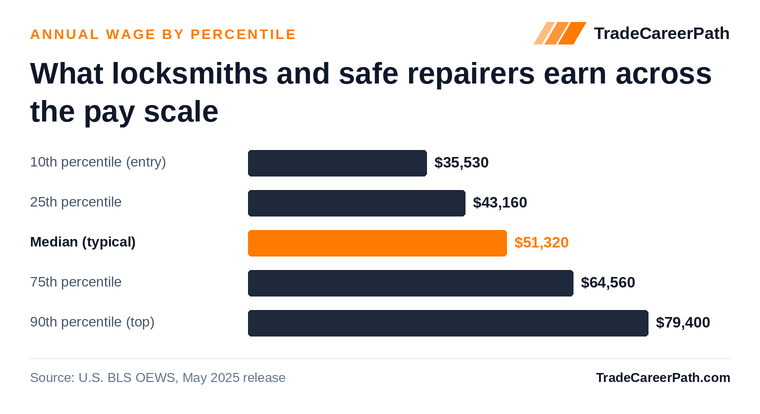
| Percentile | Annual wage |
|---|---|
| 10th | $35,530 |
| 25th | $43,160 |
| 50th (median) | $51,320 |
| 75th | $64,560 |
| 90th | $79,400 |
| Year | Employment |
|---|---|
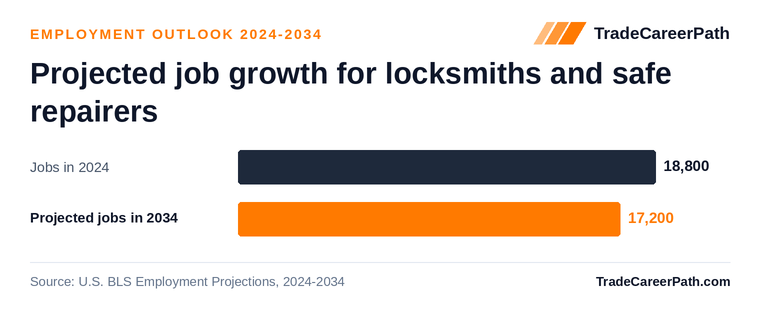
| 2024 | 18,800 |
| 2034 projected | 17,200 |
| Percent change | -8.3% |
Locksmith Salary and Requirements by State
Select your state for local wage data, training options, and requirements:
Alabama · Alaska · Arizona · Arkansas · California · Colorado · Connecticut · Delaware · District of Columbia · Florida · Georgia · Hawaii · Idaho · Illinois · Indiana · Iowa · Kansas · Kentucky · Louisiana · Maine · Maryland · Massachusetts · Michigan · Minnesota · Mississippi · Missouri · Montana · Nebraska · Nevada · New Hampshire · New Jersey · New Mexico · New York · North Carolina · North Dakota · Ohio · Oklahoma · Oregon · Pennsylvania · Rhode Island · South Carolina · South Dakota · Tennessee · Texas · Utah · Vermont · Virginia · Washington · West Virginia · Wisconsin · Wyoming
Workplace Safety Snapshot
BLS Survey of Occupational Injuries and Illnesses data (2023-2024) report approximately 89.6 days-away, restricted, or transfer cases per 10,000 full-time-equivalent workers in locksmiths and safe repairers (about 0.90 per 100 FTE). Source: BLS Survey of Occupational Injuries and Illnesses, Table R98.
Frequently Asked Questions
How long does locksmith training take?
It typically takes typically 6 months to 2 years of training. The most common entry path is through a certificate or associate degree program. A high school diploma or GED is generally required to get started.
How much do locksmiths make?
The median annual salary for locksmiths is $51,320 according to the Bureau of Labor Statistics (May 2025). Entry-level workers earn around $35,530, while those in the 90th percentile earn over $79,400. Pay varies by state, experience, and specialization.
What is the job outlook for locksmiths?
The Bureau of Labor Statistics projects -8.3% employment growth for this occupation from 2024 to 2034, which is roughly on pace with the overall economy. Approximately 1,700 job openings are expected each year due to growth, retirements, and workers leaving the field.
Do you need a college degree to work as a locksmith?
No. A college degree is not required to work as a locksmith. Most people enter the field through a certificate or associate degree program. A high school diploma or GED is typically the only educational prerequisite.
Which states pay locksmiths the most?
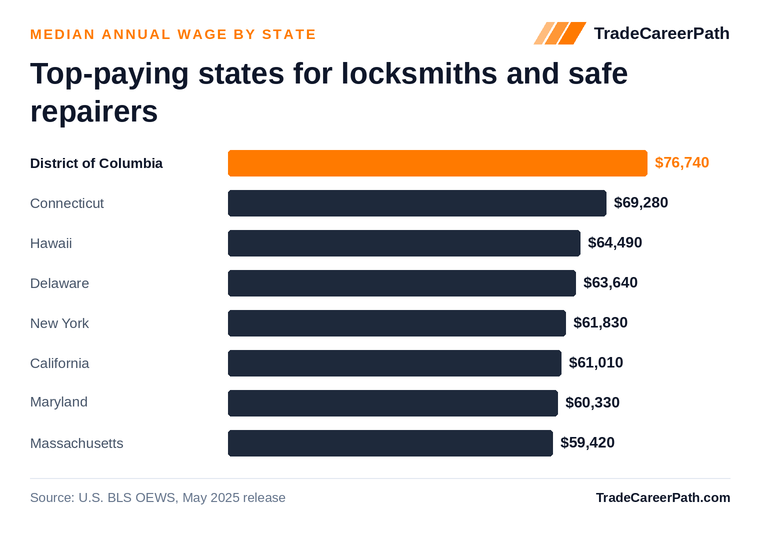
According to the U.S. Bureau of Labor Statistics (May 2025 OEWS), the highest-paying states for locksmiths are District of Columbia, Connecticut, and Hawaii. Median annual wages: District of Columbia ($76,740); Connecticut ($69,280); Hawaii ($64,490).
Which states employ the most locksmiths?
BLS reports the largest concentrations of locksmiths in California, Florida, and Texas. Employment levels: California (2,060 workers); Florida (1,440 workers); Texas (1,420 workers) (May 2025).
How much do experienced locksmiths earn?
The top 10% of locksmiths earn more than $79,400 per year, according to BLS Occupational Employment and Wage Statistics (May 2025). Experienced workers in this band typically hold senior credentials, supervisory roles, or specialty certifications.
What is entry-level pay for locksmiths?
BLS reports the bottom 10% of locksmiths earn under $35,530 per year. New workers often start near this level and see pay rise as they accumulate experience and credentials.
How many locksmiths work in the United States?
BLS reports approximately 15,040 locksmiths employed nationwide as of May 2025.
How many job openings are expected for locksmiths each year?
BLS projects approximately 1,700 openings per year for locksmiths from 2024 through 2034, including new positions, retirements, and workers transitioning out. The occupation is projected to grow -8.3% from 2024 to 2034, classified as in decline growth.
How much do locksmiths make per hour?
The median hourly wage for locksmiths is $24.68, according to BLS (May 2025). Hourly pay ranges from about $17.08 (bottom 10%) to $38.17 (top 10%).
How Locksmith Pay Compares to Similar Trades
Side-by-side comparison of Locksmith and the closest related careers, based on U.S. Bureau of Labor Statistics data (May 2025 OEWS + 2024-2034 Employment Projections).
| Career | Median Pay | 10-Year Growth | Annual Openings |
|---|---|---|---|
| Locksmith this guide | $51,320 | -8.3% | 1,700 |
| Home Security and Alarm Technician Listings | $60,070 | +10.4% | 9,400 |
| Electrician | $63,190 | +9.5% | 81,000 |
| Maintenance Technician | $49,590 | +3.8% | 159,800 |
Source: BLS Occupational Employment and Wage Statistics + BLS Employment Projections.
Sources
- U.S. Bureau of Labor Statistics, Occupational Employment and Wage Statistics (May 2025)
- U.S. Bureau of Labor Statistics, Employment Projections 2024-2034
- U.S. Bureau of Labor Statistics, Survey of Occupational Injuries and Illnesses (2023-2024, Table R98)
- U.S. Department of Labor, Wage and Hour Division, Davis-Bacon General Wage Determinations (2026)
Locksmith Salary by State
About this guide: Researched and written by the TradeCareerPath Editorial Team. Our editorial team researches and sources every trade school and career guide using federal labor and education data, including BLS OEWS and Employment Projections, DOL apprenticeship records, IPEDS, College Scorecard, and state licensing boards. We follow the editorial standards documented at /editorial-policy/.
Data sources
Figures on this page are sourced from the federal and state datasets below. Methodology: how we rank and source data.
| Data | Provider | Vintage |
|---|---|---|
| Occupational Employment and Wage Statistics (OEWS) | U.S. Bureau of Labor Statistics | May 2025 |
| Employment Projections | U.S. Bureau of Labor Statistics | 2024-2034 |
| Integrated Postsecondary Education Data System | National Center for Education Statistics (IPEDS) | 2024 |
| College Scorecard (school-level outcomes) | U.S. Department of Education | latest release |
| College Scorecard (field-of-study earnings) | U.S. Department of Education | latest release (updated 2026-06-12) |
| Occupational licensing requirements | CareerOneStop (U.S. Department of Labor) | latest release (updated 2026-02-22) |
| Registered apprenticeship programs | CareerOneStop / Apprenticeship.gov (U.S. Department of Labor) | latest release (updated 2025-10-25) |
| O*NET occupation profiles (skills, tasks, tools, job zones) | U.S. Department of Labor (O*NET / Employment & Training Admin.) | O*NET 29.1 (updated 2026-06-13) |