
How to Become a Logistician in 2026
Is Logistician Right for You?
The U.S. Department of Labor's O*NET profile for Logisticians (SOC 13-1081) describes the work this way: Analyze and coordinate the ongoing logistical functions of a firm or organization. Responsible for the entire life cycle of a product, including acquisition, distribution, internal allocation, delivery, and final disposal of resources.
What the work involves
- Maintain and develop positive business relationships with a customer's key personnel involved in, or directly relevant to, a logistics activity.
- Develop an understanding of customers' needs and take actions to ensure that such needs are met.
- Manage subcontractor activities, reviewing proposals, developing performance specifications, and serving as liaisons between subcontractors and organizations.
- Develop proposals that include documentation for estimates.
- Review logistics performance with customers against targets, benchmarks, and service agreements.
Skills and knowledge that matter
Skills: Critical Thinking, Reading Comprehension, Active Listening, Speaking, Monitoring, Coordination.
Knowledge: Transportation, English Language, Administration and Management, Customer and Personal Service.
Tools and technology you may use
Technology: Computer aided design CAD software, Business intelligence and data analysis software, Enterprise system management software, Autodesk AutoCAD, Intuit QuickBooks, Microsoft Access.
Typical preparation
O*NET Job Zone Four (Considerable Preparation Needed). Most of these occupations require a four-year bachelor's degree, but some do not. Employees in these occupations usually need several years of work-related experience, on-the-job training, and/or vocational training.
Interest fit
O*NET interest profile: Conventional, Enterprising, Investigative. People who enjoy structured, detail-oriented work with clear procedures and data often find this occupation a good fit.
Source: O*NET 31.0 (updated 2026-10-14)
Quick answer: Training as a logistician requires a 4-year degree - typically a Bachelor’s in supply chain management, logistics, or business. The national median pay is $82,320 per year, and BLS projects +17.6% employment change from 2025 to 2035 (BLS OEWS, May 2025; BLS Employment Projections, 2025-35).
Logistician at a Glance
| Metric | Detail | Source |
|---|---|---|
| Median annual wage | $82,320 | BLS OEWS, May 2025 |
| Typical wage range | $50,890 (10th pct) - $133,160 (90th pct) | BLS OEWS, May 2025 |
| Employment | 251,040 nationwide | BLS OEWS, May 2025 |
| Projected growth (2025-35) | +17.6%, about 26,600 openings per year | BLS Employment Projections, 2025-35 |
| Typical education | Bachelor’s in supply chain management, logistics, or business | BLS Occupational Outlook Handbook |
| License / certification | No license; APICS/ASCM certifications valued | None for most roles |
What Does a Logistician Do?
Logisticians manage supply chains end to end - they decide how product moves from supplier to customer, which carriers haul it, where it sits in inventory, and what it all costs. It is the office career built directly on top of trucking, dispatch, and warehouse operations knowledge: the people who plan the freight instead of hauling it.
Day to day, the work splits by desk. A transportation analyst builds routing guides, negotiates carrier contracts, and audits freight bills to find where money leaks out of the network. An inventory or demand planner decides how much stock each distribution center carries and lives with the consequences of guessing wrong in either direction. A distribution or warehouse-side logistician plans labor, dock schedules, and slotting so trailers turn on time. In defense and aerospace - one of the field’s biggest employers - logisticians manage spare-parts pipelines and lifecycle support for equipment that has to stay mission-ready for decades. Everywhere, the raw material is data: TMS and ERP systems, spreadsheets, KPI dashboards, and a daily stream of exceptions that need a decision in the next hour.
If you are coming from the cab or the dispatch desk, the shortest way to say it: the driver executes the load and the dispatcher covers today’s board; the logistician designs the network they both work inside. You already know why a delivery window fails, what detention actually costs, and which lanes are lies on paper - that operating knowledge is exactly what the analyst desks lack, and it is why former drivers who add the degree tend to move fast.
Skills That Make a Great Logistician
- Routing, load planning, and mode selection
- Inventory management and demand planning
- TMS/ERP systems (transportation and warehouse management platforms)
- Carrier negotiation and contract management
- Data analysis and KPI tracking - Excel at minimum, SQL or Python as a differentiator
- Cost modeling: knowing what a lane, a touch, or a stockout actually costs
- Writing and communication: routing guides, SOPs, and carrier scorecards carry the job
Logistician Salary
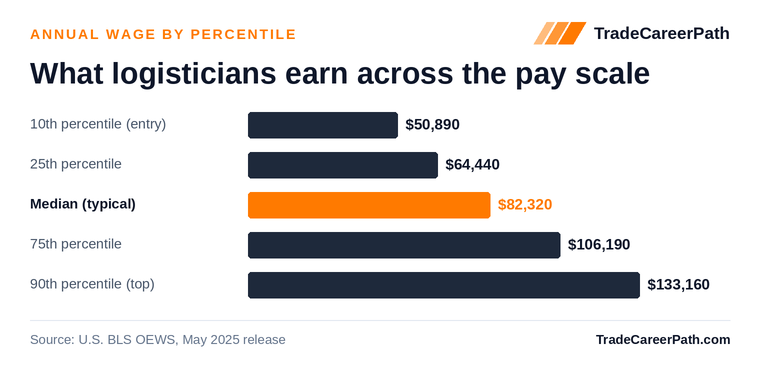
Logistics pays solid white-collar money for a degree that working adults can realistically finish. The national median is $82,320 per year, with the 10th percentile - roughly the entry analyst desks - at $50,890 and the 90th percentile reaching $133,160 (BLS OEWS, May 2025). The mean of $89,730 sits above the median, which tells you the top of this field - senior supply chain and defense-sector roles - pulls the average up.
Where the Jobs and the Money Are
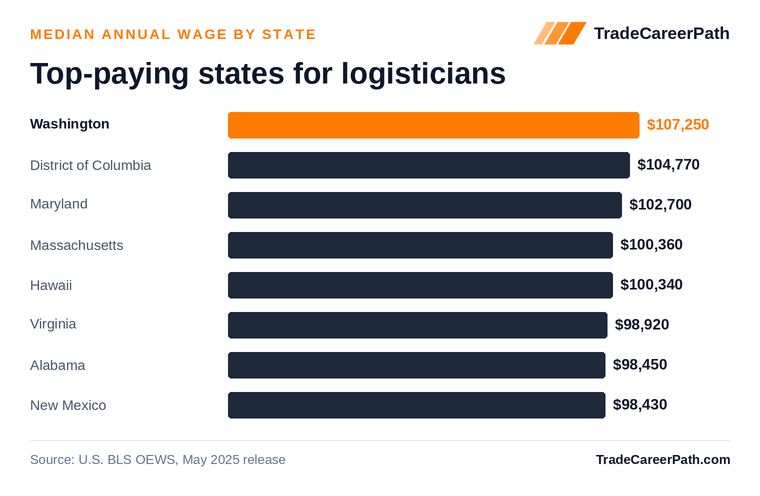
This is a big occupation - 251,040 jobs nationwide - and it goes wherever freight and federal contracts go. The single largest cluster is California with 32,940 logisticians at a $92,890 median, followed by Texas (21,030 jobs, $75,480 median) and Florida (15,020 jobs, $76,410 median) (BLS OEWS, May 2025). The best pay concentrates around the ports of the Pacific Northwest and the defense corridor surrounding Washington, DC:
| State | Median annual wage | Employment |
|---|---|---|
| Washington | $107,250 | 5,670 |
| District of Columbia | $104,770 | 1,350 |
| Maryland | $102,700 | 6,840 |
| Massachusetts | $100,360 | 5,250 |
| Hawaii | $100,340 | 570 |
Maryland is the standout hub: logisticians are about one and a half times as concentrated there as in the average state labor market (location quotient 1.53), driven by defense logistics work, and DC itself runs above average too (1.19). California pairs the biggest job count with an above-average concentration (1.12), which means depth - room to change employers without relocating. Washington State pays the most at a roughly average concentration, so the money is real but the seats are fewer.
How to Become a Logistician
1. Use operations experience
Driving, dispatch, or warehouse work is directly relevant - employers value people who know freight from the seat. Say so explicitly on applications: a CDL plus years of OTR or regional work reads as proof you understand transit times, hours-of-service, detention, and what actually happens at a dock. Dispatchers and load planners are even closer to the target job - much of the analyst work is the same decisions with better tools and a longer horizon.
2. Earn a bachelor’s degree
Supply chain management, logistics, or business administration - online programs fit driving schedules, and this field has some of the deepest online-degree availability of any career on this site. The degree is 120 credit hours; before enrolling anywhere, get a written transfer evaluation, because prior college, military logistics training, and industry certifications are commonly worth real credit at transfer-friendly schools.
3. Start in analysis or coordination
Load planning, inventory analysis, and transportation coordination are the entry desks. Third-party logistics companies (3PLs), big retailers’ distribution networks, manufacturers, and defense contractors all hire at the bachelor’s level - and 3PLs in particular will often move a strong dispatcher into an analyst seat while the degree is still in progress.
4. Add ASCM/APICS credentials
CLTD (Certified in Logistics, Transportation and Distribution) and CSCP (Certified Supply Chain Professional) are the recognized industry credentials, and they accelerate advancement. They are exam-based, self-paced, and cheap next to a degree - a common play is to earn one mid-degree so your resume shows both momentum and industry vocabulary.
5. Advance
Logistics manager, supply chain manager, or distribution center leadership. The fork comes when you have a few years at the analyst desk: deepen into a technical specialty (network design, demand planning, procurement) or take the operations-leadership track running a site or a regional network. Both paths are covered in the career ladder below.
Career Ladder: Titles and Realistic Pay
The BLS wage percentiles map cleanly onto how logistics careers actually progress. Use this as a sanity check on offers, not a guarantee:
| Stage | Typical titles | Years in | Realistic pay (BLS OEWS, May 2025) |
|---|---|---|---|
| Entry level | Logistics coordinator, transportation analyst, load planner | 0-3 | ~$50,890-$64,440 (10th-25th pct) |
| Mid-career | Logistics analyst II, demand planner, ops supervisor | 3-8 | ~$82,320 (median) |
| Senior | Senior logistician, logistics manager, network analyst lead | 8-15 | ~$106,190 (75th pct) |
| Leadership | Supply chain manager, DC general manager, director of logistics | 15+ | $133,160+ (90th pct) |
Two notes for career changers. First, prior trade experience compresses this ladder: former drivers and dispatchers routinely skip the bottom of the entry band because they need no education in how freight actually moves - many land mid-band on day one. Second, the 90th-percentile figure understates the top of this track: distribution center general managers and supply chain directors at large retailers and defense primes are often classified as managers rather than logisticians, and their bonus-heavy compensation runs above the wage data shown here.
Do You Need a License?
No. There is no state license for logisticians - this is a certification field, not a licensed one. The credentials that move your resume are industry certifications and system skills:
- ASCM/APICS CLTD and CSCP: the recognized professional credentials in transportation and supply chain, respectively. Neither is legally required; both are widely valued in hiring and promotion.
- TMS/ERP proficiency: demonstrated skill in the major transportation and enterprise systems often matters more to a hiring manager than any certificate.
- Security clearance: on defense logistics programs - a large slice of the field, especially in Maryland and DC - clearability widens the market and adds a pay premium.
The one adjacent path with a real federal requirement is freight brokerage, which requires FMCSA registration and a surety bond - see the Freight Broker page if that route interests you.
Why an Online Degree Works for This Career
For CDL drivers and dispatchers, supply chain is the classic off-the-road move: you already understand freight, hours-of-service, and what breaks a delivery schedule. Online supply-chain bachelor’s programs are plentiful, and the occupation has one of the strongest BLS growth projections of any degree career on this site. The coursework is spreadsheet-and-operations math rather than calculus, which makes it one of the more finishable degrees for someone studying in a sleeper berth or between dispatch shifts - and employer tuition assistance is common at large carriers, 3PLs, and retailers.
Job Outlook for 2026 and Beyond
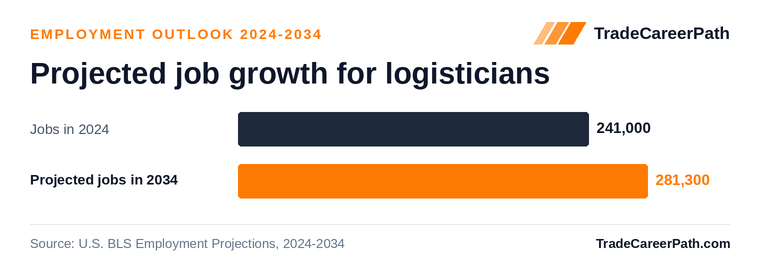
BLS projects logistician employment to grow +17.6% from 2025 to 2035 - from 255,100 to 300,000 jobs - with about 26,600 openings per year once retirements and occupation changes are counted (BLS Employment Projections, 2025-35). That is one of the strongest growth rates of any bachelor’s-level occupation this site covers. The latest wage data (OEWS, May 2025) puts the median at $82,320, up from the 2024 figure of $80,880 - pay is rising alongside the headcount.
The demand drivers are structural: e-commerce keeps pushing inventory closer to customers, companies are re-shoring and diversifying supply chains after a decade of disruptions, and defense logistics budgets are funded years ahead. For career changers, the openings figure is the number that matters - 26,600 seats a year in a 251,040-person occupation means constant hiring, and the pool of candidates who genuinely understand freight operations is far smaller than the pool with the degree alone.
Cost and Time to Complete the Degree
For logisticians, the credential is: Bachelor’s in supply chain management, logistics, or business. A bachelor’s degree is typically 120 credit hours: four years full-time, and commonly five to six years part-time while working. Transfer credit is the other lever: prior college, military training, apprenticeship coursework, and industry certifications can be worth meaningful credit at transfer-friendly schools, so get a written transfer evaluation before enrolling anywhere. Costs vary widely by school type; in-state public online programs are usually the value benchmark, and employer tuition assistance is common for working adults in this field.
Pros and Cons of Training as a Logistician
Pros
- Median pay of $82,320 nationally (BLS OEWS, May 2025)
- BLS projects +17.6% employment growth through 2035 - about 26,600 openings a year
- Field experience from the trades is a genuine hiring advantage
- No license required; accredited online degree paths exist for working adults
Cons
- Requires a 4-year degree (typically 120 credit hours)
- Entry-level pay starts near $50,890 at the 10th percentile - a possible pay cut for a top-earning OTR driver in year one
Frequently Asked Questions
Can a truck driver move into logistics?
Yes - it is the standard career ladder out of the cab, and BLS projects double-digit growth for logisticians this decade. The bachelor's degree is what unlocks the analyst and manager titles.
How much do logisticians make?
The national median annual wage for logisticians is $82,320 (BLS OEWS, May 2025). The top 10% earn $133,160 or more, while entry-level pay starts around $50,890.
What is the job outlook for logisticians?
BLS projects employment of logisticians to change by +17.6% from 2025 to 2035 (BLS Employment Projections, 2025-35).
How long does logistician training take?
The bachelor's degree is 120 credit hours: four years full-time, commonly five to six years part-time while driving or dispatching. Transfer credit for prior college, military logistics training, or industry certifications can meaningfully shorten it at transfer-friendly schools.
Is logistics a hard degree?
It is one of the more manageable business degrees - statistics, operations math, and spreadsheet modeling rather than calculus and physics. Drivers and dispatchers usually find the coursework easier than fresh high-school graduates do, because they already understand freight, transit times, and what breaks a schedule.
Should I get a supply chain degree or a general business degree?
For someone coming from trucking or warehousing, a supply chain management or logistics major is usually the better buy - the coursework maps directly to the analyst desks that hire at entry level. A business administration degree with a supply chain concentration is a fine fallback and keeps more doors open outside the freight world.
Can you train as a logistician without a degree?
Sometimes - coordinators and dispatchers do move up on experience alone, especially inside 3PLs. But the analyst and manager titles that pay the $82,320 median increasingly require the bachelor's, and without it your ceiling is usually the coordination desk rather than the roles at $106,190 (75th percentile) and above.
Do logisticians need a license?
No state license exists for logisticians. The credentials that matter are industry certifications - ASCM/APICS CLTD and CSCP are the most recognized - plus TMS/ERP system skills. Freight brokerage is the one adjacent path with a federal registration requirement.
Logistician Salary and Requirements by State
Alabama · Alaska · Arizona · Arkansas · California · Colorado · Connecticut · Delaware · District of Columbia · Florida · Georgia · Hawaii · Idaho · Illinois · Indiana · Iowa · Kansas · Kentucky · Louisiana · Maine · Maryland · Massachusetts · Michigan · Minnesota · Mississippi · Missouri · Montana · Nebraska · Nevada · New Hampshire · New Jersey · New Mexico · New York · North Carolina · North Dakota · Ohio · Oklahoma · Oregon · Pennsylvania · Rhode Island · South Carolina · South Dakota · Tennessee · Texas · Utah · Vermont · Virginia · Washington · West Virginia · Wisconsin · Wyoming
Related Careers and Degree Paths
- Truck Driver - the feeder trade this page is built for
- Freight Broker - the entrepreneurial side of the same freight market
- Industrial Engineer - the engineering track for optimizing the same operations
- Industrial Production Manager - running the plants that logistics networks serve
- All trade careers that require a 4-year degree
Degree and Program Guides
- Online Supply Chain Management Degrees - the degree and ASCM credentials behind logistics roles
Sources
- U.S. Bureau of Labor Statistics, Occupational Employment and Wage Statistics (OEWS), May 2025 - Logisticians (SOC 13-1081)
- U.S. Bureau of Labor Statistics, Employment Projections, 2025-35
- U.S. Bureau of Labor Statistics, Occupational Outlook Handbook - education and licensing requirements
Logistician Salary by State
About this guide: Researched and written by the TradeCareerPath Editorial Team. Our editorial team researches and sources every trade school and career guide using federal labor and education data, including BLS OEWS and Employment Projections, DOL apprenticeship records, IPEDS, College Scorecard, and state licensing boards. We follow the editorial standards documented at /editorial-policy/.
Data sources
Figures on this page are sourced from the federal and state datasets below. Methodology: how we rank and source data.
| Data | Provider | Vintage |
|---|---|---|
| Occupational Employment and Wage Statistics (OEWS) | U.S. Bureau of Labor Statistics | May 2025 |
| Employment Projections | U.S. Bureau of Labor Statistics | 2025-2035 |
| Integrated Postsecondary Education Data System | National Center for Education Statistics (IPEDS) | 2024 |
| College Scorecard (school-level outcomes) | U.S. Department of Education | latest release |
| College Scorecard (field-of-study earnings) | U.S. Department of Education | latest release (updated 2026-06-12) |
| Occupational licensing requirements | CareerOneStop (U.S. Department of Labor) | latest release (updated 2026-02-22) |
| Registered apprenticeship programs | CareerOneStop / Apprenticeship.gov (U.S. Department of Labor) | latest release (updated 2025-10-25) |
| O*NET occupation profiles (skills, tasks, tools, job zones) | U.S. Department of Labor (O*NET / Employment & Training Admin.) | O*NET 31.0 (updated 2026-10-14) |