
LPN to RN Programs: Bridge Your License to a $97K Career (2026)
Quick answer: LPN to RN bridge programs credit your practical nursing license toward the RN degree, typically taking 12 to 18 months for the ADN route. The payoff is the largest single raise in nursing: the national median jumps from $64,400 (LPN) to $97,550 (RN), per BLS OEWS, May 2025.
The LPN to RN Pay Gap
| License | National median pay | Source |
|---|---|---|
| Licensed Practical Nurse (LPN/LVN) | $64,400 | BLS OEWS, May 2025 |
| Registered Nurse (RN) | $97,550 | BLS OEWS, May 2025 |
Same hospitals, same units, roughly $33,000 apart at the median. The RN license also unlocks the specializations and leadership roles LPNs are excluded from: ICU, ER, case management, and the full RN career path.
The scale of the destination matters too. Registered nursing is one of the largest occupations in the country - 3,379,720 RNs employed nationwide (BLS OEWS, May 2025) - which means the bridge does not just raise your pay, it drops you into a job market with openings in essentially every county in America.
Your Two Bridge Options
LPN to ADN (the fast route)
The associate-degree bridge is the shortest path to the RN license: usually 12 to 18 months, offered at community colleges and online-hybrid programs. You graduate eligible for the NCLEX-RN. The trade-off is that many hospital systems now prefer BSN-prepared nurses for hiring and promotion.
LPN to BSN (the durable route)
The bachelor’s bridge takes 2.5 to 3 years but lands you at the credential hospitals increasingly require. If your goal is leadership, specialty units, or keeping every door open, bridging straight to the BSN saves you doing a second bridge later.
Either way, accredited programs (look for ACEN or CCNE accreditation) grant advanced placement for your LPN coursework and clinical experience.
What the Work Is Like on the Other Side
You already know the floor. What changes with the RN badge is not the setting - it is scope, judgment, and accountability.
As an LPN you work under an RN’s or physician’s direction: you collect the vitals, pass the meds, do the wound care, and report what you see. As an RN, you own the nursing process end to end. You do the admission assessment and the shift assessments, and your assessment - not just your observation - goes in the chart. You build and revise the care plan. You push IV medications, hang blood, titrate drips in units that allow it, and take the phone call from the physician at 0300 to advocate for a patient whose numbers you do not like. When something goes sideways, you are the one deciding whether this is “watch it” or “rapid response, now.”
The other daily difference is delegation. RNs supervise LPNs and aides, which means part of the job is deciding what you can safely hand off and what you must do yourself - and being legally accountable for that call. Many bridge graduates say this is the real adjustment: not the skills, which you largely have, but carrying the decision instead of relaying it.
The upside of that accountability is range. The RN license is the entry ticket to units and roles that are closed to LPNs almost everywhere: ICU, emergency, OR circulating, labor and delivery, oncology, cath lab, case management, and eventually charge and management roles. LPN work concentrates heavily in long-term care; RN work spans the whole building and beyond it - home health, outpatient surgery centers, school nursing, insurance review, and travel contracts.
RN Salary: What the Bridge Buys You
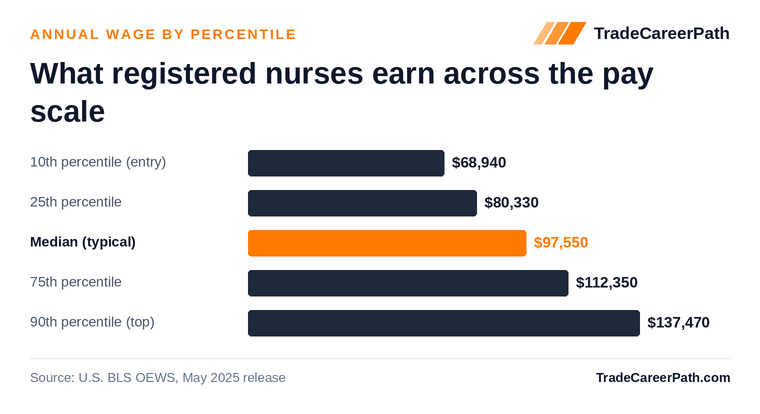
The national median for registered nurses is $97,550, with a mean of $101,420 (BLS OEWS, May 2025). Even the 10th percentile - roughly where new-grad RNs start - is $68,940, which is already above the LPN median. The 90th percentile reaches $137,470.
The RN Career Ladder: Titles and Realistic Pay
The BLS wage percentiles map cleanly onto how an RN career actually progresses. As a bridge graduate you enter with a clinical head start most new grads do not have - many former LPNs move off the bottom band faster because they already know how a unit runs.
| Stage | Typical titles | Realistic pay (BLS OEWS, May 2025) |
|---|---|---|
| New grad RN | Staff nurse (med-surg, LTC, clinic) | ~$68,940-$80,330 (10th-25th pct) |
| Established RN | Staff nurse II/III, specialty unit RN | ~$97,550 (median) |
| Senior / specialty | Charge nurse, certified specialty RN (ICU, ER, OR) | ~$112,350 (75th pct) |
| Leadership / high-demand | Nurse manager, house supervisor, high-cost-of-living markets | $137,470+ (90th pct) |
Two notes. First, these are base-wage figures - shift differentials for nights and weekends, overtime, and travel-contract rates routinely push real earnings above the band for the same title. Second, the 90th-percentile number is heavily shaped by West Coast markets, which brings us to geography.
Where RNs Earn the Most
| State | Median annual wage | RN employment |
|---|---|---|
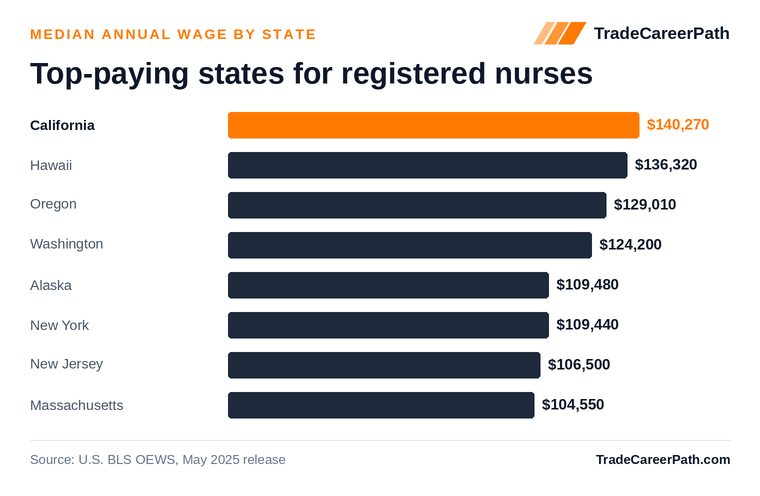
| California | $140,270 | 338,940 |
| Hawaii | $136,320 | 12,940 |
| Oregon | $129,010 | 39,730 |
| Washington | $124,200 | 69,260 |
| Alaska | $109,480 | 7,510 |
California is the outlier in both directions: the highest median in the country at $140,270 and by far the largest RN workforce at 338,940. For volume closer to home, Texas employs 271,380 RNs at a $95,970 median and Florida employs 229,940 at $84,190 (BLS OEWS, May 2025). One practical note for bridge graduates: the RN license travels well - most states participate in the Nurse Licensure Compact, and states that do not still license by endorsement - so the pay map is genuinely actionable in a way it is not for many careers.
How the Bridge Works
- Verify your standing. An active, unencumbered LPN license and usually 6 to 12 months of work experience.
- Choose ADN or BSN bridge. Decide based on your market: check whether local hospitals hire ADN grads.
- Complete the program. Online coursework plus clinicals scheduled around LPN shifts; most programs are built for working nurses.
- Pass the NCLEX-RN. A different exam from the NCLEX-PN; most bridge curricula include prep.
- Upgrade your license and your badge. Apply to your state board of nursing for RN licensure.
Licensing: The NCLEX-RN and Your State Board
There is no shortcut around the license, and as an LPN you would not expect one. RN licensure in every state requires two things: graduation from a state-approved nursing program (your ADN or BSN bridge), and a passing result on the NCLEX-RN administered through your state board of nursing.
A few specifics worth knowing before you enroll:
- The NCLEX-RN is a different exam from the NCLEX-PN, not a longer version of it. It tests RN-scope judgment - prioritization, delegation, and clinical decision-making - which is exactly the material bridge curricula spend the most time on. Your PN exam history does not carry over.
- Your LPN record follows you. State boards review your existing license during the RN application; an active, unencumbered LPN license makes this routine, while past discipline needs to be disclosed and explained.
- Compact states. If your state belongs to the Nurse Licensure Compact, one multistate RN license covers practice in every other compact state - a significant advantage for travel nursing and border-town work.
- Accreditation is the gate. Only graduates of board-approved programs may sit for the NCLEX-RN, which is why ACEN or CCNE accreditation on the bridge program is non-negotiable. Verify a program’s approval directly with your state board before paying anyone a deposit.
Job Outlook for RNs Through 2034
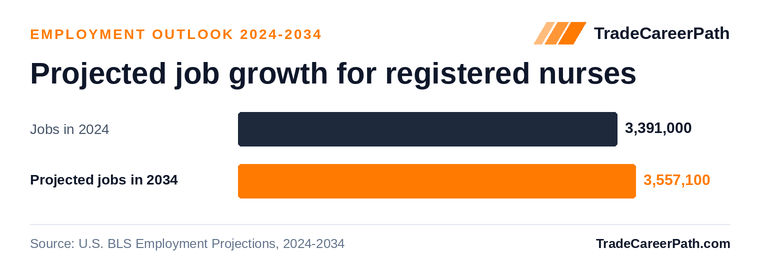
BLS projects RN employment to grow 5.6% from 2025 to 2035 - from 3,465,400 to 3,660,100 jobs - with about 180,800 openings per year once retirements and nurses leaving the occupation are counted (BLS Employment Projections, 2025-35).
For a career changer, the openings number is the one that matters. A growth rate of 5.6% sounds modest, but on a base of 3.4 million workers it means the profession adds and refills jobs at a pace few occupations match - 180,800 seats a year is more annual openings than many entire occupations have workers. The drivers are structural: an aging population, chronic-condition care, and a large cohort of RNs reaching retirement age. Wages have tracked that demand - the projections dataset put the 2024 median at $93,600, and the May 2025 OEWS median is $97,550.
For LPNs specifically, this is the safest kind of bridge: you are moving between two roles in the same buildings, often for the same employer, into the larger and faster-hiring of the two occupations.
Frequently Asked Questions
How long does an LPN to RN bridge program take?
Most LPN-to-RN (ADN) bridges take 12 to 18 months of full-time study, since your LPN coursework and experience count toward the RN curriculum. LPN-to-BSN bridges typically run 2.5 to 3 years.
How much more does an RN make than an LPN?
The national median for registered nurses is $97,550 versus $64,400 for licensed practical nurses (BLS OEWS, May 2025). That is a median difference of about $33,000 per year for the same clinical setting.
Can I do an LPN to RN program online?
Coursework, yes. Every accredited bridge program pairs online classes with in-person clinical hours arranged at facilities near you, and most are scheduled around working LPN shifts.
Do I have to take the NCLEX again?
Yes. Completing the bridge program qualifies you to sit for the NCLEX-RN, which is a separate exam from the NCLEX-PN you passed as an LPN.
Is the LPN to RN bridge hard?
The pharmacology, pathophysiology, and care-planning coursework is a real step up from PN school, but working LPNs have a large head start: the clinical skills, patient assessment habits, and medical vocabulary are already second nature. The hardest part for most is balancing shifts with study, which is why bridge programs are built around working schedules.
Should I do an LPN to ADN or LPN to BSN bridge?
The ADN bridge is faster and cheaper and makes you NCLEX-RN eligible sooner; the BSN bridge takes longer but matches what many hospital systems now prefer for hiring and promotion. If your local hospitals hire ADN grads, bridging to the ADN and finishing an RN-to-BSN later while employed - often with tuition assistance - is a common path.
Can you train as an RN without a degree?
No. RN licensure requires graduating from an approved nursing program - at minimum an associate degree in nursing (ADN) or a hospital diploma program - and then passing the NCLEX-RN. Your LPN license alone cannot be upgraded to RN without completing an accredited bridge program.
What is the job outlook for registered nurses?
BLS projects RN employment to grow 5.6% from 2025 to 2035, from 3,465,400 to 3,660,100 jobs, with about 180,800 openings per year on average once retirements and occupation changes are counted (BLS Employment Projections, 2025-35).
Keep Climbing
- How to Become a Registered Nurse: the full guide
- RN to BSN Online: the next bridge
- RN salary and requirements in your state
- All trade careers that require a 4-year degree
Degree and Program Guides
- Online Nursing Degrees - all nursing routes compared
- BSN vs ADN - choosing your RN degree level
Sources
- U.S. Bureau of Labor Statistics, Occupational Employment and Wage Statistics (OEWS), May 2025 - Licensed Practical and Licensed Vocational Nurses (29-2061); Registered Nurses (29-1141)
- U.S. Bureau of Labor Statistics, Employment Projections, 2025-35 - Registered Nurses
- U.S. Bureau of Labor Statistics, Occupational Outlook Handbook - education and licensure requirements
Lpn to Rn Salary by State
About this guide: Researched and written by the TradeCareerPath Editorial Team. Our editorial team researches and sources every trade school and career guide using federal labor and education data, including BLS OEWS and Employment Projections, DOL apprenticeship records, IPEDS, College Scorecard, and state licensing boards. We follow the editorial standards documented at /editorial-policy/.
Data sources
Figures on this page are sourced from the federal and state datasets below. Methodology: how we rank and source data.
| Data | Provider | Vintage |
|---|---|---|
| Occupational Employment and Wage Statistics (OEWS) | U.S. Bureau of Labor Statistics | May 2025 |
| Employment Projections | U.S. Bureau of Labor Statistics | 2025-2035 |
| Integrated Postsecondary Education Data System | National Center for Education Statistics (IPEDS) | 2024 |
| College Scorecard (school-level outcomes) | U.S. Department of Education | latest release |
| College Scorecard (field-of-study earnings) | U.S. Department of Education | latest release (updated 2026-06-12) |
| Occupational licensing requirements | CareerOneStop (U.S. Department of Labor) | latest release (updated 2026-02-22) |
| Registered apprenticeship programs | CareerOneStop / Apprenticeship.gov (U.S. Department of Labor) | latest release (updated 2025-10-25) |
| O*NET occupation profiles (skills, tasks, tools, job zones) | U.S. Department of Labor (O*NET / Employment & Training Admin.) | O*NET 31.0 (updated 2026-10-14) |