
Machinist to Industrial Engineer: The Shop-Floor Degree Path (2026)
Quick answer: Yes. A CNC machinist becomes an industrial engineer by earning the accredited bachelor’s degree, usually part-time over five to six years while working, less with transfer credit. The national median moves from $58,750 (CNC machinist) to $102,440 (industrial engineer), per BLS OEWS, May 2025, and your field experience is an asset the whole way.
The Numbers
| Role | National median pay | Source |
|---|---|---|
| CNC Machinist | $58,750 | BLS OEWS, May 2025 |
| Industrial Engineer | $102,440 | BLS OEWS, May 2025 |
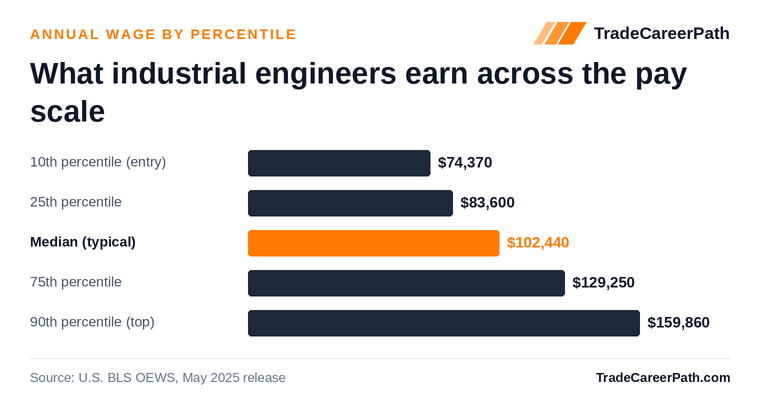
That is the median-to-median jump, but it understates the ceiling. Industrial engineering is a 365,740-person occupation nationally with a mean wage of $109,900, and the 90th percentile sits at $159,860 (BLS OEWS, May 2025) - territory a machinist essentially cannot reach on the spindle side without owning the shop.
Full career details, percentiles, and state-by-state pay: Industrial Engineer career guide.
What Your Experience Is Worth
Setups, feeds and speeds, tolerances, and what actually slows a cell down. Industrial engineering is the discipline of production itself, and engineers who have made chips diagnose floor problems that spreadsheet-only IEs cannot see.
This is not a courtesy point - it is the specific hiring edge. When an IE proposes a cycle-time reduction, the machinists in the room know within seconds whether it survives contact with a real setup. An IE who ran machines for years writes standards that hold up, gets straight answers from operators, and spots the difference between a process problem and a maintenance problem. New graduates spend their first two years learning what you already know.
What the Work Is Like on the Other Side
Day to day, an industrial engineer’s job is to make the whole system produce more with less - less time, less scrap, less walking, less overtime. Where a machinist owns one cell, the IE owns the flow between all of them.
A typical week: time studies and line-balancing on a cell that keeps missing rate; a layout revision for a new product introduction, done in CAD and argued over with maintenance and the toolroom; a scrap Pareto pulled from the quality system, followed by a root-cause session at the machine with the operator; a cost justification for a fixture or a cobot, written for a plant manager who thinks in payback months. There are more meetings and far more writing than the trade side - standard work documents, capital requests, capacity models in Excel or simulation software - but the work still lives on the floor. Good IEs wear steel toes most days; the ones who never leave the office get ignored, and deserve it.
The mental shift is the real change. As a machinist, you are measured on parts out the door today. As an IE, you are measured on whether the plant hits rate this quarter, and your best work is often invisible - a bottleneck that never formed, an injury that never happened. You trade the satisfaction of a finished part for scale: one good process change outproduces any single operator, every shift, indefinitely.
What Transfers
Machining and manufacturing-technology coursework commonly transfers into manufacturing engineering technology programs; NIMS credentials and apprenticeship hours strengthen both transfer evaluations and hiring.
Ask every program for a written transfer-credit evaluation before enrolling; it is free, and the difference between schools can be a full year of your life.
Two degree labels lead to the same jobs, and it pays to know both. A BS in industrial engineering is the classic route and the one that keeps every door open, including graduate school. A BS in manufacturing engineering technology (MET) is often the better fit for a working machinist: more evening and online sections, heavier credit for shop coursework, and a lighter theoretical math load - while manufacturers hire both degrees into the same process and manufacturing engineering roles. If the PE license or a master’s might ever matter to you, confirm the program is ABET-accredited before you commit either way.
The Path, Step by Step
- Close the math gap first. Most working tradespeople start with algebra-to-calculus refreshers at a community college; cheap, online, and it de-risks the whole plan.
- Pick an accredited program built for working adults. ABET accreditation if you may ever want the PE license; evening, online, or hybrid formats.
- Submit everything for transfer credit. Apprenticeship records, certifications, military training, and old college credits.
- Keep working your trade. Your income funds the degree, and your daily work keeps compounding into exactly the experience employers want attached to the diploma.
- Move sideways before you graduate. Design-adjacent roles (drafting, field engineering, QA) often open to students partway through and convert to engineering titles at graduation.
The Career Ladder on the Engineering Side
The BLS wage percentiles for industrial engineers map cleanly onto how the career actually progresses. Use this as a sanity check on offers, not a guarantee:
| Stage | Typical titles | Years in | Realistic pay (BLS OEWS, May 2025) |
|---|---|---|---|
| Entry level | Manufacturing engineer I, process engineer, IE I | 0-3 | ~$74,370-$83,600 (10th-25th pct) |
| Mid-career | IE II/III, lean/continuous-improvement engineer | 3-10 | ~$102,440 (median) |
| Senior | Senior IE, plant IE lead, master black belt | 10-15 | ~$129,250 (75th pct) |
| Principal / leadership | Principal engineer, engineering or operations manager | 15+ | $159,860+ (90th pct) |
Note the floor: the 10th percentile for industrial engineers is $74,370 - already well above the $58,750 CNC machinist median. Former machinists are also routinely hired above the bottom of the entry band, because they need no supervision around real equipment. And the ladder’s top rungs lead somewhere the trade rarely does: IE is the classic feeder role into operations management and plant management.
Where Industrial Engineers Earn the Most
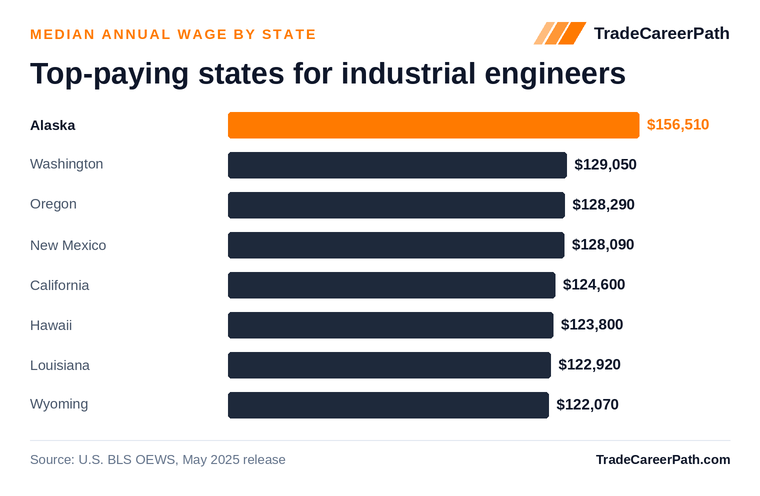
Pay concentrates where the industries do - aerospace in the Pacific Northwest, semiconductors and national labs in New Mexico, and the sheer scale of California manufacturing. BLS reports state data for 51 states and territories; these are the top five by median wage:
| State | Median annual wage | Employment |
|---|---|---|
| Alaska | $156,510 | 220 |
| Washington | $129,050 | 6,130 |
| Oregon | $128,290 | 5,810 |
| New Mexico | $128,090 | 1,140 |
| California | $124,600 | 32,680 |
Alaska pays the most but employs only 220 IEs - a thin market. For a machinist planning the move, the depth of the market matters as much as the median: California (32,680 jobs), Michigan (30,990), and Texas (30,980) are the three largest employers of industrial engineers, and Michigan’s concentration is nearly three times the national average thanks to the auto industry (BLS OEWS, May 2025). If you already machine in a manufacturing state, the odds are good the IE jobs are in the same buildings.
Job Outlook for 2026 and Beyond
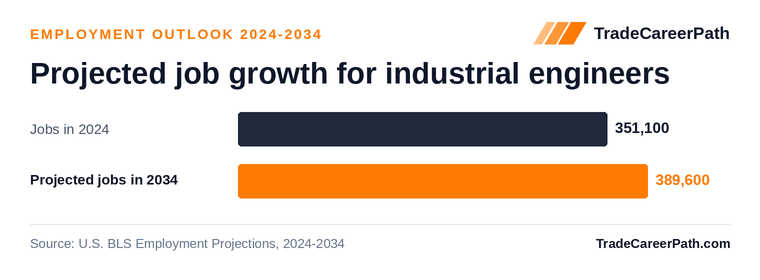
This is one of the strongest outlooks of any engineering discipline. BLS projects industrial engineering employment to grow +12.4% from 2025 to 2035 - from 365,100 to 410,600 jobs - with about 23,100 openings per year once retirements and occupation changes are counted (BLS Employment Projections, 2025-35). Pay is moving too: the 2024 projections-series median of $101,140 has already been passed by the May 2025 OEWS median of $102,440.
The drivers favor exactly your background. Reshoring and automation both create IE work - every new line, robot cell, and lights-out machining installation needs someone to lay it out, balance it, and prove the cost case. The occupation is large and the openings number is the one that matters for a career changer: 25,200 seats a year means employers in every manufacturing region are hiring at the bachelor’s level, continuously.
Do You Need a PE License?
Mostly no. Industrial engineers overwhelmingly work for manufacturers under the “industrial exemption” - the company, not the individual engineer, carries legal design responsibility, so most IEs never license and it costs them nothing in pay or advancement inside a plant.
If you want the option anyway - the PE helps in consulting, expert-witness work, and some government roles - keep the path open from day one: choose an ABET-accredited program, take the Fundamentals of Engineering (FE) exam near graduation while the coursework is fresh, log four years of qualifying experience, then sit for the PE exam under your state board’s rules. In this field, certifications tend to matter more day to day than the license: Six Sigma belts, lean credentials, and quality certifications are the ones that show up in job postings, and your NIMS credentials already signal the same hands-on seriousness.
If This Path Is Not Quite Right
Related jumps from the same starting point:
- Industrial Production Manager - the management route to running the floor, sometimes without the engineering degree
- Mechanical Engineer - if you would rather design the parts and machines than the process
- Welding Engineer - the joining-process specialty, for machinists in fab-heavy shops
- Online Engineering Degrees for Tradespeople - how to pick an ABET program that fits a work schedule
Or browse all trade careers that require a 4-year degree.
Frequently Asked Questions
Can a CNC machinist really work as an industrial engineer?
Yes. The requirement is the accredited bachelor's degree; nothing about starting in the trade blocks the path, and employers consistently treat field experience as an advantage rather than a detour.
How long does it take while working full-time?
Typically five to six years part-time for the bachelor's, less with transfer credit. Machining and manufacturing-technology coursework commonly transfers into manufacturing engineering technology programs.
What is the pay difference?
The national median is $58,750 for CNC machinists versus $102,440 for the degree role (BLS OEWS, May 2025), a difference of about $43,690 per year at the median.
Is the industrial engineering degree hard for a machinist?
The math sequence - algebra through calculus, plus statistics - is the real hurdle, and most working machinists need a refresher before the first engineering course. The manufacturing content itself is the easy part: process planning, tooling, and quality courses cover material you have lived on the floor.
Industrial engineering vs mechanical engineering - which degree should a machinist pick?
Industrial engineering fits if you want to own the process - layout, scheduling, quality, cost. Mechanical engineering fits if you want to design the parts and machines themselves. For process-minded machinists, industrial (or manufacturing engineering technology) usually has more evening and online options and a shorter math sequence at many schools.
Can you train as an industrial engineer without a degree?
Not with the engineer title at most employers - the bachelor's is the screen. Without it, the realistic ceiling is manufacturing technician, quality technician, or production supervisor. Experience plus certifications shortens the degree through transfer credit, but it does not replace it.
Do industrial engineers need a PE license?
Usually no. Most industrial engineers work for manufacturers under the industrial exemption, so the company holds design responsibility and licensure is optional. If you want the PE - useful in consulting and some government work - the path is an ABET degree, the FE exam, four years of experience, then the PE exam.
What is the job outlook for industrial engineers?
Strong. BLS projects employment to grow +12.4% from 2025 to 2035, from 365,100 to 410,600 jobs, with about 23,100 openings per year on average (BLS Employment Projections, 2025-35).
Industrial Engineer Salary and Requirements by State
State-by-state medians, wage ranges, and school options are on the destination career’s state pages - start from the Industrial Engineer career guide and pick your state, or jump straight to the biggest markets: California, Michigan, Texas, Washington, and Oregon.
Degree and Program Guides
- Online Industrial Engineering Degrees - accredited program options for this path
Sources
- U.S. Bureau of Labor Statistics, Occupational Employment and Wage Statistics (OEWS), May 2025 - Industrial Engineers (SOC 17-2112) and CNC machinists
- U.S. Bureau of Labor Statistics, Employment Projections, 2025-35
- U.S. Bureau of Labor Statistics, Occupational Outlook Handbook - education and licensing requirements for industrial engineers
Machinist to Industrial Engineer Salary by State
About this guide: Researched and written by the TradeCareerPath Editorial Team. Our editorial team researches and sources every trade school and career guide using federal labor and education data, including BLS OEWS and Employment Projections, DOL apprenticeship records, IPEDS, College Scorecard, and state licensing boards. We follow the editorial standards documented at /editorial-policy/.
Data sources
Figures on this page are sourced from the federal and state datasets below. Methodology: how we rank and source data.
| Data | Provider | Vintage |
|---|---|---|
| Occupational Employment and Wage Statistics (OEWS) | U.S. Bureau of Labor Statistics | May 2025 |
| Employment Projections | U.S. Bureau of Labor Statistics | 2025-2035 |
| Integrated Postsecondary Education Data System | National Center for Education Statistics (IPEDS) | 2024 |
| College Scorecard (school-level outcomes) | U.S. Department of Education | latest release |
| College Scorecard (field-of-study earnings) | U.S. Department of Education | latest release (updated 2026-06-12) |
| Occupational licensing requirements | CareerOneStop (U.S. Department of Labor) | latest release (updated 2026-02-22) |
| Registered apprenticeship programs | CareerOneStop / Apprenticeship.gov (U.S. Department of Labor) | latest release (updated 2025-10-25) |
| O*NET occupation profiles (skills, tasks, tools, job zones) | U.S. Department of Labor (O*NET / Employment & Training Admin.) | O*NET 31.0 (updated 2026-10-14) |