
How to Become a Maintenance Technician in 2026
Is Maintenance Technician Right for You?
The U.S. Department of Labor's O*NET profile for Maintenance and Repair Workers, General (SOC 49-9071) describes the work this way: Perform work involving the skills of two or more maintenance or craft occupations to keep machines, mechanical equipment, or the structure of a building in repair. Duties may involve pipe fitting; HVAC maintenance; insulating; welding; machining; carpentry; repairing electrical or mechanical equipment; installing, aligning, and balancing new equipment; and repairing buildings, floors, or stairs.
What the work involves
- Perform routine maintenance, such as inspecting drives, motors, or belts, checking fluid levels, replacing filters, or doing other preventive maintenance actions.
- Inspect, operate, or test machinery or equipment to diagnose machine malfunctions.
- Adjust functional parts of devices or control instruments, using hand tools, levels, plumb bobs, or straightedges.
- Repair machines, equipment, or structures, using tools such as hammers, hoists, saws, drills, wrenches, or equipment such as precision measuring instruments or electrical or electronic testing devices.
- Order parts, supplies, or equipment from catalogs or suppliers.
Skills and knowledge that matter
Skills: Equipment Maintenance, Repairing, Troubleshooting, Critical Thinking, Active Learning, Monitoring.
Knowledge: Mechanical, English Language, Building and Construction, Mathematics.
Tools and technology you may use
Technology: Operating system software, Computer aided design CAD software, Facilities management software, Apple macOS, Autodesk AutoCAD, Facebook.
Typical preparation
O*NET Job Zone Three (Medium Preparation Needed). Most occupations in this zone require training in vocational schools, related on-the-job experience, or an associate's degree. Employees in these occupations usually need one or two years of training involving both on-the-job experience and informal training with experienced workers. A recognized apprenticeship program may be associated with these occupations.
Interest fit
O*NET interest profile: Realistic, Conventional, Investigative. People who enjoy hands-on, practical work with tools, machines, plants, or materials often find this occupation a good fit.
Source: O*NET 31.0 (updated 2026-10-14)
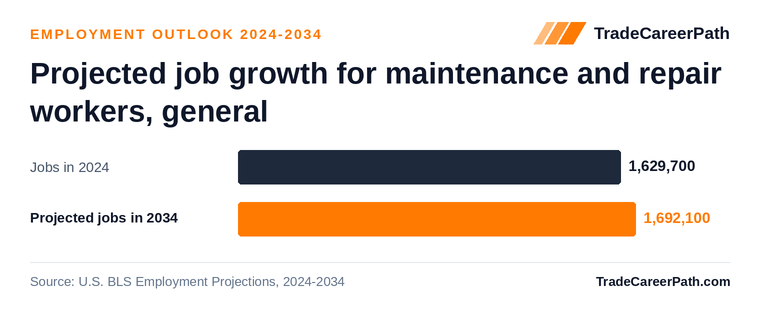
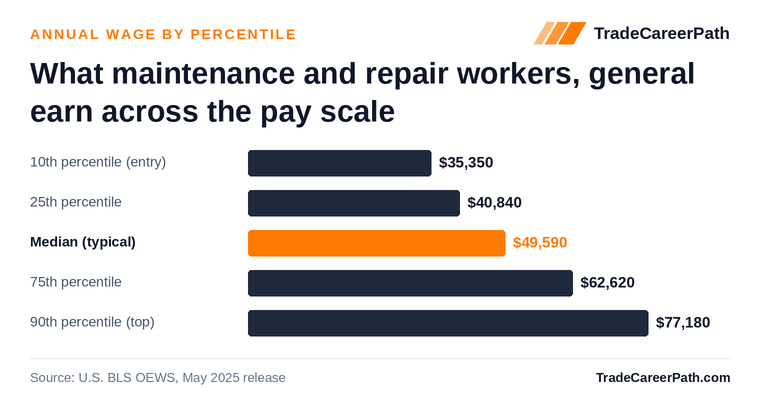
Quick answer: Training as a maintenance technician usually takes 6 months to 2 years. You complete a certificate ($4,000 to $12,000) or an associate degree, build hands-on experience through an apprenticeship or paid on-the-job training, and add certifications such as EPA Section 608 or the SMRP CMRT as your work requires. There is no single licensing exam in most cases. The median maintenance technician salary is $49,590 per year ($23.84/hour), and employers post about 148,700 openings nationwide each year (BLS, May 2025).
Maintenance technicians, also listed by the BLS as general maintenance and repair workers, keep buildings, machinery, and systems running across factories, hospitals, schools, and commercial properties. They handle preventive maintenance, repairs, and troubleshooting on electrical, mechanical, and HVAC systems, often as the first call when something breaks down.
How to Become a Maintenance Technician
Most people enter the field in about six months to two years, depending on the path they choose. There is no single licensing exam for general maintenance work. Instead, you build the career through training, hands-on experience, and certifications that match the systems you work on.
1. Earn a high school diploma or GED
A high school diploma or GED is the baseline requirement for most maintenance programs and entry-level jobs. Before you enroll, it helps to take classes that mirror the work: algebra and basic geometry for measurements and loads, physics for how mechanical and electrical systems behave, and any shop, welding, or electronics class your school offers. Comfort with computers matters too, since modern facilities run on computerized maintenance management systems (CMMS), building automation controls, and digital work orders. If you are changing careers and already hold a diploma or a degree, you can move straight to training. Many strong technicians come from other hands-on fields, such as the military, automotive work, or construction, and bring transferable skills in tools, troubleshooting, and safety. The goal at this stage is simply to be ready for technical coursework and to show employers you can read manuals, follow procedures, and work safely.
2. Complete a maintenance or industrial technology program
This is the core training, and you have a few formats to choose from. Certificate programs take roughly 6 to 12 months and focus on practical, job-ready skills. Associate degree programs take about 2 years and add broader technical knowledge that supports advancement. Typical coursework covers electrical systems and motor controls, hydraulics and pneumatics, welding and fabrication, HVAC and refrigeration basics, blueprint reading, and preventive maintenance planning. Look for programs with well-equipped labs, because the hands-on portions, such as wiring a circuit or troubleshooting a pump, are what employers care about most. Many schools offer evening or partly online classes for working students, though the shop work still needs to be done in person. Some programs also align with industry standards from groups like NIMS or MSSC, which can make it easier to earn recognized credentials later.
3. Gain hands-on experience
Coursework gets you started, but employers want proof you can do the work. Apprenticeships, internships, and entry-level maintenance roles let you practice real tasks, such as diagnosing a failed motor, replacing belts and bearings, or running a preventive-maintenance route, under the eye of an experienced technician. Many employers provide paid, moderate-term on-the-job training, which BLS lists as the typical way maintenance workers reach full competence. As you go, keep track of the equipment and systems you have worked on, since hiring managers often ask about specific machinery, controls, or facility types. This stage is also where you learn the soft skills that separate good technicians from great ones: reading a situation quickly, communicating with operators and managers, and knowing when to repair versus replace a part.
4. Earn certifications
Certifications are usually optional for general maintenance work, but they can open doors and are sometimes required by law. EPA Section 608 certification is mandatory to handle refrigerants in HVAC and refrigeration work. OSHA 10 or OSHA 30 safety training is widely expected and often required on industrial and construction sites. For broader recognition, the Society for Maintenance & Reliability Professionals (SMRP) issues the Certified Maintenance and Reliability Technician (CMRT) and the Certified Maintenance and Reliability Professional (CMRP), and the International Maintenance Institute (IMI) issues a Certified Maintenance Technician credential. Manufacturing-focused standards from NIMS or MSSC can also signal competence to factory employers. Certification exam fees generally run about $50 to $200. Pick the credentials that match the systems and industries you want to work in rather than collecting every one.
5. Apply for maintenance technician jobs
Manufacturing plants, hospitals, schools, hotels, property management firms, and government agencies all hire maintenance technicians. On your resume, lead with hands-on experience, the equipment and systems you know, your safety training, and any certifications you hold. Tailor each application to the setting, since a facilities role at an apartment complex looks different from an industrial role on a production line. Networking through local trade groups and instructors can surface openings before they are posted. Once you land a role, keep learning new equipment and controls. With experience and added credentials, technicians move into maintenance supervisor, facilities engineer, industrial machinery mechanic, and building systems roles that pay more.
What Maintenance Technicians Do
Maintenance technicians repair, install, and maintain the equipment and systems that keep facilities running. They combine electrical, mechanical, and diagnostic skills to spot problems early and fix them fast. When a machine goes down, the technician is often the first call that gets production or a building back online.
Common Responsibilities
- Inspect and maintain machinery, HVAC systems, and building infrastructure
- Perform routine preventive maintenance
- Troubleshoot electrical or mechanical issues
- Read blueprints and technical manuals
- Keep maintenance records and safety logs
- Ensure compliance with safety and environmental regulations
Skills and Qualities for Success
- Strong mechanical aptitude
- Problem-solving and troubleshooting skills
- Electrical and HVAC knowledge
- Time management and dependability
- Physical stamina and attention to safety
- Ability to read schematics and manuals
Where Maintenance Technicians Work
- Manufacturing plants
- Commercial buildings
- Hospitals and schools
- Hotels and property management firms
- Food production and packaging facilities
- Government and public works departments
Education and Training Paths
| Pathway | Typical Duration | Outcome |
|---|---|---|
| Certificate | 6-12 months | Entry-level employment |
| Associate Degree | 2 years | Broader technical knowledge and advancement potential |
| Apprenticeship | 2-3 years | Earn while you learn model |
Career Growth and Advancement
Experienced technicians can move into:
- Maintenance Supervisor or Manager
- Industrial Machinery Mechanic
- HVAC Specialist
- Facilities Engineer
- Building Systems Technician
Cost and Program Duration
- Program Cost: varies by school, format and location depending on location and school
- Duration: 6 months to 2 years
- Certification Fees: $50 to $200
Many schools offer evening or online classes for working students.
Pros and Cons
✅ Pros
- Strong job demand across industries
- Hands-on, active work environment
- Good pay without a four-year degree
- Transferable technical skills
⚠️ Cons
- Physically demanding work
- Emergency or on-call shifts possible
- Exposure to noise and machinery
Licensing and Requirements
Licensing varies by state and industry. General maintenance work usually has no single license, but specialized tasks can. EPA Section 608 is required to handle refrigerants, and some employers require HVAC or electrical certifications for specialized maintenance work.
Find Maintenance Technician Schools Near You
Quick Facts: Maintenance Technician Salary, Education, and Outlook
Industry Organizations & Certifying Bodies
These are the recognized national organizations, unions, certifying bodies, and regulatory authorities that shape this trade. They issue the credentials, sponsor the apprenticeships, publish the codes, and represent workers and employers.
- Society for Maintenance & Reliability Professionals (SMRP) Issues the CMRP and CMRT certifications.
- International Maintenance Institute (IMI) Issues the Certified Maintenance Technician credential.
Wage and Employment Charts
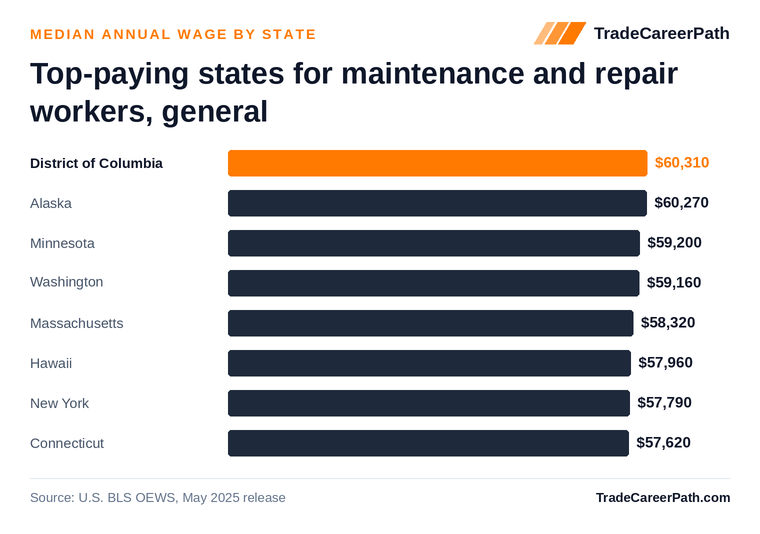
Maintenance Technician Salary and Requirements by State
Select your state for local wage data, training options, and requirements:
Alabama · Alaska · Arizona · Arkansas · California · Colorado · Connecticut · Delaware · District of Columbia · Florida · Georgia · Hawaii · Idaho · Illinois · Indiana · Iowa · Kansas · Kentucky · Louisiana · Maine · Maryland · Massachusetts · Michigan · Minnesota · Mississippi · Missouri · Montana · Nebraska · Nevada · New Hampshire · New Jersey · New Mexico · New York · North Carolina · North Dakota · Ohio · Oklahoma · Oregon · Pennsylvania · Rhode Island · South Carolina · South Dakota · Tennessee · Texas · Utah · Vermont · Virginia · Washington · West Virginia · Wisconsin · Wyoming
Workplace Safety Snapshot
BLS Survey of Occupational Injuries and Illnesses data (2023-2024) report approximately 342.4 days-away, restricted, or transfer cases per 10,000 full-time-equivalent workers in maintenance and repair workers, general (about 3.42 per 100 FTE). Source: BLS Survey of Occupational Injuries and Illnesses, Table R98.
Frequently Asked Questions
How long does maintenance technician training take?
It typically takes 6 months to 2 years. A certificate program runs about 6 to 12 months, while an associate degree takes roughly 2 years. Many technicians also learn through moderate-term on-the-job training. A high school diploma or GED is generally required to start.
Do you need a college degree to work as a maintenance technician?
No. A college degree is not required. Most people enter the field through a certificate or associate degree program, or through paid on-the-job training with an employer. A high school diploma or GED is typically the only educational prerequisite.
How much does maintenance technician training cost?
Programs generally cost about $4,000 to $12,000 depending on the format and school, with certificate programs usually costing less than degree programs. Optional certification exams add roughly $50 to $200 in fees.
Do maintenance technicians need a license or certification?
Certification is usually optional, though some specialties carry requirements. EPA Section 608 certification is legally required to handle refrigerants, and many employers prefer OSHA 10 or 30 safety training. Voluntary credentials such as the SMRP Certified Maintenance and Reliability Technician (CMRT) or the IMI Certified Maintenance Technician can strengthen a resume.
Is it hard to train as a maintenance technician?
Entry is relatively accessible because there is no single licensing exam and most people finish training in 6 months to 2 years. The work itself is hands-on and can be physically demanding, and it rewards people who enjoy troubleshooting electrical, mechanical, and HVAC problems.
Can you train to be a maintenance technician online?
Partly. Many schools offer the classroom portion of maintenance and industrial technology programs online or in evening classes for working students. The hands-on skills, such as electrical wiring, hydraulics, and welding, still require lab or shop time and on-the-job practice.
How much do maintenance technicians earn?
The median wage for maintenance and repair workers is $49,590 per year, or about $23.84 per hour (BLS, May 2025). The lowest 10 percent earn around $35,350 and the highest 10 percent earn about $77,180, with pay varying by industry, experience, and location.
How Maintenance Technician Pay Compares to Similar Trades
Side-by-side comparison of Maintenance Technician and the closest related careers, based on U.S. Bureau of Labor Statistics data (May 2025 OEWS + 2025-2035 Employment Projections).
| Career | Median Pay | 10-Year Growth | Annual Openings |
|---|---|---|---|
| Maintenance Technician this guide | $49,590 | +4.2% | 148,700 |
| Mechanic & Engine Technician | $50,620 | +5.0% | 66,200 |
| Diesel Mechanic | $61,770 | +3.6% | 24,400 |
| HVAC Technician | $61,010 | +10.9% | 40,600 |
| Electrician | $63,190 | +9.2% | 72,700 |
Source: BLS Occupational Employment and Wage Statistics + BLS Employment Projections.
Advance Your Career with a Degree
Experienced Maintenance Technician professionals often step up into degree-track careers where field experience is a hiring advantage:
- Mechanical Engineer - median pay $104,110 (BLS OEWS, May 2025); requires a 4-year degree
- Health and Safety Engineer - median pay $115,160 (BLS OEWS, May 2025); requires a 4-year degree
- Industrial Engineer - median pay $102,440 (BLS OEWS, May 2025); requires a 4-year degree
- Industrial Production Manager - median pay $126,060 (BLS OEWS, May 2025); requires a 4-year degree
- Aerospace Engineer - median pay $134,960 (BLS OEWS, May 2025); requires a 4-year degree
- Petroleum Engineer - median pay $144,910 (BLS OEWS, May 2025); requires a 4-year degree
- Agricultural Engineer - median pay $98,590 (BLS OEWS, May 2025); requires a 4-year degree
- Facilities Manager - median pay $106,660 (BLS OEWS, May 2025); requires a 4-year degree
- Chemical Engineer - median pay $125,040 (BLS OEWS, May 2025); requires a 4-year degree
- Biomedical Engineer - median pay $109,370 (BLS OEWS, May 2025); requires a 4-year degree
- Geoscientist - median pay $101,920 (BLS OEWS, May 2025); requires a 4-year degree
- Nuclear Engineer - median pay $133,970 (BLS OEWS, May 2025); requires a 4-year degree
- Mining Engineer - median pay $106,220 (BLS OEWS, May 2025); requires a 4-year degree
- Merchant Marine Officer - median pay $92,460 (BLS OEWS, May 2025); requires a 4-year degree
See all trade careers that require a 4-year degree.
Degree and Program Guides
- Online Industrial Technology Degrees - the applied degree for plant and facilities leadership
Sources
- U.S. Bureau of Labor Statistics, Occupational Employment and Wage Statistics (May 2025)
- U.S. Bureau of Labor Statistics, Employment Projections 2025-2035
- U.S. Bureau of Labor Statistics, Survey of Occupational Injuries and Illnesses (2023-2024, Table R98)
- U.S. Department of Labor, Wage and Hour Division, Davis-Bacon General Wage Determinations (2026)
Maintenance Technician Salary by State
About this guide: Researched and written by the TradeCareerPath Editorial Team. Our editorial team researches and sources every trade school and career guide using federal labor and education data, including BLS OEWS and Employment Projections, DOL apprenticeship records, IPEDS, College Scorecard, and state licensing boards. We follow the editorial standards documented at /editorial-policy/.
Data sources
Figures on this page are sourced from the federal and state datasets below. Methodology: how we rank and source data.
| Data | Provider | Vintage |
|---|---|---|
| Occupational Employment and Wage Statistics (OEWS) | U.S. Bureau of Labor Statistics | May 2025 |
| Employment Projections | U.S. Bureau of Labor Statistics | 2025-2035 |
| Integrated Postsecondary Education Data System | National Center for Education Statistics (IPEDS) | 2024 |
| College Scorecard (school-level outcomes) | U.S. Department of Education | latest release |
| College Scorecard (field-of-study earnings) | U.S. Department of Education | latest release (updated 2026-06-12) |
| Occupational licensing requirements | CareerOneStop (U.S. Department of Labor) | latest release (updated 2026-02-22) |
| Registered apprenticeship programs | CareerOneStop / Apprenticeship.gov (U.S. Department of Labor) | latest release (updated 2025-10-25) |
| O*NET occupation profiles (skills, tasks, tools, job zones) | U.S. Department of Labor (O*NET / Employment & Training Admin.) | O*NET 31.0 (updated 2026-10-14) |