
How to Become a Marine Engineer in 2026
Is Marine Engineer Right for You?
The U.S. Department of Labor's O*NET profile for Marine Engineers and Naval Architects (SOC 17-2121) describes the work this way: Design, develop, and evaluate the operation of marine vessels, ship machinery, and related equipment, such as power supply and propulsion systems.
What the work involves
- Design complete hull and superstructure according to specifications and test data, in conformity with standards of safety, efficiency, and economy.
- Supervise other engineers and crew members and train them for routine and emergency duties.
- Study design proposals and specifications to establish basic characteristics of craft, such as size, weight, speed, propulsion, displacement, and draft.
- Perform monitoring activities to ensure that ships comply with international regulations and standards for life-saving equipment and pollution preventatives.
- Oversee construction and testing of prototype in model basin and develop sectional and waterline curves of hull to establish center of gravity, ideal hull form, and buoyancy and stability data.
Skills and knowledge that matter
Skills: Speaking, Reading Comprehension, Critical Thinking, Active Listening, Writing, Complex Problem Solving.
Knowledge: Engineering and Technology, Mathematics, Design, Physics.
Tools and technology you may use
Tools: Desktop computers, Hard hats, Laptop computers, Personal computers, Plotters, Programmable logic controllers PLC.
Technology: Document management software, Computer aided design CAD software, Analytical or scientific software, Adobe Acrobat, Autodesk AutoCAD, Dassault Systemes SolidWorks.
Typical preparation
O*NET Job Zone Four (Considerable Preparation Needed). Most of these occupations require a four-year bachelor's degree, but some do not. Employees in these occupations usually need several years of work-related experience, on-the-job training, and/or vocational training.
Interest fit
O*NET interest profile: Realistic, Investigative, Conventional. People who enjoy hands-on, practical work with tools, machines, plants, or materials often find this occupation a good fit.
Source: O*NET 29.1 (updated 2026-06-13)
Quick answer: Training as a marine engineer requires a 4-year degree - typically a Bachelor’s in marine engineering, naval architecture, or marine systems. The national median pay is $112,230 per year, and BLS projects +5.8% employment change from 2024 to 2034 (BLS OEWS, May 2025; BLS Employment Projections, 2024-34).
Marine Engineer at a Glance
| Metric | Detail | Source |
|---|---|---|
| Median annual wage | $112,230 | BLS OEWS, May 2025 |
| Typical wage range | $83,010 (10th pct) - $173,330 (90th pct) | BLS OEWS, May 2025 |
| Employment | 8,250 nationwide | BLS OEWS, May 2025 |
| Projected growth (2024-34) | +5.8%, about 600 openings per year | BLS Employment Projections, 2024-34 |
| Typical education | Bachelor’s in marine engineering, naval architecture, or marine systems | BLS Occupational Outlook Handbook |
| License / certification | USCG engineering license for shipboard roles; PE for design sign-off | Federal (USCG) |
What Does a Marine Engineer Do?
Marine engineers and naval architects design ships, offshore platforms, and their propulsion and mechanical systems, and oversee shipyard construction and repair - the engineering layer above shipfitters, marine welders, and diesel mechanics.
Day to day, the job splits along a few well-worn lines. A marine engineer on the machinery side sizes propulsion plants, routes piping, and specifies the pumps, generators, and HVAC that keep a vessel alive - then walks the shipyard to verify the build matches the drawings. A naval architect runs stability and structural calculations and proves to a classification society that the hull will survive its design loads. A licensed shipboard engineer stands watch in the engine room, manages fuel and maintenance, and troubleshoots casualties at sea, where there is no vendor tech to call. Survey work - for class societies, insurers, or the Coast Guard - is the third path: crawling tanks and machinery spaces, judging wastage and cracks, and writing the report that decides whether a ship keeps sailing. Nearly everything is rule-driven; class rules and USCG regulations shape the daily routine as much as the math does.
If you are coming in from shipyard welding or marine diesel work, the shortest way to say it: the tradesperson builds or fixes what the drawing says; the engineer decides what the drawing must say and proves it is safe. The weld procedure spec, the repair disposition on a wasted frame, the decision to derate an engine - those work as your calls.
Skills That Make a Great Marine Engineer
- Propulsion and power systems
- Hull form, stability, and structural basics
- Classification-society rules and USCG regulations
- Hydraulics, piping, and auxiliary systems
- Shipyard construction and repair practices
- CAD and analysis tools (AutoCAD, Rhino, ship-design and FEA packages)
- Writing: survey reports, engineering dispositions, and class submissions carry the job
Marine Engineer Salary
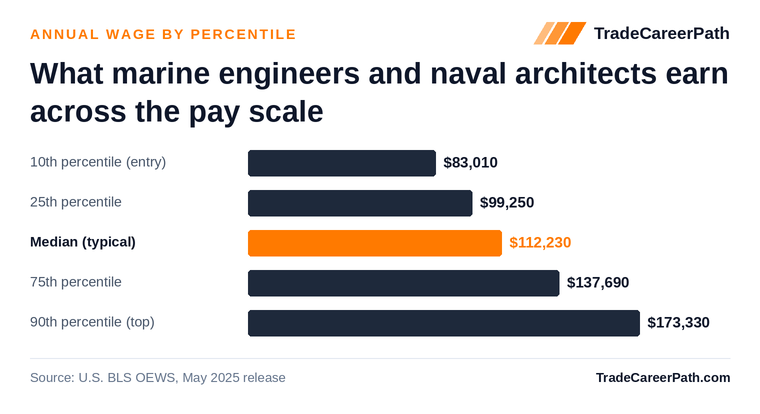
Marine engineering pays well above the trades that feed into it. The national median is $112,230 per year, and the 10th percentile - roughly where new graduates start - is $83,010, already above the median for most shipyard trades. The 75th percentile is $137,690, and the top 10% earn $173,330 or more (BLS OEWS, May 2025). Sailing billets often add rotation pay and overtime that push total earnings past the shoreside figures shown here.
Where the Jobs and the Money Are
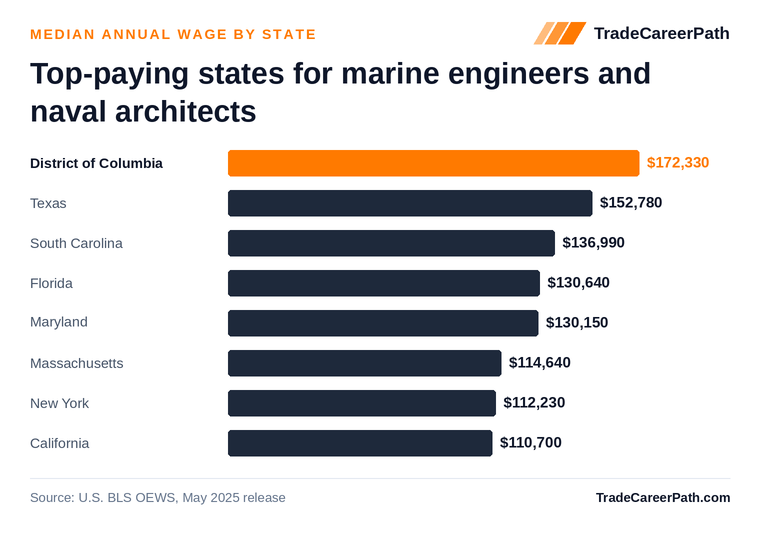
This is a small, coastal occupation - 8,250 people nationwide - and it clusters hard around Navy and shipbuilding money. The District of Columbia is the extreme case: 490 marine engineers, a $172,330 median, and a location quotient of 13.28 - the occupation is more than thirteen times as concentrated there as in the average labor market, courtesy of NAVSEA, program offices, and defense consultancies. Maryland (location quotient 2.04) rides the same Navy ecosystem, and Washington State (370 jobs, location quotient 1.97) pairs Puget Sound Naval Shipyard with a large commercial and ferry fleet.
| State | Median annual wage | Employment |
|---|---|---|
| District of Columbia | $172,330 | 490 |
| Texas | $152,780 | 330 |
| South Carolina | $136,990 | 40 |
| Florida | $130,640 | 370 |
| Maryland | $130,150 | 300 |
Texas pays a $152,780 median on Gulf offshore and shipyard work, and Florida combines 370 jobs with a $130,640 median across cruise, yacht, and repair markets. The practical read: if you want the ability to change employers without moving, aim for the DC-Maryland corridor, Puget Sound, the Gulf Coast, or Florida - elsewhere, expect one or two employers per port town.
How to Become a Marine Engineer
1. Earn a bachelor’s degree
Marine engineering, naval architecture, or marine engineering technology - and in this field, the state and federal maritime academies dominate, because an academy degree bundles the coursework, the sea time, and the USCG license exam prep into one four-year package. If a residential academy is not realistic, ABET-accredited mechanical engineering with marine electives is a well-trodden alternative for shoreside design work, and it stays marketable outside the maritime industry too.
2. Choose shipboard or shoreside
Decide early, because the credentials diverge. Shipboard engineering officers need a USCG license and the physical, drug-testing, and sea-time requirements that come with it - in exchange for rotation schedules and strong total pay. Shoreside roles in design offices, classification societies, and shipyards need no license to start and offer a normal home life. Plenty of engineers sail for a stretch, then come ashore as surveyors or superintendents.
3. Start in a shipyard or design office
Shipbuilders, ship-repair yards, naval-architecture firms, classification societies, and the Navy’s civilian engineering corps all hire at the bachelor’s level. For former tradespeople, production engineering and repair-superintendent roles are the classic entry points: the job is judging real steel and real machinery, and a background running a torch or tearing down a marine diesel is a visible advantage.
4. Gain licensure
Shipboard, the entry credential is the USCG Third Assistant Engineer license - earned through a maritime academy or, more slowly, by accumulating qualifying sea time and passing the Coast Guard exams. Shoreside, the PE is the design-authority credential. Neither is mandatory for every job, but each one unlocks a tier of work - and pay - that unlicensed engineers cannot touch. Details in the licensing section below.
5. Advance
Sailing engineers climb the license ladder: Third, Second, First Assistant, then Chief Engineer, each step gated by sea time and exams. Shoreside, the track runs to senior naval architect, principal engineer, chief surveyor, or engineering management at a yard or program office - the fork usually comes around the ten-year mark. Both tracks are covered in the career ladder below.
Career Ladder: Titles and Realistic Pay
The BLS wage percentiles map cleanly onto how maritime careers actually progress. Use this as a sanity check on offers, not a guarantee:
| Stage | Typical titles | Years in | Realistic pay (BLS OEWS, May 2025) |
|---|---|---|---|
| Entry level | Engineer I, junior naval architect, Third Assistant Engineer | 0-3 | ~$83,010-$99,250 (10th-25th pct) |
| Mid-career | Engineer II/III, project naval architect, Second Assistant Engineer | 3-10 | ~$112,230 (median) |
| Senior | Senior marine engineer, lead naval architect, First Assistant Engineer | 10-15 | ~$137,690 (75th pct) |
| Principal / leadership | Chief Engineer, principal naval architect, chief surveyor, engineering manager | 15+ | $173,330+ (90th pct) |
Two notes for career changers. First, prior trade experience compresses this ladder: former shipyard welders and marine diesel mechanics are routinely hired above the bottom of the entry band because they need less supervision around real hulls and machinery. Second, the figures are base wages - sailing billets add rotation pay and overtime, and senior shipboard engineers on good contracts often out-earn the 90th-percentile number.
Do You Need a License?
It depends entirely on which side of the pier you work. Shipboard, the answer is an unambiguous yes: engineering officers on U.S.-flag vessels must hold a USCG engineering license, starting at Third Assistant Engineer. The maritime academies are the direct route - degree, cadet sea time, and license exam in one program - while the “hawsepipe” route (working up from unlicensed engine-room ratings via sea time and Coast Guard exams) still exists but is slower. Expect a merchant mariner credential, TWIC card, physical, and drug-testing program as standing requirements.
Shoreside, most design engineers work unlicensed under their employer’s responsibility, the same industrial arrangement common across manufacturing. The PE matters for consultants, engineers who stamp drawings for regulators or clients, and anyone eyeing principal-level roles at naval-architecture firms - the path is the standard one: ABET degree, FE exam (you can sit for it as a senior), four years of experience, then the PE exam. Classification-society surveyors carry their society’s own authorization rather than a state license, earned through training and experience on the job.
Why an Online Degree Works for This Career
Shipyard welders and marine diesel mechanics already know hulls and engine rooms from the inside. A marine engineering or naval architecture bachelor’s - including maritime-academy programs with distance options - moves you to the design and survey side of the same vessels. Shipyards and repair companies commonly offer tuition assistance, and an online mechanical-engineering degree with marine electives is a legitimate back door into shoreside roles for anyone who cannot relocate to an academy. In a field of 8,250 people, employers actively hunt for engineers who have actually built or fixed a ship.
Job Outlook for 2026 and Beyond
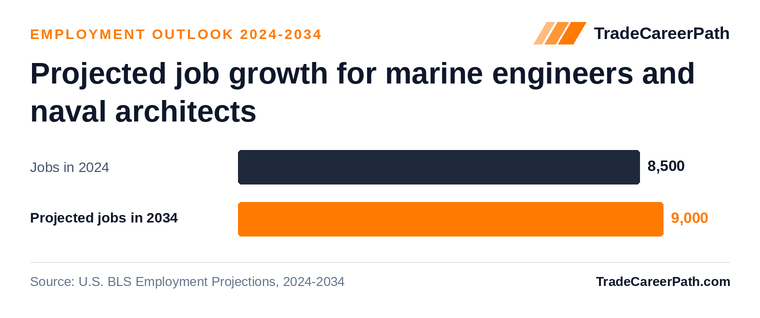
BLS projects employment of marine engineers and naval architects to grow +5.8% from 2024 to 2034 - from 8,500 to 9,000 jobs - with about 600 openings per year once retirements and occupation changes are counted (BLS Employment Projections, 2024-34). The latest wage data (OEWS, May 2025) puts the median at $112,230, up from the 2024 figure of $105,670 - a meaningful year-over-year rise for an occupation this small, driven by competition for licensed and experienced engineers.
The demand drivers are structural: Navy shipbuilding and sustainment programs are funded years ahead, the Jones Act keeps U.S.-flag construction and crewing domestic, and offshore energy needs vessel and platform engineering. For a career changer, the openings number matters most: 600 seats a year in an 8,250-person occupation means steady hiring, and the license, citizenship, and clearance requirements on much of the work keep the candidate pool tight.
Cost and Time to Complete the Degree
For marine engineers and naval architects, the credential is: Bachelor’s in marine engineering, naval architecture, or marine systems. A bachelor’s degree is typically 120 credit hours: four years full-time, and commonly five to six years part-time while working. Transfer credit is the other lever: prior college, military training, apprenticeship coursework, and industry certifications can be worth meaningful credit at transfer-friendly schools, so get a written transfer evaluation before enrolling anywhere. Costs vary widely by school type; in-state public online programs are usually the value benchmark, and employer tuition assistance is common for working adults in this field - shipyards and defense contractors in particular. The state maritime academies are public schools, and several offer in-region tuition deals that make the license-plus-degree package cheaper than it looks.
Pros and Cons of Training as a Marine Engineer
Pros
- Median pay of $112,230 nationally (BLS OEWS, May 2025)
- BLS projects +5.8% employment growth through 2034
- Field experience from the trades is a genuine hiring advantage
- Accredited online and hybrid degree paths exist for working adults
Cons
- Requires a 4-year degree (typically 120 credit hours)
- Entry-level pay starts near $83,010 at the 10th percentile
- Licensing hurdle: USCG engineering license for shipboard roles; PE for design sign-off
- Small, geographically concentrated field - most jobs sit in a handful of port regions
Frequently Asked Questions
Can a shipyard welder work as a marine engineer?
Yes - fabrication experience on real hulls is directly relevant to naval architecture and marine engineering, and the bachelor's degree is the entry requirement BLS lists for the occupation.
How much do marine engineers and naval architects make?
The national median annual wage for marine engineers and naval architects is $112,230 (BLS OEWS, May 2025). The top 10% earn $173,330 or more, while entry-level pay starts around $83,010.
What is the job outlook for marine engineers and naval architects?
BLS projects employment of marine engineers and naval architects to change by +5.8% from 2024 to 2034 (BLS Employment Projections, 2024-34).
How long does marine engineer training take?
The bachelor's degree is 120 credit hours: four years full-time, commonly five to six years part-time while working. Maritime-academy programs run four years and include sea time toward the USCG license. Transfer credit from prior college, military service, or apprenticeship coursework can meaningfully shorten it.
Is marine engineering hard?
The degree is math-heavy - thermodynamics, fluid mechanics, and ship stability are unavoidable. Tradespeople who have worked engine rooms or shipyards usually find the machinery and systems courses easier than fresh high-school graduates do, because the hardware is already familiar.
Should I study marine engineering or naval architecture?
Marine engineering covers propulsion, power, and shipboard machinery - the natural fit for diesel mechanics and engine-room hands. Naval architecture covers hull form, structure, and stability - the natural fit for shipfitters and welders. Many programs combine both, and employers hire across the two titles constantly.
Can you train as a marine engineer without a degree?
Not with the engineer title in design and survey work - employers require the bachelor's. Shipboard, an unlicensed engine-room rating can 'hawsepipe' up to a USCG engineering license through sea time and exams, but shoreside design, classification, and naval-architecture roles expect the degree.
Do marine engineers need a license?
It depends on the track. Shipboard engineering officers need a USCG license - typically Third Assistant Engineer to start, earned through a maritime academy or accumulated sea time. Shoreside designers usually work unlicensed under a company's responsibility, with the PE reserved for engineers who sign off drawings or work as consultants.
Marine Engineer Salary and Requirements by State
California · District of Columbia · Florida · Georgia · Hawaii · Maine · Maryland · Massachusetts · Michigan · Mississippi · New York · South Carolina · Texas · Washington · Wisconsin
Related Careers and Degree Paths
- Ship Officer - the deck-side USCG license track on the same vessels
- Mechanical Engineer - the broader degree that also qualifies you for shoreside marine roles
- Welding Engineer - the fabrication-engineering path shipyard welders also consider
- Marine Technician - the hands-on boat-systems trade that feeds this career
- Online Engineering Degrees for Tradespeople - how to pick an accredited program that fits a work schedule
Degree and Program Guides
- Online Mechanical Engineering Degrees - the closest widely available online engineering degree
Sources
- U.S. Bureau of Labor Statistics, Occupational Employment and Wage Statistics (OEWS), May 2025 - Marine Engineers and Naval Architects (SOC 17-2121)
- U.S. Bureau of Labor Statistics, Employment Projections, 2024-34
- U.S. Bureau of Labor Statistics, Occupational Outlook Handbook - education and licensing requirements
Marine Engineer Salary by State
About this guide: Researched and written by the TradeCareerPath Editorial Team. Our editorial team researches and sources every trade school and career guide using federal labor and education data, including BLS OEWS and Employment Projections, DOL apprenticeship records, IPEDS, College Scorecard, and state licensing boards. We follow the editorial standards documented at /editorial-policy/.
Data sources
Figures on this page are sourced from the federal and state datasets below. Methodology: how we rank and source data.
| Data | Provider | Vintage |
|---|---|---|
| Occupational Employment and Wage Statistics (OEWS) | U.S. Bureau of Labor Statistics | May 2025 |
| Employment Projections | U.S. Bureau of Labor Statistics | 2024-2034 |
| Integrated Postsecondary Education Data System | National Center for Education Statistics (IPEDS) | 2024 |
| College Scorecard (school-level outcomes) | U.S. Department of Education | latest release |
| College Scorecard (field-of-study earnings) | U.S. Department of Education | latest release (updated 2026-06-12) |
| Occupational licensing requirements | CareerOneStop (U.S. Department of Labor) | latest release (updated 2026-02-22) |
| Registered apprenticeship programs | CareerOneStop / Apprenticeship.gov (U.S. Department of Labor) | latest release (updated 2025-10-25) |
| O*NET occupation profiles (skills, tasks, tools, job zones) | U.S. Department of Labor (O*NET / Employment & Training Admin.) | O*NET 29.1 (updated 2026-06-13) |