
How to Become a Massage Therapist in 2026
Is Massage Therapist Right for You?
The U.S. Department of Labor's O*NET profile for Massage Therapists (SOC 31-9011) describes the work this way: Perform therapeutic massages of soft tissues and joints. May assist in the assessment of range of motion and muscle strength, or propose client therapy plans.
What the work involves
- Massage and knead muscles and soft tissues of the body to provide treatment for medical conditions, injuries, or wellness maintenance.
- Apply finger and hand pressure to specific points of the body.
- Confer with clients about their medical histories and problems with stress or pain to determine how massage will be most helpful.
- Maintain massage areas by restocking supplies or sanitizing equipment.
- Treat clients in professional settings or travel to clients' offices and homes.
Skills and knowledge that matter
Skills: Active Listening, Speaking, Social Perceptiveness, Service Orientation, Reading Comprehension, Critical Thinking.
Knowledge: Customer and Personal Service, English Language, Biology, Medicine and Dentistry.
Tools and technology you may use
Technology: Calendar and scheduling software, Medical software, Spreadsheet software, Microsoft Excel, Microsoft Word.
Typical preparation
O*NET Job Zone Three (Medium Preparation Needed). Most occupations in this zone require training in vocational schools, related on-the-job experience, or an associate's degree. Employees in these occupations usually need one or two years of training involving both on-the-job experience and informal training with experienced workers. A recognized apprenticeship program may be associated with these occupations.
Interest fit
O*NET interest profile: Social, Realistic, Investigative. People who enjoy working with, helping, and teaching other people often find this occupation a good fit.
Source: O*NET 31.0 (updated 2026-10-14)
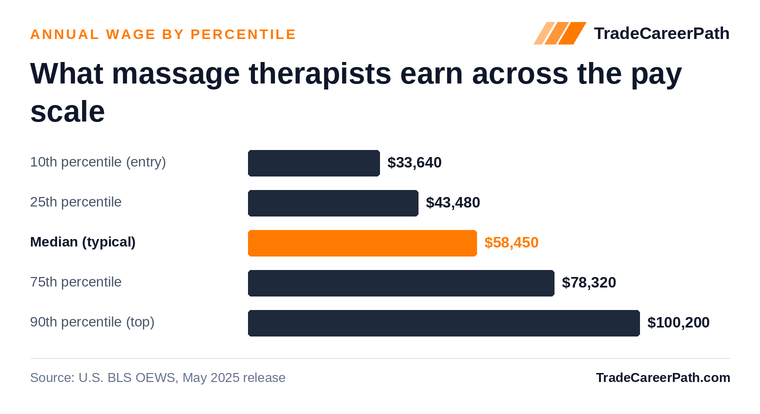
Quick answer: Training as a massage therapist usually takes 6 months to 2 years. You complete an approved training program of about 500 to 1,000 hours, pass a licensing exam (most states use the MBLEx), and apply for a state license. Most states require a license, and an optional BCTMB credential from NCBTMB can strengthen your resume. The median massage therapist salary is $58,450 per year ($28.10/hour), and about 20,400 openings are projected nationwide each year (BLS, May 2025).
Massage therapists treat clients by manipulating muscles and soft tissue to ease pain, reduce stress, and support recovery. The work blends anatomy, technique, and client care, and you can train, get licensed, and start working in roughly two years.
How to Become a Massage Therapist
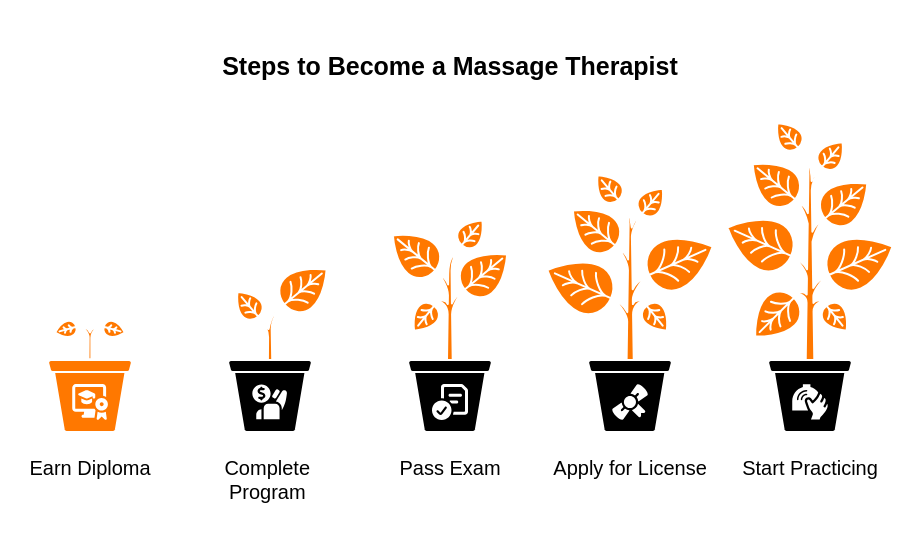
Most people enter the field in about six months to two years, depending on the program they choose. The path runs through training, a licensing exam, and a state license, plus optional certification that can help your career.
1. Earn a high school diploma or GED
A high school diploma or GED is the minimum requirement for most massage therapy programs. Before you enroll, it helps to build the foundation the work depends on. Anatomy and biology classes give you a head start on the body systems you will study in depth, and communication classes prepare you for the constant client interaction the job involves. Basic comfort with computers and scheduling tools is useful too, since many therapists manage their own bookings and client records. If you are changing careers and already hold a diploma or a degree in another field, you can move straight to choosing a program. Many strong therapists come from unrelated backgrounds and bring helpful skills in customer service, time management, and physical work. Staying in good physical condition before you start also pays off, because massage is demanding on your hands, wrists, and back.
2. Complete an approved massage therapy program
This is the core credential. Most programs run 500 to 1,000 hours and combine classroom instruction with supervised hands-on practice. Coursework typically covers anatomy and physiology, kinesiology, pathology, ethics and professional boundaries, business basics, and a range of techniques such as Swedish, deep tissue, and sports massage. The hands-on portion is where you build real skill, practicing on classmates and supervised clients until your body mechanics and pressure control work as second nature. When comparing schools, check whether the program carries accreditation from the Commission on Massage Therapy Accreditation (COMTA), which reviews massage schools against recognized standards. Just as important, confirm that the program meets the specific hour requirement of the state where you plan to work, since that number varies from state to state. Ask each school about tuition and start dates so you can compare costs directly.
3. Pass your licensing exam
Most states require the MBLEx (Massage and Bodywork Licensing Examination), administered by the Federation of State Massage Therapy Boards (FSMTB). The exam tests the knowledge you build in school, including anatomy and physiology, kinesiology, pathology, client assessment, ethics, and the practice of massage. Your school’s curriculum is built to prepare you, but most candidates also study with practice exams and review guides in the weeks before testing. Give yourself a realistic study schedule rather than cramming, since the material is broad. A few states use their own exam or add requirements on top of the MBLEx, so confirm exactly what your state board accepts before you register. Once you pass, your score becomes part of your license application.
4. Apply for state licensure
Each state sets its own rules, but the application usually asks for proof that you graduated from an approved program, your passing exam score, a completed application with fees, and a background check. CPR or first aid certification is commonly required as well, so plan to complete a course if your program did not include one. Read your state board’s checklist carefully and gather documents early, because transcripts and background checks can take time to process. Some states also require continuing education each renewal cycle to keep your license active, so note those rules from the start. Working without the proper license is not allowed in states that regulate the profession, so finish this step before you take on paying clients.
5. Start practicing and build experience
With a license in hand, you can work in spas, wellness centers, chiropractic and physical therapy offices, hospitals, fitness centers, or resorts, or you can build a private or mobile practice. Many new therapists start as employees to gain steady experience and a client base before going independent. As you grow, an optional Board Certified in Therapeutic Massage and Bodywork (BCTMB) credential from the National Certification Board for Therapeutic Massage and Bodywork (NCBTMB) can signal advanced competence to employers and clients. Specialty training in areas such as sports massage, medical or rehabilitation massage, or prenatal work can open higher-paying roles and help you stand out. Over time, experienced therapists move into instructor roles, clinical settings, or business ownership.
What Massage Therapists Do
Massage therapists treat clients by manipulating the body’s soft tissue to relieve pain, improve circulation, reduce stress, and aid recovery from injury. They talk with clients about symptoms and goals, evaluate muscle and tissue condition, and plan treatment that fits each person’s needs. The work is physical and personal, and a single session can make a real difference in how someone feels and moves.
Day to day, the job mixes hands-on treatment with assessment, documentation, and client communication. Therapists also maintain a clean, calm treatment space and often manage their own schedules and records.
Typical Responsibilities
- Perform therapeutic and relaxation massage using techniques such as Swedish, deep tissue, and sports massage
- Assess clients’ muscle condition, symptoms, and goals
- Create and adjust personalized treatment plans
- Maintain client records and recommend follow-up care
- Keep the treatment area clean, safe, and welcoming
Key Skills and Traits for Success
- Strong communication and empathy
- Good hand strength, dexterity, and body mechanics
- Solid understanding of anatomy and physiology
- Professionalism and respect for client confidentiality
- Physical stamina for a hands-on workday
Where You’ll Work
Massage therapists work in a range of settings, including:
- Spas and wellness centers
- Chiropractic and physical therapy offices
- Hospitals and rehabilitation clinics
- Fitness centers and resorts
- Private or mobile practices
Education and Licensing Paths
| Pathway | Typical Duration | Outcome |
|---|---|---|
| Certificate or diploma program | 500 to 1,000 training hours | Most common entry credential |
| Associate degree | About 2 years | Adds general education credits |
| State license (MBLEx in most states) | After completing training | Required to practice in most states |
| BCTMB board certification (optional) | After licensure | Signals advanced competence |
Career Growth and Advancement
With experience, massage therapists may move into roles such as:
- Sports Massage Specialist
- Medical or Rehabilitation Massage Therapist
- Massage Instructor or Trainer
- Spa or Wellness Business Owner
Cost and Duration of Training
- Program cost: varies by program, format, and school, so request current tuition from each school you consider
- Time to complete: about six months to two years, with most programs running 500 to 1,000 hours
- License renewal: many states require continuing education each cycle
Choosing a COMTA-accredited program can help you compare quality across schools.
Pros and Cons
Pros
- High job satisfaction and direct client impact
- Flexible hours and self-employment potential
- Strong projected demand
- No four-year degree required
Cons
- Physically demanding work
- Requires ongoing continuing education
- Income can vary by season and client volume
Quick Facts: Massage Therapist Salary, Education, and Outlook
Industry Organizations & Certifying Bodies
These are the recognized national organizations, unions, certifying bodies, and regulatory authorities that shape this trade. They issue the credentials, sponsor the apprenticeships, publish the codes, and represent workers and employers.
- Federation of State Massage Therapy Boards (FSMTB) Administers the MBLEx licensure exam used by most states.
- National Certification Board for Therapeutic Massage and Bodywork (NCBTMB) Issues the BCTMB (Board Certified in Therapeutic Massage and Bodywork) credential.
- Commission on Massage Therapy Accreditation (COMTA) Accredits massage-therapy schools and programs.
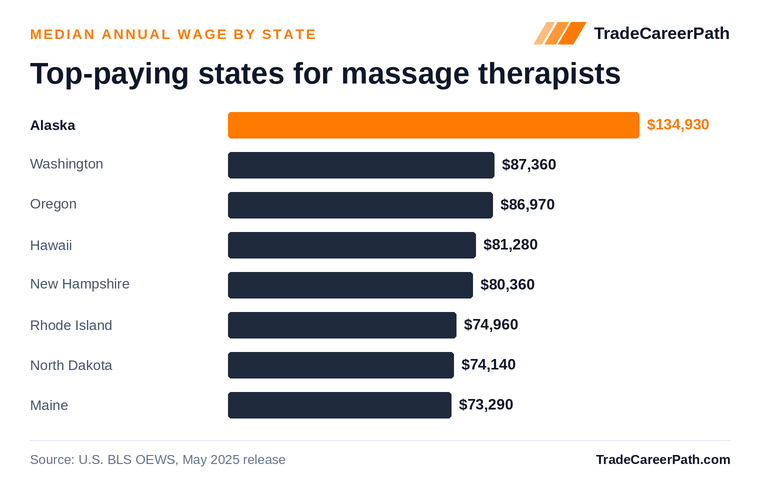
Wage and Employment Charts
Massage Therapist Salary and Requirements by State
Select your state for local wage data, training options, and requirements:
Alabama · Alaska · Arizona · Arkansas · California · Colorado · Connecticut · Delaware · District of Columbia · Florida · Georgia · Hawaii · Idaho · Illinois · Indiana · Iowa · Kansas · Kentucky · Louisiana · Maine · Maryland · Massachusetts · Michigan · Minnesota · Mississippi · Missouri · Montana · Nebraska · Nevada · New Hampshire · New Jersey · New Mexico · New York · North Carolina · North Dakota · Ohio · Oklahoma · Oregon · Pennsylvania · Rhode Island · South Carolina · South Dakota · Tennessee · Texas · Utah · Vermont · Virginia · Washington · West Virginia · Wisconsin · Wyoming
Workplace Safety Snapshot
BLS Survey of Occupational Injuries and Illnesses data (2023-2024) report approximately 84.9 days-away, restricted, or transfer cases per 10,000 full-time-equivalent workers in massage therapists (about 0.85 per 100 FTE). Source: BLS Survey of Occupational Injuries and Illnesses, Table R98.
Frequently Asked Questions
How long does massage therapist training take?
Most people finish in about 6 months to 2 years. Training programs typically run 500 to 1,000 hours, and you then pass a licensing exam and apply for a state license. A high school diploma or GED is generally required to start.
Do you need a college degree to work as a massage therapist?
No. A college degree is not required. Most people enter the field through a certificate or associate degree program of 500 to 1,000 hours. A high school diploma or GED is typically the only educational prerequisite before enrolling.
Is a license required to work as a massage therapist?
Most states license massage therapists, and many use the MBLEx exam administered by the Federation of State Massage Therapy Boards (FSMTB). Requirements vary by state and commonly include graduating from an approved program, passing the exam, and clearing a background check.
What exam do most states require for massage therapy?
Most states require the MBLEx (Massage and Bodywork Licensing Examination) from the Federation of State Massage Therapy Boards (FSMTB). Some states have additional or alternative requirements, so check the rules where you plan to work.
How much does massage therapist training cost?
Costs vary by program, format, and school, so request current tuition from each school you are considering. Choosing a program with accreditation from the Commission on Massage Therapy Accreditation (COMTA) can help you compare quality across options.
Is massage therapist a growing career?
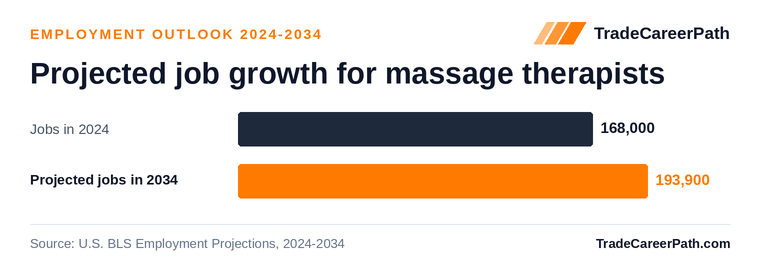
Yes. BLS projects 15.3% employment growth for massage therapists between 2024 and 2034, classified as much faster than average. About 24,700 openings are projected nationwide each year over that period.
Can you train as a massage therapist online?
Some classroom topics such as anatomy and ethics can be studied online, but hands-on massage practice and the required training hours must be completed in person. Confirm that any program meets your state's education requirements before enrolling.
Advance Your Career with a Degree
Experienced Massage Therapy professionals often step up into degree-track careers where field experience is a hiring advantage:
- Exercise Physiologist - median pay $59,460 (BLS OEWS, May 2025); requires a 4-year degree
See all trade careers that require a 4-year degree.
Sources
- U.S. Bureau of Labor Statistics, Occupational Employment and Wage Statistics (May 2025)
- U.S. Bureau of Labor Statistics, Employment Projections 2025-2035
- U.S. Bureau of Labor Statistics, Survey of Occupational Injuries and Illnesses (2023-2024, Table R98)
- U.S. Department of Labor, Wage and Hour Division, Davis-Bacon General Wage Determinations (2026)
Massage Therapy Salary by State
About this guide: Researched and written by the TradeCareerPath Editorial Team. Our editorial team researches and sources every trade school and career guide using federal labor and education data, including BLS OEWS and Employment Projections, DOL apprenticeship records, IPEDS, College Scorecard, and state licensing boards. We follow the editorial standards documented at /editorial-policy/.
Data sources
Figures on this page are sourced from the federal and state datasets below. Methodology: how we rank and source data.
| Data | Provider | Vintage |
|---|---|---|
| Occupational Employment and Wage Statistics (OEWS) | U.S. Bureau of Labor Statistics | May 2025 |
| Employment Projections | U.S. Bureau of Labor Statistics | 2025-2035 |
| Integrated Postsecondary Education Data System | National Center for Education Statistics (IPEDS) | 2024 |
| College Scorecard (school-level outcomes) | U.S. Department of Education | latest release |
| College Scorecard (field-of-study earnings) | U.S. Department of Education | latest release (updated 2026-06-12) |
| Occupational licensing requirements | CareerOneStop (U.S. Department of Labor) | latest release (updated 2026-02-22) |
| Registered apprenticeship programs | CareerOneStop / Apprenticeship.gov (U.S. Department of Labor) | latest release (updated 2025-10-25) |
| O*NET occupation profiles (skills, tasks, tools, job zones) | U.S. Department of Labor (O*NET / Employment & Training Admin.) | O*NET 31.0 (updated 2026-10-14) |