
How to Become a Mechanical Engineer in 2026
Is Mechanical Engineer Right for You?
The U.S. Department of Labor's O*NET profile for Mechanical Engineers (SOC 17-2141) describes the work this way: Perform engineering duties in planning and designing tools, engines, machines, and other mechanically functioning equipment. Oversee installation, operation, maintenance, and repair of equipment such as centralized heat, gas, water, and steam systems.
What the work involves
- Read and interpret blueprints, technical drawings, schematics, or computer-generated reports.
- Research, design, evaluate, install, operate, or maintain mechanical products, equipment, systems or processes to meet requirements.
- Specify system components or direct modification of products to ensure conformance with engineering design, performance specifications, or environmental regulations.
- Confer with engineers or other personnel to implement operating procedures, resolve system malfunctions, or provide technical information.
- Investigate equipment failures or difficulties to diagnose faulty operation and recommend remedial actions.
Skills and knowledge that matter
Skills: Reading Comprehension, Active Listening, Critical Thinking, Mathematics, Science, Complex Problem Solving.
Knowledge: Design, Engineering and Technology, Production and Processing, Mechanical.
Tools and technology you may use
Technology: Computer aided manufacturing CAM software, Analytical or scientific software, Development environment software, Adobe Illustrator, Autodesk AutoCAD, Autodesk AutoCAD Civil 3D.
Typical preparation
O*NET Job Zone Four (Considerable Preparation Needed). Most of these occupations require a four-year bachelor's degree, but some do not. Employees in these occupations usually need several years of work-related experience, on-the-job training, and/or vocational training.
Interest fit
O*NET interest profile: Realistic, Investigative, Conventional. People who enjoy hands-on, practical work with tools, machines, plants, or materials often find this occupation a good fit.
Source: O*NET 31.0 (updated 2026-10-14)
Quick answer: Training as a mechanical engineer requires a 4-year degree - typically an ABET-accredited bachelor’s in mechanical engineering. The national median pay is $104,110 per year, and BLS projects +11.2% employment change from 2025 to 2035 (BLS OEWS, May 2025; BLS Employment Projections, 2025-35).
Mechanical Engineer at a Glance
| Metric | Detail | Source |
|---|---|---|
| Median annual wage | $104,110 | BLS OEWS, May 2025 |
| Typical wage range | $73,990 (10th pct) - $164,340 (90th pct) | BLS OEWS, May 2025 |
| Employment | 296,810 nationwide | BLS OEWS, May 2025 |
| Projected growth (2025-35) | +11.2%, about 17,800 openings per year | BLS Employment Projections, 2025-35 |
| Typical education | ABET-accredited bachelor’s in mechanical engineering | BLS Occupational Outlook Handbook |
| License / certification | PE license for roles approving designs; optional otherwise | State licensing boards |
What Does a Mechanical Engineer Do?
Mechanical engineers design, analyze, and test machines and thermal systems - HVAC equipment, engines, pumps, manufacturing lines, robotics, medical devices, and consumer products - and they own the engineering decisions behind the hardware that technicians and mechanics install, service, and repair.
Day to day, the work depends heavily on the sub-specialty. A design engineer lives in CAD, turning requirements into parts and assemblies, running tolerance stack-ups, and defending choices in design reviews. A thermal or HVAC engineer sizes heat exchangers, models airflow and refrigeration loads, and selects equipment that has to hit efficiency numbers on paper before anyone cuts sheet metal. A test engineer writes the test plan, instruments the prototype, and chases the gap between what the model predicted and what the strain gauges actually read. A manufacturing engineer owns the line itself - fixturing, process capability, cost-per-part - and dispositions the nonconforming parts that quality flags. Nearly everything is documented and reviewed: drawings carry GD&T that a machinist will hold you to, FEA results get checked before a design is released, and change orders have a paper trail.
If you are coming from HVAC, automotive, machining, or industrial maintenance, the shortest way to say it: the technician diagnoses and fixes the machine; the engineer decides what the machine must be and proves on paper that it will work before it exists. The compressor you have replaced a dozen times, the tolerance callout that made a part impossible to fixture, the design flaw you have cursed on a 2 a.m. breakdown call - those decisions work as yours to make, and field experience tells you which ones matter.
Skills That Make a Great Mechanical Engineer
- CAD modeling (SolidWorks, CATIA, NX)
- Thermodynamics, heat transfer, and fluid systems
- FEA simulation and hand-calculation sanity checks
- GD&T and tolerance stack-ups
- Prototyping and design-for-manufacture
- Materials selection and failure analysis
- MATLAB or Python for analysis and test-data reduction
- Writing: design reviews, test reports, and engineering change orders carry the job
Mechanical Engineer Salary
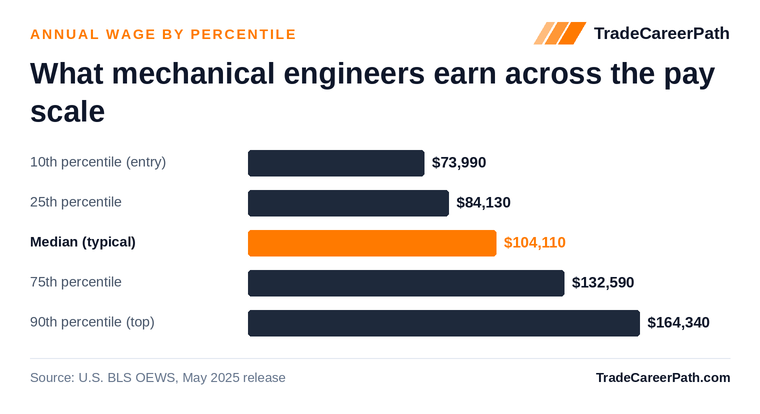
Mechanical engineering pays a clear premium over the trades that feed into it. The national median is $104,110 per year, and the 10th percentile - roughly where new graduates start - is $73,990, which is at or above the median for most mechanical trades. The 75th percentile sits at $132,590, and the top 10% earn $164,340 or more (BLS OEWS, May 2025). Pay is also unusually portable: nearly every manufacturing region in the country hires at these numbers.
Where the Jobs and the Money Are
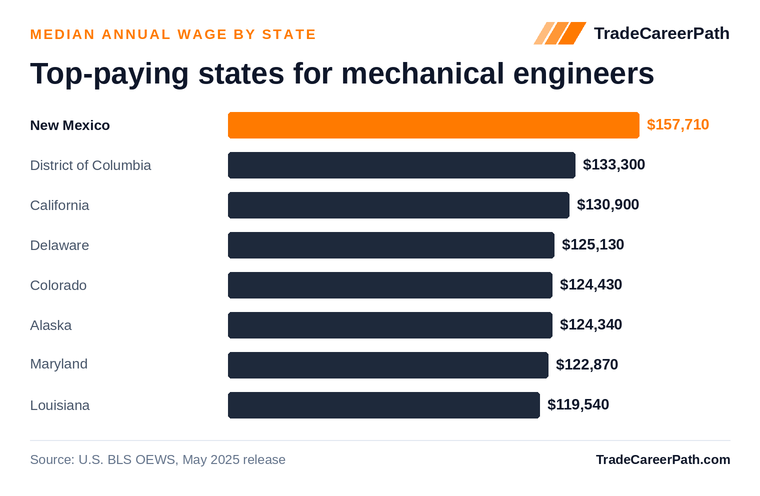
Mechanical engineering is spread across the whole industrial map, but the pay peaks and the job clusters are in different places. The best medians are in New Mexico - driven by the national labs and defense work, where mechanical engineers are about 1.6 times as concentrated as in the average state labor market - along with California and Colorado (BLS OEWS, May 2025).
| State | Median annual wage | Employment |
|---|---|---|
| New Mexico | $157,710 | 2,710 |
| District of Columbia | $133,300 | 510 |
| California | $130,900 | 30,530 |
| Delaware | $125,130 | 610 |
| Colorado | $124,430 | 7,190 |
The sheer volume is elsewhere. Michigan is the single deepest market - 34,630 mechanical engineers at a $104,890 median, with a location quotient of 4.12, meaning the occupation is more than four times as common there as in the average state, thanks to the auto industry. California (30,530 jobs at $130,900) and Texas (22,080 jobs at $112,410) round out the big three. For a career changer, a high-LQ state like Michigan or Colorado (LQ 1.31) means more employers competing for you and room to change jobs without relocating.
How to Become a Mechanical Engineer
1. Earn an ABET-accredited bachelor’s
Mechanical engineering or mechanical engineering technology. Accreditation is the one non-negotiable: employers screen for it, graduate schools require it, and the FE/PE licensure path assumes it. For working technicians, the straight ME degree is usually the better buy over MET - it opens every title and every state’s PE path - and there are more ABET-accredited online and evening ME options than for any other engineering discipline, most pairing remote coursework with short lab intensives.
2. Pass the FE exam
Recommended at graduation for the EIT (Engineer in Training) designation, even if you defer the PE. The Fundamentals of Engineering exam is least costly to pass while the coursework is fresh. If you end up designing building systems - the natural landing spot for former HVAC techs - the PE will eventually matter, and the FE is the gate you cannot skip.
3. Start in design, test, or manufacturing
Entry roles include design engineer, test engineer, and manufacturing engineer. For former technicians, test and manufacturing engineering are the classic entry points, because the job is judging real hardware rather than working purely from models. Say your trade background out loud in applications; it reads as proof, not a gap.
4. Master the toolchain
CAD (SolidWorks/CATIA), FEA simulation, and GD&T are the professional stack. You can start on all three before you graduate - student licenses are cheap or free, and a portfolio of modeled and analyzed parts does more in an interview than GPA. GD&T in particular is where trade experience shines: you have lived the consequences of a bad tolerance callout.
5. Advance or license
Senior engineer, engineering manager; the PE license for consulting and sign-off authority. The fork comes around the ten-year mark: deepen into a staff or principal technical role, move into management, or hang out a consulting shingle - where the PE becomes the ticket. All three tracks appear in the career ladder below.
Career Ladder: Titles and Realistic Pay
The BLS wage percentiles map cleanly onto how mechanical engineering careers actually progress. Use this as a sanity check on offers, not a guarantee:
| Stage | Typical titles | Years in | Realistic pay (BLS OEWS, May 2025) |
|---|---|---|---|
| Entry level | Engineer I, design engineer, test engineer | 0-3 | ~$73,990-$84,130 (10th-25th pct) |
| Mid-career | Engineer II/III, project engineer, product owner | 3-10 | ~$104,110 (median) |
| Senior | Senior/staff engineer, technical lead | 10-15 | ~$132,590 (75th pct) |
| Principal / leadership | Principal engineer, PE consultant, engineering manager | 15+ | $164,340+ (90th pct) |
Two notes for career changers. First, prior trade experience compresses this ladder: former HVAC techs, mechanics, and machinists are routinely hired above the bottom of the entry band because they need less supervision around real hardware and can talk to the shop floor. Second, the wage data shown here is base salary only - bonus, overtime on test programs, and equity at product companies push senior total compensation well above the 90th-percentile figure.
Do You Need a PE License?
Mostly no. Mechanical engineers at manufacturers work under the “industrial exemption” - the company, not the individual engineer, holds design responsibility for its products, so most never license. Where the PE genuinely matters:
- Building systems and HVAC design: mechanical drawings submitted for construction permits need a PE stamp. If your plan is HVAC tech to HVAC design engineer, treat the PE as required, not optional.
- Consulting and expert work: independent practice, forensic engineering, and sign-off authority all require the license.
The path is standard in every state: ABET degree, pass the Fundamentals of Engineering (FE) exam - you can sit for it as a senior - then four years of qualifying experience, then the PE exam in mechanical engineering, per your state board’s rules. Getting the FE done at graduation keeps the option open cheaply; deferring it for a decade means re-learning long-forgotten coursework.
Why an Online Degree Works for This Career
For HVAC technicians, mechanics, machinists, and maintenance techs, mechanical engineering is the direct degree upgrade: the same systems you service, at the design level. ABET-accredited online ME programs pair remote coursework with short on-campus or local lab intensives, built for working adults who cannot quit to attend day classes. Employer tuition assistance is common at manufacturers, utilities, and mechanical contractors, so many technicians finish with most of the tuition covered, without giving up income or seniority.
Job Outlook for 2026 and Beyond
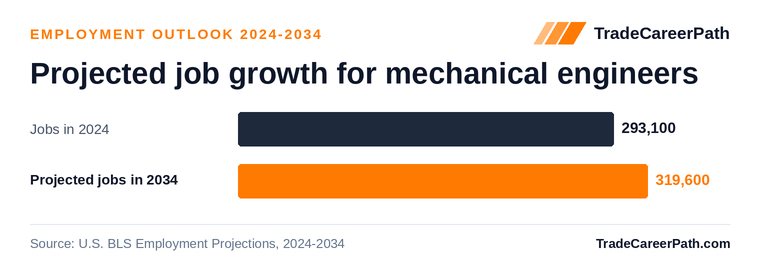
BLS projects mechanical engineering employment to grow +11.2% from 2025 to 2035 - from 298,500 to 332,000 jobs - with about 17,800 openings per year once retirements and occupation changes are counted (BLS Employment Projections, 2025-35). That growth rate is strong for an occupation this large. The latest wage data (OEWS, May 2025) puts the median at $104,110, up from the 2024 figure of $102,320 - pay is rising, not just holding.
The demand drivers are broad rather than tied to one industry: factory automation and robotics, electric-vehicle and battery programs, reshored manufacturing capacity, and the endless replacement cycle in HVAC and building systems. For a career changer, the openings number is the one that matters - 17,800 seats a year in a 296,810-person occupation means steady hiring in essentially every industrial region of the country, so the degree travels with you.
Cost and Time to Complete the Degree
For mechanical engineers, the credential is: ABET-accredited bachelor’s in mechanical engineering. A bachelor’s degree is typically 120 credit hours: four years full-time, and commonly five to six years part-time while working. Transfer credit is the other lever: prior college, military training, apprenticeship coursework, and industry certifications can be worth meaningful credit at transfer-friendly schools, so get a written transfer evaluation before enrolling anywhere. Costs vary widely by school type; in-state public online programs are usually the value benchmark, and employer tuition assistance is common for working adults in this field.
Pros and Cons of Training as a Mechanical Engineer
Pros
- Median pay of $104,110 nationally (BLS OEWS, May 2025)
- BLS projects +11.2% employment growth through 2035, about 17,800 openings per year
- Field experience from the trades is a genuine hiring advantage
- Accredited online and hybrid degree paths exist for working adults
Cons
- Requires a 4-year degree (typically 120 credit hours)
- Entry-level pay starts near $73,990 at the 10th percentile
- Licensing hurdle: PE license for roles approving designs; optional otherwise
Frequently Asked Questions
Can an HVAC tech or mechanic work as a mechanical engineer?
Yes - hands-on experience with real systems is an edge most engineering students lack. The requirement is the ABET-accredited bachelor's; online and evening programs exist for working technicians.
How much do mechanical engineers make?
The national median annual wage for mechanical engineers is $104,110 (BLS OEWS, May 2025). The top 10% earn $164,340 or more, while entry-level pay starts around $73,990.
What is the job outlook for mechanical engineers?
BLS projects employment of mechanical engineers to change by +11.2% from 2025 to 2035 (BLS Employment Projections, 2025-35).
How long does mechanical engineer training take?
The ABET-accredited bachelor's is typically 120 credit hours: four years full-time, commonly five to six years part-time while working. Transfer credit from prior college, military training, or apprenticeship coursework can meaningfully shorten it at transfer-friendly schools.
Is mechanical engineering hard?
The degree is math-heavy - calculus, differential equations, thermodynamics, and fluid mechanics are unavoidable. Working technicians usually find the machine-design and systems courses easier than fresh high-school graduates do, because the physics is easier to absorb when you have already worked on the hardware.
Should I get a mechanical engineering or mechanical engineering technology degree?
Mechanical engineering (ME) is the safer buy: it opens every engineer title and the full FE-to-PE licensure path in all states. Mechanical engineering technology (MET) is more hands-on and often friendlier to transfer credit, but some employers and some state PE boards treat it as second-tier. If both fit your schedule, choose the ABET-accredited ME.
Can you train as a mechanical engineer without a degree?
Not with the engineer title at most employers - hiring screens for the ABET-accredited bachelor's. Without it, the ceiling is engineering technician, designer/drafter, or manufacturing and quality roles. Trade experience shortens the degree through transfer credit, but does not replace it.
Do mechanical engineers need a PE license?
Usually no - most work at manufacturers under the industrial exemption, where the company holds design responsibility. The PE matters if you want consulting work, public-facing sign-off authority, or an HVAC/building-systems design career. The path is the FE exam, four years of qualifying experience, then the PE exam.
Mechanical Engineer Salary and Requirements by State
Alabama · Alaska · Arizona · Arkansas · California · Colorado · Connecticut · Delaware · District of Columbia · Florida · Georgia · Hawaii · Idaho · Illinois · Indiana · Iowa · Kansas · Kentucky · Louisiana · Maine · Maryland · Massachusetts · Michigan · Minnesota · Mississippi · Missouri · Montana · Nebraska · Nevada · New Hampshire · New Jersey · New Mexico · New York · North Carolina · North Dakota · Ohio · Oklahoma · Oregon · Pennsylvania · Rhode Island · South Carolina · South Dakota · Tennessee · Texas · Utah · Vermont · Virginia · Washington · West Virginia · Wisconsin · Wyoming
Related Careers and Degree Paths
- Aerospace Engineer - the higher-paying specialty the same ME degree can qualify you for
- Electrical Engineer - the controls and power side of the same machines
- Industrial Engineer - process and efficiency work; an Industrial Engineer shares much of the ME curriculum
- HVAC Tech to Mechanical Engineer - the step-by-step bridge path for HVAC technicians
- Online Engineering Degrees for Tradespeople - how to pick an ABET program that fits a work schedule
Degree and Program Guides
- Online Mechanical Engineering Degrees - ABET options built for working HVAC and mechanical techs
Sources
- U.S. Bureau of Labor Statistics, Occupational Employment and Wage Statistics (OEWS), May 2025 - Mechanical Engineers (SOC 17-2141)
- U.S. Bureau of Labor Statistics, Employment Projections, 2025-35
- U.S. Bureau of Labor Statistics, Occupational Outlook Handbook - education and licensing requirements
Mechanical Engineer Salary by State
About this guide: Researched and written by the TradeCareerPath Editorial Team. Our editorial team researches and sources every trade school and career guide using federal labor and education data, including BLS OEWS and Employment Projections, DOL apprenticeship records, IPEDS, College Scorecard, and state licensing boards. We follow the editorial standards documented at /editorial-policy/.
Data sources
Figures on this page are sourced from the federal and state datasets below. Methodology: how we rank and source data.
| Data | Provider | Vintage |
|---|---|---|
| Occupational Employment and Wage Statistics (OEWS) | U.S. Bureau of Labor Statistics | May 2025 |
| Employment Projections | U.S. Bureau of Labor Statistics | 2025-2035 |
| Integrated Postsecondary Education Data System | National Center for Education Statistics (IPEDS) | 2024 |
| College Scorecard (school-level outcomes) | U.S. Department of Education | latest release |
| College Scorecard (field-of-study earnings) | U.S. Department of Education | latest release (updated 2026-06-12) |
| Occupational licensing requirements | CareerOneStop (U.S. Department of Labor) | latest release (updated 2026-02-22) |
| Registered apprenticeship programs | CareerOneStop / Apprenticeship.gov (U.S. Department of Labor) | latest release (updated 2025-10-25) |
| O*NET occupation profiles (skills, tasks, tools, job zones) | U.S. Department of Labor (O*NET / Employment & Training Admin.) | O*NET 31.0 (updated 2026-10-14) |