
Medical Assistant to RN: The Complete Pathway (2026)
Quick answer: Medical assistants work as RNs through an ADN (about 2 years) or BSN (4 years) plus the NCLEX-RN. Your clinical-office experience with vitals, injections, and patient flow gives you a running start, and some programs credit prior allied-health coursework. The median pay jump is from $45,690 (medical assistant) to $97,550 (RN), per BLS OEWS, May 2025.
The Medical Assistant to RN Pay Gap
| Credential | National median pay | Source |
|---|---|---|
| Medical Assistant | $45,690 | BLS OEWS, May 2025 |
| Registered Nurse (RN) | $97,550 | BLS OEWS, May 2025 |
That is roughly $52,000 per year at the median, and the RN license also opens hospital, specialty, and leadership roles the MA credential cannot reach. Even the 10th percentile for RNs - $68,940 - is well above the MA median, which is the cleanest way to say it: a below-average RN paycheck beats a typical MA paycheck by a wide margin (BLS OEWS, May 2025).
How the Pathway Works
- Pick ADN or BSN. The ADN (about 2 years, community college) is the fast, cheap route to the license; the BSN (4 years) is the credential large hospital systems prefer. The RN to BSN completion exists later if you start with the ADN.
- Ask about transfer credit. MA diploma coursework (anatomy, terminology, pharmacology basics) transfers at some schools, especially where your MA program was accredited; a transfer evaluation is free and can shave a semester or more.
- Keep working while you study. Evening, weekend, and hybrid nursing tracks are built for working healthcare staff, and clinic employers are often flexible with school schedules for staff they want to keep.
- Pass the NCLEX-RN. The national licensure exam; program pass rates are public, so check them when choosing a school.
- Convert your experience into placement. Ambulatory and clinic RN roles actively prefer former MAs; ER and inpatient units value the patient-handling reps too.
Why MAs Make Strong Nursing Students
You already chart, room patients, take vitals, give injections, and manage difficult conversations. Nursing school adds assessment depth, pharmacology, and clinical judgment on top of habits you already have, which is why MA-to-RN students consistently report the clinical portions feeling familiar while classmates are still learning to talk to patients.
The adjustment is not the patients - it is the accountability. As an MA you work under a provider’s direction and scope; as a nursing student you are trained to assess, decide, and document as the responsible clinician. Expect care plans, dosage-calculation exams, and instructors who push you past “the doctor said to” into “here is why, and here is what I am watching for.” That shift in thinking is the real curriculum, and MAs who lean into it tend to land at or near the top of their cohorts clinically.
What the Work Is Like on the Other Side
The RN job is not a faster version of the MA job - it is a different seat. As an MA, your day is throughput: rooming, vitals, injections, callbacks, keeping the provider’s schedule moving. As an RN, your day is a patient load you own.
On a hospital floor, that means taking report on four to six patients, doing your own head-to-toe assessments, and building a plan for the shift: which meds are due, which patient is trending the wrong way, who needs to be pushed to walk, which family needs a hard conversation. You pass medications - including IV drugs an MA can never touch - titrate drips within protocol, catch the early signs of deterioration, and call the physician with a recommendation, not just a report. Your documentation is the legal record of the patient’s care, and when something goes wrong at 3 a.m., you are the clinician in the room making the first decisions.
Clinic and ambulatory RN roles look more like your current world - telephone triage, medication management, patient education, procedure support - but with independent judgment attached: you are deciding whether the caller with chest tightness gets a same-day slot or an ambulance. The trade-offs are real too: hospital nursing means 12-hour shifts, nights, weekends, holidays, and physical strain your clinic job may not have. Former MAs generally report the same thing - the work is heavier and the stakes are higher, and that is exactly what the pay difference is buying.
RN Salary: What the License Is Worth
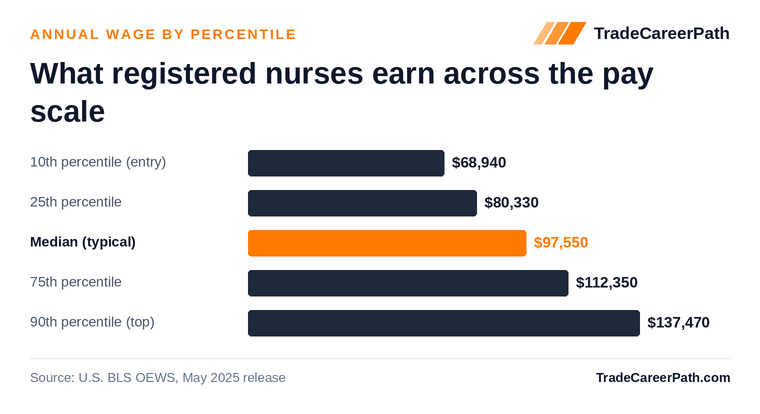
The national median for registered nurses is $97,550, with a mean of $101,420. The spread matters as much as the median: $68,940 at the 10th percentile - roughly new-grad territory in average-wage states - up to $137,470 at the 90th percentile, where experienced nurses in high-wage states and specialties live (BLS OEWS, May 2025).
Career Ladder: Titles and Realistic Pay
The BLS wage percentiles map cleanly onto how RN careers actually progress. Use this as a sanity check on offers, not a guarantee:
| Stage | Typical titles | Years in | Realistic pay (BLS OEWS, May 2025) |
|---|---|---|---|
| Entry level | New-grad RN, clinic RN, med-surg staff nurse | 0-3 | ~$68,940-$80,330 (10th-25th pct) |
| Mid-career | Staff RN, specialty unit (ER, ICU, OR, L&D) | 3-10 | ~$97,550 (median) |
| Senior | Charge nurse, preceptor, specialty-certified RN | 10-15 | ~$112,350 (75th pct) |
| Advanced / leadership | Nurse manager, house supervisor, high-wage-state staff RN | 15+ | $137,470+ (90th pct) |
Two notes for former MAs. First, your clinic years compress the bottom of this ladder - hospitals and ambulatory networks treat MA experience as evidence you will not freeze around patients, and many former MAs move into specialty units faster than classmates without patient-care history. Second, the upper band is heavily geography-driven: the same staff-nurse job pays very differently in California than in a low-wage state, and shift differentials and overtime routinely push hospital take-home above the base-wage figures shown here.
Where RNs Earn the Most
| State | Median annual wage | Employment |
|---|---|---|
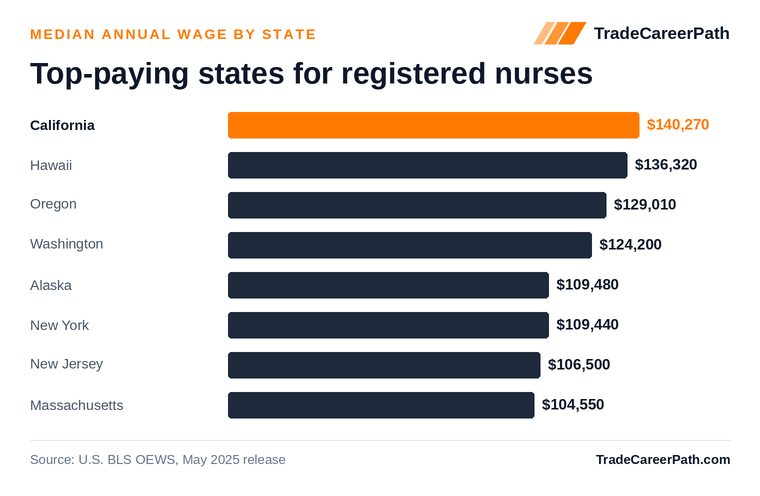
| California | $140,270 | 338,940 |
| Hawaii | $136,320 | 12,940 |
| Oregon | $129,010 | 39,730 |
| Washington | $124,200 | 69,260 |
| Alaska | $109,480 | 7,510 |
The West Coast dominates RN pay: California’s median of $140,270 is more than $40,000 above the national median, and the state employs 338,940 RNs - the largest nursing workforce in the country, so the high wage comes with a deep job market rather than a handful of scarce seats. For sheer volume elsewhere, Texas employs 271,380 RNs at a $95,970 median and Florida 229,940 at $84,190 (BLS OEWS, May 2025).
Job Outlook for 2026 and Beyond
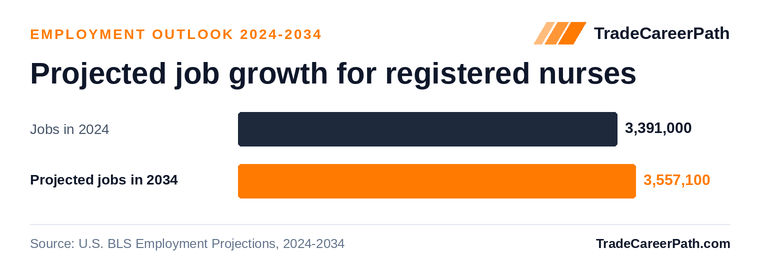
BLS projects registered nursing employment to grow 5.6% from 2025 to 2035 - from 3,465,400 to 3,660,100 jobs - with about 180,800 openings per year once retirements and occupation changes are counted (BLS Employment Projections, 2025-35).
The percentage looks modest; the openings figure is the number that matters. In an occupation of 3,379,720 nurses (BLS OEWS, May 2025), 180,800 annual openings means hospitals, clinics, home health, and long-term care are hiring constantly, everywhere - not just in a few hub metros the way many degree careers concentrate. An aging population, chronic-disease management, and a wave of nurse retirements keep the demand structural rather than cyclical. For a career changer, that translates to something rare: near-certainty that the license will be worth something in whatever state you end up in.
Licensing: The NCLEX-RN and Your State Board
Unlike medical assisting - where certification is voluntary in most settings - registered nursing is a licensed profession in every state. There is no exemption and no experience-based workaround. The sequence is fixed:
- Graduate from a state-approved nursing program - an ADN, BSN, or one of the remaining hospital diploma programs. Your MA credential and experience help you get in and get through; they do not substitute for the program.
- Apply to your state board of nursing for licensure by examination, including any background-check and fingerprinting requirements your state imposes.
- Pass the NCLEX-RN, the national licensure exam. It tests clinical judgment, not memorization - prioritization, delegation, and “which patient do you see first” scenarios. Program NCLEX pass rates are public; treat them as the single most honest quality signal when comparing schools.
- Maintain the license with your state’s renewal cycle and continuing-education requirements.
Most states now participate in the Nurse Licensure Compact, so a multistate license issued by your home state lets you practice in other compact states without relicensing - useful if you are eyeing travel nursing or a move. Specialty certifications (such as critical care or emergency nursing) come later and are employer-valued but optional; the RN license itself is the only mandatory credential.
Frequently Asked Questions
Can a medical assistant work as an RN?
Yes. There is no license bridge, so the route is an ADN or BSN plus the NCLEX-RN, but MA experience strengthens admissions, may earn transfer credit, and maps directly onto nursing clinicals.
How long does medical assistant to RN take?
About 2 years through an ADN or 4 years through a BSN, minus any transfer credit for prior accredited allied-health coursework.
How much more does an RN make than a medical assistant?
The national median for RNs is $97,550 versus $45,690 for medical assistants (BLS OEWS, May 2025), about $52,000 more per year at the median.
Is nursing school hard for a medical assistant?
The clinical portions feel familiar - vitals, injections, charting, and patient communication are already your daily work. The hard parts are pharmacology, pathophysiology, and care-plan writing, which are new to almost everyone. MAs typically struggle less than classmates with no patient-care background.
Should a medical assistant get an ADN or a BSN?
The ADN is the fastest, most affordable route to the RN license and the pay that comes with it; the BSN is the credential large hospital systems increasingly prefer for hiring and promotion. A common play is ADN first, start earning RN wages, then finish an RN-to-BSN completion program - often with employer tuition assistance.
Can you train as an RN without a degree?
No. Every state requires graduation from an approved nursing program - an ADN or BSN (a few hospital diploma programs remain) - before you can sit for the NCLEX-RN. Medical assistant experience shortens and strengthens the path, but it cannot replace the nursing program.
Do RNs need a license?
Yes, in every state. You must graduate from a state-approved nursing program, pass the NCLEX-RN, and hold an active license from your state board of nursing. Many states participate in the Nurse Licensure Compact, which lets one multistate license cover practice in other compact states.
What is the job outlook for RNs?
BLS projects registered nursing employment to grow 5.6% from 2025 to 2035 - from 3,465,400 to 3,660,100 jobs - with about 180,800 openings per year on average (BLS Employment Projections, 2025-35).
Keep Climbing
- How to Become a Registered Nurse: the full guide
- CNA to RN pathways
- LPN to RN bridge programs
- All trade careers that require a 4-year degree
Degree and Program Guides
- Online Nursing Degrees - all nursing routes compared
- Accelerated BSN Programs - the fast route if you already hold a bachelor’s
Sources
- U.S. Bureau of Labor Statistics, Occupational Employment and Wage Statistics (OEWS), May 2025 - Medical Assistants (31-9092); Registered Nurses (29-1141)
- U.S. Bureau of Labor Statistics, Employment Projections, 2025-35 - Registered Nurses
- U.S. Bureau of Labor Statistics, Occupational Outlook Handbook - registered nurses, education and licensure
Medical Assistant to Rn Salary by State
About this guide: Researched and written by the TradeCareerPath Editorial Team. Our editorial team researches and sources every trade school and career guide using federal labor and education data, including BLS OEWS and Employment Projections, DOL apprenticeship records, IPEDS, College Scorecard, and state licensing boards. We follow the editorial standards documented at /editorial-policy/.
Data sources
Figures on this page are sourced from the federal and state datasets below. Methodology: how we rank and source data.
| Data | Provider | Vintage |
|---|---|---|
| Occupational Employment and Wage Statistics (OEWS) | U.S. Bureau of Labor Statistics | May 2025 |
| Employment Projections | U.S. Bureau of Labor Statistics | 2025-2035 |
| Integrated Postsecondary Education Data System | National Center for Education Statistics (IPEDS) | 2024 |
| College Scorecard (school-level outcomes) | U.S. Department of Education | latest release |
| College Scorecard (field-of-study earnings) | U.S. Department of Education | latest release (updated 2026-06-12) |
| Occupational licensing requirements | CareerOneStop (U.S. Department of Labor) | latest release (updated 2026-02-22) |
| Registered apprenticeship programs | CareerOneStop / Apprenticeship.gov (U.S. Department of Labor) | latest release (updated 2025-10-25) |
| O*NET occupation profiles (skills, tasks, tools, job zones) | U.S. Department of Labor (O*NET / Employment & Training Admin.) | O*NET 31.0 (updated 2026-10-14) |