
How to Become a Medical Assistant in 2026
Is Medical Assistant Right for You?
The U.S. Department of Labor's O*NET profile for Medical Assistants (SOC 31-9092) describes the work this way: Perform administrative and certain clinical duties under the direction of a physician. Administrative duties may include scheduling appointments, maintaining medical records, billing, and coding information for insurance purposes. Clinical duties may include taking and recording vital signs and medical histories, preparing patients for examination, drawing blood, and administering medications as directed by physician.
What the work involves
- Interview patients to obtain medical information and measure their vital signs, weight, and height.
- Clean and sterilize instruments and dispose of contaminated supplies.
- Record patients' medical history, vital statistics, or information such as test results in medical records.
- Explain treatment procedures, medications, diets, or physicians' instructions to patients.
- Prepare treatment rooms for patient examinations, keeping the rooms neat and clean.
Skills and knowledge that matter
Skills: Social Perceptiveness, Active Listening, Speaking, Reading Comprehension, Critical Thinking, Monitoring.
Knowledge: English Language, Customer and Personal Service, Medicine and Dentistry, Administrative.
Tools and technology you may use
Technology: Calendar and scheduling software, Billing and invoicing software, Accounting software, eClinicalWorks EHR software, Epic Systems, Intuit QuickBooks.
Typical preparation
O*NET Job Zone Three (Medium Preparation Needed). Most occupations in this zone require training in vocational schools, related on-the-job experience, or an associate's degree. Employees in these occupations usually need one or two years of training involving both on-the-job experience and informal training with experienced workers. A recognized apprenticeship program may be associated with these occupations.
Interest fit
O*NET interest profile: Conventional, Social, Realistic. People who enjoy structured, detail-oriented work with clear procedures and data often find this occupation a good fit.
Source: O*NET 31.0 (updated 2026-10-14)
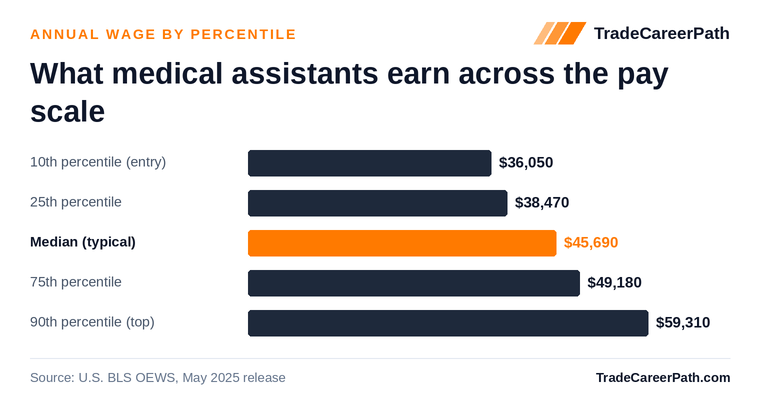
Quick answer: Training as a medical assistant usually takes 6 months to 2 years. You complete a certificate program (often under a year) or an associate degree, finish a supervised clinical externship, and can earn an optional certification such as the Certified Medical Assistant (CMA) from AAMA. Training cost varies by program and school. No four-year degree is required, and most states do not require a license. The median medical assistant salary is $45,690 per year ($21.97/hour), and employers post about 109,700 openings nationwide each year (BLS, May 2025).
Medical assistants support physicians and nurses by handling both clinical and administrative work, from taking vital signs to scheduling appointments. It is one of the fastest ways into a healthcare career, with training that often takes less than a year and strong projected demand.
How to Become a Medical Assistant
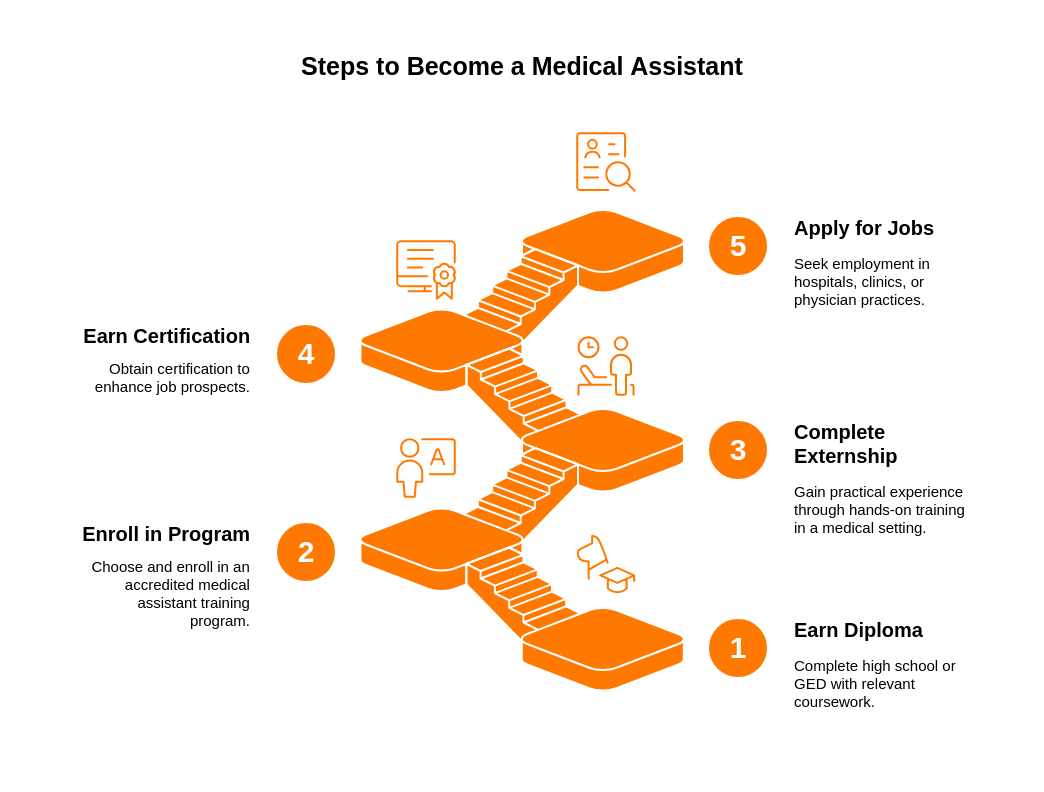
Most people enter the field in about six months to two years, depending on the education path they choose. There is no single national license to pass. Instead, you build the career through training, a hands-on externship, and an optional certification that many employers prefer.
1. Earn a high school diploma or GED
A high school diploma or GED is the minimum requirement for every medical assistant program and almost every entry-level role in a clinic. Before you enroll, it helps to build the skills the work depends on. Classes in biology and anatomy give you a head start on medical terminology, while basic math supports tasks like measuring doses and recording results. Comfort with computers matters too, because nearly every office runs on electronic health records, scheduling software, and patient portals. Strong communication and a steady, patient manner go a long way, since you will spend much of the day interacting with patients who may be nervous or unwell. If you are changing careers and already hold a diploma or a degree in another field, you can move straight to the next step. Many medical assistants come from unrelated backgrounds and bring useful skills in customer service, organization, and multitasking.
2. Complete a medical assistant training program
This is the core credential, and you have a few formats to choose from. Certificate or diploma programs often take under a year and are popular with people who want to start working quickly. Associate degree programs take about two years and combine general-education credits with medical assistant coursework. When comparing schools, look for accreditation from a recognized body such as the Commission on Accreditation of Allied Health Education Programs (CAAHEP), which signals the program meets standards for curriculum and clinical training and can affect your eligibility for certain certification exams later. Typical coursework covers anatomy and physiology, medical terminology, pharmacology basics, clinical procedures like taking vitals and drawing blood, and administrative skills like coding, billing, and scheduling. Many programs deliver the classroom portion online while arranging in-person labs and clinical hours, which gives working students flexibility. Confirm a program’s accreditation before you enroll so your training counts when you apply for jobs and certification.
3. Finish a clinical externship
Coursework prepares you, but employers want to see real experience. Most accredited programs build in a supervised externship at a clinic, hospital department, or physician office, often lasting several weeks toward the end of your training. This is where classroom skills work as real. You practice taking patient vital signs and histories, assisting with exams and injections, preparing exam rooms, collecting lab samples, and documenting everything in the electronic health record under the eye of experienced staff. Treat the externship like an extended interview. Show up early, ask questions, and learn each office’s workflow, because many medical assistants are hired by the same site where they completed their hours. Keep track of the procedures you have performed and the systems you have used, since that record helps you speak specifically about your skills when you apply for paid roles.
4. Earn a certification
Certification is voluntary in most states, but many employers prefer or require it, and it can support better pay. The most widely recognized credentials are the Certified Medical Assistant (CMA) from the American Association of Medical Assistants (AAMA), the Registered Medical Assistant (RMA) from American Medical Technologists (AMT), and the Certified Clinical Medical Assistant (CCMA) from the National Healthcareer Association (NHA). Eligibility usually depends on completing an accredited training program, and each exam tests clinical and administrative knowledge. Some credentials, such as the CMA, expect graduation from a CAAHEP-accredited program, which is one reason accreditation matters when you pick a school. After you pass, certifications are renewed through continuing education every few years. Check the certifying organization’s website for current eligibility, exam content, and renewal rules before you apply.
5. Apply for medical assistant jobs
Physician practices, outpatient clinics, hospitals, urgent care centers, and specialty offices all hire medical assistants. Start with the site where you completed your externship, then broaden your search. Tailor your resume to highlight the clinical procedures and software you know, and note your certification if you have earned one. Many roles list whether they lean clinical, administrative, or a mix of both, so read the description and emphasize the matching skills. Once you land a role, on-the-job experience and added certifications can open the door to specialized work in areas like cardiology or pediatrics, as well as lead or supervisory positions and adjacent paths such as medical billing, phlebotomy, or further healthcare training.
What Does a Medical Assistant Do?
Medical assistants keep a clinic running by handling both clinical and administrative work. That mix is what makes the role so common across healthcare, and it gives you exposure to direct patient care and office operations at the same time.
On the clinical side, they take patient vital signs and histories, assist with exams and minor procedures, give injections when allowed by state rules, prepare exam rooms, and collect and prepare lab samples. On the administrative side, they schedule appointments, manage electronic health records, handle insurance forms and billing tasks, and keep the front office moving.
Typical Responsibilities
- Take patient vital signs and record medical histories
- Assist with exams, injections, and lab samples
- Schedule appointments and manage electronic health records (EHR)
- Prepare exam rooms and sterilize instruments
- Handle insurance forms and billing tasks
Some medical assistants focus more on clinical work, others on administrative tasks, and many split the day between both. Some specialize in settings like pediatrics or cardiology.
Key Skills and Traits for Success
- Empathy and clear patient communication
- Organization and the ability to multitask
- Knowledge of basic anatomy and medical terminology
- Comfort with computers and EHR systems
- Teamwork and adaptability in a busy office
If you like helping people, learning quickly, and staying organized, you will do well as a medical assistant.
Work Settings for Medical Assistants
Medical assistants work in many environments, including:
- Physician offices and group practices
- Outpatient clinics and urgent care centers
- Hospitals and hospital departments
- Specialty offices such as pediatrics, cardiology, or dermatology
Certification and Licensing Requirements
Licensing is not mandatory in most states, but employers strongly prefer certified applicants, and certification can support higher pay.
National certifying bodies
- AAMA, Certified Medical Assistant (CMA)
- AMT, Registered Medical Assistant (RMA)
- NHA, Certified Clinical Medical Assistant (CCMA)
Certification usually requires completing an accredited program and passing a national exam. Renewal involves continuing education every few years.
Cost and Duration of Training
- Program cost: varies by program and school; certificate programs are generally less expensive than associate degree programs
- Time to complete: six months to two years
- Certification: voluntary in most states, renewed through continuing education
Many medical assistant programs deliver coursework online with in-person clinical hours, which helps students learn at a flexible pace.
Pros and Cons
Pros
- Entry into healthcare in under a year for many programs
- Strong, much-faster-than-average job growth
- Options to specialize or move into supervisory roles
- Work available in clinics, hospitals, and specialty offices
Cons
- Physically active, with long periods on your feet
- Mix of clinical and administrative duties to juggle
- Certification renewals required every few years
Start Your Medical Assistant Journey
If you are compassionate, organized, and comfortable in a busy medical setting, medical assisting offers a quick, stable way into healthcare with room to grow into specialized or managerial roles.
Quick Facts: Medical Assistant Salary, Education, and Outlook
Medical-Assistant Salary in U.S.
Salary Range
Employment & Outlook
Industry Organizations & Certifying Bodies
These are the recognized national organizations, unions, certifying bodies, and regulatory authorities that shape this trade. They issue the credentials, sponsor the apprenticeships, publish the codes, and represent workers and employers.
- American Association of Medical Assistants (AAMA) Issues the Certified Medical Assistant (CMA) credential.
- American Medical Technologists (AMT) Issues the Registered Medical Assistant (RMA) credential.
- National Healthcareer Association (NHA) Issues the Certified Clinical Medical Assistant (CCMA) credential.
- Commission on Accreditation of Allied Health Education Programs (CAAHEP) Accredits medical-assistant training programs.
Wage and Employment Charts
Medical Assistant Salary and Requirements by State
Select your state for local wage data, training options, and requirements:
Alabama · Alaska · Arizona · Arkansas · California · Colorado · Connecticut · Delaware · District of Columbia · Florida · Georgia · Hawaii · Idaho · Illinois · Indiana · Iowa · Kansas · Kentucky · Louisiana · Maine · Maryland · Massachusetts · Michigan · Minnesota · Mississippi · Missouri · Montana · Nebraska · Nevada · New Hampshire · New Jersey · New Mexico · New York · North Carolina · North Dakota · Ohio · Oklahoma · Oregon · Pennsylvania · Rhode Island · South Carolina · South Dakota · Tennessee · Texas · Utah · Vermont · Virginia · Washington · West Virginia · Wisconsin · Wyoming
Workplace Safety Snapshot
BLS Survey of Occupational Injuries and Illnesses data (2023-2024) report approximately 77.3 days-away, restricted, or transfer cases per 10,000 full-time-equivalent workers in medical assistants (about 0.77 per 100 FTE). Source: BLS Survey of Occupational Injuries and Illnesses, Table R98.
Frequently Asked Questions
How long does medical assistant training take?
It typically takes 6 months to 2 years of training. The most common entry paths are a certificate program (often under a year) or an associate degree (about 2 years). A high school diploma or GED is generally required to get started.
Do you need a college degree to work as a medical assistant?
No. A college degree is not required to work as a medical assistant. Most people enter the field through a certificate or associate degree program. A high school diploma or GED is typically the only educational prerequisite.
How much does medical assistant training cost?
Training cost varies by program and school. Certificate programs are generally less expensive than associate degree programs, and online formats can change the total. Contact the schools you are considering for current tuition and fees, and ask about financial aid.
Is certification required to work as a medical assistant?
In most states certification is voluntary rather than legally required, but many employers prefer or require it. Common credentials include the Certified Medical Assistant (CMA) from the American Association of Medical Assistants, the Registered Medical Assistant (RMA) from American Medical Technologists, and the Certified Clinical Medical Assistant (CCMA) from the National Healthcareer Association.
Is it hard to train as a medical assistant?
Entry is relatively accessible because no four-year degree is required and most people finish training in 6 months to 2 years. The coursework covers anatomy, medical terminology, and clinical skills, and the job keeps you on your feet juggling patient care and office tasks.
Can you train to be a medical assistant online?
Yes. Many schools offer medical assistant certificate and associate degree programs with online coursework, paired with in-person or externship clinical training so you practice hands-on skills. Look for programs with accreditation from an organization such as CAAHEP before you enroll.
How many medical assistants work in the United States?
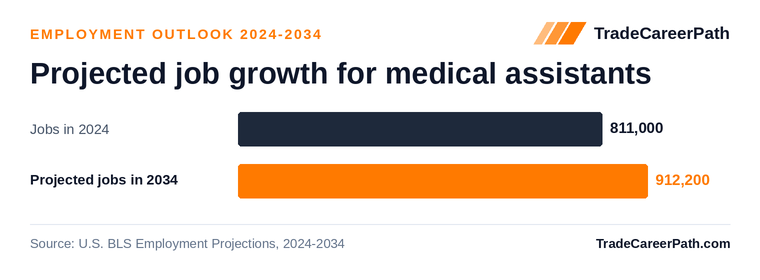
BLS reports approximately 817,870 medical assistants employed nationwide (May 2025), and projects about 109,700 job openings each year over the 2025 to 2035 decade.
How Medical Assistant Pay Compares to Similar Trades
Side-by-side comparison of Medical Assistant and the closest related careers, based on U.S. Bureau of Labor Statistics data (May 2025 OEWS + 2025-2035 Employment Projections).
| Career | Median Pay | 10-Year Growth | Annual Openings |
|---|---|---|---|
| Medical Assistant this guide | $45,690 | +12.9% | 109,700 |
| Phlebotomy Technician | $45,230 | +6.8% | 18,000 |
| EKG Technician | $74,310 | +3.7% | 3,400 |
| Patient Care Technician | $42,260 | +2.6% | 196,200 |
| Certified Nursing Assistant (CNA) | $42,260 | +2.6% | 196,200 |
Source: BLS Occupational Employment and Wage Statistics + BLS Employment Projections.
Advance Your Career with a Degree
Experienced Medical Assistant professionals often step up into degree-track careers where field experience is a hiring advantage:
- Registered Nurse (RN) - median pay $97,550 (BLS OEWS, May 2025); requires a 4-year degree
- Medical assistant to RN - the clinical ladder from the MA desk
See all trade careers that require a 4-year degree.
Sources
- U.S. Bureau of Labor Statistics, Occupational Employment and Wage Statistics (May 2025)
- U.S. Bureau of Labor Statistics, Employment Projections 2025-2035
- U.S. Bureau of Labor Statistics, Survey of Occupational Injuries and Illnesses (2023-2024, Table R98)
- U.S. Department of Labor, Wage and Hour Division, Davis-Bacon General Wage Determinations (2026)
Medical Assistant Salary by State
About this guide: Researched and written by the TradeCareerPath Editorial Team. Our editorial team researches and sources every trade school and career guide using federal labor and education data, including BLS OEWS and Employment Projections, DOL apprenticeship records, IPEDS, College Scorecard, and state licensing boards. We follow the editorial standards documented at /editorial-policy/.
Data sources
Figures on this page are sourced from the federal and state datasets below. Methodology: how we rank and source data.
| Data | Provider | Vintage |
|---|---|---|
| Occupational Employment and Wage Statistics (OEWS) | U.S. Bureau of Labor Statistics | May 2025 |
| Employment Projections | U.S. Bureau of Labor Statistics | 2025-2035 |
| Integrated Postsecondary Education Data System | National Center for Education Statistics (IPEDS) | 2024 |
| College Scorecard (school-level outcomes) | U.S. Department of Education | latest release |
| College Scorecard (field-of-study earnings) | U.S. Department of Education | latest release (updated 2026-06-12) |
| Occupational licensing requirements | CareerOneStop (U.S. Department of Labor) | latest release (updated 2026-02-22) |
| Registered apprenticeship programs | CareerOneStop / Apprenticeship.gov (U.S. Department of Labor) | latest release (updated 2025-10-25) |
| O*NET occupation profiles (skills, tasks, tools, job zones) | U.S. Department of Labor (O*NET / Employment & Training Admin.) | O*NET 31.0 (updated 2026-10-14) |