
How to Become a Medical Biller: Training and Certification
Is Medical Biller Right for You?
The U.S. Department of Labor's O*NET profile for Medical Records Specialists (SOC 29-2072) describes the work this way: Compile, process, and maintain medical records of hospital and clinic patients in a manner consistent with medical, administrative, ethical, legal, and regulatory requirements of the healthcare system. Classify medical and healthcare concepts, including diagnosis, procedures, medical services, and equipment, into the healthcare industry's numerical coding system. Includes medical coders.
What the work involves
- Protect the security of medical records to ensure that confidentiality is maintained.
- Review records for completeness, accuracy, and compliance with regulations.
- Scan patients' health records into electronic formats.
- Release information to persons or agencies according to regulations.
- Enter data, such as demographic characteristics, history and extent of disease, diagnostic procedures, or treatment into computer.
Skills and knowledge that matter
Skills: Reading Comprehension, Critical Thinking, Active Listening, Writing, Speaking, Time Management.
Knowledge: Administrative, English Language, Customer and Personal Service, Computers and Electronics.
Tools and technology you may use
Technology: Categorization or classification software, Medical software, Billing and invoicing software, eClinicalWorks EHR software, Epic Systems, Henry Schein Dentrix.
Typical preparation
O*NET Job Zone Three (Medium Preparation Needed). Most occupations in this zone require training in vocational schools, related on-the-job experience, or an associate's degree. Employees in these occupations usually need one or two years of training involving both on-the-job experience and informal training with experienced workers. A recognized apprenticeship program may be associated with these occupations.
Interest fit
O*NET interest profile: Conventional, Investigative, Social. People who enjoy structured, detail-oriented work with clear procedures and data often find this occupation a good fit.
Source: O*NET 31.0 (updated 2026-10-14)
Want a healthcare job with strong pay, office stability, and no patient contact?
Training as a medical biller covers how to train, certify, and manage healthcare billing and insurance claims.
Medical billers play a crucial role in connecting patients, insurance companies, and healthcare providers. Their accuracy ensures hospitals and clinics get paid on time and patients are billed correctly.
Quick answers
What does a medical biller do?
Medical billers use patient information and medical records to create insurance claims and invoices. They also verify insurance and follow up on reimbursements.
How long does medical biller training take?
Most medical billing programs are certificate or diploma programs that take about 9-18 months.
Is certification required to work as a medical biller?
Certification is not required by law, but it can increase employability and pay.
Which certifications are mentioned on this page?
This page mentions CPB (AAPC), CBCS (NHA), and CHBME (HBMA).
Where do medical billers work?
Medical billers often work in physician offices, clinics, and hospitals, and some roles are with insurance companies.
Can medical billing be done remotely?
Some medical billers transition to remote roles after gaining experience, and remote and hybrid positions are common.
At a glance
- Typical training: certificate or diploma program (about 9-18 months)
- Optional certifications: CPB (AAPC), CBCS (NHA), CHBME (HBMA)
- Common work settings: physician offices, clinics, hospitals, insurance companies
- Common tasks: submit claims, track approvals/rejections, follow up on reimbursements
- Work format: on-site, hybrid, or remote (some transition after experience)
What Does a Medical Biller Do?
Medical billers process patient information and medical records to create accurate insurance claims and invoices. They review codes entered by medical coders, verify patient insurance, and handle reimbursement follow-ups.
Common responsibilities
- Preparing and submitting insurance claims
- Reviewing medical codes and patient data for accuracy
- Tracking claim approvals and rejections
- Communicating with insurance companies and patients
- Managing billing software and payment records
Medical billers often work in physician offices, clinics, and hospitals, while some transition to remote roles after gaining experience.
How to Become a Medical Biller in 5 Steps
Most medical billing careers start with a short certificate or diploma program lasting 9-18 months, followed by optional national certification.
Earn your high school diploma or GED
This is the minimum requirement to begin training.Complete an accredited medical billing program
Choose a program that covers:- Healthcare law and ethics
- Billing software and insurance systems
- Anatomy and terminology basics
- HIPAA and reimbursement regulations
Gain practical experience
Some programs offer simulated billing exercises or externships with local medical offices.Earn national certification (optional but valuable)
Certification increases employability and pay. Top credentials include:- CPB (Certified Professional Biller) (AAPC)
- CBCS (Certified Billing and Coding Specialist) (NHA)
- CHBME (Certified Healthcare Billing and Management Executive) (HBMA)
Apply for medical billing positions
Entry-level jobs are available in hospitals, clinics, and insurance companies. Remote and hybrid positions are also common.
Certification Options
While not required by law, certification demonstrates skill and professionalism to employers.
Top certifying organizations
- AAPC (American Academy of Professional Coders) (CPB)
- NHA (National Healthcareer Association) (CBCS)
- HBMA (Healthcare Billing and Management Association) (CHBME)
Certified billers earn higher salaries and have better advancement opportunities within healthcare organizations.
Skills Needed for Success
- Attention to detail and accuracy
- Strong communication and customer service
- Understanding of insurance and reimbursement systems
- Computer proficiency with EHR and billing platforms
- Ability to handle confidential patient information
Medical billing is ideal for professionals who enjoy organization, financial accuracy, and helping patients navigate insurance systems.
Career Outlook and Salary
Medical billing professionals are in steady demand as healthcare facilities expand digital and remote billing systems.
Medical Biller Salary Snapshot
U.S.14,000 openings/yr
Remote positions continue to grow as healthcare moves toward paperless claim processing.
Start Your Medical Billing Journey
Medical billing offers a fast, secure route into healthcare administration without direct patient care.
With training and certification, you can enter the field in less than two years.
Wage and Employment Charts
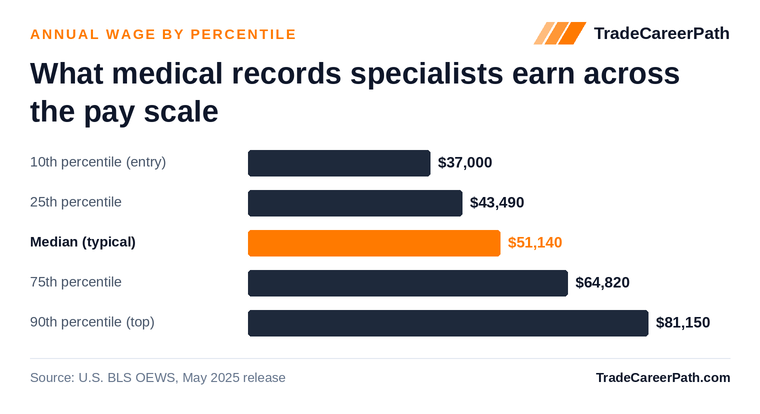
| Percentile | Annual wage |
|---|---|
| 10th | $37,000 |
| 25th | $43,490 |
| 50th (median) | $51,140 |
| 75th | $64,820 |
| 90th | $81,150 |
| Year | Employment |
|---|---|
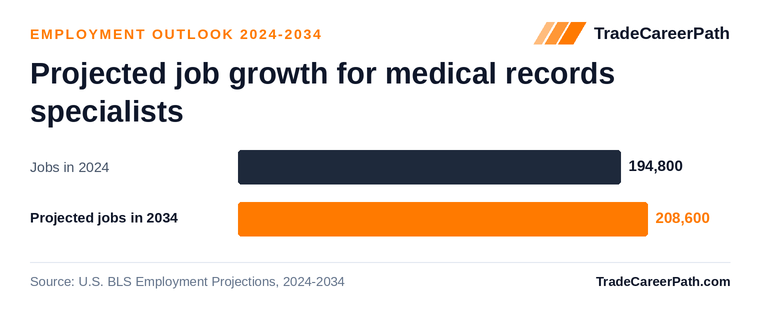
| 2025 | 200,700 |
| 2035 projected | 216,300 |
| Percent change | +7.8% |
Medical Biller Salary and Requirements by State
Select your state for local wage data, training options, and requirements:
Alabama · Alaska · Arizona · Arkansas · California · Colorado · Connecticut · Delaware · District of Columbia · Florida · Georgia · Hawaii · Idaho · Illinois · Indiana · Iowa · Kansas · Kentucky · Louisiana · Maine · Maryland · Massachusetts · Michigan · Minnesota · Mississippi · Missouri · Montana · Nebraska · Nevada · New Hampshire · New Jersey · New Mexico · New York · North Carolina · North Dakota · Ohio · Oklahoma · Oregon · Pennsylvania · Rhode Island · South Carolina · South Dakota · Tennessee · Texas · Utah · Vermont · Virginia · Washington · West Virginia · Wisconsin · Wyoming
Workplace Safety Snapshot
BLS Survey of Occupational Injuries and Illnesses data (2023-2024) report approximately 36.9 days-away, restricted, or transfer cases per 10,000 full-time-equivalent workers in medical records specialists (about 0.37 per 100 FTE). Source: BLS Survey of Occupational Injuries and Illnesses, Table R98.
Frequently Asked Questions
How long does medical biller training take?
It typically takes typically 6 months to 2 years of training. The most common entry path is through a certificate or associate degree program. A high school diploma or GED is generally required to get started.
How much do medical billers make?
The median annual salary for medical billers is $51,140 according to the Bureau of Labor Statistics (May 2025). Entry-level workers earn around $37,000, while those in the 90th percentile earn over $81,150. Pay varies by state, experience, and specialization.
What is the job outlook for medical billers?
The Bureau of Labor Statistics projects 7.8% employment growth for this occupation from 2025 to 2035, which is about as fast as average. Approximately 14,000 job openings are expected each year due to growth, retirements, and workers leaving the field.
Do you need a college degree to work as a medical biller?
No. A college degree is not required to work as a medical biller. Most people enter the field through a certificate or associate degree program. A high school diploma or GED is typically the only educational prerequisite.
Which states pay medical billers the most?
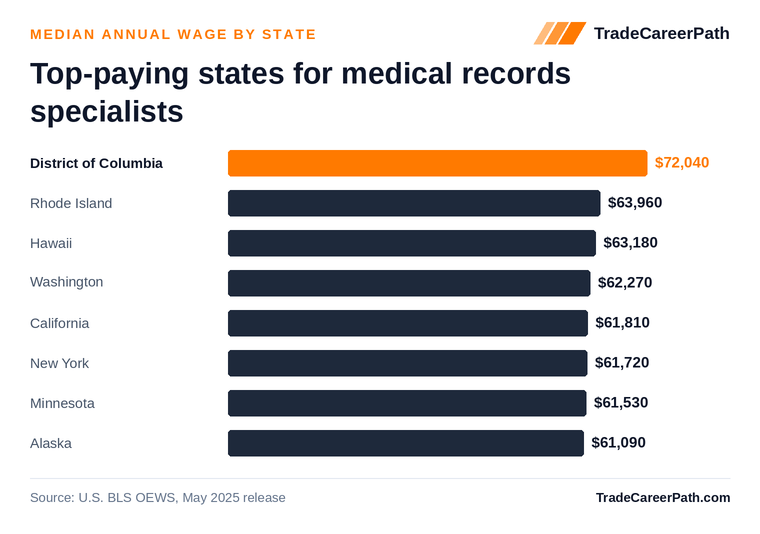
According to the U.S. Bureau of Labor Statistics (May 2025 OEWS), the highest-paying states for medical billers are District of Columbia, Rhode Island, and Hawaii. Median annual wages: District of Columbia ($72,040); Rhode Island ($63,960); Hawaii ($63,180).
Which states employ the most medical billers?
BLS reports the largest concentrations of medical billers in Florida, California, and Texas. Employment levels: Florida (21,490 workers); California (18,700 workers); Texas (17,210 workers) (May 2025).
How much do experienced medical billers earn?
The top 10% of medical billers earn more than $81,150 per year, according to BLS Occupational Employment and Wage Statistics (May 2025). Experienced workers in this band typically hold senior credentials, supervisory roles, or specialty certifications.
What is entry-level pay for medical billers?
BLS reports the bottom 10% of medical billers earn under $37,000 per year. New workers often start near this level and see pay rise as they accumulate experience and credentials.
How many medical billers work in the United States?
BLS reports approximately 194,720 medical billers employed nationwide as of May 2025.
How many job openings are expected for medical billers each year?
BLS projects approximately 14,000 openings per year for medical billers from 2025 through 2035, including new positions, retirements, and workers transitioning out. The occupation is projected to grow 7.8% from 2025 to 2035, classified as faster than average growth.
Is medical biller a growing career?
Yes. BLS projects 7.8% employment growth for medical billers between 2024 and 2034, classified as faster than average. Employment is projected to rise from approximately 200,700 jobs in 2024 to 216,300 in 2034.
How much do medical billers make per hour?
The median hourly wage for medical billers is $24.59, according to BLS (May 2025). Hourly pay ranges from about $17.79 (bottom 10%) to $39.01 (top 10%).
How Medical Biller Pay Compares to Similar Trades
Side-by-side comparison of Medical Biller and the closest related careers, based on U.S. Bureau of Labor Statistics data (May 2025 OEWS + 2025-2035 Employment Projections).
| Career | Median Pay | 10-Year Growth | Annual Openings |
|---|---|---|---|
| Medical Biller this guide | $51,140 | +7.8% | 14,000 |
| Medical Billing & Coding | $51,140 | +7.8% | 14,000 |
| Medical Coder | $51,140 | +7.8% | 14,000 |
| Medical Office Administration | $45,930 | +4.8% | 89,200 |
Source: BLS Occupational Employment and Wage Statistics + BLS Employment Projections.
Sources
- U.S. Bureau of Labor Statistics, Occupational Employment and Wage Statistics (May 2025)
- U.S. Bureau of Labor Statistics, Employment Projections 2025-2035
- U.S. Bureau of Labor Statistics, Survey of Occupational Injuries and Illnesses (2023-2024, Table R98)
- U.S. Department of Labor, Wage and Hour Division, Davis-Bacon General Wage Determinations (2026)
Medical Biller Salary by State
About this guide: Researched and written by the TradeCareerPath Editorial Team. Our editorial team researches and sources every trade school and career guide using federal labor and education data, including BLS OEWS and Employment Projections, DOL apprenticeship records, IPEDS, College Scorecard, and state licensing boards. We follow the editorial standards documented at /editorial-policy/.
Data sources
Figures on this page are sourced from the federal and state datasets below. Methodology: how we rank and source data.
| Data | Provider | Vintage |
|---|---|---|
| Occupational Employment and Wage Statistics (OEWS) | U.S. Bureau of Labor Statistics | May 2025 |
| Employment Projections | U.S. Bureau of Labor Statistics | 2025-2035 |
| Integrated Postsecondary Education Data System | National Center for Education Statistics (IPEDS) | 2024 |
| College Scorecard (school-level outcomes) | U.S. Department of Education | latest release |
| College Scorecard (field-of-study earnings) | U.S. Department of Education | latest release (updated 2026-06-12) |
| Occupational licensing requirements | CareerOneStop (U.S. Department of Labor) | latest release (updated 2026-02-22) |
| Registered apprenticeship programs | CareerOneStop / Apprenticeship.gov (U.S. Department of Labor) | latest release (updated 2025-10-25) |
| O*NET occupation profiles (skills, tasks, tools, job zones) | U.S. Department of Labor (O*NET / Employment & Training Admin.) | O*NET 31.0 (updated 2026-10-14) |