
How to Become a Medical Biller and Coder in 2026
Is Medical Biller and Coder Right for You?
The U.S. Department of Labor's O*NET profile for Medical Records Specialists (SOC 29-2072) describes the work this way: Compile, process, and maintain medical records of hospital and clinic patients in a manner consistent with medical, administrative, ethical, legal, and regulatory requirements of the healthcare system. Classify medical and healthcare concepts, including diagnosis, procedures, medical services, and equipment, into the healthcare industry's numerical coding system. Includes medical coders.
What the work involves
- Protect the security of medical records to ensure that confidentiality is maintained.
- Review records for completeness, accuracy, and compliance with regulations.
- Scan patients' health records into electronic formats.
- Release information to persons or agencies according to regulations.
- Enter data, such as demographic characteristics, history and extent of disease, diagnostic procedures, or treatment into computer.
Skills and knowledge that matter
Skills: Reading Comprehension, Critical Thinking, Active Listening, Writing, Speaking, Time Management.
Knowledge: Administrative, English Language, Customer and Personal Service, Computers and Electronics.
Tools and technology you may use
Technology: Categorization or classification software, Medical software, Billing and invoicing software, eClinicalWorks EHR software, Epic Systems, Henry Schein Dentrix.
Typical preparation
O*NET Job Zone Three (Medium Preparation Needed). Most occupations in this zone require training in vocational schools, related on-the-job experience, or an associate's degree. Employees in these occupations usually need one or two years of training involving both on-the-job experience and informal training with experienced workers. A recognized apprenticeship program may be associated with these occupations.
Interest fit
O*NET interest profile: Conventional, Investigative, Social. People who enjoy structured, detail-oriented work with clear procedures and data often find this occupation a good fit.
Source: O*NET 31.0 (updated 2026-10-14)
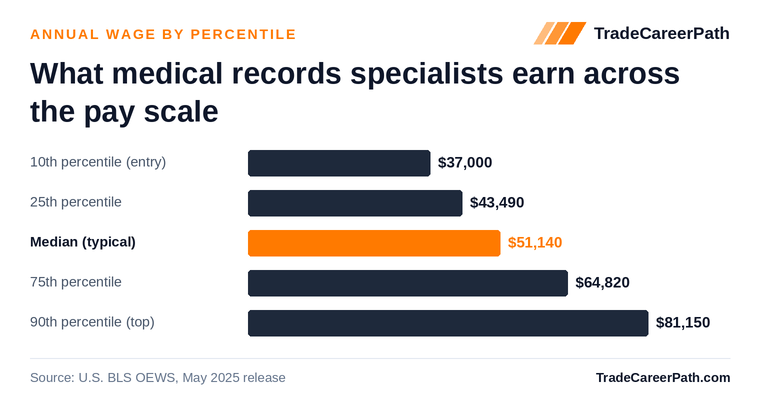
Quick answer: Training as a medical biller and coder usually takes 9 to 24 months. You complete a certificate program (about 9 to 12 months) or an associate degree (about 2 years), learn the ICD-10, CPT, and HCPCS coding systems, and can earn an optional national certification such as the CPC (AAPC) or CCA (AHIMA). Most states do not require a license. The median medical records specialist salary is $51,140 per year ($24.59/hour), with about 14,000 openings nationwide each year (BLS, May 2025).
Medical billers and coders translate diagnoses, procedures, and treatments into the standardized codes used for insurance claims and patient records. If you are detail-oriented, tech-comfortable, and want into healthcare without years of school, this role offers a fast path with remote and hybrid options.
How to Become a Medical Biller and Coder
Most people enter the field in about 9 to 24 months, depending on whether they choose a certificate or a degree. There is no single national license to earn. You build the career through training, hands-on practice, and an optional certification that employers value.
1. Earn a high school diploma or GED
A high school diploma or GED is the baseline requirement for nearly every medical billing and coding program. Before you enroll, it helps to build the skills the work depends on: careful reading, basic math, and comfort with computers. Classes in biology and anatomy give you a head start on the medical terminology you will study later, and any course that builds attention to detail is good preparation. Much of the job runs on software, including electronic health record (EHR) systems, claim-submission portals, and coding lookup tools, so being comfortable navigating applications and spreadsheets matters. If you are switching careers and already hold a diploma or a degree in another field, you can move straight to training. Many strong coders come from unrelated backgrounds and bring useful skills in organization, data entry, and customer service.
2. Complete a medical billing and coding program
This is the core of your preparation, and you have a few formats to choose from. Certificate programs take roughly 9 to 12 months and are popular with adults who want to enter the field quickly. Associate degree programs take about 2 years and combine general-education credits with coding-specific coursework, which can help with advancement later. Coursework typically covers medical terminology, human anatomy and physiology, the ICD-10, CPT, and HCPCS code sets, insurance and reimbursement rules, and HIPAA privacy compliance. Many programs are available fully online, which lets working students learn at a flexible pace. When comparing schools, ask how the program prepares you for a certification exam and whether it includes practice with real coding scenarios. Confirm tuition and fees directly with each school, since costs vary widely by program and format.
3. Practice coding and build experience
Coursework teaches the rules, but accuracy comes from repetition. Look for a program that includes an externship or practicum, so you can apply codes to real or realistic patient records and claims under supervision. If a formal externship is not available, entry-level roles such as medical records clerk, billing assistant, or front-office staff in a clinic put you inside a healthcare setting where you can learn the workflow. As you practice, focus on reading clinical documentation carefully, choosing the correct ICD-10 and CPT codes, and understanding why a claim gets denied so you can prevent it. Speed matters, but accuracy matters more, because a single miscoded claim can delay payment or create compliance problems. The reps you build now are what let you pass a certification exam and reassure employers that you can do the work.
4. Earn a national certification
Certification is usually voluntary, but many employers prefer or require it, and it can support higher pay. The most widely recognized credentials come from established organizations: the CPC (Certified Professional Coder) from AAPC, the CCA (Certified Coding Associate) and CCS (Certified Coding Specialist) from AHIMA, and the CBCS (Certified Billing and Coding Specialist) from the NHA. Entry-level coders often start with the CPC, CCA, or CBCS, then add advanced credentials as they gain experience. Each exam tests your knowledge of code sets, anatomy, and billing rules. Check current eligibility and exam details on the certifying organization’s website, since requirements and fees change. Some healthcare systems reimburse exam costs once you are hired, so it is worth asking employers about that benefit.
5. Apply for jobs, including remote roles
Hospitals, physician offices, outpatient clinics, insurance carriers, and large healthcare networks all hire billers and coders. Tailor your resume to highlight your certification, the code sets you know, and any externship or practice experience. Many roles are now remote or hybrid, especially for coders who hold a certification and have some experience, though entry-level positions are more likely to start on-site. Networking through professional associations and using their job boards can speed up your search. Once you land a role, on-the-job experience and additional certifications open the door to specialties such as inpatient coding, outpatient coding, medical auditing, and billing management.
What Do Medical Billers and Coders Do?
Medical billers and coders work behind the scenes of healthcare, turning patient information into standardized data that drives treatment records, billing, and insurance reimbursement. Their work keeps hospitals, clinics, and doctors’ offices paid and running on time.
Typical Duties Include:
- Reviewing patient charts and clinical documentation
- Assigning ICD-10, CPT, and HCPCS medical codes
- Preparing and submitting insurance claims
- Ensuring HIPAA compliance and accurate recordkeeping
- Communicating with providers, patients, and insurance carriers
Many professionals specialize in hospital coding, physician offices, or outpatient care centers. Others work remotely for large healthcare networks.
Skills That Make Great Coders
- Strong attention to detail and accuracy
- Analytical and problem-solving skills
- Understanding of medical terminology and anatomy
- Computer proficiency and EHR familiarity
- Discretion with confidential patient data
If you enjoy precision work, organization, and the healthcare field, this is a career where those strengths shine.
Work Environment and Career Options
Medical billers and coders work in:
- Hospitals and clinics
- Private practices
- Insurance companies
- Remote and home offices
Specializations include:
- Inpatient coding
- Outpatient coding
- Medical auditing
- Billing management
Certification and Licensing Requirements
While most states do not require a license, national certification improves job prospects and earning potential. Common certifying organizations include:
- AAPC (American Academy of Professional Coders): CPC, CPB, CPMA
- AHIMA (American Health Information Management Association): CCA, CCS, RHIT
- NHA (National Healthcareer Association): CBCS
Most employers prefer certified candidates, and some healthcare systems reimburse exam fees once you are hired. Confirm current eligibility and fees on each organization’s website.
Cost and Duration of Training
- Program cost: varies by program and school; certificate programs generally cost less than associate degree programs
- Time to complete: about 9 to 24 months
- Certification: optional but often preferred by employers
Many programs are available online, which helps students learn at a flexible pace. Confirm tuition and fees directly with each school before enrolling.
Pros and Cons of Medical Coding Careers
Pros
- Remote and hybrid job options
- Entry within about 1 to 2 years
- Stable, growing field
- No patient care duties
Cons
- Sitting or screen-heavy work
- Repetitive coding tasks
- Certification renewal required
Quick Facts: Medical Coding Salary, Education, and Outlook
Start Your Medical Coding Journey
Medical billing and coding offers a fast, flexible route into healthcare, without patient care duties or a long degree.
Wage and Employment Charts
Medical Billing and Coding Specialist Salary and Requirements by State
Select your state for local wage data, training options, and requirements:
Alabama · Alaska · Arizona · Arkansas · California · Colorado · Connecticut · Delaware · District of Columbia · Florida · Georgia · Hawaii · Idaho · Illinois · Indiana · Iowa · Kansas · Kentucky · Louisiana · Maine · Maryland · Massachusetts · Michigan · Minnesota · Mississippi · Missouri · Montana · Nebraska · Nevada · New Hampshire · New Jersey · New Mexico · New York · North Carolina · North Dakota · Ohio · Oklahoma · Oregon · Pennsylvania · Rhode Island · South Carolina · South Dakota · Tennessee · Texas · Utah · Vermont · Virginia · Washington · West Virginia · Wisconsin · Wyoming
Workplace Safety Snapshot
BLS Survey of Occupational Injuries and Illnesses data (2023-2024) report approximately 36.9 days-away, restricted, or transfer cases per 10,000 full-time-equivalent workers in medical records specialists (about 0.37 per 100 FTE). Source: BLS Survey of Occupational Injuries and Illnesses, Table R98.
Frequently Asked Questions
How long does medical biller and coder training take?
It typically takes 9 to 24 months of training. A certificate program usually runs about 9 to 12 months, while an associate degree takes around 2 years. A high school diploma or GED is generally required to get started.
Do you need a college degree to work as a medical biller and coder?
No. A college degree is not required. Most people enter the field through a certificate or associate degree program. A high school diploma or GED is typically the only educational prerequisite, and many employers prefer candidates who hold a national certification.
How much does medical billing and coding training cost?
Costs vary widely by program and school, with certificate programs generally costing less than associate degree programs. Confirm tuition, fees, and any certification exam costs directly with each school before you enroll, since published prices change often.
Is certification required for medical billing and coding?
Most states do not require a license. National certification is usually voluntary, but many employers prefer or require it. Common credentials include the CPC from AAPC, the CCA or CCS from AHIMA, and the CBCS from the NHA.
Is medical billing and coding a growing career?
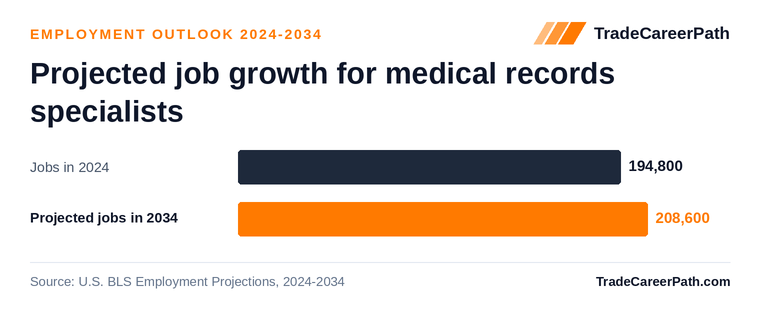
Yes. BLS projects 7.8% employment growth for medical records specialists between 2025 and 2035, faster than the average for all occupations. About 14,000 openings are projected nationwide each year over that period.
Can you do medical billing and coding from home?
Often, yes. Many hospitals, physician groups, and healthcare networks hire remote and hybrid coders, especially for staff who already hold a certification and have some experience. Entry-level roles are more likely to start on-site.
Is medical billing and coding hard to learn?
The work rewards people who are detail-oriented and patient. Training covers medical terminology, anatomy, and coding systems such as ICD-10, CPT, and HCPCS, which takes focused study. Most students finish a certificate or associate program within 9 to 24 months.
How Medical Billing Coding Pay Compares to Similar Trades
Side-by-side comparison of Medical Billing & Coding and the closest related careers, based on U.S. Bureau of Labor Statistics data (May 2025 OEWS + 2025-2035 Employment Projections).
| Career | Median Pay | 10-Year Growth | Annual Openings |
|---|---|---|---|
| Medical Billing & Coding this guide | $51,140 | +7.8% | 14,000 |
| Medical Biller | $51,140 | +7.8% | 14,000 |
| Medical Coder | $51,140 | +7.8% | 14,000 |
| Medical Office Administration | $45,930 | +4.8% | 89,200 |
Source: BLS Occupational Employment and Wage Statistics + BLS Employment Projections.
Sources
- U.S. Bureau of Labor Statistics, Occupational Employment and Wage Statistics (May 2025)
- U.S. Bureau of Labor Statistics, Employment Projections 2025-2035
- U.S. Bureau of Labor Statistics, Survey of Occupational Injuries and Illnesses (2023-2024, Table R98)
- U.S. Department of Labor, Wage and Hour Division, Davis-Bacon General Wage Determinations (2026)
Medical Billing Coding Salary by State
About this guide: Researched and written by the TradeCareerPath Editorial Team. Our editorial team researches and sources every trade school and career guide using federal labor and education data, including BLS OEWS and Employment Projections, DOL apprenticeship records, IPEDS, College Scorecard, and state licensing boards. We follow the editorial standards documented at /editorial-policy/.
Data sources
Figures on this page are sourced from the federal and state datasets below. Methodology: how we rank and source data.
| Data | Provider | Vintage |
|---|---|---|
| Occupational Employment and Wage Statistics (OEWS) | U.S. Bureau of Labor Statistics | May 2025 |
| Employment Projections | U.S. Bureau of Labor Statistics | 2025-2035 |
| Integrated Postsecondary Education Data System | National Center for Education Statistics (IPEDS) | 2024 |
| College Scorecard (school-level outcomes) | U.S. Department of Education | latest release |
| College Scorecard (field-of-study earnings) | U.S. Department of Education | latest release (updated 2026-06-12) |
| Occupational licensing requirements | CareerOneStop (U.S. Department of Labor) | latest release (updated 2026-02-22) |
| Registered apprenticeship programs | CareerOneStop / Apprenticeship.gov (U.S. Department of Labor) | latest release (updated 2025-10-25) |
| O*NET occupation profiles (skills, tasks, tools, job zones) | U.S. Department of Labor (O*NET / Employment & Training Admin.) | O*NET 31.0 (updated 2026-10-14) |