
How to Become a Medical Dosimetrist in 2026
Is Medical Dosimetrist Right for You?
The U.S. Department of Labor's O*NET profile for Medical Dosimetrists (SOC 29-2036) describes the work this way: Generate radiation treatment plans, develop radiation dose calculations, communicate and supervise the treatment plan implementation, and consult with members of radiation oncology team.
What the work involves
- Design the arrangement of radiation fields to reduce exposure to critical patient structures, such as organs, using computers, manuals, and guides.
- Plan the use of beam modifying devices, such as compensators, shields, and wedge filters, to ensure safe and effective delivery of radiation treatment.
- Identify and outline bodily structures, using imaging procedures, such as x-ray, magnetic resonance imaging, computed tomography, or positron emission tomography.
- Calculate the delivery of radiation treatment, such as the amount or extent of radiation per session, based on the prescribed course of radiation therapy.
- Calculate, or verify calculations of, prescribed radiation doses.
Skills and knowledge that matter
Skills: Critical Thinking, Reading Comprehension, Active Listening, Speaking, Writing, Judgment and Decision Making.
Knowledge: Mathematics, Physics, Computers and Electronics, Biology.
Tools and technology you may use
Technology: Development environment software, Medical software, Eclipse IDE, MEDITECH software.
Typical preparation
O*NET Job Zone Four (Considerable Preparation Needed). Most of these occupations require a four-year bachelor's degree, but some do not. Employees in these occupations usually need several years of work-related experience, on-the-job training, and/or vocational training.
Interest fit
O*NET interest profile: Investigative, Conventional, Realistic. People who enjoy working with ideas, searching for facts, and figuring out problems often find this occupation a good fit.
Source: O*NET 29.1 (updated 2026-06-13)
Quick answer: Training as a medical dosimetrist requires a 4-year degree - typically a Bachelor’s degree + JRCERT-accredited medical dosimetry program. The national median pay is $147,470 per year, and BLS projects +3.5% employment change from 2024 to 2034 (BLS OEWS, May 2025; BLS Employment Projections, 2024-34).
Medical Dosimetrist at a Glance
| Metric | Detail | Source |
|---|---|---|
| Median annual wage | $147,470 | BLS OEWS, May 2025 |
| Typical wage range | $111,670 (10th pct) - $185,450 (90th pct) | BLS OEWS, May 2025 |
| Employment | 3,410 nationwide | BLS OEWS, May 2025 |
| Projected growth (2024-34) | +3.5%, about 200 openings per year | BLS Employment Projections, 2024-34 |
| Typical education | Bachelor’s degree + JRCERT-accredited medical dosimetry program | BLS Occupational Outlook Handbook |
| License / certification | MDCB certification (CMD) is the industry standard; some states license | State licensing boards |
What Does a Medical Dosimetrist Do?
Medical dosimetrists design radiation treatment plans for cancer patients. Working from the radiation oncologist’s prescription, they calculate exactly how the beams will be shaped, angled, and weighted so the tumor receives the prescribed dose while the healthy tissue around it - spinal cord, heart, lungs, salivary glands - stays under its limits. The plan they build is the plan the linear accelerator delivers, fraction by fraction, for weeks.
Day to day, the work varies by treatment technique. On external-beam cases, a dosimetrist contours organs at risk on CT images, builds IMRT or VMAT plans in a treatment-planning system, iterates against the physician’s dose constraints, and presents the plan for approval. On brachytherapy cases, the planning happens fast - source positions and dwell times are calculated while the patient is prepped. Stereotactic work (SRS/SBRT) demands sub-millimeter precision and heavy quality-assurance documentation. Between plans there are chart checks, plan adaptations when a patient’s anatomy changes mid-course, and constant back-and-forth with the medical physicist who independently verifies the numbers. Almost nothing goes to treatment on one person’s say-so - the QA culture is closer to aviation than to most of healthcare.
If you are a radiologic technologist or radiation therapist, here is the shortest way to say it: the therapist delivers the treatment; the dosimetrist decides what the treatment looks like. You already know the machines, the immobilization devices, the patient setup, and what happens when a plan is impractical at the console. That knowledge is exactly why the profession recruits from your ranks - dosimetry programs and hiring managers treat therapy-floor experience as the strongest predictor of a good planner.
Skills That Make a Great Medical Dosimetrist
- Treatment-planning systems (Eclipse, RayStation, Pinnacle)
- Radiation physics and dose-calculation methods
- Cross-sectional anatomy and organ-at-risk contouring
- IMRT/VMAT optimization and plan evaluation
- Brachytherapy and stereotactic (SRS/SBRT) planning
- Precision calculation, chart checks, and QA discipline
- Oncology-team collaboration - physicians, physicists, and therapists all touch every plan
- Written documentation: every plan decision must be traceable
Medical Dosimetrist Salary
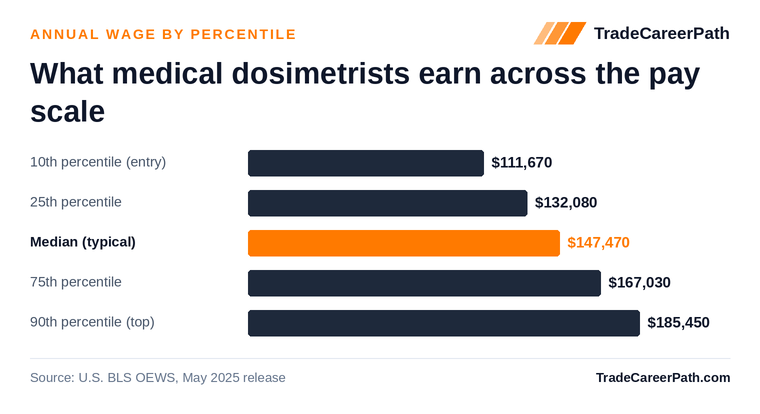
Dosimetry has one of the highest medians of any bachelor’s-entry health occupation BLS tracks. The national median is $147,470 per year, and even the 10th percentile - roughly where newly certified dosimetrists start - is $111,670, which is above the median for nearly every skilled trade. The 75th percentile sits at $167,030, and the 90th percentile reaches $185,450 (BLS OEWS, May 2025). For a radiation therapist weighing the move up, that spread is the whole argument.
Where the Jobs and the Money Are
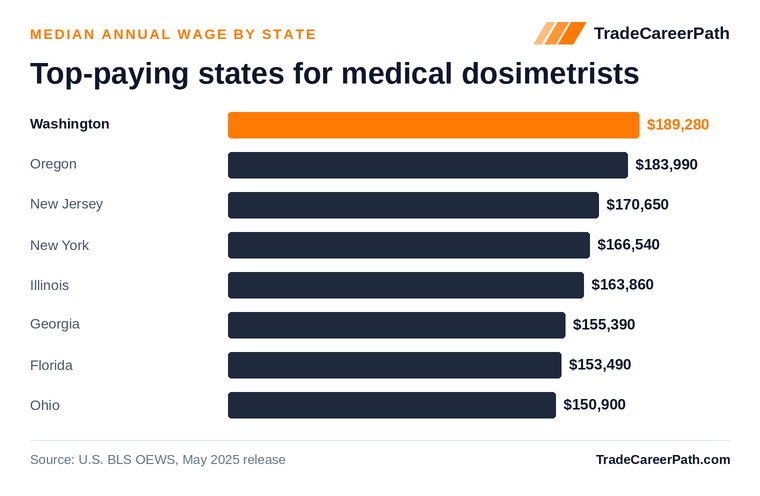
This is a small, specialized occupation - 3,410 jobs nationwide (BLS OEWS, May 2025) - concentrated wherever cancer centers cluster. The biggest state job markets are Texas (330 dosimetrists), Florida (320), and New York (300), while the West Coast pays best.
| State | Median annual wage | Employment |
|---|---|---|
| Washington | $189,280 | 60 |
| Oregon | $183,990 | 40 |
| New Jersey | $170,650 | 90 |
| New York | $166,540 | 300 |
| Illinois | $163,860 | 140 |
Concentration matters as much as headline pay. Florida and New York have location quotients of 1.48 and 1.40 - dosimetrists are roughly one and a half times as common there as in the average state labor market - which means more employers, more academic medical centers, and more room to change jobs without relocating. Washington and Oregon pay the most but employ few (60 and 40 respectively), so those markets reward patience. Texas combines the largest headcount with a solid 1.08 concentration, making it the easiest market for a first dosimetry job even though its $134,680 median trails the coasts.
How to Become a Medical Dosimetrist
1. Start in radiologic technology or radiation therapy
Most dosimetrists come up through imaging or therapy roles - the standard feeder path. Radiation therapy is the most direct: you work daily with the same linear accelerators, immobilization devices, and treatment plans you will later design. Radiologic technologists get there too, usually by adding a radiation-therapy credential or leaning on strong cross-sectional imaging experience. Either way, clinical hours are not a detour - JRCERT dosimetry programs weigh them heavily in admissions, and some effectively require them.
2. Earn the bachelor’s degree
Any major works when paired with clinical experience; health science is the most direct route, and many working techs finish a bachelor’s completion program online while staying full-time on the therapy floor. If you are still early in your imaging career, choose a degree-completion path that accepts your associate-level radiologic technology credits - a written transfer evaluation before you enroll can save a year of coursework.
3. Complete a JRCERT dosimetry program
These accredited programs run 12 to 24 months and are the gate to certification. Several are offered in hybrid or online formats built specifically for working therapists: didactic coursework online, clinical planning hours arranged at an affiliated cancer center - sometimes the one you already work at. Accreditation is the non-negotiable; the MDCB exam eligibility rules assume it, and employers screen for it.
4. Pass the MDCB exam
The Certified Medical Dosimetrist (CMD) credential from the Medical Dosimetrist Certification Board is the hiring standard - job postings list it the way nursing postings list the RN license. Passing it converts your program into a career; maintaining it requires ongoing continuing education, which employers generally support.
5. Advance
Senior dosimetrist, chief dosimetrist, or the medical physics graduate track. The fork comes after several years of planning: deepen into complex techniques (stereotactic, adaptive, proton planning where available), move into the chief role running a planning team, or use dosimetry as the launchpad into a medical physics master’s - the profession directly above this one on the same ladder.
Career Ladder: Titles and Realistic Pay
The BLS wage percentiles map cleanly onto how dosimetry careers actually progress. Use this as a sanity check on offers, not a guarantee:
| Stage | Typical titles | Years in | Realistic pay (BLS OEWS, May 2025) |
|---|---|---|---|
| Entry level | Medical dosimetrist (new CMD) | 0-3 | ~$111,670-$132,080 (10th-25th pct) |
| Mid-career | Staff dosimetrist | 3-10 | ~$147,470 (median) |
| Senior | Senior dosimetrist, lead planner | 10-15 | ~$167,030 (75th pct) |
| Chief / leadership | Chief dosimetrist, dosimetry supervisor | 15+ | $185,450+ (90th pct) |
Two notes for career changers. First, prior clinical experience compresses this ladder: a radiation therapist who becomes a dosimetrist already knows the treatment machines, the physicians, and the workflow, and is routinely hired above the bottom of the entry band because they need less supervision from day one. Second, this is a small occupation with steady turnover pressure - senior and chief roles open up regularly relative to the field’s size, and dosimetrists willing to relocate to a high-paying, low-headcount market can jump bands faster than the years-in column suggests.
Do You Need a License?
The credential that actually governs hiring is not a state license - it is MDCB certification. The Certified Medical Dosimetrist (CMD) credential is the nationwide industry standard, and eligibility now runs through a JRCERT-accredited dosimetry program. Practically, no CMD means no serious job offers, regardless of what your state requires.
State licensing is a patchwork on top of that. Some states regulate medical dosimetrists or radiation-therapy personnel under their radiologic technology or radiation-safety licensing laws; others do not license the role at all. Many dosimetrists also carry an ARRT credential in radiography or radiation therapy from their feeder career, which satisfies most state radiologic licensing schemes where they apply. The reliable general rule: earn the CMD, keep any ARRT credential you already hold active, and check your state’s radiologic licensing board before you relocate - not because the CMD might not be enough for employers, but because a state statute can add paperwork on top of it.
Why an Online Degree Works for This Career
This is the top rung of the radiologic ladder: radiologic technologist, then radiation therapist, then dosimetrist. Clinical imaging experience counts heavily for dosimetry program admission, and the pay jump is dramatic: dosimetry has one of the highest medians of any bachelor’s-entry health occupation BLS tracks. Because the feeder workforce is already employed in hospitals, the education pipeline is built for working adults - online bachelor’s completion programs for techs, then hybrid JRCERT dosimetry programs with clinical hours arranged locally. Hospital tuition assistance is common, and many therapists complete the entire path without leaving their job or their seniority.
Job Outlook for 2026 and Beyond
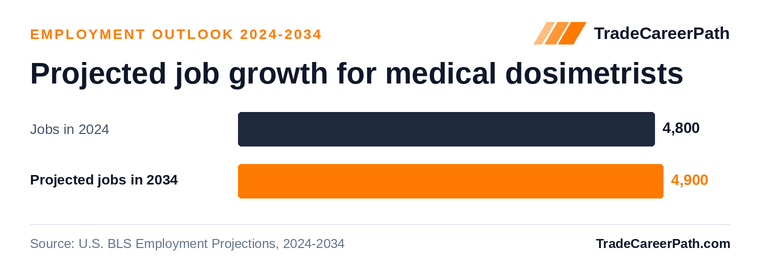
BLS projects medical dosimetrist employment to grow +3.5% from 2024 to 2034 - from 4,800 to 4,900 jobs - with about 200 openings per year once retirements and occupation changes are counted (BLS Employment Projections, 2024-34). Wages, meanwhile, are moving faster than headcount: the projections dataset recorded a 2024 median of $138,110, and the May 2025 OEWS median came in at $147,470 - a substantial one-year jump that reflects how hard it is to fill these seats.
Read together, this is a classic small-specialty market: modest percentage growth on a tiny base, but persistent demand as cancer incidence rises with an aging population. For a career changer, the 200 annual openings against a 3,410-person occupation (BLS OEWS, May 2025) is the meaningful figure - steady replacement hiring in a field where the accredited-program pipeline stays narrow. The barrier to entry that makes the path long is the same barrier that keeps the pay high.
Cost and Time to Complete the Degree
For medical dosimetrists, the credential is: Bachelor’s degree + JRCERT-accredited medical dosimetry program. Plan for the bachelor’s plus a 12-to-24-month JRCERT-accredited dosimetry program afterward; radiologic techs and radiation therapists already working in imaging can complete the dosimetry portion in hybrid formats. Transfer credit is the other lever: prior college, military training, apprenticeship coursework, and industry certifications can be worth meaningful credit at transfer-friendly schools, so get a written transfer evaluation before enrolling anywhere. Costs vary widely by school type; in-state public online programs are usually the value benchmark, and employer tuition assistance is common for working adults in this field.
Pros and Cons of Training as a Medical Dosimetrist
Pros
- Median pay of $147,470 nationally (BLS OEWS, May 2025)
- BLS projects +3.5% employment growth through 2034
- Field experience from the trades is a genuine hiring advantage
- Accredited online and hybrid degree paths exist for working adults
Cons
- Requires a 4-year degree (typically 120 credit hours)
- Entry-level pay starts near $111,670 at the 10th percentile
- Licensing hurdle: MDCB certification (CMD) is the industry standard; some states license
Frequently Asked Questions
How does a radiology tech work as a dosimetrist?
The standard path is clinical imaging or radiation therapy experience plus a bachelor's degree, then a JRCERT-accredited dosimetry program and the MDCB exam. It is the highest-paying rung of the radiologic career ladder.
How much do medical dosimetrists make?
The national median annual wage for medical dosimetrists is $147,470 (BLS OEWS, May 2025). The top 10% earn $185,450 or more, while entry-level pay starts around $111,670.
What is the job outlook for medical dosimetrists?
BLS projects employment of medical dosimetrists to change by +3.5% from 2024 to 2034 (BLS Employment Projections, 2024-34).
How long does medical dosimetrist training take?
Plan on the bachelor's degree plus a 12-to-24-month JRCERT-accredited dosimetry program. For a working radiologic tech or radiation therapist who already has clinical experience, the dosimetry portion is the main add - many programs run in hybrid or online formats so you can keep working.
Is medical dosimetry hard?
The coursework is math- and physics-heavy: dose calculations, radiation physics, and cross-sectional anatomy are unavoidable. Techs and therapists who already work around linear accelerators usually find the clinical side familiar - the challenge is the planning software and the physics, not the patient environment.
Should I work as a radiation therapist or a medical dosimetrist?
Radiation therapy is the faster entry point and the classic stepping stone; dosimetry sits above it on the same ladder and pays a national median of $147,470 (BLS OEWS, May 2025). Many people do both in sequence - therapy experience is exactly what dosimetry programs want to see.
Can you train as a medical dosimetrist without a degree?
Not anymore. Hiring standards have converged on a bachelor's degree plus a JRCERT-accredited dosimetry program and MDCB certification. Clinical experience as a radiologic tech or radiation therapist shortens and strengthens the path, but it does not replace the degree or the CMD credential.
Do medical dosimetrists need a license?
MDCB certification (the CMD credential) is the industry hiring standard nationwide. Some states also regulate dosimetrists or radiation-therapy personnel under state radiologic licensing laws, so check your state board - but in most of the country the CMD is the credential that actually gets you hired.
Medical Dosimetrist Salary and Requirements by State
Arizona · Arkansas · California · Florida · Georgia · Illinois · Indiana · Kansas · Maryland · Massachusetts · Michigan · Mississippi · Missouri · New Jersey · New York · North Carolina · Ohio · Oklahoma · Oregon · Pennsylvania · South Carolina · Tennessee · Texas · Virginia · Washington · West Virginia · Wisconsin
Related Careers and Degree Paths
- Radiology Technician - the classic first rung on the ladder that leads here
- MRI Technologist - the advanced-imaging branch of the same career tree
- Sonography & Ultrasound Technician - another imaging specialty with a clinical feeder path
- Registered Nurse - the other high-paying clinical move for healthcare workers with a bachelor’s
- All trade careers that require a 4-year degree
Sources
- U.S. Bureau of Labor Statistics, Occupational Employment and Wage Statistics (OEWS), May 2025 - Medical Dosimetrists (SOC 29-2036)
- U.S. Bureau of Labor Statistics, Employment Projections, 2024-34
- U.S. Bureau of Labor Statistics, Occupational Outlook Handbook - education, certification, and licensing requirements
Medical Dosimetrist Salary by State
About this guide: Researched and written by the TradeCareerPath Editorial Team. Our editorial team researches and sources every trade school and career guide using federal labor and education data, including BLS OEWS and Employment Projections, DOL apprenticeship records, IPEDS, College Scorecard, and state licensing boards. We follow the editorial standards documented at /editorial-policy/.
Data sources
Figures on this page are sourced from the federal and state datasets below. Methodology: how we rank and source data.
| Data | Provider | Vintage |
|---|---|---|
| Occupational Employment and Wage Statistics (OEWS) | U.S. Bureau of Labor Statistics | May 2025 |
| Employment Projections | U.S. Bureau of Labor Statistics | 2024-2034 |
| Integrated Postsecondary Education Data System | National Center for Education Statistics (IPEDS) | 2024 |
| College Scorecard (school-level outcomes) | U.S. Department of Education | latest release |
| College Scorecard (field-of-study earnings) | U.S. Department of Education | latest release (updated 2026-06-12) |
| Occupational licensing requirements | CareerOneStop (U.S. Department of Labor) | latest release (updated 2026-02-22) |
| Registered apprenticeship programs | CareerOneStop / Apprenticeship.gov (U.S. Department of Labor) | latest release (updated 2025-10-25) |
| O*NET occupation profiles (skills, tasks, tools, job zones) | U.S. Department of Labor (O*NET / Employment & Training Admin.) | O*NET 29.1 (updated 2026-06-13) |