
How to Become a Medical Office Administrator in 2026
Is Medical Office Administrator Right for You?
The U.S. Department of Labor's O*NET profile for Medical Secretaries and Administrative Assistants (SOC 43-6013) describes the work this way: Perform secretarial duties using specific knowledge of medical terminology and hospital, clinic, or laboratory procedures. Duties may include scheduling appointments, billing patients, and compiling and recording medical charts, reports, and correspondence.
What the work involves
- Answer telephones and direct calls to appropriate staff.
- Schedule and confirm patient diagnostic appointments, surgeries, or medical consultations.
- Complete insurance or other claim forms.
- Greet visitors, ascertain purpose of visit, and direct them to appropriate staff.
- Transmit correspondence or medical records by mail, e-mail, or fax.
Skills and knowledge that matter
Skills: Speaking, Active Listening, Service Orientation, Reading Comprehension, Writing, Time Management.
Knowledge: Customer and Personal Service, English Language, Administrative, Medicine and Dentistry.
Tools and technology you may use
Tools: Credit card processing machines, Desktop computers, Dictaphones, Hospital intercom equipment, Laptop computers, Laser facsimile machines.
Technology: Accounting software, Word processing software, Medical software, eClinicalWorks EHR software, Epic Systems, Google Docs.
Typical preparation
O*NET Job Zone Two (Some Preparation Needed). These occupations usually require a high school diploma. Employees in these occupations need anywhere from a few months to one year of working with experienced employees. A recognized apprenticeship program may be associated with these occupations.
Interest fit
O*NET interest profile: Conventional, Social, Enterprising. People who enjoy structured, detail-oriented work with clear procedures and data often find this occupation a good fit.
Source: O*NET 29.1 (updated 2026-06-13)
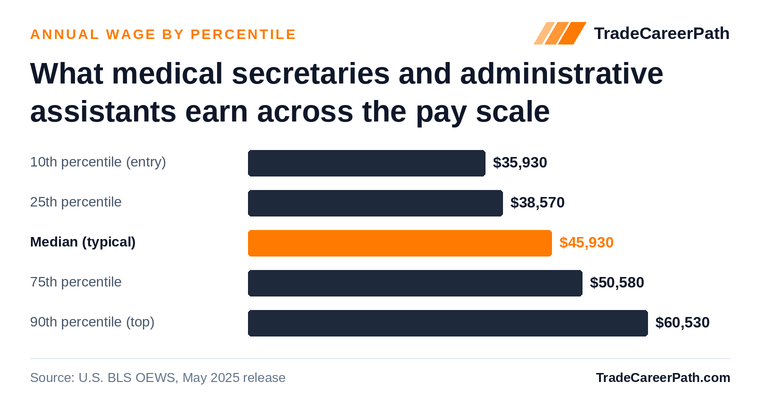
Quick answer: Training as a medical office administrator usually takes 6 to 18 months. You complete a certificate ($3,500 to $12,000) or an associate degree, get hands-on experience through an externship or front-office job, and can earn an optional certification such as the Certified Medical Administrative Assistant (CMAA). No state license is required for most roles. The median salary is $45,930 per year ($22.08/hour), and there are about 85,900 openings nationwide each year (BLS, May 2025).
Medical office administrators handle scheduling, billing, records, and communication in clinics, hospitals, and private practices. They keep the front office organized so medical teams can focus on patients, making this a fast way into healthcare without direct clinical work.
How to Become a Medical Office Administrator
Most people enter this field in about 6 to 18 months, depending on whether they choose a certificate or a degree. There is no single licensing exam to pass. Instead, you build the career through training, hands-on experience, and an optional certification.
1. Earn a high school diploma or GED
A high school diploma or GED is the minimum requirement for almost every medical office administration program and front-office job. Before you enroll, it helps to build the skills the work depends on. Communication and writing classes prepare you for handling patient calls, correspondence, and documentation. Computer applications and keyboarding matter a great deal, since the job runs on scheduling software, billing systems, and electronic health records. Business or accounting classes give you a head start on the billing and insurance side of the role. If you are changing careers and already hold a diploma or another degree, you can move straight to the next step. Many strong administrators come from retail, customer service, or general office backgrounds and bring useful skills in organization, multitasking, and working with people.
2. Complete a medical office administration program
This is the core credential, and you have a few formats to choose from. Certificate programs take about 6 to 12 months and suit people who want to enter the field quickly. Associate degree programs take about 2 years and combine general-education credits with administrative coursework, which can help with promotion later. Typical coursework covers medical terminology, health insurance and billing, medical office procedures, medical law and ethics, and electronic health records (EHR). Many programs are available fully or partly online, which lets working students learn at a flexible pace. When comparing schools, look at accreditation and whether the program includes an externship, since hands-on placement is one of the most useful parts of training. Confirm a program's accreditation before you enroll so your credits and certificate carry weight with employers.
3. Get hands-on experience
Coursework prepares you, but employers want to see real experience. Many certificate and associate programs build an externship into the curriculum, placing you in a clinic or hospital front office so you can practice scheduling appointments, verifying insurance, posting charges, and managing patient records under supervision. If a formal externship is not available, an entry-level role such as front-desk receptionist, scheduler, or file clerk gets you inside a medical office where you can learn the daily workflow and earn references. Pay attention to how a real office handles patient privacy under HIPAA, insurance claim submission, and the electronic health record system, because hiring managers value applicants who already understand those systems. The contacts and references you build during this step often lead directly to your first full-time job.
4. Earn optional certification
Certification is voluntary in most roles, but it can strengthen your resume and help you stand out, especially if you have limited experience. Common credentials in this field include the Certified Medical Administrative Assistant (CMAA) and the Certified Electronic Health Records Specialist (CEHRS), both offered through the National Healthcareer Association (NHA), and the Certified Medical Reimbursement Specialist (CMRS) for those who focus on billing. Eligibility usually depends on completing a training program, and each exam tests practical knowledge of office procedures, billing, records, or privacy rules. Exam fees generally run about $125 to $200. Decide which credential fits your goals: CMAA is broad and front-office focused, CEHRS centers on records systems, and CMRS leans toward billing and reimbursement work.
5. Apply for medical office jobs
Clinics, hospitals, dental and specialty practices, outpatient centers, and insurance companies all hire administrative staff. Tailor your resume to the setting you are targeting and highlight accuracy, professionalism, and your comfort with scheduling, billing, and EHR software. List any externship, certification, and specific systems you have used, since employers often screen for hands-on familiarity. Networking through your program, instructors, and externship site is one of the fastest ways to hear about openings. Once you land a role, on-the-job experience and any certifications you hold can open the door to senior front-office, billing coordinator, and office manager positions over time.
What Medical Office Administrators Do
Medical office administrators manage the business and administrative functions that keep healthcare facilities running. They handle the scheduling, billing, and records work that lets physicians and nurses focus on patient care. Their work keeps the office organized, compliant, and able to get paid for the care it provides.
Common Responsibilities
- Schedule patient appointments
- Maintain electronic health records (EHR)
- Process insurance claims and billing
- Handle office communication and correspondence
- Manage patient data and privacy compliance (HIPAA)
- Support physicians and nursing staff with administrative tasks
Medical office administrators connect patients, staff, and insurers, keeping daily operations on track.
Key Skills and Qualities
- Strong organization and multitasking
- Communication and customer service
- Attention to detail and accuracy
- Basic medical terminology knowledge
- Computer and EHR software skills
- Professionalism and confidentiality
Work Settings
Medical office administrators work in a wide range of healthcare environments:
- Physician offices and clinics
- Hospitals and outpatient centers
- Dental and chiropractic offices
- Insurance companies
- Long-term care and rehabilitation facilities
Education and Career Paths
| Pathway | Typical Duration | Outcome |
|---|---|---|
| Certificate | 6 to 12 months | Entry-level administrative employment |
| Associate Degree | 2 years | Advanced roles and promotion potential |
| Bachelor’s Degree | 4 years | Management and supervisory opportunities |
Career Growth and Advancement
With experience, you can move into roles like:
- Medical Office Manager
- Health Information Specialist
- Billing or Insurance Coordinator
- Healthcare Administrator
Cost and Duration of Training
- Program cost: about varies by school, format and location depending on format and school
- Time to complete: 6 to 18 months
- Certification exam fees: generally around $125 to $200
Many programs offer online learning options that fit around full-time work schedules.
Pros and Cons
Pros
- Stable, in-demand healthcare role
- Flexible training options
- Steady pay without clinical work
- Transferable administrative skills
Cons
- Requires multitasking under pressure
- Mostly desk-based work
- Dealing with insurance paperwork and deadlines
Licensing and Certification
Medical office administrators generally do not need a state license, but employers often prefer applicants who hold a nationally recognized certification such as the CMAA or CEHRS.
Take the Next Step Toward a Medical Office Career
If you are organized, tech-savvy, and ready to work in healthcare without direct patient care, medical office administration could be a strong fit.
Find Medical Office Administration Programs Near You
Quick Facts: Medical Office Administrator Salary, Education, and Outlook
Wage and Employment Charts
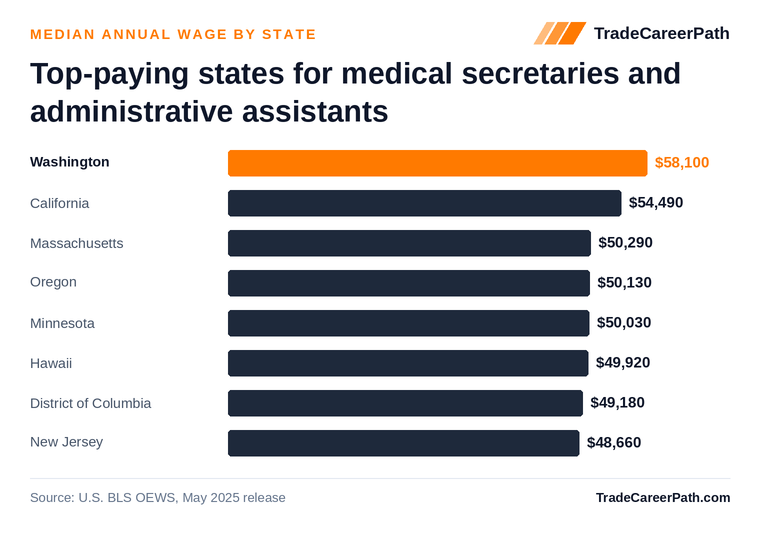
Medical Office Administrator Salary and Requirements by State
Select your state for local wage data, training options, and requirements:
Alabama · Alaska · Arizona · Arkansas · California · Colorado · Connecticut · Delaware · District of Columbia · Florida · Georgia · Hawaii · Idaho · Illinois · Indiana · Iowa · Kansas · Kentucky · Louisiana · Maine · Maryland · Massachusetts · Michigan · Minnesota · Mississippi · Missouri · Montana · Nebraska · Nevada · New Hampshire · New Jersey · New Mexico · New York · North Carolina · North Dakota · Ohio · Oklahoma · Oregon · Pennsylvania · Rhode Island · South Carolina · South Dakota · Tennessee · Texas · Utah · Vermont · Virginia · Washington · West Virginia · Wisconsin · Wyoming
Workplace Safety Snapshot
BLS Survey of Occupational Injuries and Illnesses data (2023-2024) report approximately 22.2 days-away, restricted, or transfer cases per 10,000 full-time-equivalent workers in medical secretaries and administrative assistants (about 0.22 per 100 FTE). Source: BLS Survey of Occupational Injuries and Illnesses, Table R98.
Frequently Asked Questions
How long does medical office administrator training take?
It typically takes 6 to 18 months of training. The most common entry path is a certificate program (about 6 to 12 months) or an associate degree (about 2 years). A high school diploma or GED is generally required to get started.
How much does medical office administration training cost?
Programs typically cost about $3,500 to $12,000 depending on the format and school, with certificate programs generally costing less than degree programs. Optional certification exams usually add a fee of roughly $125 to $200.
Do you need a college degree to work as a medical office administrator?
No. A college degree is not required. Most people enter the field through a certificate or associate degree program. A high school diploma or GED is typically the only educational prerequisite.
Is certification required for medical office administrators?
In most states, certification is voluntary rather than legally required. Credentials such as the Certified Medical Administrative Assistant (CMAA) or Certified Electronic Health Records Specialist (CEHRS) can strengthen your resume and help with hiring, but employers do not always require them.
Is it hard to train as a medical office administrator?
Entry is relatively accessible because no clinical training or license is required, and most people finish training in 6 to 18 months. The job itself can be demanding, with a steady mix of scheduling, billing, and records work under deadlines and patient privacy rules.
Can you study medical office administration online?
Yes. Many colleges and career schools offer medical office administration certificate and associate degree programs fully or partly online. Before enrolling, confirm the program's accreditation and whether it includes a hands-on externship.
How many medical office administrators work in the United States?
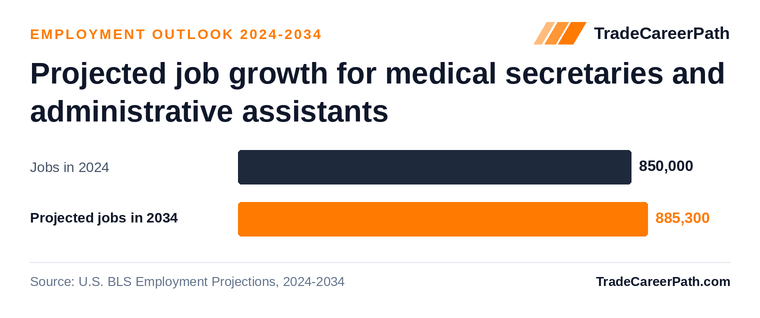
BLS reports approximately 961,610 medical secretaries and administrative assistants employed nationwide as of May 2025, with a median wage of $45,930 per year.
How Medical Office Administration Pay Compares to Similar Trades
Side-by-side comparison of Medical Office Administration and the closest related careers, based on U.S. Bureau of Labor Statistics data (May 2025 OEWS + 2024-2034 Employment Projections).
| Career | Median Pay | 10-Year Growth | Annual Openings |
|---|---|---|---|
| Medical Office Administration this guide | $45,930 | +4.2% | 85,900 |
| Medical Billing & Coding | $51,140 | +7.1% | 14,200 |
| Medical Biller | $51,140 | +7.1% | 14,200 |
| Medical Coder | $51,140 | +7.1% | 14,200 |
| Medical Assistant | $45,690 | +12.5% | 112,300 |
Source: BLS Occupational Employment and Wage Statistics + BLS Employment Projections.
Sources
- U.S. Bureau of Labor Statistics, Occupational Employment and Wage Statistics (May 2025)
- U.S. Bureau of Labor Statistics, Employment Projections 2024-2034
- U.S. Bureau of Labor Statistics, Survey of Occupational Injuries and Illnesses (2023-2024, Table R98)
- U.S. Department of Labor, Wage and Hour Division, Davis-Bacon General Wage Determinations (2026)
Medical Office Administration Salary by State
About this guide: Researched and written by the TradeCareerPath Editorial Team. Our editorial team researches and sources every trade school and career guide using federal labor and education data, including BLS OEWS and Employment Projections, DOL apprenticeship records, IPEDS, College Scorecard, and state licensing boards. We follow the editorial standards documented at /editorial-policy/.
Data sources
Figures on this page are sourced from the federal and state datasets below. Methodology: how we rank and source data.
| Data | Provider | Vintage |
|---|---|---|
| Occupational Employment and Wage Statistics (OEWS) | U.S. Bureau of Labor Statistics | May 2025 |
| Employment Projections | U.S. Bureau of Labor Statistics | 2024-2034 |
| Integrated Postsecondary Education Data System | National Center for Education Statistics (IPEDS) | 2024 |
| College Scorecard (school-level outcomes) | U.S. Department of Education | latest release |
| College Scorecard (field-of-study earnings) | U.S. Department of Education | latest release (updated 2026-06-12) |
| Occupational licensing requirements | CareerOneStop (U.S. Department of Labor) | latest release (updated 2026-02-22) |
| Registered apprenticeship programs | CareerOneStop / Apprenticeship.gov (U.S. Department of Labor) | latest release (updated 2025-10-25) |
| O*NET occupation profiles (skills, tasks, tools, job zones) | U.S. Department of Labor (O*NET / Employment & Training Admin.) | O*NET 29.1 (updated 2026-06-13) |