
How to Become a Mental Health Technician in 2026
Is Mental Health Technician Right for You?
The U.S. Department of Labor's O*NET profile for Psychiatric Technicians (SOC 29-2053) describes the work this way: Care for individuals with mental or emotional conditions or disabilities, following the instructions of physicians or other health practitioners. Monitor patients' physical and emotional well-being and report to medical staff. May participate in rehabilitation and treatment programs, help with personal hygiene, and administer oral or injectable medications.
What the work involves
- Provide nursing, psychiatric, or personal care to patients with cognitive, intellectual, or developmental disabilities.
- Encourage patients to develop work skills and to participate in social, recreational, or other therapeutic activities that enhance interpersonal skills or develop social relationships.
- Restrain violent, potentially violent, or suicidal patients by verbal or physical means as required.
- Lead prescribed individual or group therapy sessions as part of specific therapeutic procedures.
- Monitor patients' physical and emotional well-being and report unusual behavior or physical ailments to medical staff.
Skills and knowledge that matter
Skills: Social Perceptiveness, Monitoring, Active Listening, Speaking, Coordination, Reading Comprehension.
Knowledge: Psychology, Therapy and Counseling, English Language, Customer and Personal Service.
Tools and technology you may use
Tools: Bag valve mask BVM resuscitators, Blood drawing syringes, Blood pressure cuffs, Cold therapy equipment, Crutches, Desktop computers.
Technology: Medical software, Inventory management software, Spreadsheet software, Microsoft Excel, Microsoft Office software, Microsoft Outlook.
Typical preparation
O*NET Job Zone Three (Medium Preparation Needed). Most occupations in this zone require training in vocational schools, related on-the-job experience, or an associate's degree. Employees in these occupations usually need one or two years of training involving both on-the-job experience and informal training with experienced workers. A recognized apprenticeship program may be associated with these occupations.
Interest fit
O*NET interest profile: Social, Investigative, Conventional. People who enjoy working with, helping, and teaching other people often find this occupation a good fit.
Source: O*NET 29.1 (updated 2026-06-13)
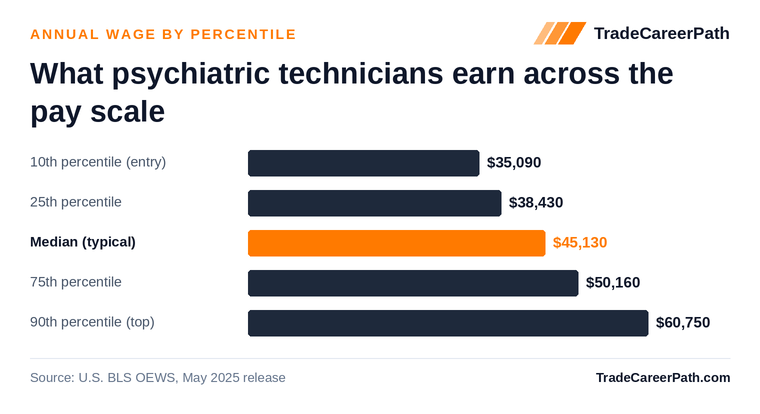
Quick answer: Training as a mental health technician usually takes 6 months to 2 years. You finish a certificate or associate degree program ($3,000 to $10,000), build hands-on skills through a supervised practicum or paid on-the-job training, and can earn an optional credential such as the National Certified Psychiatric Technician (NCPT) from the AAPT. Most states do not require a license. The median mental health technician salary is $45,130 per year ($21.70/hour), and employers post about 15,900 openings nationwide each year (BLS, May 2025).
Mental health technicians, also called psychiatric technicians or behavioral health aides, support people living with mental illness, developmental disabilities, or substance use disorders. They work under nurses, psychiatrists, and psychologists to observe patients, help with daily care, and keep treatment plans on track. If you are patient, steady under pressure, and want to help people through hard days, this is a direct path into health care without years of schooling.
How to Become a Mental Health Technician
Most people enter this field in about 6 months to 2 years, depending on the education path they choose. There is no single national license. Instead, you build the career through training, supervised clinical experience, and an optional certification.
1. Earn a High School Diploma or GED
A high school diploma or GED is the minimum requirement for every mental health technician program and almost every entry-level role. Before you enroll, it helps to take classes that prepare you for patient care: psychology, biology and health science, and any course that builds clear writing and communication. You will spend a lot of the job observing behavior and documenting it accurately, so practice in note-taking and plain, precise writing pays off. Comfort with basic computers and electronic record systems matters too, since most facilities chart on software. If you are changing careers and already hold a diploma or a degree in another field, you can move straight to the next step. Many strong technicians come from unrelated backgrounds and bring useful skills in communication, patience, and staying calm during stressful situations.
2. Complete a Mental Health or Psychiatric Technician Program
This is the core credential, and you have a few formats to choose from. A certificate program takes roughly 6 to 12 months and is popular with people who want to enter the field quickly. An associate degree takes about 2 years, combines general-education credits with clinical coursework, and can open the door to advancement. A bachelor's degree takes about 4 years and helps with supervisory or specialized roles. Typical coursework covers abnormal psychology, therapeutic communication, crisis intervention and de-escalation, pharmacology basics, and patient care and safety. Many programs deliver lecture content online, but the clinical hours happen in person at a hospital or treatment center. When comparing schools, confirm the program is accredited and ask how it arranges the supervised practicum, since that hands-on time is what employers look for first.
3. Gain Supervised Clinical Experience
Coursework prepares you, but employers want to see real experience with patients. Most programs build in a supervised practicum at a psychiatric hospital, behavioral health unit, or residential facility, where you practice observing and documenting behavior, assisting with daily living activities, supporting group activities, and de-escalating crises safely under the direction of nurses or licensed staff. If a formal practicum is not available, entry-level roles such as behavioral health aide, mental health associate, or patient care technician get you inside a facility where you can learn the workflow and earn references. Pay attention to the routines that keep units safe: handoffs between shifts, accurate charting, and clear communication with the clinical team. This is also where many employers offer paid on-the-job training, so you can build skills while you earn.
4. Consider Professional Certification
Certification is voluntary in most states, but it can strengthen your resume, signal commitment, and support higher pay. The most recognized credential comes from the American Association of Psychiatric Technicians (AAPT), which issues the National Certified Psychiatric Technician (NCPT) credential. Eligibility generally depends on a mix of education and work experience, and the exam covers patient care, ethics, and the practical knowledge the job requires. Certification exam fees typically run about $125 to $250. Some states also set their own rules, such as registration with a health board or a state-specific exam, before you can work independently. Check your state's requirements and your employer's policies, because the path that makes the most sense often depends on where you plan to work.
5. Apply for Mental Health Technician Roles
Psychiatric hospitals, behavioral health centers, substance abuse treatment facilities, residential and group homes, correctional facilities, and community clinics all hire mental health technicians. Tailor your resume to the setting you are targeting and lead with the clinical experience you built during your practicum or entry-level job. Highlight concrete skills employers screen for: patient observation and documentation, de-escalation, teamwork, and dependability across shifts. Because this is shift-based work, flexibility with evenings, nights, and weekends can make you a stronger candidate. Once you land a role, on-the-job experience and any certification you hold can open the door to senior technician, charge or lead positions, and specialized roles. Some technicians use the experience as a stepping stone toward nursing, counseling, or social work with further education.
What Mental Health Technicians Do
Mental health technicians work under the supervision of nurses, psychiatrists, or psychologists to provide care and monitor patients with mental health conditions. They are the steady, daily presence on a unit, watching for changes in behavior and helping patients move toward stability and recovery.
Common Responsibilities
- Observe and document patient behavior
- Assist with daily living activities (meals, hygiene, exercise)
- Administer medications under supervision
- Help implement treatment and therapy plans
- De-escalate crises safely and compassionately
- Support patient progress toward recovery goals
Skills and Qualities You’ll Need
- Emotional resilience and patience
- Active listening and communication skills
- Empathy and compassion
- Teamwork and professionalism
- Strong observational and record-keeping abilities
- Ability to handle stressful or emergency situations calmly
Where Mental Health Technicians Work
You’ll find opportunities in a range of care environments:
- Psychiatric hospitals and mental health facilities
- Substance abuse treatment centers
- Residential or group homes
- Correctional facilities
- Community health clinics
Education and Training Paths
| Pathway | Typical Duration | Outcome |
|---|---|---|
| Certificate | 6 to 12 months | Entry-level employment |
| Associate Degree | 2 years | Broader clinical training and advancement potential |
| Bachelor’s Degree | 4 years | Qualifies for supervisory or advanced roles |
Career Growth and Advancement
Experienced technicians can progress into specialized or supervisory roles such as:
- Behavioral Health Specialist
- Psychiatric Nurse Assistant
- Case Manager or Mental Health Coordinator
- Registered Nurse (RN) with additional education
Cost and Program Duration
- Program Cost: varies by school, format and location depending on program type
- Duration: 6 months to 2 years
- Certification Exam Fees: typically $125 to $250
Many programs are available online or through community colleges, though clinical hours are completed in person.
Pros and Cons
Pros
- Helping patients in psychiatric and residential settings
- Strong job stability and fast projected growth
- Short training period
- Opportunities to grow into nursing or counseling fields
Cons
- Can be emotionally demanding
- Shift work or overnight schedules
- Potential for stressful situations
Licensing and Requirements
Licensing requirements vary by state. Some states require technicians to pass an exam or register with a health board, while others accept voluntary certification such as the AAPT’s NCPT credential. Check your state’s rules and your employer’s policies before you apply.
Find Mental Health Technician Programs Near You
Quick Facts: Mental Health Technician Salary, Education, and Outlook

Industry Organizations & Certifying Bodies
These are the recognized national organizations, unions, certifying bodies, and regulatory authorities that shape this trade. They issue the credentials, sponsor the apprenticeships, publish the codes, and represent workers and employers.
- American Association of Psychiatric Technicians (AAPT) Issues the National Certified Psychiatric Technician (NCPT) credentials.
Wage and Employment Charts
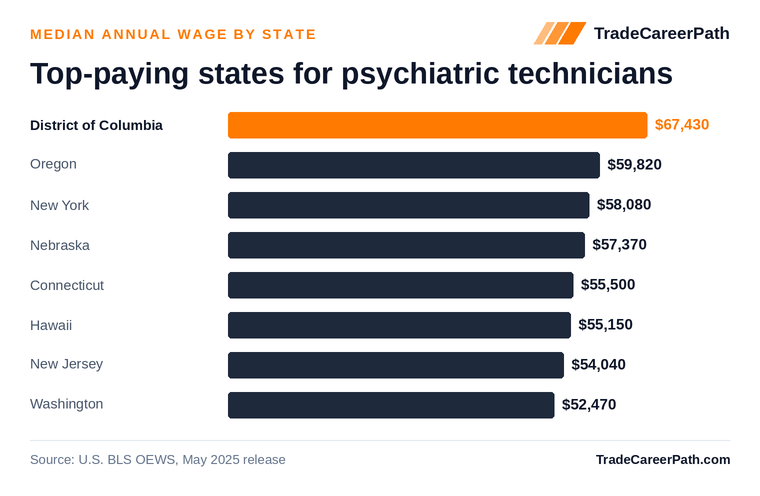
Mental Health Technician Salary and Requirements by State
Select your state for local wage data, training options, and requirements:
Alabama · Alaska · Arizona · Arkansas · California · Colorado · Connecticut · Delaware · District of Columbia · Florida · Georgia · Hawaii · Idaho · Illinois · Indiana · Iowa · Kansas · Kentucky · Louisiana · Maine · Maryland · Massachusetts · Michigan · Minnesota · Mississippi · Missouri · Montana · Nebraska · Nevada · New Hampshire · New Jersey · New Mexico · New York · North Carolina · North Dakota · Ohio · Oklahoma · Oregon · Pennsylvania · Rhode Island · South Carolina · South Dakota · Tennessee · Texas · Utah · Vermont · Virginia · Washington · West Virginia · Wisconsin · Wyoming
Workplace Safety Snapshot
BLS Survey of Occupational Injuries and Illnesses data (2023-2024) report approximately 735.0 days-away, restricted, or transfer cases per 10,000 full-time-equivalent workers in psychiatric technicians (about 7.35 per 100 FTE). Source: BLS Survey of Occupational Injuries and Illnesses, Table R98.
Frequently Asked Questions
How long does mental health tech training take?
It typically takes 6 months to 2 years of training. The most common entry path is a certificate program (about 6 to 12 months) or an associate degree (about 2 years). A high school diploma or GED is generally required to get started.
Do you need a college degree to work as a mental health tech?
No. A college degree is not required to work as a mental health tech. Most people enter the field through a certificate or associate degree program. A high school diploma or GED is typically the only educational prerequisite.
How much does mental health tech training cost?
Mental health technician programs typically cost about $3,000 to $10,000 depending on the format and school, with certificate programs generally costing less than degree programs. Optional certification exam fees usually add roughly $125 to $250.
Is certification required to work as a mental health tech?
In most states certification is voluntary rather than legally required. The American Association of Psychiatric Technicians (AAPT) offers the National Certified Psychiatric Technician (NCPT) credential, which can strengthen your resume and pay. A few states set their own registration or exam rules, so check your state's requirements before you apply.
How much do mental health technicians earn?
The median mental health technician wage is $45,130 per year, or about $21.70 per hour (BLS, May 2025). The lowest 10 percent earn around $35,090 and the highest 10 percent earn around $60,750, with pay varying by employer, setting, and state.
Is mental health technician a growing career?
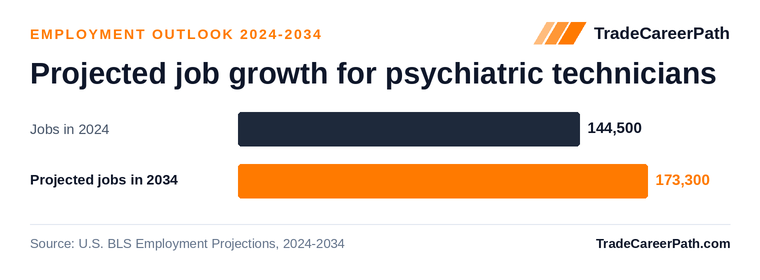
Yes. BLS projects 20.0 percent employment growth for psychiatric technicians between 2024 and 2034, classified as much faster than average. Employers post about 15,900 openings nationwide each year over that period.
Can you train as a mental health tech online?
Many programs offer classroom coursework online, but the field requires hands-on clinical or supervised practice that happens in person. Look for programs that pair online instruction with a local practicum or arrange on-the-job training with an employer.
How Mental Health Tech Pay Compares to Similar Trades
Side-by-side comparison of Mental Health Technician and the closest related careers, based on U.S. Bureau of Labor Statistics data (May 2025 OEWS + 2024-2034 Employment Projections).
| Career | Median Pay | 10-Year Growth | Annual Openings |
|---|---|---|---|
| Mental Health Technician this guide | $45,130 | +20.0% | 15,900 |
| Patient Care Technician | $42,260 | +2.3% | 204,100 |
| Occupational Therapy Assistant | $72,300 | +19.2% | 7,200 |
| Medical Assistant | $45,690 | +12.5% | 112,300 |
Source: BLS Occupational Employment and Wage Statistics + BLS Employment Projections.
Advance Your Career with a Degree
Experienced Mental Health Technician professionals often step up into degree-track careers where field experience is a hiring advantage:
- Substance Abuse Counselor - median pay $59,350 (BLS OEWS, May 2025); requires a 4-year degree
See all trade careers that require a 4-year degree.
Degree and Program Guides
- Online Counseling Degrees - the degree route into licensed behavioral health work
Degree and Program Guides
- Online Social Work Degrees - the BSW/MSW licensure ladder
Sources
- U.S. Bureau of Labor Statistics, Occupational Employment and Wage Statistics (May 2025)
- U.S. Bureau of Labor Statistics, Employment Projections 2024-2034
- U.S. Bureau of Labor Statistics, Survey of Occupational Injuries and Illnesses (2023-2024, Table R98)
- U.S. Department of Labor, Wage and Hour Division, Davis-Bacon General Wage Determinations (2026)
Mental Health Tech Salary by State
About this guide: Researched and written by the TradeCareerPath Editorial Team. Our editorial team researches and sources every trade school and career guide using federal labor and education data, including BLS OEWS and Employment Projections, DOL apprenticeship records, IPEDS, College Scorecard, and state licensing boards. We follow the editorial standards documented at /editorial-policy/.
Data sources
Figures on this page are sourced from the federal and state datasets below. Methodology: how we rank and source data.
| Data | Provider | Vintage |
|---|---|---|
| Occupational Employment and Wage Statistics (OEWS) | U.S. Bureau of Labor Statistics | May 2025 |
| Employment Projections | U.S. Bureau of Labor Statistics | 2024-2034 |
| Integrated Postsecondary Education Data System | National Center for Education Statistics (IPEDS) | 2024 |
| College Scorecard (school-level outcomes) | U.S. Department of Education | latest release |
| College Scorecard (field-of-study earnings) | U.S. Department of Education | latest release (updated 2026-06-12) |
| Occupational licensing requirements | CareerOneStop (U.S. Department of Labor) | latest release (updated 2026-02-22) |
| Registered apprenticeship programs | CareerOneStop / Apprenticeship.gov (U.S. Department of Labor) | latest release (updated 2025-10-25) |
| O*NET occupation profiles (skills, tasks, tools, job zones) | U.S. Department of Labor (O*NET / Employment & Training Admin.) | O*NET 29.1 (updated 2026-06-13) |