
How to Become a Mining Engineer in 2026
Is Mining Engineer Right for You?
The U.S. Department of Labor's O*NET profile for Mining and Geological Engineers, Including Mining Safety Engineers (SOC 17-2151) describes the work this way: Conduct subsurface surveys to identify the characteristics of potential land or mining development sites. May specify the ground support systems, processes, and equipment for safe, economical, and environmentally sound extraction or underground construction activities. May inspect areas for unsafe geological conditions, equipment, and working conditions. May design, implement, and coordinate mine safety programs.
What the work involves
- Prepare technical reports for use by mining, engineering, and management personnel.
- Inspect mining areas for unsafe structures, equipment, and working conditions.
- Select or develop mineral location, extraction, and production methods, based on factors such as safety, cost, and deposit characteristics.
- Select locations and plan underground or surface mining operations, specifying processes, labor usage, and equipment that will result in safe, economical, and environmentally sound extraction of minerals and ores.
- Prepare schedules, reports, and estimates of the costs involved in developing and operating mines.
Skills and knowledge that matter
Skills: Complex Problem Solving, Writing, Speaking, Reading Comprehension, Judgment and Decision Making, Critical Thinking.
Knowledge: Engineering and Technology, Mathematics, English Language, Production and Processing.
Tools and technology you may use
Tools: Clinometers, Color plotting printers, Combustible gas detectors, Computer scanners, Desktop computers, Digital plotters.
Technology: Computer aided design CAD software, Office suite software, Network security or virtual private network VPN management software, Autodesk AutoCAD, Autodesk AutoCAD Civil 3D, Microsoft Access.
Typical preparation
O*NET Job Zone Four (Considerable Preparation Needed). Most of these occupations require a four-year bachelor's degree, but some do not. Employees in these occupations usually need several years of work-related experience, on-the-job training, and/or vocational training.
Interest fit
O*NET interest profile: Realistic, Investigative, Conventional. People who enjoy hands-on, practical work with tools, machines, plants, or materials often find this occupation a good fit.
Source: O*NET 29.1 (updated 2026-06-13)
Quick answer: Training as a mining and geological engineer requires a 4-year degree - typically an ABET-accredited bachelor’s in mining or geological engineering. The national median pay is $106,220 per year, and BLS projects +0.7% employment change from 2024 to 2034 (BLS OEWS, May 2025; BLS Employment Projections, 2024-34).
Mining Engineer at a Glance
| Metric | Detail | Source |
|---|---|---|
| Median annual wage | $106,220 | BLS OEWS, May 2025 |
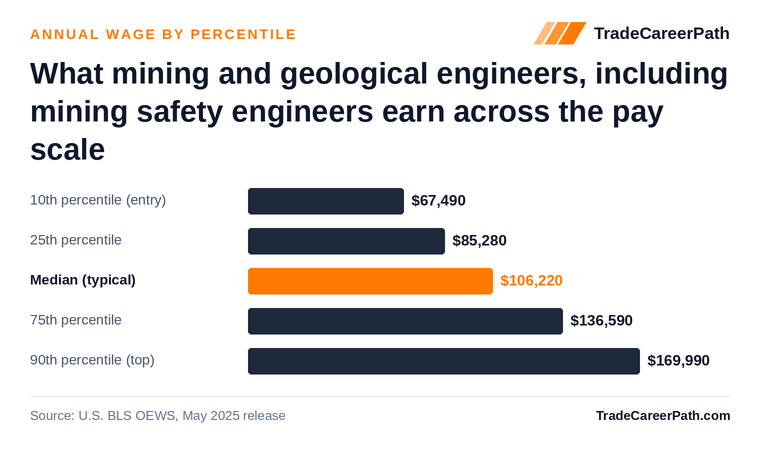
| Typical wage range | $67,490 (10th pct) - $169,990 (90th pct) | BLS OEWS, May 2025 |
| Employment | 6,080 nationwide | BLS OEWS, May 2025 |
| Projected growth (2024-34) | +0.7%, about 400 openings per year | BLS Employment Projections, 2024-34 |
| Typical education | ABET-accredited bachelor’s in mining or geological engineering | BLS Occupational Outlook Handbook |
| License / certification | PE license common for senior and consulting roles | State licensing boards |
What Does a Mining Engineer Do?
Mining engineers design mines and quarries and keep them producing safely: they own the blast plans, ventilation systems, ground control, haulage layouts, and reclamation plans behind the extraction work that drillers, blasters, and heavy-equipment operators actually perform.
Day to day, the work splits by sub-specialty. A mine planning engineer builds and updates the pit or panel design in software, sequences the ore body, and reconciles what the survey data says was actually mined against the plan. A drill-and-blast engineer designs shot patterns, powder factors, and timing, then walks the muck pile to see whether fragmentation matched the design - and adjusts when it did not. A ventilation engineer models airflow underground, sizes fans and regulators, and signs off on gas and dust compliance. A geotechnical or ground-control engineer maps rock structure, specifies bolting and support patterns, and makes the call when a highwall or back starts moving. Mining safety engineers sit closest to the regulator: MSHA compliance, incident investigation, and the paperwork that keeps a mine’s permit alive. Almost all of it is documented and reviewed, because in this industry an engineering mistake is measured in injuries and citations, not just cost.
If you are coming from mining, blasting, or operating iron, the shortest way to say it: the operator executes the plan; the engineer writes it and answers for it. The blast you loaded, the ramp grade you hauled, the ground support you installed - deciding what those should be becomes your job. That pit-and-underground judgment is exactly what mining programs cannot teach a 19-year-old, and it is why operations actively recruit degree-holders who have worked the face.
Skills That Make a Great Mining Engineer
- Mine planning and design
- Blast design and vibration control
- Ventilation engineering
- Ground control and rock mechanics
- MSHA regulatory fluency
- Mine planning and modeling software (Deswik, Vulcan, Surpac) plus strong spreadsheet skills
- Surveying and geology fundamentals - reading the ore body drives every other decision
- Writing: ground-control plans, ventilation plans, and permit documents carry the job
Mining Engineer Salary
Mining engineering pays like the specialized field it is. The national median is $106,220 per year, and the mean is higher still at $115,410 - a sign that the top of the field pulls hard. Even the 10th percentile, roughly where new graduates start, is $67,490, and the 90th percentile reaches $169,990 (BLS OEWS, May 2025). For an experienced miner or operator, the degree is the difference between topping out at operator pay and starting a ladder that runs well past it.
Where the Jobs and the Money Are
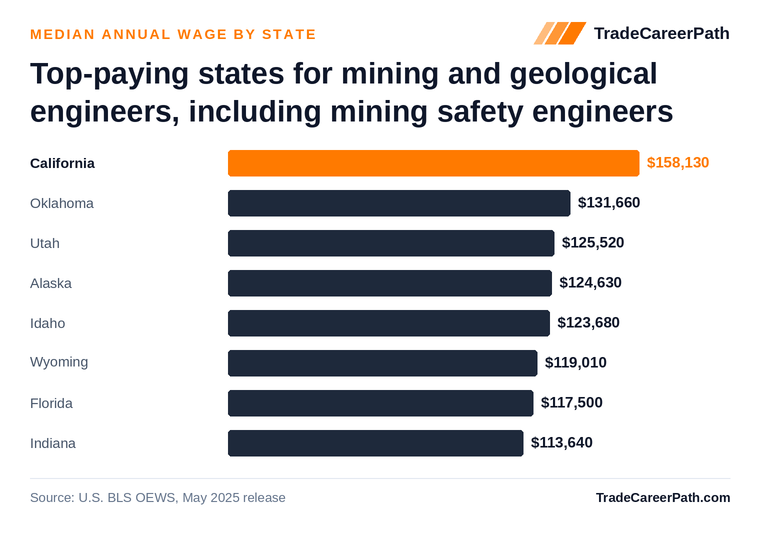
Mining engineering goes where the ore is. The biggest employment clusters are Arizona’s copper belt (690 engineers, median $102,130) and Colorado (670 engineers, median $96,820), with California third at 520 - though California’s jobs skew toward aggregates, consulting, and regulatory work rather than hardrock mines (BLS OEWS, May 2025).
| State | Median annual wage | Employment |
|---|---|---|
| California | $158,130 | 520 |
| Oklahoma | $131,660 | 90 |
| Utah | $125,520 | 230 |
| Alaska | $124,630 | 300 |
| Idaho | $123,680 | 110 |
The concentration numbers tell the real story. In Alaska, mining engineers are about 23 times as common in the workforce as in the average state labor market - remote-site premiums and rotation schedules push pay to a $124,630 median. Utah and Idaho run more than three times the national concentration, and Arizona and Colorado more than five times: those are the states where you can change employers without changing your address. BLS publishes state data for 28 states in this occupation; in the rest, the jobs are scattered across individual quarries and consulting offices.
How to Become a Mining Engineer
1. Earn an ABET-accredited bachelor’s
Mining engineering or geological engineering - a handful of specialized programs nationally. Accreditation is the one non-negotiable: employers screen for it, and the FE/PE licensure path assumes it. Because so few schools offer the mining degree, look hard at distance and hybrid options built for working miners, and at geological engineering programs, which feed the same occupation and sometimes fit a work schedule better. Get a written transfer evaluation before you enroll anywhere.
2. Use mine experience
MSHA-experienced candidates with operator backgrounds are actively recruited. Say so explicitly on applications: years at the face, on a blast crew, or in a haul truck read as proof you understand ground conditions, equipment cycles, and mine culture - things most new graduates have only seen on a senior-design field trip. Some schools grant credit for MSHA training and industry coursework, which shortens the degree.
3. Start as a mine or planning engineer
Coal, metals, aggregates, and industrial-minerals operations hire at the bachelor’s level. The classic first seats are pit or underground planning engineer, drill-and-blast engineer, and ventilation engineer-in-training - jobs where a former operator’s instincts show up immediately. Aggregates and industrial minerals are the overlooked entry point: quarries exist in nearly every state, so you do not have to move to a metals district to start.
4. Pursue the PE
Standard for senior, consulting, and regulatory sign-off roles. Sit for the Fundamentals of Engineering (FE) exam as a senior or soon after graduating - it is far easier while the coursework is fresh. After four years of qualifying experience you can take the PE exam (mining and mineral processing is its own PE discipline) through your state board. Permit applications, reclamation plans, and impoundment designs frequently require a licensed engineer’s stamp, so the PE is what unlocks consulting and chief-engineer work.
5. Advance
Chief engineer, mine management, or consulting. The fork comes with experience: stay technical and work as the site’s chief engineer or a specialist consultant in ventilation or geotechnics, or cross to the operations side as mine superintendent and mine manager - a track where a degree plus real operating experience is the whole qualification.
Career Ladder: Titles and Realistic Pay
The BLS wage percentiles map cleanly onto how mine-site careers actually progress. Use this as a sanity check on offers, not a guarantee:
| Stage | Typical titles | Years in | Realistic pay (BLS OEWS, May 2025) |
|---|---|---|---|
| Entry level | Engineer-in-training, junior mine/planning engineer | 0-3 | ~$67,490-$85,280 (10th-25th pct) |
| Mid-career | Mine engineer, drill-and-blast or ventilation engineer | 3-10 | ~$106,220 (median) |
| Senior | Senior/principal engineer, technical services lead | 10-15 | ~$136,590 (75th pct) |
| Chief / management | Chief engineer, mine manager, consultant (PE) | 15+ | $169,990+ (90th pct) |
Two notes for career changers. First, prior mine experience compresses this ladder: former operators and blasters are routinely hired above the bottom of the entry band because they need no introduction to the pit and already hold MSHA experience. Second, the base-wage data understates senior mining pay - remote-site rotation premiums, production bonuses, and camp allowances at metals operations often push total compensation well above the figures shown here.
Do You Need a PE License?
Not on day one - but in mining, more than in most manufacturing-side engineering fields, the PE eventually matters. Mine-site engineers early in their careers work under their employer’s responsibility, and no state requires a license just to hold the job. The license becomes the gate at three points:
- Regulatory sign-off: permit applications, reclamation plans, tailings and impoundment designs, and some ground-control submittals require a licensed professional engineer’s stamp.
- Consulting: independent practice legally requires the PE in every state.
- Seniority: chief engineer and technical-services postings commonly list the PE as required or strongly preferred.
The path is the standard one: ABET degree, pass the FE exam (take it as a senior), four years of qualifying experience under supervision, then the PE exam - mining and mineral processing is a dedicated PE discipline. Alongside the license, MSHA certifications and, for blasting-heavy roles, a state blaster’s license round out the credential stack; requirements vary by state, so check your board’s rules.
Why an Online Degree Works for This Career
Miners, blasters, and heavy-equipment operators bring exactly the pit-and-underground judgment this degree formalizes. The occupation is small and BLS projects roughly flat employment - but mining schools graduate few engineers, employers report persistent shortages, and pay for experienced-hand engineers reflects it. Several mining programs run distance and hybrid tracks specifically for working mine employees, and operator tuition assistance is common at the larger coal, metals, and aggregates companies - many working miners finish the degree without giving up their job or their seniority.
Job Outlook for 2026 and Beyond
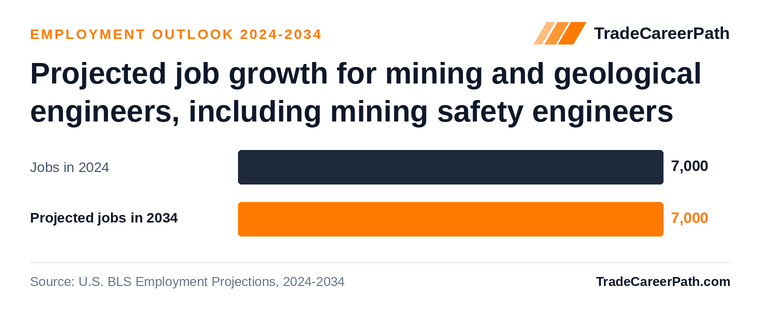
BLS projects employment of mining and geological engineers to change by +0.7% from 2024 to 2034 - holding at about 7,000 jobs - with roughly 400 openings per year once retirements and occupation changes are counted (BLS Employment Projections, 2024-34). The latest wage data (OEWS, May 2025) puts the median at $106,220, up from the 2024 figure of $101,020 - real wage movement in a field where headcount is flat, which is what a supply shortage looks like.
Read those numbers the right way. Flat growth in a 6,080-person occupation sounds bad until you weigh it against how few mining engineers U.S. schools produce each year. The 400 annual openings are driven heavily by retirements in a field with an aging workforce, and employers consistently favor candidates who already know mines - which is precisely the experienced-miner profile. Demand drivers are also shifting in the field’s favor: critical-minerals policy, copper for electrification, and aggregates for construction all need engineers, and every operating mine needs its ventilation, ground-control, and permit work stamped regardless of whether the industry grows.
Cost and Time to Complete the Degree
For mining engineers, the credential is: ABET-accredited bachelor’s in mining or geological engineering. A bachelor’s degree is typically 120 credit hours: four years full-time, and commonly five to six years part-time while working. Transfer credit is the other lever: prior college, military training, apprenticeship coursework, and industry certifications can be worth meaningful credit at transfer-friendly schools, so get a written transfer evaluation before enrolling anywhere. Costs vary widely by school type; in-state public online programs are usually the value benchmark, and employer tuition assistance is common for working adults in this field. Because so few schools offer the mining degree, compare their distance options directly - the handful of programs that serve working miners know exactly how to handle rotation schedules and transfer credit.
Pros and Cons of Training as a Mining Engineer
Pros
- Median pay of $106,220 nationally (BLS OEWS, May 2025)
- Few graduates nationally - about 400 openings per year with little competition for experienced hands
- Field experience from the trades is a genuine hiring advantage
- Accredited online and hybrid degree paths exist for working adults
Cons
- Requires a 4-year degree (typically 120 credit hours)
- Entry-level pay starts near $67,490 at the 10th percentile
- Small occupation (6,080 jobs) concentrated in mining states - relocation is often part of the deal
- Licensing hurdle: PE license common for senior and consulting roles
Frequently Asked Questions
Is mining engineering worth it with flat job growth?
The occupation is small and BLS projects roughly flat employment - but few schools produce mining engineers, so experienced-miner graduates face little competition for six-figure roles. It is a supply-side story, not a demand-side one.
How much do mining engineers make?
The national median annual wage for mining and geological engineers, including mining safety engineers is $106,220 (BLS OEWS, May 2025). The top 10% earn $169,990 or more, while entry-level pay starts around $67,490.
What is the job outlook for mining engineers?
BLS projects employment of mining and geological engineers, including mining safety engineers to change by +0.7% from 2024 to 2034 (BLS Employment Projections, 2024-34).
How long does mining engineer training take?
The ABET-accredited bachelor's is 120 credit hours: four years full-time, commonly five to six years part-time while working. Transfer credit from prior college, military training, or MSHA and industry coursework can meaningfully shorten it at transfer-friendly schools.
Is mining engineering hard?
The degree is math- and geology-heavy - statics, rock mechanics, fluid mechanics, and mine ventilation are unavoidable. Working miners and operators usually find the practical courses far easier than fresh high-school graduates do, because blast behavior, ground conditions, and haulage cycles are things they have already seen underground or in the pit.
Should I get a mining or geological engineering degree?
Both feed the same job market - BLS groups them in one occupation. Mining engineering aims at mine planning, blasting, and ventilation; geological engineering leans toward site characterization, slope stability, and groundwater, and its graduates also work in geotechnical and environmental firms outside mining. Pick by which program you can actually attend while working - only a handful of schools offer either.
Can you train as a mining engineer without a degree?
Not with the engineer title - employers and state PE boards require the ABET-accredited bachelor's. Without it, the ceiling is senior operator, shift boss, or engineering technician. Mine experience shortens the path and makes you the candidate schools and employers want, but it does not replace the degree.
Do mining engineers need a PE license?
Not to start - most mine-site engineers work under their employer's responsibility. But the PE becomes the standard credential for senior, consulting, and regulatory sign-off work, and permit and reclamation documents often require a licensed engineer's stamp. The path: ABET degree, FE exam, four years of qualifying experience, then the PE exam.
Mining Engineer Salary and Requirements by State
Alabama · Alaska · Arizona · California · Colorado · Florida · Idaho · Illinois · Indiana · Kentucky · Michigan · Minnesota · Montana · Nevada · New York · North Carolina · Ohio · Oklahoma · Oregon · Pennsylvania · South Carolina · Tennessee · Texas · Utah · Virginia · West Virginia · Wisconsin · Wyoming
Related Careers and Degree Paths
- Geoscientist - the geology side of the same industry: exploration, ore-body modeling, and site characterization
- Petroleum Engineer - the other extraction-engineering path, with a similar small-field, high-pay profile
- Civil Engineer - geotechnical and earthworks overlap, with far more programs and job locations
- Health & Safety Engineer - the compliance-and-safety route that mining safety experience feeds directly
- Online Engineering Degrees for Tradespeople - how to pick an ABET program that fits a work schedule
Sources
- U.S. Bureau of Labor Statistics, Occupational Employment and Wage Statistics (OEWS), May 2025 - Mining and Geological Engineers, Including Mining Safety Engineers (SOC 17-2151)
- U.S. Bureau of Labor Statistics, Employment Projections, 2024-34
- U.S. Bureau of Labor Statistics, Occupational Outlook Handbook - education and licensing requirements
Mining Engineer Salary by State
About this guide: Researched and written by the TradeCareerPath Editorial Team. Our editorial team researches and sources every trade school and career guide using federal labor and education data, including BLS OEWS and Employment Projections, DOL apprenticeship records, IPEDS, College Scorecard, and state licensing boards. We follow the editorial standards documented at /editorial-policy/.
Data sources
Figures on this page are sourced from the federal and state datasets below. Methodology: how we rank and source data.
| Data | Provider | Vintage |
|---|---|---|
| Occupational Employment and Wage Statistics (OEWS) | U.S. Bureau of Labor Statistics | May 2025 |
| Employment Projections | U.S. Bureau of Labor Statistics | 2024-2034 |
| Integrated Postsecondary Education Data System | National Center for Education Statistics (IPEDS) | 2024 |
| College Scorecard (school-level outcomes) | U.S. Department of Education | latest release |
| College Scorecard (field-of-study earnings) | U.S. Department of Education | latest release (updated 2026-06-12) |
| Occupational licensing requirements | CareerOneStop (U.S. Department of Labor) | latest release (updated 2026-02-22) |
| Registered apprenticeship programs | CareerOneStop / Apprenticeship.gov (U.S. Department of Labor) | latest release (updated 2025-10-25) |
| O*NET occupation profiles (skills, tasks, tools, job zones) | U.S. Department of Labor (O*NET / Employment & Training Admin.) | O*NET 29.1 (updated 2026-06-13) |