
How to Become an MRI Technologist
Is MRI Technologist Right for You?
The U.S. Department of Labor's O*NET profile for Magnetic Resonance Imaging Technologists (SOC 29-2035) describes the work this way: Operate Magnetic Resonance Imaging (MRI) scanners. Monitor patient safety and comfort, and view images of area being scanned to ensure quality of pictures. May administer gadolinium contrast dosage intravenously. May interview patient, explain MRI procedures, and position patient on examining table. May enter into the computer data such as patient history, anatomical area to be scanned, orientation specified, and position of entry.
What the work involves
- Review physicians' orders to confirm prescribed exams.
- Conduct screening interviews of patients to identify contraindications, such as ferrous objects, pregnancy, prosthetic heart valves, cardiac pacemakers, or tattoos.
- Select appropriate imaging techniques or coils to produce required images.
- Operate magnetic resonance imaging (MRI) scanners.
- Provide headphones or earplugs to patients to improve comfort and reduce unpleasant noise.
Skills and knowledge that matter
Skills: Reading Comprehension, Active Listening, Monitoring, Speaking, Operations Monitoring, Critical Thinking.
Knowledge: Customer and Personal Service, English Language, Physics, Computers and Electronics.
Tools and technology you may use
Technology: Calendar and scheduling software, Medical software, Spreadsheet software, eClinicalWorks EHR software, MEDITECH software, Microsoft Excel.
Typical preparation
O*NET Job Zone Three (Medium Preparation Needed). Most occupations in this zone require training in vocational schools, related on-the-job experience, or an associate's degree. Employees in these occupations usually need one or two years of training involving both on-the-job experience and informal training with experienced workers. A recognized apprenticeship program may be associated with these occupations.
Interest fit
O*NET interest profile: Realistic, Conventional, Investigative. People who enjoy hands-on, practical work with tools, machines, plants, or materials often find this occupation a good fit.
Source: O*NET 31.0 (updated 2026-10-14)
MRI technologists operate advanced imaging equipment that helps doctors diagnose injuries and diseases.
Their work captures detailed internal body images that guide medical decisions every day.
If you enjoy technology, healthcare, and precision work that directly helps patients, training as an MRI technologist offers a meaningful and high-skill medical career.
Quick answers
- What does an MRI technologist do? MRI technologists use MRI scanners to capture diagnostic images. They focus on image quality while keeping patients safe and comfortable.
- Where do MRI technologists work? Common work settings include hospitals, imaging centers, outpatient clinics, physician offices, diagnostic laboratories, and mobile imaging units.
- What education is common for MRI technologists? Typical pathways include a certificate program (about 1 year) or an associate degree (about 2 years). A bachelor’s degree can support advanced imaging or management positions.
- Do MRI technologists need certification? Many employers require certification through ARRT or ARMRIT.
- How long does MRI technologist training take? Training commonly takes 1 to 2 years, depending on the program.
- How much does MRI technologist training cost? Program costs are listed as varies by school, format and location plus certification exam fees around $200 to $400.
At a glance
- Works with MRI scanners to produce diagnostic images
- Typical training: 1 to 2 years (certificate or associate degree)
- Common certifications: ARRT or ARMRIT
- Program cost: varies by school, format and location; exam fees: about $200 to $400
What MRI Technologists Do
MRI technologists use magnetic resonance imaging scanners to capture diagnostic images of the human body. They ensure accurate imaging while maintaining patient safety and comfort.
Typical Responsibilities
- Operate MRI scanners and adjust imaging parameters
- Screen patients for safety and explain procedures
- Position patients for imaging
- Collaborate with radiologists on scan quality
- Maintain and calibrate imaging equipment
- Follow strict radiation safety and privacy protocols
MRI technologists combine medical knowledge with technology to produce images that aid in accurate diagnoses.
Key Skills and Traits for Success
- Technical and mechanical aptitude
- Empathy and communication with patients
- Strong attention to detail
- Critical thinking and problem-solving
- Knowledge of anatomy and imaging physics
- Adherence to safety procedures and ethics
Common Work Environments
MRI technologists work in:
- Hospitals and imaging centers
- Outpatient clinics
- Physician offices
- Diagnostic laboratories
- Mobile imaging units
How to Become an MRI Technologist (5 Steps)
1. Earn a High School Diploma or GED
Focus on science and math courses such as anatomy, biology, and physics to prepare for medical imaging training.
2. Complete an MRI Technology Program
Enroll in an accredited associate degree or certificate program in MRI or radiologic technology. Coursework includes anatomy, patient care, and physics of imaging.
3. Get Certified or Registered
Most employers require certification through:
- ARRT - American Registry of Radiologic Technologists
- ARMRIT - American Registry of Magnetic Resonance Imaging Technologists
These certifications confirm professional standards and patient safety knowledge.
4. Gain Clinical Experience
Hands-on clinical rotations allow students to work with MRI scanners, interpret images, and develop patient interaction skills.
5. Maintain Certification and Continue Education
Certified technologists complete continuing education every two years to stay current with technology and safety protocols.
Education and Certification Options
| Pathway | Typical Duration | Outcome |
|---|---|---|
| Certificate Program | 1 year | Fast entry into imaging support roles |
| Associate Degree | 2 years | Prepares for ARRT or ARMRIT certification |
| Bachelor’s Degree | 4 years | Advanced imaging or management positions |
Career Growth and Advancement
With experience, MRI technologists can move into:
- Lead MRI Technologist - manages imaging schedules and quality
- Clinical Instructor - trains new technologists
- Radiologic Supervisor or Manager - oversees imaging departments
- Specialist Roles - research, pediatrics, or advanced imaging fields
Cost and Duration of Training
- Program Cost: varies by school, format and location depending on degree level and institution
- Duration: 1-2 years
- Certification Exam Fees: around $200-$400
Accredited programs and certifications provide clear paths into stable healthcare roles with advancement opportunities.
Pros and Cons
Pros
- High job stability in healthcare
- Technology-focused medical role
- Meaningful patient interaction
- Strong national demand
Cons
- Standing for long hours
- Requires precision and concentration
- Exposure to emotional healthcare situations
Quick Facts: MRI Technologist Salary, Education, and Outlook
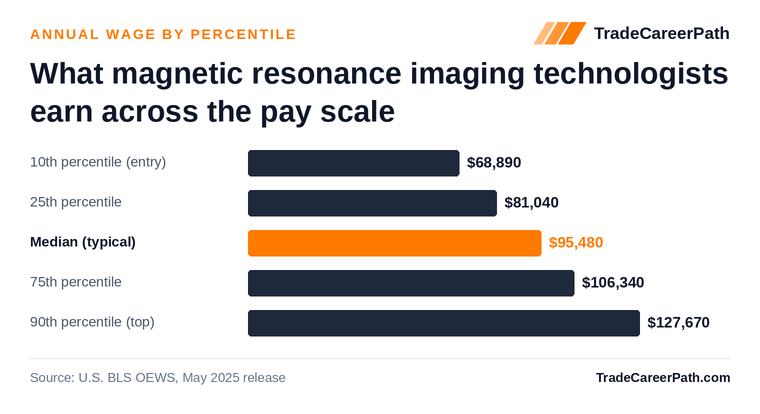
Wage and Employment Charts
| Percentile | Annual wage |
|---|---|
| 10th | $68,890 |
| 25th | $81,040 |
| 50th (median) | $95,480 |
| 75th | $106,340 |
| 90th | $127,670 |
| Year | Employment |
|---|---|
| 2025 | 43,900 |
| 2035 projected | 47,300 |
| Percent change | +7.7% |
MRI Technologist Salary and Requirements by State
Select your state for local wage data, training options, and requirements:
Alabama · Alaska · Arizona · Arkansas · California · Colorado · Connecticut · Delaware · District of Columbia · Florida · Georgia · Hawaii · Idaho · Illinois · Indiana · Iowa · Kansas · Kentucky · Louisiana · Maine · Maryland · Massachusetts · Michigan · Minnesota · Mississippi · Missouri · Montana · Nebraska · Nevada · New Hampshire · New Jersey · New Mexico · New York · North Carolina · North Dakota · Ohio · Oklahoma · Oregon · Pennsylvania · Rhode Island · South Carolina · South Dakota · Tennessee · Texas · Utah · Vermont · Virginia · Washington · West Virginia · Wisconsin · Wyoming
Workplace Safety Snapshot
BLS Survey of Occupational Injuries and Illnesses data (2023-2024) report approximately 185.7 days-away, restricted, or transfer cases per 10,000 full-time-equivalent workers in magnetic resonance imaging technologists (about 1.86 per 100 FTE). Source: BLS Survey of Occupational Injuries and Illnesses, Table R98.
Frequently Asked Questions
How long does mri technologist training take?
It typically takes typically 6 months to 2 years of training. The most common entry path is through a certificate or associate degree program. A high school diploma or GED is generally required to get started.
How much do mri technologists make?
The median annual salary for mri technologists is $95,480 according to the Bureau of Labor Statistics (May 2025). Entry-level workers earn around $68,890, while those in the 90th percentile earn over $127,670. Pay varies by state, experience, and specialization.
What is the job outlook for mri technologists?
The Bureau of Labor Statistics projects 7.7% employment growth for this occupation from 2025 to 2035, which is about as fast as average. Approximately 2,300 job openings are expected each year due to growth, retirements, and workers leaving the field.
Do you need a college degree to work as a mri technologist?
No. A college degree is not required to work as a mri technologist. Most people enter the field through a certificate or associate degree program. A high school diploma or GED is typically the only educational prerequisite.
Which states pay mri technologists the most?
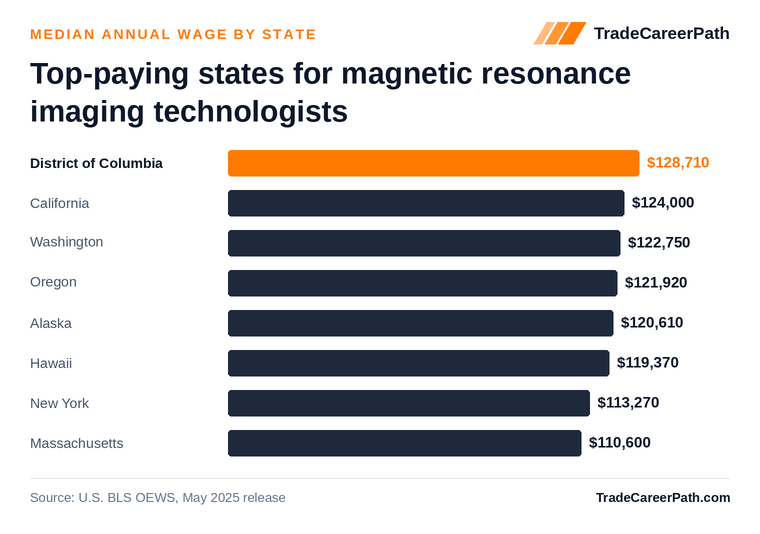
According to the U.S. Bureau of Labor Statistics (May 2025 OEWS), the highest-paying states for mri technologists are District of Columbia, California, and Washington. Median annual wages: District of Columbia ($128,710); California ($124,000); Washington ($122,750).
Which states employ the most mri technologists?
BLS reports the largest concentrations of mri technologists in California, New York, and Texas. Employment levels: California (3,570 workers); New York (3,240 workers); Texas (2,930 workers) (May 2025).
How much do experienced mri technologists earn?
The top 10% of mri technologists earn more than $127,670 per year, according to BLS Occupational Employment and Wage Statistics (May 2025). Experienced workers in this band typically hold senior credentials, supervisory roles, or specialty certifications.
What is entry-level pay for mri technologists?
BLS reports the bottom 10% of mri technologists earn under $68,890 per year. New workers often start near this level and see pay rise as they accumulate experience and credentials.
How many mri technologists work in the United States?
BLS reports approximately 43,390 mri technologists employed nationwide as of May 2025.
How many job openings are expected for mri technologists each year?
BLS projects approximately 2,300 openings per year for mri technologists from 2025 through 2035, including new positions, retirements, and workers transitioning out. The occupation is projected to grow 7.7% from 2025 to 2035, classified as faster than average growth.
Is mri technologist a growing career?
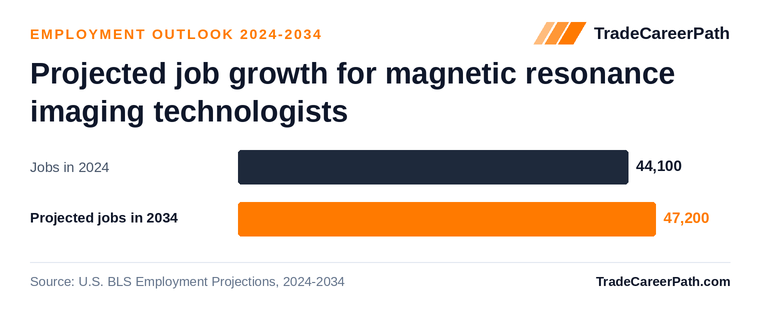
Yes. BLS projects 7.7% employment growth for mri technologists between 2024 and 2034, classified as faster than average. Employment is projected to rise from approximately 43,900 jobs in 2024 to 47,300 in 2034.
How much do mri technologists make per hour?
The median hourly wage for mri technologists is $45.91, according to BLS (May 2025). Hourly pay ranges from about $33.12 (bottom 10%) to $61.38 (top 10%).
Sources
- U.S. Bureau of Labor Statistics, Occupational Employment and Wage Statistics (May 2025)
- U.S. Bureau of Labor Statistics, Employment Projections 2025-2035
- U.S. Bureau of Labor Statistics, Survey of Occupational Injuries and Illnesses (2023-2024, Table R98)
- U.S. Department of Labor, Wage and Hour Division, Davis-Bacon General Wage Determinations (2026)
Mri Technologist Salary by State
About this guide: Researched and written by the TradeCareerPath Editorial Team. Our editorial team researches and sources every trade school and career guide using federal labor and education data, including BLS OEWS and Employment Projections, DOL apprenticeship records, IPEDS, College Scorecard, and state licensing boards. We follow the editorial standards documented at /editorial-policy/.
Data sources
Figures on this page are sourced from the federal and state datasets below. Methodology: how we rank and source data.
| Data | Provider | Vintage |
|---|---|---|
| Occupational Employment and Wage Statistics (OEWS) | U.S. Bureau of Labor Statistics | May 2025 |
| Employment Projections | U.S. Bureau of Labor Statistics | 2025-2035 |
| Integrated Postsecondary Education Data System | National Center for Education Statistics (IPEDS) | 2024 |
| College Scorecard (school-level outcomes) | U.S. Department of Education | latest release |
| College Scorecard (field-of-study earnings) | U.S. Department of Education | latest release (updated 2026-06-12) |
| Occupational licensing requirements | CareerOneStop (U.S. Department of Labor) | latest release (updated 2026-02-22) |
| Registered apprenticeship programs | CareerOneStop / Apprenticeship.gov (U.S. Department of Labor) | latest release (updated 2025-10-25) |
| O*NET occupation profiles (skills, tasks, tools, job zones) | U.S. Department of Labor (O*NET / Employment & Training Admin.) | O*NET 31.0 (updated 2026-10-14) |