
How to Become a Nuclear Engineer in 2026
Is Nuclear Engineer Right for You?
The U.S. Department of Labor's O*NET profile for Nuclear Engineers (SOC 17-2161) describes the work this way: Conduct research on nuclear engineering projects or apply principles and theory of nuclear science to problems concerned with release, control, and use of nuclear energy and nuclear waste disposal.
What the work involves
- Design or develop nuclear equipment, such as reactor cores, radiation shielding, or associated instrumentation or control mechanisms.
- Monitor nuclear facility operations to identify any design, construction, or operation practices that violate safety regulations and laws or could jeopardize safe operations.
- Initiate corrective actions or order plant shutdowns in emergency situations.
- Examine accidents to obtain data for use in design of preventive measures.
- Direct operating or maintenance activities of nuclear power plants to ensure efficiency and conformity to safety standards.
Skills and knowledge that matter
Skills: Science, Critical Thinking, Writing, Reading Comprehension, Monitoring, Mathematics.
Knowledge: Engineering and Technology, Physics, Mathematics, English Language.
Tools and technology you may use
Tools: Anticontamination clothing, Desktop computers, Face masks, Nuclear wireline logging instruments, Personal computers, Reactivity computer systems.
Technology: Analytical or scientific software, Object or component oriented development software, Computer aided design CAD software, C++, Linux, Microsoft Access.
Typical preparation
O*NET Job Zone Four (Considerable Preparation Needed). Most of these occupations require a four-year bachelor's degree, but some do not. Employees in these occupations usually need several years of work-related experience, on-the-job training, and/or vocational training.
Interest fit
O*NET interest profile: Investigative, Realistic, Conventional. People who enjoy working with ideas, searching for facts, and figuring out problems often find this occupation a good fit.
Source: O*NET 29.1 (updated 2026-06-13)
Quick answer: Training as a nuclear engineer requires a 4-year degree - typically an ABET-accredited bachelor’s in nuclear or mechanical engineering. The national median pay is $133,970 per year, and BLS projects -1.1% employment change from 2024 to 2034 (BLS OEWS, May 2025; BLS Employment Projections, 2024-34).
Nuclear Engineer at a Glance
| Metric | Detail | Source |
|---|---|---|
| Median annual wage | $133,970 | BLS OEWS, May 2025 |
| Typical wage range | $92,960 (10th pct) - $196,290 (90th pct) | BLS OEWS, May 2025 |
| Employment | 15,280 nationwide | BLS OEWS, May 2025 |
| Projected growth (2024-34) | -1.1%, about 800 openings per year | BLS Employment Projections, 2024-34 |
| Typical education | ABET-accredited bachelor’s in nuclear or mechanical engineering | BLS Occupational Outlook Handbook |
| License / certification | PE license for some roles; NRC licensing applies to operator positions | Federal (NRC) |
What Does a Nuclear Engineer Do?
Nuclear engineers design reactor systems, radiation shielding, and safety programs for power plants, the Navy, and medical and industrial applications - the engineering authority above plant operators and radiation-protection technicians.
Day to day, the work is disciplined analysis inside one of the most heavily documented industries in the country. A reactor engineer tracks core performance, models fuel burnup, and plans the next refueling outage. A thermal-hydraulics or safety-analysis engineer runs the calculations that prove the plant stays within its design basis - and defends them in front of reviewers. A radiation-protection engineer sets shielding requirements, ALARA dose budgets, and survey programs. Licensing engineers translate all of it into submittals the NRC will accept. Beyond utilities, national laboratories put nuclear engineers on research reactors, fuel-cycle work, and weapons stewardship, while the SMR sector needs design and licensing engineers to move new reactor concepts through NRC review. Everything is procedure-driven, peer-checked, and traceable - in this industry an unverified calculation is a reportable problem, not a footnote.
If you are coming from the operations side - a licensed reactor operator or a Navy nuke - the shortest way to say it: the operator executes the procedure; the engineer writes it, proves it is safe, and dispositions what happens when the plant does something unexpected. The engineering evaluation on that degraded pump you flagged from the control room - that becomes your call, and it is exactly why utilities prize operator-experienced engineers: you know how the plant actually behaves, not just how the models say it should.
Skills That Make a Great Nuclear Engineer
- Reactor physics fundamentals
- Radiation protection and ALARA dose management
- Thermal-hydraulic and safety analysis
- NRC regulatory fluency (10 CFR, tech specs, licensing basis)
- Procedural rigor and human-performance discipline
- Analysis codes and tools (MCNP, RELAP-class codes) plus MATLAB or Python
- Writing: engineering evaluations, condition reports, and licensing submittals carry the job
Nuclear Engineer Salary
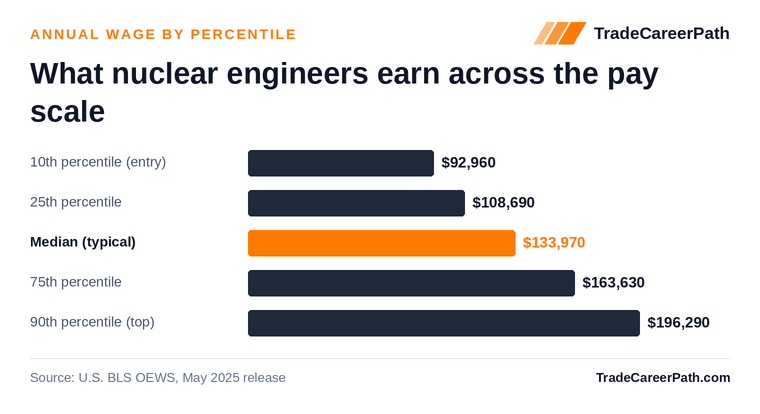
Nuclear engineering pays near the top of the engineering professions. The national median is $133,970 per year, and even the 10th percentile - roughly where new graduates start - is $92,960, which is above the median for most skilled trades. The 75th percentile is $163,630, and the 90th percentile reaches $196,290 (BLS OEWS, May 2025). The mean of $140,420 sits above the median - the top of this field pulls the average up.
Where the Jobs and the Money Are
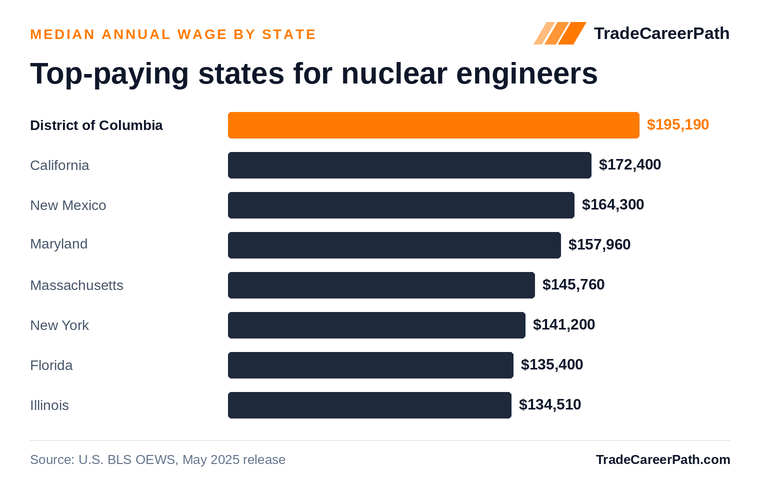
This is a small, concentrated occupation - 15,280 engineers nationwide, clustered around operating plants, national laboratories, and DOE sites. South Carolina leads with 1,440 nuclear engineers, followed by Washington with 1,380 (Hanford and the Navy’s Puget Sound work) and California with 1,070 (BLS OEWS, May 2025).
| State | Median annual wage | Employment |
|---|---|---|
| District of Columbia | $195,190 | 230 |
| California | $172,400 | 1,070 |
| New Mexico | $164,300 | 500 |
| Maryland | $157,960 | 180 |
| Massachusetts | $145,760 | 210 |
The location-quotient data tells the real story. In South Carolina, nuclear engineers are more than six times as common as in the average state labor market; in New Mexico (Los Alamos and Sandia), nearly six times; in Washington, about four times. Those are the deep markets where you can change employers without relocating. The District of Columbia is the opposite pattern - a small regulatory and policy cluster around the NRC and DOE paying a $195,190 median, the highest in the country.
How to Become a Nuclear Engineer
1. Earn an ABET-accredited bachelor’s
Nuclear engineering, or mechanical engineering with a nuclear focus. Accreditation is the one non-negotiable: employers screen for it, graduate schools require it, and the FE/PE licensure path assumes it. Dedicated nuclear-engineering programs are few, so for working adults the mechanical-engineering route with a nuclear or energy concentration usually offers far more accredited online and evening options - and utilities and labs hire mechanical engineers into nuclear roles as a matter of course.
2. Use operations or Navy experience
Licensed-operator and nuclear-Navy backgrounds are prized by utilities and national labs - say so explicitly on applications. An RO or SRO license, or Navy nuclear qualification, reads as proof you understand how the plant actually behaves, fails, and recovers, which most graduates cannot claim. Many schools grant transfer credit for Navy Nuclear Power School and operator-training coursework; get a written transfer evaluation before you enroll anywhere.
3. Start in reactor engineering or radiation protection
Utilities, the Navy’s civilian engineering corps, and national laboratories all hire at the bachelor’s level. Reactor engineering, radiation protection, and systems engineering are the classic entry points for former operators, because the job is judging real plant conditions rather than working purely from models. Fuel vendors, engineering-services firms, and the NRC itself also hire here.
4. Pursue senior reactor operator or PE tracks
The fork depends on your path. If you stay in operations, the senior reactor operator (SRO) license - an NRC credential earned through the utility’s training program - is the premium ticket, and degreed SROs are strong candidates for operations management. If you go the design and analysis route, the FE-then-PE sequence is the equivalent long play: sit for the FE as a senior, log four years of qualifying experience, then take the PE.
5. Advance
Senior engineer, licensing and regulatory affairs, or plant management. The fork comes around the ten-year mark: deepen into a technical-authority role in safety analysis or licensing, or take the leadership track toward engineering management and, for operator-licensed engineers, plant operations leadership. Both are covered in the career ladder below.
Career Ladder: Titles and Realistic Pay
The BLS wage percentiles map cleanly onto how nuclear careers actually progress. Use this as a sanity check on offers, not a guarantee:
| Stage | Typical titles | Years in | Realistic pay (BLS OEWS, May 2025) |
|---|---|---|---|
| Entry level | Engineer I, reactor engineer, radiation-protection engineer | 0-3 | ~$92,960-$108,690 (10th-25th pct) |
| Mid-career | Engineer II/III, system engineer, safety analyst | 3-10 | ~$133,970 (median) |
| Senior | Senior/staff engineer, licensing engineer, technical lead | 10-15 | ~$163,630 (75th pct) |
| Principal / leadership | Principal engineer, regulatory-affairs lead, engineering manager | 15+ | $196,290+ (90th pct) |
Two notes for career changers. First, prior operations experience compresses this ladder: former licensed operators and Navy nukes are routinely hired above the bottom of the entry band because they need far less supervision around a live plant. Second, these are base-wage figures - utilities add outage premiums, SRO differentials, and bonuses that push senior total compensation well above the numbers here.
Do You Need a PE License?
Mostly no. Nuclear engineers at utilities, vendors, and national labs work under the “industrial exemption” - the organization, not the individual engineer, holds design responsibility, so most never license. Two credentials matter more in this industry:
- NRC operator licenses (RO/SRO): these attach to operator positions, not engineering titles - but a degreed engineer who earns an SRO license through a utility’s training program becomes one of the most valuable people on site, and it is the standard gateway to operations management.
- Security clearance: Navy, DOE, and national-laboratory work often requires U.S. citizenship and a clearance, and clearability meaningfully widens the market.
If you want the PE anyway - it helps in consulting and civil-structural interface work - the path is: ABET degree, the Fundamentals of Engineering (FE) exam (you can sit for it as a senior), four years of qualifying experience, then the PE exam, per your state board’s rules.
Why an Online Degree Works for This Career
Power plant operators and Navy nukes are the classic feeders - NRC operator experience is deeply respected in the industry, and the bachelor’s converts that operating knowledge into engineering authority. ABET-accredited online programs (often mechanical engineering with a nuclear or energy track) serve working operators on rotating shifts, and utility tuition assistance is common - many operators complete the degree with most of the tuition covered, without giving up their license, seniority, or shift pay. Be clear-eyed on the trend: BLS projects a small employment decline for the occupation, though new SMR construction could shift demand, and median pay remains among the highest in engineering.
Job Outlook for 2026 and Beyond
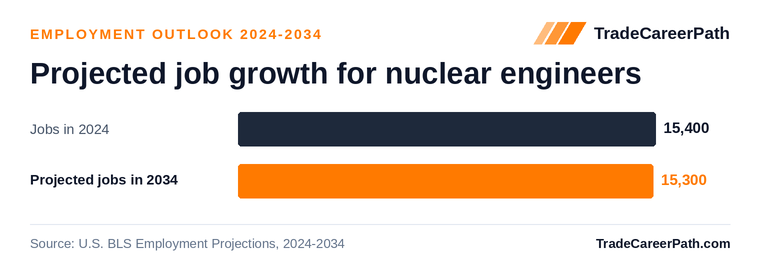
BLS projects nuclear engineering employment to change -1.1% from 2024 to 2034 - from 15,400 to 15,300 jobs - with about 800 openings per year once retirements and occupation changes are counted (BLS Employment Projections, 2024-34). The latest wage data (OEWS, May 2025) puts the median at $133,970, up from the 2024 figure of $127,520 - solid wage growth in a single year for a field that is supposedly shrinking.
Read those two numbers together and the picture is more nuanced than “declining field.” The headcount is flat, but the openings figure matters more than the growth rate: 800 seats a year in a 15,280-person occupation is steady replacement hiring as an aging workforce retires. Demand also concentrates where career changers are strongest - existing plants need engineers who understand operations, license renewals and uprates need licensing engineers, and the SMR sector is adding NRC-review work that did not exist a decade ago. The bet is not on a growing occupation; it is on being one of the few qualified people in a small, high-paying, hard-to-enter one.
Cost and Time to Complete the Degree
For nuclear engineers, the credential is: ABET-accredited bachelor’s in nuclear or mechanical engineering. A bachelor’s degree is typically 120 credit hours: four years full-time, and commonly five to six years part-time while working. Transfer credit is the other lever: prior college, Navy Nuclear Power School, licensed-operator training, and industry certifications can be worth meaningful credit at transfer-friendly schools, so get a written transfer evaluation before enrolling anywhere. Costs vary widely by school type; in-state public online programs are usually the value benchmark, and utility tuition assistance is common for working adults in this field.
Pros and Cons of Training as a Nuclear Engineer
Pros
- Median pay of $133,970 nationally (BLS OEWS, May 2025)
- Field experience from operations or the Navy is a genuine hiring advantage
- Accredited online and hybrid degree paths exist for working adults
- Small candidate pool: clearance and operator-experience requirements keep competition thin
Cons
- Requires a 4-year degree (typically 120 credit hours)
- Entry-level pay starts near $92,960 at the 10th percentile
- Licensing hurdle: PE license for some roles; NRC licensing applies to operator positions
- BLS projects a -1.1% employment change through 2034; plan around replacement demand of about 800 openings per year
- Jobs cluster around plant and lab sites - relocation is often part of the deal
Frequently Asked Questions
Is nuclear engineering still a good field?
BLS projects a slight employment decline through 2034, so go in with open eyes - but median pay is among the highest of any engineering discipline, and operator-experienced engineers remain in demand at existing plants and in the growing SMR sector.
How much do nuclear engineers make?
The national median annual wage for nuclear engineers is $133,970 (BLS OEWS, May 2025). The top 10% earn $196,290 or more, while entry-level pay starts around $92,960.
What is the job outlook for nuclear engineers?
BLS projects employment of nuclear engineers to change by -1.1% from 2024 to 2034 (BLS Employment Projections, 2024-34).
How long does nuclear engineer training take?
The ABET-accredited bachelor's is 120 credit hours: four years full-time, commonly five to six years part-time while working. Navy nuclear training and licensed-operator coursework often earn transfer credit at transfer-friendly schools, which can shorten the degree.
Is nuclear engineering hard?
The degree is math-heavy - reactor physics, thermodynamics, and heat transfer sit on top of calculus and differential equations. Plant operators and Navy nukes usually have an easier time than fresh high-school graduates because they already understand the systems the math describes.
Should I get a nuclear or mechanical engineering degree?
For working operators, mechanical engineering with a nuclear or energy concentration is often the smarter buy: far more ABET-accredited online options, and the degree stays marketable outside the nuclear industry. Utilities and national labs hire mechanical engineers into nuclear roles routinely.
Can you train as a nuclear engineer without a degree?
Not with the engineer title - employers require the ABET-accredited bachelor's. Without it, the ceiling is licensed operator, radiation-protection technician, or maintenance roles. Operator experience shortens and strengthens the degree path, but does not replace it.
Do nuclear engineers need a PE license?
Usually no - most work at utilities and labs under the industrial exemption, so the PE is optional. NRC operator licenses apply to control-room roles, not engineering titles. If you want the PE, the path is the ABET degree, the FE exam, four years of qualifying experience, then the PE exam.
Nuclear Engineer Salary and Requirements by State
Alabama · California · District of Columbia · Florida · Georgia · Idaho · Illinois · Maine · Maryland · Massachusetts · Michigan · New Mexico · New York · North Carolina · Pennsylvania · South Carolina · Texas · Virginia · Washington
Related Careers and Degree Paths
- Mechanical Engineer - the broader degree that also qualifies you for nuclear roles
- Electrical Engineer - the power-systems and I&C side of the same plants
- Chemical Engineer - fuel-cycle, reprocessing, and process-safety work overlaps heavily
- Online Engineering Degrees for Tradespeople - how to pick an ABET program that fits a shift schedule
- All trade careers that require a 4-year degree
Sources
- U.S. Bureau of Labor Statistics, Occupational Employment and Wage Statistics (OEWS), May 2025 - Nuclear Engineers (SOC 17-2161)
- U.S. Bureau of Labor Statistics, Employment Projections, 2024-34
- U.S. Bureau of Labor Statistics, Occupational Outlook Handbook - education and licensing requirements
Nuclear Engineer Salary by State
About this guide: Researched and written by the TradeCareerPath Editorial Team. Our editorial team researches and sources every trade school and career guide using federal labor and education data, including BLS OEWS and Employment Projections, DOL apprenticeship records, IPEDS, College Scorecard, and state licensing boards. We follow the editorial standards documented at /editorial-policy/.
Data sources
Figures on this page are sourced from the federal and state datasets below. Methodology: how we rank and source data.
| Data | Provider | Vintage |
|---|---|---|
| Occupational Employment and Wage Statistics (OEWS) | U.S. Bureau of Labor Statistics | May 2025 |
| Employment Projections | U.S. Bureau of Labor Statistics | 2024-2034 |
| Integrated Postsecondary Education Data System | National Center for Education Statistics (IPEDS) | 2024 |
| College Scorecard (school-level outcomes) | U.S. Department of Education | latest release |
| College Scorecard (field-of-study earnings) | U.S. Department of Education | latest release (updated 2026-06-12) |
| Occupational licensing requirements | CareerOneStop (U.S. Department of Labor) | latest release (updated 2026-02-22) |
| Registered apprenticeship programs | CareerOneStop / Apprenticeship.gov (U.S. Department of Labor) | latest release (updated 2025-10-25) |
| O*NET occupation profiles (skills, tasks, tools, job zones) | U.S. Department of Labor (O*NET / Employment & Training Admin.) | O*NET 29.1 (updated 2026-06-13) |