
How to Become a Licensed Vocational Nurse (LVN)
Is Licensed Vocational Nurse (LVN) Right for You?
The U.S. Department of Labor's O*NET profile for Licensed Practical and Licensed Vocational Nurses (SOC 29-2061) describes the work this way: Care for ill, injured, or convalescing patients or persons with disabilities in hospitals, nursing homes, clinics, private homes, group homes, and similar institutions. May work under the supervision of a registered nurse. Licensing required.
What the work involves
- Observe patients, charting and reporting changes in patients' conditions, such as adverse reactions to medication or treatment, and taking any necessary action.
- Measure and record patients' vital signs, such as height, weight, temperature, blood pressure, pulse, or respiration.
- Administer prescribed medications or start intravenous fluids, noting times and amounts on patients' charts.
- Provide basic patient care or treatments, such as taking temperatures or blood pressures, dressing wounds, treating bedsores, giving enemas or douches, rubbing with alcohol, massaging, or performing catheterizations.
- Answer patients' calls and determine how to assist them.
Skills and knowledge that matter
Skills: Service Orientation, Social Perceptiveness, Coordination, Active Listening, Speaking, Monitoring.
Knowledge: Customer and Personal Service, English Language, Psychology, Medicine and Dentistry.
Tools and technology you may use
Technology: Categorization or classification software, Medical software, Video conferencing software, eClinicalWorks EHR software, Epic Systems, MEDITECH software.
Typical preparation
O*NET Job Zone Three (Medium Preparation Needed). Most occupations in this zone require training in vocational schools, related on-the-job experience, or an associate's degree. Employees in these occupations usually need one or two years of training involving both on-the-job experience and informal training with experienced workers. A recognized apprenticeship program may be associated with these occupations.
Interest fit
O*NET interest profile: Social, Realistic, Conventional. People who enjoy working with, helping, and teaching other people often find this occupation a good fit.
Source: O*NET 31.0 (updated 2026-10-14)
Want to join the nursing field quickly and make a real impact every day?
training as a Licensed Vocational Nurse (LVN) is one of the fastest, most reliable ways to start a healthcare career in states like California and Texas.
LVNs (called Licensed Practical Nurses, or LPNs, in most states) provide essential bedside care and support for patients across hospitals, clinics, and long-term care facilities. You’ll work under registered nurses (RNs) and physicians to deliver compassionate, hands-on care.
Quick answers
What is an LVN?
An LVN (Licensed Vocational Nurse) provides hands-on bedside care and support for patients in a range of healthcare settings.
Is an LVN the same as an LPN?
In most states, LVNs are called Licensed Practical Nurses (LPNs). The role is similar, but the title varies by state.
What do LVNs do day to day?
Common duties include taking vital signs, administering medications, assisting with daily activities, and reporting changes in patient condition.
What are the main steps to work as an LVN?
This page outlines five steps: earn a diploma or GED, complete an accredited program, apply for the NCLEX-PN, pass the exam, and meet state requirements for licensure.
Do LVNs have to pass the NCLEX-PN?
Yes. After completing your program, you apply through your state board and pass the NCLEX-PN to qualify for licensure.
Where do LVNs work?
LVNs work across hospitals, clinics, and long-term care facilities, as well as home health care and hospice services.
At a glance
- Also called LPN in most states
- Works under RNs and physicians
- Path: diploma/GED, accredited program with clinical rotations, NCLEX-PN, state licensure
- Common workplaces: hospitals, clinics, long-term care, home health, hospice
What Licensed Vocational Nurses Actually Do
LVNs provide clinical support, comfort, and communication between patients and medical teams.
Common Responsibilities
- Taking vital signs and recording patient data
- Administering medications and injections
- Assisting patients with daily activities (eating, bathing, dressing)
- Performing wound care and changing dressings
- Collecting samples for lab tests
- Monitoring and reporting changes in patient condition
LVNs are the backbone of nursing care, bringing both medical skill and compassion to every shift.
How to Become a Licensed Vocational Nurse (5 Steps)
Training as an LVN can take just over a year, offering one of the faster paths into professional nursing.
Earn a High School Diploma or GED
A strong foundation in science and math helps prepare you for nursing coursework.Complete an Accredited LVN Program
Enroll in a state-approved vocational nursing program, typically at a trade school or community college.
Coursework typically includes:- Nursing fundamentals and pharmacology
- Anatomy and physiology
- Patient care procedures
- Clinical rotations in hospitals or long-term care facilities
Apply for the NCLEX-PN Exam
After completing your program, you’ll apply to your state’s nursing board for authorization to test.Pass the NCLEX-PN
The National Council Licensure Examination for Practical Nurses (NCLEX-PN) ensures you meet national nursing competency standards.Get Licensed and Start Your Career
Once you pass the NCLEX-PN and complete state requirements, you’ll officially be licensed as an LVN and ready to work in hospitals, clinics, or private care.
Licensing & Certification
All LVNs must be licensed by their state’s nursing board. Most states require:
- Graduation from an accredited program
- Passing the NCLEX-PN
- Submitting fingerprints and background checks
Optional certifications can enhance your skills and income:
- IV Therapy
- Wound Care
- Pediatric or Geriatric Nursing
- Pharmacology and Medication Administration
Continuing education keeps you current with evolving healthcare standards and helps you move up the nursing ladder.
Skills That Make You Great at This
- Compassion and strong interpersonal skills
- Attention to detail and recordkeeping
- Problem-solving and decision-making
- Emotional strength and professionalism
- Teamwork and patient communication
LVNs bridge the gap between patients and providers, offering both empathy and efficiency in care.
Where You’ll Work (and Grow)
LVNs are employed in a wide range of healthcare settings:
- Hospitals and urgent care centers
- Physician offices and clinics
- Nursing homes and assisted living facilities
- Home health care and hospice services
- Military and correctional facilities
Career Growth Paths
- Charge Nurse or Team Leader
- Registered Nurse (via LVN-to-RN bridge program)
- Specialized Care Nurse (pediatrics, geriatrics, etc.)
- Clinical or Administrative Coordinator
Nursing Lvn Salary Snapshot
U.S.51,800 openings/yr
Pros & Cons
Pros:
- Fast entry into the nursing field
- Strong demand and job stability
- Rewarding and meaningful work
- Opportunities for specialization and advancement
Cons:
- Physically demanding and emotionally challenging
- Long or overnight shifts
- Requires continuing education for license renewal
Start Your LVN Nursing Journey
If you’re ready to join a high-demand, high-impact field, training as a Licensed Vocational Nurse is a smart and rewarding move.
Wage and Employment Charts
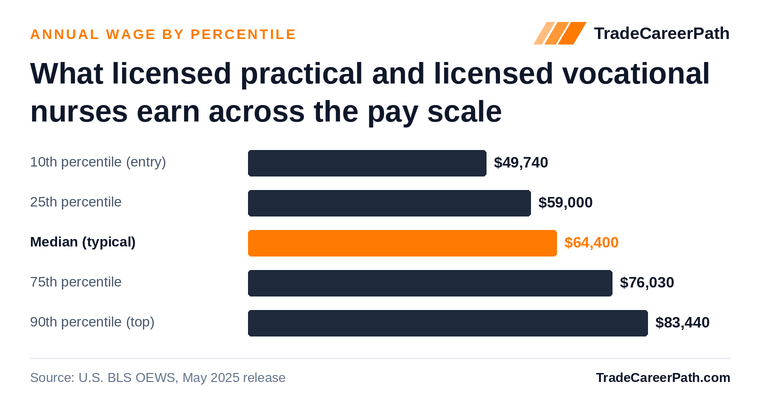
| Percentile | Annual wage |
|---|---|
| 10th | $49,740 |
| 25th | $59,000 |
| 50th (median) | $64,400 |
| 75th | $76,030 |
| 90th | $83,440 |
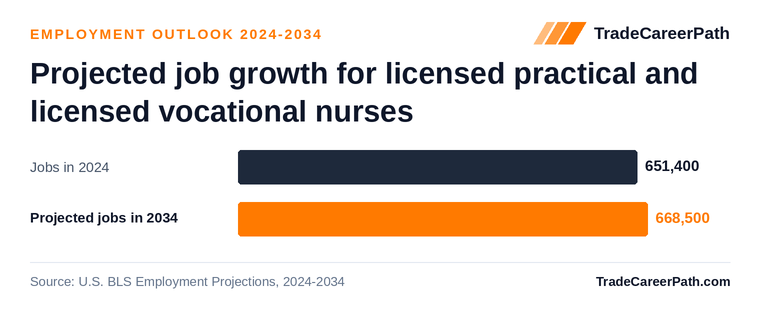
| Year | Employment |
|---|---|
| 2025 | 666,900 |
| 2035 projected | 686,700 |
| Percent change | +3.0% |
Licensed Vocational Nurse Salary and Requirements by State
Select your state for local wage data, training options, and requirements:
Alabama · Alaska · Arizona · Arkansas · California · Colorado · Connecticut · Delaware · District of Columbia · Florida · Georgia · Hawaii · Idaho · Illinois · Indiana · Iowa · Kansas · Kentucky · Louisiana · Maine · Maryland · Massachusetts · Michigan · Minnesota · Mississippi · Missouri · Montana · Nebraska · Nevada · New Hampshire · New Jersey · New Mexico · New York · North Carolina · North Dakota · Ohio · Oklahoma · Oregon · Pennsylvania · Rhode Island · South Carolina · South Dakota · Tennessee · Texas · Utah · Vermont · Virginia · Washington · West Virginia · Wisconsin · Wyoming
Workplace Safety Snapshot
BLS Survey of Occupational Injuries and Illnesses data (2023-2024) report approximately 232.5 days-away, restricted, or transfer cases per 10,000 full-time-equivalent workers in licensed practical and licensed vocational nurses (about 2.33 per 100 FTE). Source: BLS Survey of Occupational Injuries and Illnesses, Table R98.
Frequently Asked Questions
How long does nursing LVN training take?
It typically takes typically 6 months to 2 years of training. The most common entry path is through a certificate or associate degree program. A high school diploma or GED is generally required to get started.
How much do nursing lvns make?
The median annual salary for nursing lvns is $64,400 according to the Bureau of Labor Statistics (May 2025). Entry-level workers earn around $49,740, while those in the 90th percentile earn over $83,440. Pay varies by state, experience, and specialization.
What is the job outlook for nursing lvns?
The Bureau of Labor Statistics projects 3.0% employment growth for this occupation from 2025 to 2035, which is roughly on pace with the overall economy. Approximately 51,800 job openings are expected each year due to growth, retirements, and workers leaving the field.
Do you need a college degree to work as a nursing LVN?
No. A college degree is not required to work as a nursing LVN. Most people enter the field through a certificate or associate degree program. A high school diploma or GED is typically the only educational prerequisite.
Which states pay LVNs the most?
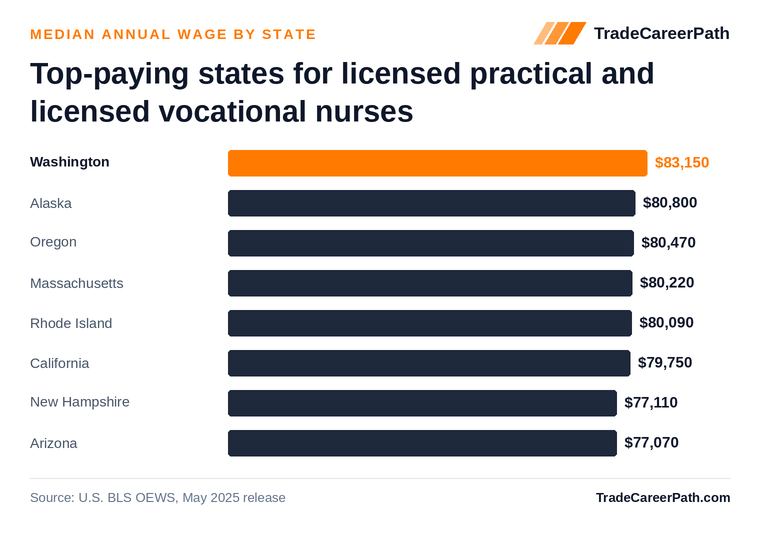
According to the U.S. Bureau of Labor Statistics (May 2025 OEWS), the highest-paying states for LVNs are Washington, Alaska, and Oregon. Median annual wages: Washington ($83,150); Alaska ($80,800); Oregon ($80,470).
Which states employ the most LVNs?
BLS reports the largest concentrations of LVNs in California, Texas, and Ohio. Employment levels: California (82,850 workers); Texas (57,560 workers); Ohio (39,900 workers) (May 2025).
How much do experienced LVNs earn?
The top 10% of LVNs earn more than $83,440 per year, according to BLS Occupational Employment and Wage Statistics (May 2025). Experienced workers in this band typically hold senior credentials, supervisory roles, or specialty certifications.
What is entry-level pay for LVNs?
BLS reports the bottom 10% of LVNs earn under $49,740 per year. New workers often start near this level and see pay rise as they accumulate experience and credentials.
How many LVNs work in the United States?
BLS reports approximately 648,410 LVNs employed nationwide as of May 2025.
How many job openings are expected for LVNs each year?
BLS projects approximately 51,800 openings per year for LVNs from 2024 through 2035, including new positions, retirements, and workers transitioning out. The occupation is projected to grow 3.0% from 2024 to 2034, classified as about as fast as average growth.
How much do LVNs make per hour?
The median hourly wage for LVNs is $30.96, according to BLS (May 2025). Hourly pay ranges from about $23.91 (bottom 10%) to $40.12 (top 10%).
How Nursing Lvn Pay Compares to Similar Trades
Side-by-side comparison of Nursing LPN/LVN and the closest related careers, based on U.S. Bureau of Labor Statistics data (May 2025 OEWS + 2025-2035 Employment Projections).
| Career | Median Pay | 10-Year Growth | Annual Openings |
|---|---|---|---|
| Nursing LPN/LVN this guide | $64,400 | +3.0% | 51,800 |
| Nursing LPN/LVN | $64,400 | +3.0% | 51,800 |
| Certified Nursing Assistant (CNA) | $42,260 | +2.6% | 196,200 |
| Patient Care Technician | $42,260 | +2.6% | 196,200 |
| Medical Assistant | $45,690 | +12.9% | 109,700 |
Source: BLS Occupational Employment and Wage Statistics + BLS Employment Projections.
Sources
- U.S. Bureau of Labor Statistics, Occupational Employment and Wage Statistics (May 2025)
- U.S. Bureau of Labor Statistics, Employment Projections 2025-2035
- U.S. Bureau of Labor Statistics, Survey of Occupational Injuries and Illnesses (2023-2024, Table R98)
- U.S. Department of Labor, Wage and Hour Division, Davis-Bacon General Wage Determinations (2026)
Nursing Lvn Salary by State
About this guide: Researched and written by the TradeCareerPath Editorial Team. Our editorial team researches and sources every trade school and career guide using federal labor and education data, including BLS OEWS and Employment Projections, DOL apprenticeship records, IPEDS, College Scorecard, and state licensing boards. We follow the editorial standards documented at /editorial-policy/.
Data sources
Figures on this page are sourced from the federal and state datasets below. Methodology: how we rank and source data.
| Data | Provider | Vintage |
|---|---|---|
| Occupational Employment and Wage Statistics (OEWS) | U.S. Bureau of Labor Statistics | May 2025 |
| Employment Projections | U.S. Bureau of Labor Statistics | 2025-2035 |
| Integrated Postsecondary Education Data System | National Center for Education Statistics (IPEDS) | 2024 |
| College Scorecard (school-level outcomes) | U.S. Department of Education | latest release |
| College Scorecard (field-of-study earnings) | U.S. Department of Education | latest release (updated 2026-06-12) |
| Occupational licensing requirements | CareerOneStop (U.S. Department of Labor) | latest release (updated 2026-02-22) |
| Registered apprenticeship programs | CareerOneStop / Apprenticeship.gov (U.S. Department of Labor) | latest release (updated 2025-10-25) |
| O*NET occupation profiles (skills, tasks, tools, job zones) | U.S. Department of Labor (O*NET / Employment & Training Admin.) | O*NET 31.0 (updated 2026-10-14) |