
How to Become an Occupational Therapy Assistant in 2026
Is Occupational Therapy Assistant Right for You?
The U.S. Department of Labor's O*NET profile for Occupational Therapy Assistants (SOC 31-2011) describes the work this way: Assist occupational therapists in providing occupational therapy treatments and procedures. May, in accordance with state laws, assist in development of treatment plans, carry out routine functions, direct activity programs, and document the progress of treatments. Generally requires formal training.
What the work involves
- Instruct, or assist in instructing, patients and families in home programs, basic living skills, or the care and use of adaptive equipment.
- Maintain and promote a positive attitude toward clients and their treatment programs.
- Report to supervisors, verbally or in writing, on patients' progress, attitudes, and behavior.
- Implement, or assist occupational therapists with implementing, treatment plans designed to help clients function independently.
- Monitor patients' performance in therapy activities, providing encouragement.
Skills and knowledge that matter
Skills: Speaking, Social Perceptiveness, Service Orientation, Active Listening, Reading Comprehension, Time Management.
Knowledge: Customer and Personal Service, Psychology, Education and Training, English Language.
Tools and technology you may use
Tools: Alternative computer keyboards, Arm braces, Augmentative communication systems, Automatic dishwashing systems, Back braces, Balance boards.
Technology: Accounting software, Medical software, Computer based training software, eClinicalWorks EHR software, Facebook, Microsoft Access.
Typical preparation
O*NET Job Zone Three (Medium Preparation Needed). Most occupations in this zone require training in vocational schools, related on-the-job experience, or an associate's degree. Employees in these occupations usually need one or two years of training involving both on-the-job experience and informal training with experienced workers. A recognized apprenticeship program may be associated with these occupations.
Interest fit
O*NET interest profile: Social, Conventional, Realistic. People who enjoy working with, helping, and teaching other people often find this occupation a good fit.
Source: O*NET 29.1 (updated 2026-06-13)
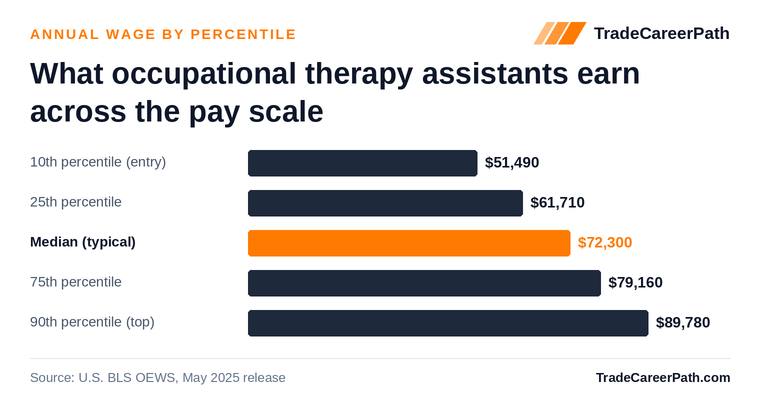
Quick answer: Training as an occupational therapy assistant usually takes about 2 years. You complete an ACOTE-accredited associate degree (tuition is often $10,000 to $30,000), finish supervised clinical fieldwork, then pass the NBCOT certification exam to earn the Certified Occupational Therapy Assistant (COTA) credential. Nearly every state then requires a license to practice. The median occupational therapy assistant salary is $72,300 per year ($34.76/hour), and employers post about 7,200 openings nationwide each year (BLS, May 2025).
Occupational therapy assistants work directly with patients under the direction of a licensed occupational therapist. They guide people through therapeutic exercises and adaptive techniques that help them rebuild motor skills, adjust to a disability, and return to daily activities after an injury or illness.
How to Become an Occupational Therapy Assistant
Most people enter the field in about two years, the time it takes to finish an accredited associate degree. The path is well defined: you complete an approved program, pass a national board exam, and earn a state license before you treat patients on your own.
1. Earn a high school diploma or GED
A high school diploma or GED is the minimum requirement for every OTA program. Because the coursework leans heavily on science, the best preparation is a solid foundation in biology, anatomy, and psychology, along with any health-occupations or sports-medicine classes your school offers. Strong reading and note-taking habits matter too, since you will study kinesiology, medical terminology, and documentation. It also helps to confirm early that you can meet a program’s admission requirements, which often include a minimum GPA, prerequisite science credits, and sometimes documented volunteer or observation hours in a therapy setting. Spending time shadowing an OTA or volunteering in a rehab clinic, nursing facility, or pediatric program is one of the best ways to make sure the work fits you, and it strengthens your application at the same time. If you already hold a diploma or another degree, you can move straight to choosing a program.
2. Complete an ACOTE-accredited OTA program
This is the core credential. You earn an associate degree from a program with accreditation from ACOTE, the accreditation council connected to the American Occupational Therapy Association (AOTA). Accreditation is not optional here: graduating from an ACOTE-accredited program is what makes you eligible to sit for the national certification exam, so confirm a school’s status before you enroll. A typical program takes about two years and blends classroom and lab study with supervised clinical fieldwork. Coursework covers anatomy and kinesiology, conditions across the lifespan, therapeutic methods, adaptive equipment, and clinical documentation. The fieldwork rotations, completed at hospitals, schools, clinics, and long-term care sites, are where you practice real treatment under a licensed supervisor. Some programs offer classroom coursework online or in a hybrid format, but the fieldwork must be done in person at approved sites.
3. Pass the NBCOT certification exam
After you graduate, you sit for the certification exam administered by the National Board for Certification in Occupational Therapy (NBCOT). Passing earns you the Certified Occupational Therapy Assistant (COTA) credential, which is the national standard the profession is built around. The exam tests the knowledge and clinical judgment you developed in your program, so most graduates prepare with NBCOT study materials and practice tests in the weeks after finishing fieldwork. Budget for the exam fee, which is about $555. Earning the COTA credential is the gateway to the next step, because state licensing boards rely on NBCOT certification to confirm you meet national competency standards. Keeping the credential active over time requires ongoing professional development.
4. Obtain your state license
Nearly every state requires occupational therapy assistants to hold a license before they can practice. Requirements are set state by state, but they almost always start with graduating from an ACOTE-accredited program and passing the NBCOT exam. From there, you submit an application to your state’s occupational therapy or health licensing board, pay a fee, and in many states pass a background check. Because the specifics, including renewal periods and continuing-education hours, vary, check your state board’s rules directly before you apply. Renewal typically requires continuing education to keep your skills current, and if you move to another state you will usually need to apply for a license there as well.
5. Start your OTA career and advance
With your license in hand, you can apply for roles across hospitals, outpatient and inpatient rehabilitation centers, skilled nursing and long-term care facilities, school systems, and home health agencies. Tailor your resume to the setting you want, highlight the fieldwork rotations that match it, and use your program’s career office and AOTA membership to find openings and connect with employers. Many new OTAs start in a general setting and then specialize over time in areas such as pediatrics, geriatrics, hand therapy, or mental health. With experience you can move into lead or senior roles, work as a fieldwork educator for students, or bridge into an occupational therapist position by completing the additional graduate-level education that role requires.
What Occupational Therapy Assistants Do
OTAs help patients rebuild the everyday and work skills they need to live independently. Working from a plan a licensed occupational therapist creates, they lead people through therapeutic exercises, teach them how to use adaptive equipment, and adjust activities so each patient can practice skills safely. Their hands-on time with patients is what turns a treatment plan into real progress.
Day to day, an OTA might help a stroke patient relearn how to dress and cook, guide a child with a developmental delay through fine-motor activities, or coach an older adult on moving safely after surgery. They also track how patients respond, update documentation, and keep the supervising therapist informed.
Typical Responsibilities
- Carry out treatment plans developed by occupational therapists
- Lead patients through physical and cognitive therapy activities
- Track progress and update clinical documentation
- Teach patients and families to use adaptive equipment
- Support rehabilitation in hospitals, schools, and clinics
OTAs make a direct difference in their patients’ independence and quality of life.
Key Skills and Traits for Success
- Compassion and patience with people who are recovering
- Clear communication and the ability to motivate
- Physical stamina for hands-on, on-your-feet therapy work
- Creativity in adapting treatments to each patient
- A working grasp of anatomy, psychology, and rehabilitation methods
Work Settings for OTAs
- Hospitals and rehabilitation centers
- Outpatient therapy clinics
- Nursing and long-term care facilities
- Schools and pediatric centers
- Home health agencies
Education and Certification Pathways
| Pathway | Typical Duration | Outcome |
|---|---|---|
| Associate degree (ACOTE-accredited) | About 2 years | Required for entry-level employment |
| NBCOT certification (COTA) | After graduation | National credential required to practice |
| State licensure | Varies by state | Legal requirement to work as an OTA |
Quick Facts: OTA Salary, Education, and Outlook
Career Growth and Advancement
With experience, OTAs can specialize or advance into:
- Occupational therapy specialist in pediatrics, geriatrics, or rehab
- Rehabilitation manager or coordinator
- Occupational therapist (OT) by completing graduate-level education
- Clinical fieldwork educator or program director
Cost and Duration of Training
- Program cost: about varies by school, format and location depending on program and school
- Duration: about 2 years for an associate degree
- NBCOT exam fee: about $555
Many OTA programs offer flexible or hybrid coursework for working students, though fieldwork is completed in person.
Pros and Cons
Pros
- Strong demand and job security
- Emotionally rewarding patient work
- Solid pay for a two-year degree
- Variety of healthcare settings
Cons
- Physically demanding work
- Requires licensure and continuing education
- Can involve emotionally challenging cases
State Licensing and Requirements
Nearly all states require OTAs to hold a license and to be NBCOT certified before practicing. Specific application steps, renewal periods, and continuing-education hours vary by state, so check your state’s occupational therapy or health licensing board for current rules.
Take the First Step Toward a Career as an OTA
If you are compassionate, hands-on, and want to help people regain their independence, training as an occupational therapy assistant offers both purpose and stability.
Industry Organizations & Certifying Bodies
These are the recognized national organizations, unions, certifying bodies, and regulatory authorities that shape this trade. They issue the credentials, sponsor the apprenticeships, publish the codes, and represent workers and employers.
- National Board for Certification in Occupational Therapy (NBCOT) Issues the COTA (Certified Occupational Therapy Assistant) credential required for licensure.
- American Occupational Therapy Association (AOTA) Professional association; ACOTE accredits OTA programs.
Wage and Employment Charts
Occupational Therapy Assistant Salary and Requirements by State
Select your state for local wage data, training options, and requirements:
Alabama · Alaska · Arizona · Arkansas · California · Colorado · Connecticut · Delaware · District of Columbia · Florida · Georgia · Hawaii · Idaho · Illinois · Indiana · Iowa · Kansas · Kentucky · Louisiana · Maine · Maryland · Massachusetts · Michigan · Minnesota · Mississippi · Missouri · Montana · Nebraska · Nevada · New Hampshire · New Jersey · New Mexico · New York · North Carolina · North Dakota · Ohio · Oklahoma · Oregon · Pennsylvania · Rhode Island · South Carolina · South Dakota · Tennessee · Texas · Utah · Vermont · Virginia · Washington · West Virginia · Wisconsin · Wyoming
Workplace Safety Snapshot
BLS Survey of Occupational Injuries and Illnesses data (2023-2024) report approximately 152.9 days-away, restricted, or transfer cases per 10,000 full-time-equivalent workers in occupational therapy assistants (about 1.53 per 100 FTE). Source: BLS Survey of Occupational Injuries and Illnesses, Table R98.
Frequently Asked Questions
How long does occupational therapy assistant training take?
Most people finish in about 2 years through an ACOTE-accredited associate degree program, which is the standard entry credential. After graduation you pass the NBCOT certification exam and apply for a state license before you can practice. A high school diploma or GED is generally required to get started.
Do you need a college degree to work as an occupational therapy assistant?
Yes. Almost all states require an associate degree from an ACOTE-accredited occupational therapy assistant program. That coursework, the supervised fieldwork inside it, and the NBCOT exam together qualify you for state licensure.
How much does occupational therapy assistant training cost?
Tuition for an associate degree program typically runs about $10,000 to $30,000 depending on whether the school is public or private and whether you study in state. The NBCOT certification exam adds a fee of about $555. Costs vary by program and school, so confirm current figures with each one.
Is certification or a license required to work as an OTA?
Yes. You must pass the National Board for Certification in Occupational Therapy (NBCOT) exam to earn the Certified Occupational Therapy Assistant (COTA) credential, and nearly every state then requires a license to practice. License renewal usually requires continuing education.
Is it hard to train as an occupational therapy assistant?
The path is structured and relatively short at about 2 years, but the coursework is rigorous. You study anatomy, kinesiology, and psychology, complete supervised clinical fieldwork, and pass a national board exam. The job itself is physically active and emotionally demanding.
Can you train as an occupational therapy assistant online?
Some ACOTE-accredited programs offer classroom coursework online or in a hybrid format, but the required fieldwork must be completed in person at approved clinical sites. Confirm a program holds ACOTE accreditation before you enroll, since it is required for NBCOT exam eligibility.
What is the difference between an OTA and an occupational therapist?
An occupational therapy assistant works under the direction of a licensed occupational therapist, carrying out treatment plans and guiding patients through therapy activities. An occupational therapist evaluates patients, designs the treatment plan, and holds a master's or doctoral degree. Many OTAs later bridge into an OT role through additional education.
How Occupational Therapy Assistant Pay Compares to Similar Trades
Side-by-side comparison of Occupational Therapy Assistant and the closest related careers, based on U.S. Bureau of Labor Statistics data (May 2025 OEWS + 2024-2034 Employment Projections).
| Career | Median Pay | 10-Year Growth | Annual Openings |
|---|---|---|---|
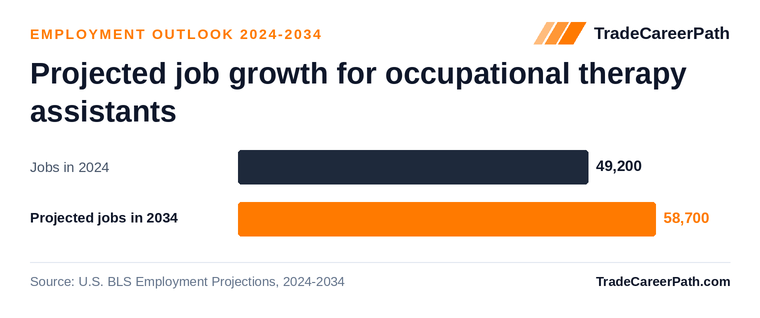
| Occupational Therapy Assistant this guide | $72,300 | +19.2% | 7,200 |
| Physical Therapy Aide | $35,240 | +2.8% | 6,600 |
| Medical Assistant | $45,690 | +12.5% | 112,300 |
| Mental Health Technician | $45,130 | +20.0% | 15,900 |
| Personal Trainer | $47,160 | +11.9% | 74,200 |
Source: BLS Occupational Employment and Wage Statistics + BLS Employment Projections.
Degree and Program Guides
- Online Physical Therapist Assistant Programs - the sibling rehabilitation credential
Sources
- U.S. Bureau of Labor Statistics, Occupational Employment and Wage Statistics (May 2025)
- U.S. Bureau of Labor Statistics, Employment Projections 2024-2034
- U.S. Bureau of Labor Statistics, Survey of Occupational Injuries and Illnesses (2023-2024, Table R98)
- U.S. Department of Labor, Wage and Hour Division, Davis-Bacon General Wage Determinations (2026)
Occupational Therapy Assistant Salary by State
About this guide: Researched and written by the TradeCareerPath Editorial Team. Our editorial team researches and sources every trade school and career guide using federal labor and education data, including BLS OEWS and Employment Projections, DOL apprenticeship records, IPEDS, College Scorecard, and state licensing boards. We follow the editorial standards documented at /editorial-policy/.
Data sources
Figures on this page are sourced from the federal and state datasets below. Methodology: how we rank and source data.
| Data | Provider | Vintage |
|---|---|---|
| Occupational Employment and Wage Statistics (OEWS) | U.S. Bureau of Labor Statistics | May 2025 |
| Employment Projections | U.S. Bureau of Labor Statistics | 2024-2034 |
| Integrated Postsecondary Education Data System | National Center for Education Statistics (IPEDS) | 2024 |
| College Scorecard (school-level outcomes) | U.S. Department of Education | latest release |
| College Scorecard (field-of-study earnings) | U.S. Department of Education | latest release (updated 2026-06-12) |
| Occupational licensing requirements | CareerOneStop (U.S. Department of Labor) | latest release (updated 2026-02-22) |
| Registered apprenticeship programs | CareerOneStop / Apprenticeship.gov (U.S. Department of Labor) | latest release (updated 2025-10-25) |
| O*NET occupation profiles (skills, tasks, tools, job zones) | U.S. Department of Labor (O*NET / Employment & Training Admin.) | O*NET 29.1 (updated 2026-06-13) |