
How to Become an Optician in 2026
Is Optician Right for You?
The U.S. Department of Labor's O*NET profile for Opticians, Dispensing (SOC 29-2081) describes the work this way: Design, measure, fit, and adapt lenses and frames for client according to written optical prescription or specification. Assist client with inserting, removing, and caring for contact lenses. Assist client with selecting frames. Measure customer for size of eyeglasses and coordinate frames with facial and eye measurements and optical prescription. Prepare work order for optical laboratory containing instructions for grinding and mounting lenses in frames. Verify exactness of finished lens spectacles. Adjust frame and lens position to fit client. May shape or reshape frames. Includes contact lens opticians.
What the work involves
- Measure clients' bridge and eye size, temple length, vertex distance, pupillary distance, and optical centers of eyes, using measuring devices.
- Verify that finished lenses are ground to specifications.
- Evaluate prescriptions in conjunction with clients' vocational and avocational visual requirements.
- Recommend specific lenses, lens coatings, and frames to suit client needs.
- Assist clients in selecting frames according to style and color, and ensure that frames are coordinated with facial and eye measurements and optical prescriptions.
Skills and knowledge that matter
Skills: Speaking, Active Listening, Reading Comprehension, Service Orientation, Critical Thinking, Writing.
Knowledge: Customer and Personal Service, Sales and Marketing, Mathematics, Production and Processing.
Tools and technology you may use
Tools: Angling pliers, Autorefractors, Bracing pliers, Bushing pullers, Cash registers, Chain nose pliers.
Technology: Medical software, Data base user interface and query software, Accounting software, Intuit QuickBooks, Microsoft Excel, Microsoft Office software.
Typical preparation
O*NET Job Zone Three (Medium Preparation Needed). Most occupations in this zone require training in vocational schools, related on-the-job experience, or an associate's degree. Employees in these occupations usually need one or two years of training involving both on-the-job experience and informal training with experienced workers. A recognized apprenticeship program may be associated with these occupations.
Interest fit
O*NET interest profile: Conventional, Realistic, Enterprising. People who enjoy structured, detail-oriented work with clear procedures and data often find this occupation a good fit.
Source: O*NET 29.1 (updated 2026-06-13)
Quick answer: Training as an optician usually takes 1 to 2 years through a certificate or associate degree program, with training costs of roughly $3,000 to $12,000. Certification through ABO and NCLE is required or recognized in many states, and some states issue their own license. Opticians earn a median of $47,260 per year ($22.72/hour) with about 6,800 openings nationwide each year (BLS, May 2025).
Opticians, also called optical technicians, help customers select, fit, and adjust eyeglasses and contact lenses. They turn a prescription from an optometrist or ophthalmologist into eyewear that fits and works for the patient.
How to Become an Optician
1. Earn a High School Diploma or GED
A high school diploma or GED is the standard starting point for optician programs and entry-level jobs. While you are in school, take math, physics, and anatomy if they are offered, since opticians work with measurements, lens geometry, and the structure of the eye every day. Basic algebra and geometry help you understand pupillary distance and lens power, and any business or customer-service coursework pays off later because the job is part healthcare and part retail. If your high school has a health-sciences track or a vocational program, those classes give you an early feel for clinical work. You do not need a strong science background to get started, but comfort with numbers and careful, detail-oriented habits will make the technical training that follows much easier to absorb.
2. Complete an Optician Training Program
Most opticians train through a certificate program of about one year or an associate degree of about two years. Coursework covers optical theory, lens materials and coatings, lens surfacing and edging, frame selection, and how to read and interpret a prescription. You also learn to measure pupillary distance, segment height, and other fitting points, plus the basics of contact lens handling. When you compare schools, look for programs with accreditation from the Commission on Opticianry Accreditation (COA), which sets education standards for the field and helps prepare you for certification exams. Many programs run in hybrid or online formats so you can keep working while you study, though the hands-on lab work and fitting practice are usually done in person. Tuition varies widely by program and school, so request cost details and start dates from each school you are considering before you enroll.
3. Gain Hands-On Experience
Classroom theory only takes you so far, so plan to build real fitting skills in a shop or clinic. Many opticians start as apprentices or trainees in a retail optical store, an optometry office, or a hospital eye clinic, and a number of states fold a supervised apprenticeship of two to three years into their path to licensure. On the job you practice taking facial and eye measurements, adjusting frames so they sit correctly, troubleshooting fit complaints, and using lab equipment to edge and mount lenses. You also sharpen the customer-service side of the work, since you spend much of the day explaining options and solving problems for patients. Ask employers whether they offer paid on-the-job training, which is common in this field, and keep track of your supervised hours in case your state board requires them for a license or exam.
4. Earn ABO and NCLE Certification
National certification is the credential most states require or recognize, and it is administered through the American Board of Opticianry and National Contact Lens Examiners (ABO-NCLE). The ABO exam covers dispensing eyeglasses, and the NCLE exam covers fitting contact lenses, so many opticians earn both to qualify for the widest range of jobs. The combined exam fees usually run about $225 to $400. Some states issue their own license on top of the national exams, while others let you work without one, so confirm the rules with your state board early. Once you are certified, expect to complete continuing education to keep your credentials active. Holding ABO and NCLE certification signals to employers that you have met a recognized standard, and it is often what separates a trainee from an optician who can work independently.
5. Apply for Optician Jobs and Advance
With training and certification in hand, you can apply at optical retail chains, vision centers, optometry and ophthalmology offices, and hospital eye departments. Tailor your resume to highlight your measurements, fitting, and lab skills along with any supervised hours and your ABO and NCLE credentials. Once you are working, experience opens up several paths: master opticians take on complex lens fittings, optical lab technicians focus on manufacturing lenses, and others move into store management or open their own shops. Some opticians use the role as a stepping stone toward ophthalmic technician work or further study. Staying current on lens technology and keeping your certifications active helps you move up and increase your earning potential over time.
What Opticians Do
Opticians interpret prescriptions written by optometrists or ophthalmologists to help patients select and fit corrective eyewear.
Typical Responsibilities
- Measure patients’ eyes and facial features for lenses and frames
- Adjust and repair eyeglasses and contact lenses
- Interpret optical prescriptions accurately
- Recommend lens coatings and frame styles
- Educate customers on lens care and maintenance
Opticians are the detail-oriented link between the medical prescription and the patient’s clear vision.
Key Skills and Traits for Success
- Strong communication and customer service
- Precision and hand-eye coordination
- Attention to detail
- Knowledge of optics and lens materials
- Manual dexterity and comfort with lab equipment
Work Settings for Opticians
- Optometry offices and clinics
- Retail optical stores and vision centers
- Hospitals or ophthalmology practices
- Optical laboratories and manufacturing facilities
Education and Certification Pathways
| Pathway | Typical Duration | Outcome |
|---|---|---|
| Certificate Program | 1 year | Entry-level employment |
| Associate Degree | 2 years | Required in some states |
| Apprenticeship | 2-3 years | On-the-job training + licensing prep |
| ABO/NCLE Certification | Exam-based | National credential recognition |
Career Growth and Advancement
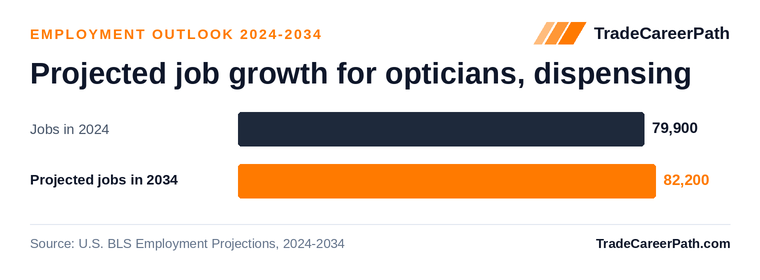
With additional experience and education, opticians can work as:
- Master Opticians, specialists in complex lens fittings
- Optical Lab Technicians, focused on manufacturing lenses
- Store Managers or Business Owners
- Ophthalmic Technicians or Optometrists (with further study)
Cost and Duration of Training
- Program Cost: varies by school, format and location
- Duration: 1 to 2 years
- Certification Exams: $225 to $400 (ABO/NCLE combined)
Many optician programs are hybrid or online, which makes it easier to balance work and study.
Pros and Cons
Pros
- Stable and growing healthcare career
- Rewarding patient interactions
- Opportunities for self-employment
- Strong income potential with experience
Cons
- Standing for long periods
- High attention to precision required
- Licensing varies by state
State Licensing and Requirements
Licensing for opticians varies by state. Some states require passing the ABO and NCLE exams, while others mandate apprenticeships or state-issued licenses.
Quick Facts: Optician Salary, Education, and Outlook
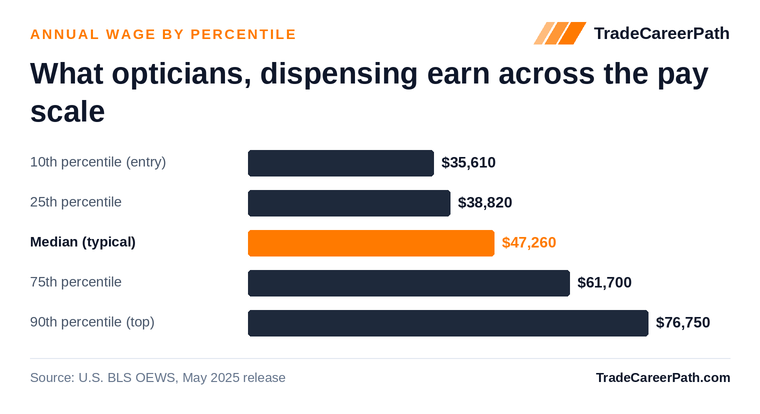
Industry Organizations & Certifying Bodies
These are the recognized national organizations, unions, certifying bodies, and regulatory authorities that shape this trade. They issue the credentials, sponsor the apprenticeships, publish the codes, and represent workers and employers.
- American Board of Opticianry & National Contact Lens Examiners (ABO-NCLE) Issues the ABO and NCLE credentials used in state licensure.
- Commission on Opticianry Accreditation (COA) Accredits optician education programs.
Wage and Employment Charts
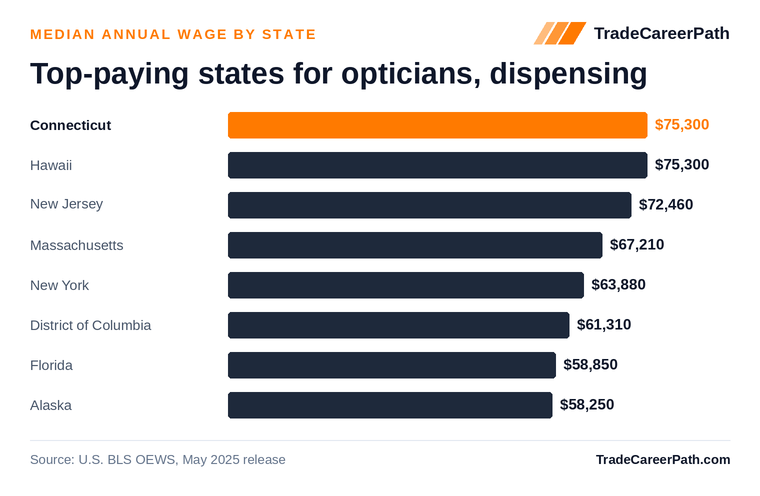
Optician Salary and Requirements by State
Select your state for local wage data, training options, and requirements:
Alabama · Alaska · Arizona · Arkansas · California · Colorado · Connecticut · Delaware · District of Columbia · Florida · Georgia · Hawaii · Idaho · Illinois · Indiana · Iowa · Kansas · Kentucky · Louisiana · Maine · Maryland · Massachusetts · Michigan · Minnesota · Mississippi · Missouri · Montana · Nebraska · Nevada · New Hampshire · New Jersey · New Mexico · New York · North Carolina · North Dakota · Ohio · Oklahoma · Oregon · Pennsylvania · Rhode Island · South Carolina · South Dakota · Tennessee · Texas · Utah · Vermont · Virginia · Washington · West Virginia · Wisconsin · Wyoming
Workplace Safety Snapshot
BLS Survey of Occupational Injuries and Illnesses data (2023-2024) report approximately 11.1 days-away, restricted, or transfer cases per 10,000 full-time-equivalent workers in opticians, dispensing (about 0.11 per 100 FTE). Source: BLS Survey of Occupational Injuries and Illnesses, Table R98.
Frequently Asked Questions
How long does optician training take?
It typically takes 1 to 2 years of training. The most common entry path is a certificate program (about 1 year) or an associate degree (about 2 years). A high school diploma or GED is generally required to get started, and some states add a supervised apprenticeship of 2 to 3 years.
Do you need a college degree to work as an optician?
No. A college degree is not required to work as an optician. Most people enter the field through a certificate or associate degree program. A high school diploma or GED is typically the only educational prerequisite.
How much does optician training cost?
Optician programs typically cost about $3,000 to $12,000 depending on the format and school, with certificate programs generally costing less than associate degrees. The ABO and NCLE certification exams usually add a combined fee of roughly $225 to $400.
Is optician certification or a license required?
It depends on the state. Many states require or recognize national certification through the American Board of Opticianry (ABO) for eyeglasses and the National Contact Lens Examiners (NCLE) for contact lenses, both administered by ABO-NCLE. Some states issue their own license, while others let you work without one. Check your state board before you enroll.
Is it hard to train as an optician?
Entry is relatively accessible because no four-year degree is required and most people finish training in 1 to 2 years. The work itself rewards precision, since you measure eyes, interpret prescriptions, and fit lenses to tight tolerances, so attention to detail and steady hands matter on the job.
Can you train as an optician online?
Yes. Many optician certificate and associate degree programs offer coursework online or in a hybrid format, which makes it easier to study while working. Hands-on labs and fitting practice are usually completed in person or through a supervised work placement.
What does an optician do compared with an optometrist?
An optician fits, adjusts, and dispenses eyeglasses and contact lenses based on a prescription. An optometrist is a doctor who examines eyes, diagnoses vision problems, and writes the prescription. Training as an optometrist requires a doctoral degree, while opticians enter the field through shorter certificate or associate programs.
How Optician Pay Compares to Similar Trades
Side-by-side comparison of Optician Certification Programs and the closest related careers, based on U.S. Bureau of Labor Statistics data (May 2025 OEWS + 2024-2034 Employment Projections).
| Career | Median Pay | 10-Year Growth | Annual Openings |
|---|---|---|---|
| Optician Certification Programs this guide | $47,260 | +2.9% | 6,800 |
| Pharmacy Technician | $45,750 | +6.4% | 49,000 |
| Medical Assistant | $45,690 | +12.5% | 112,300 |
| Dental Assistant | $48,070 | +6.4% | 52,900 |
Source: BLS Occupational Employment and Wage Statistics + BLS Employment Projections.
Sources
- U.S. Bureau of Labor Statistics, Occupational Employment and Wage Statistics (May 2025)
- U.S. Bureau of Labor Statistics, Employment Projections 2024-2034
- U.S. Bureau of Labor Statistics, Survey of Occupational Injuries and Illnesses (2023-2024, Table R98)
- U.S. Department of Labor, Wage and Hour Division, Davis-Bacon General Wage Determinations (2026)
Optician Salary by State
About this guide: Researched and written by the TradeCareerPath Editorial Team. Our editorial team researches and sources every trade school and career guide using federal labor and education data, including BLS OEWS and Employment Projections, DOL apprenticeship records, IPEDS, College Scorecard, and state licensing boards. We follow the editorial standards documented at /editorial-policy/.
Data sources
Figures on this page are sourced from the federal and state datasets below. Methodology: how we rank and source data.
| Data | Provider | Vintage |
|---|---|---|
| Occupational Employment and Wage Statistics (OEWS) | U.S. Bureau of Labor Statistics | May 2025 |
| Employment Projections | U.S. Bureau of Labor Statistics | 2024-2034 |
| Integrated Postsecondary Education Data System | National Center for Education Statistics (IPEDS) | 2024 |
| College Scorecard (school-level outcomes) | U.S. Department of Education | latest release |
| College Scorecard (field-of-study earnings) | U.S. Department of Education | latest release (updated 2026-06-12) |
| Occupational licensing requirements | CareerOneStop (U.S. Department of Labor) | latest release (updated 2026-02-22) |
| Registered apprenticeship programs | CareerOneStop / Apprenticeship.gov (U.S. Department of Labor) | latest release (updated 2025-10-25) |
| O*NET occupation profiles (skills, tasks, tools, job zones) | U.S. Department of Labor (O*NET / Employment & Training Admin.) | O*NET 29.1 (updated 2026-06-13) |