
How to Become a Paralegal in 2026
Is Paralegal Right for You?
The U.S. Department of Labor's O*NET profile for Paralegals and Legal Assistants (SOC 23-2011) describes the work this way: Assist lawyers by investigating facts, preparing legal documents, or researching legal precedent. Conduct research to support a legal proceeding, to formulate a defense, or to initiate legal action.
What the work involves
- Prepare affidavits or other documents, such as legal correspondence, and organize and maintain documents in paper or electronic filing system.
- Prepare, edit, or review legal documents, including legislation, briefs, pleadings, appeals, wills, contracts, and real estate closing statements.
- Investigate facts and law of cases and search pertinent sources, such as public records and internet sources, to determine causes of action and to prepare cases.
- Prepare for trial by performing tasks such as organizing exhibits.
- Meet with clients and other professionals to discuss details of cases.
Skills and knowledge that matter
Skills: Writing, Reading Comprehension, Active Listening, Speaking, Critical Thinking, Active Learning.
Knowledge: Law and Government, English Language, Administrative, Computers and Electronics.
Tools and technology you may use
Technology: Analytical or scientific software, Document management software, Information retrieval or search software, Adobe Acrobat, Google Docs, Google Workspace software.
Typical preparation
O*NET Job Zone Three (Medium Preparation Needed). Most occupations in this zone require training in vocational schools, related on-the-job experience, or an associate's degree. Employees in these occupations usually need one or two years of training involving both on-the-job experience and informal training with experienced workers. A recognized apprenticeship program may be associated with these occupations.
Interest fit
O*NET interest profile: Conventional, Investigative, Enterprising. People who enjoy structured, detail-oriented work with clear procedures and data often find this occupation a good fit.
Source: O*NET 31.0 (updated 2026-10-14)
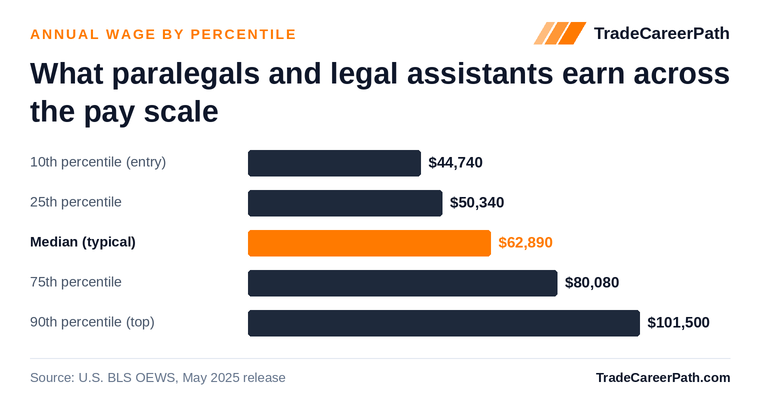
Quick answer: Training as a paralegal usually takes 6 months to 2 years. You complete a paralegal certificate ($4,000 to $15,000) or an associate degree, get hands-on experience through an internship or entry-level legal job, and can earn an optional certification such as the NALA Certified Paralegal (CP). No law degree or bar exam is required, and most states do not require a license. The median paralegal salary is $62,890 per year ($30.24/hour), and employers post about 40,800 openings nationwide each year (BLS, May 2025).
Paralegals, also called legal assistants, are essential inside law firms, corporate legal teams, and government offices. They research laws, organize evidence, prepare documents, and support attorneys before, during, and after major legal actions. If you enjoy facts, precision, and problem solving, this is a direct path into the legal field without the time or cost of law school.
How to Become a Paralegal
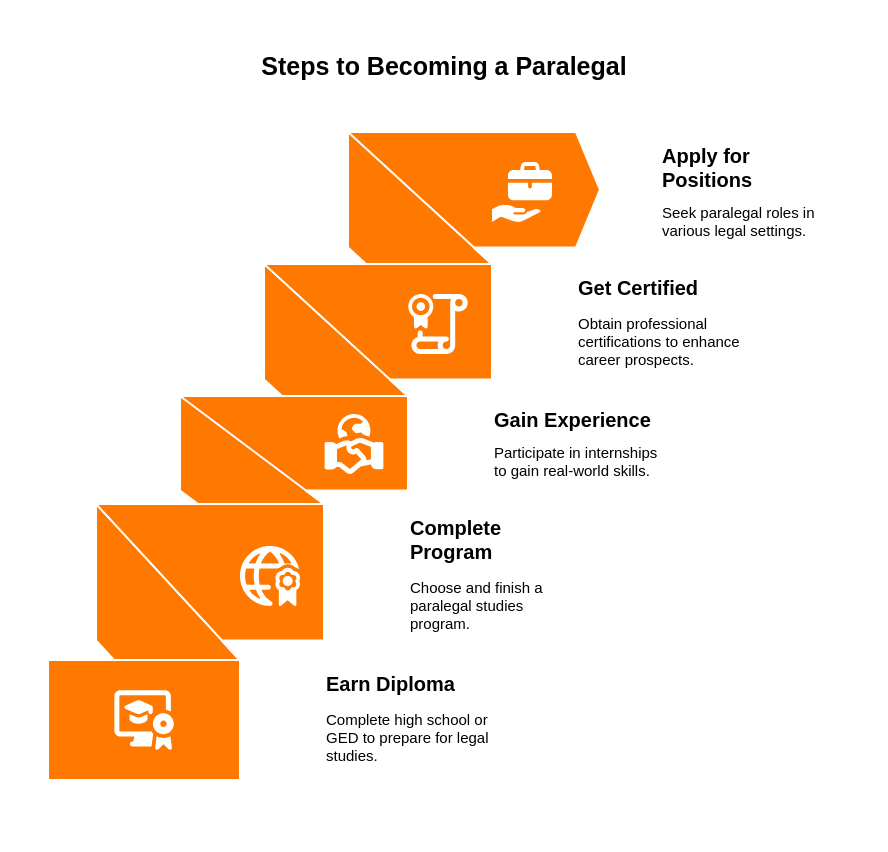
Most people enter the field in about six months to two years, depending on the education path they choose. There is no single licensing exam to pass. Instead, you build the career through education, hands-on experience, and an optional certification.
1. Earn a high school diploma or GED
A high school diploma or GED is the minimum requirement for every paralegal program and almost every entry-level legal job. Before you enroll, it helps to build the skills the work depends on: clear writing, careful reading, and basic research. English composition, government or civics, and any class that asks you to write structured arguments are good preparation for paralegal coursework. Being comfortable with computers and office software matters too, since legal work runs on document management systems, e-filing portals, and case databases. If you are changing careers and already hold a diploma or a degree in another field, you can move straight to the next step. Many strong paralegals come from unrelated backgrounds and bring useful skills in organization, communication, and project management.
2. Complete a paralegal studies program
This is the core credential, and you have several formats to choose from:
- Certificate programs take roughly 6 to 12 months and are popular with adults who already have a degree or work experience and want to switch into legal work quickly.
- Associate degree programs take about 2 years and are the most common route into the field, combining general-education credits with paralegal-specific coursework.
- Bachelor’s degrees in paralegal studies or legal studies take about 4 years and can help with corporate or senior roles.
When comparing schools, look for American Bar Association (ABA) approval. ABA approval is voluntary and not legally required, but many employers prefer it because it signals the program meets recognized standards for curriculum and faculty. Typical coursework covers legal research and writing, civil litigation and procedure, contracts, torts, ethics and professional responsibility, and legal technology. Many certificate and associate programs are available fully online, which lets working students learn at a flexible pace. Just confirm the program’s accreditation before you enroll.
3. Gain practical experience
Coursework prepares you, but employers want to see real experience. Look for an internship or externship, which many ABA-approved programs build into the curriculum, so you can practice drafting documents, organizing discovery, and using case-management software under supervision. If a formal internship is not available, entry-level roles such as legal assistant, file clerk, or law-office receptionist get you inside a firm where you can learn the workflow and earn references. As you go, save your best work, such as a research memo, a drafted pleading, or a well-organized case summary, in a writing sample portfolio. Hiring attorneys care more about whether you can produce accurate, well-written work than about which school you attended, and good samples are the best way to show it.
4. Consider professional certification
Certification is voluntary in most states, but it can strengthen your resume, signal commitment, and support higher pay. The most widely recognized credentials are:
- Certified Paralegal (CP) from NALA, the Paralegal Association
- Registered Paralegal (RP) from the National Federation of Paralegal Associations (NFPA), earned through the PACE exam
- Professional Paralegal (PP) from NALS, the Association for Legal Professionals
Eligibility generally depends on a combination of education and work experience, and each exam tests legal knowledge, ethics, and analytical skills. Exam fees usually run about $150 to $300. A handful of states also set their own rules. California, for example, defines specific education and continuing-education requirements for anyone using the title “paralegal.” Check your state bar or paralegal association for local rules before you sit for an exam.
5. Apply for paralegal roles
Law firms, corporate legal departments, government agencies, courts, and nonprofits all hire paralegals. Tailor your resume to the practice area you are targeting, such as litigation, family law, real estate, or corporate work, and attach the writing samples you built in step 3. Networking through a local or national paralegal association is one of the fastest ways to hear about openings, and many associations offer job boards and mentorship to new members. Once you land a role, on-the-job experience and any certifications you have earned can open the door to senior paralegal, paralegal manager, and corporate compliance positions over time.
How long does paralegal training take?
Your timeline depends mostly on where you are starting from:
| Your starting point | Typical path | Time to first paralegal job |
|---|---|---|
| High school diploma / GED | Associate degree in paralegal studies | About 2 years |
| Some college or a degree in another field | Paralegal certificate program | 6 to 12 months |
| Career changer who wants a degree | Associate degree (full-time) | About 2 years |
| Already working as a legal assistant | Certificate + on-the-job experience | 6 to 12 months |
These are typical ranges; part-time study, online formats, and internships can shorten or extend the timeline.
Paralegal vs. Legal Assistant
People often ask how a paralegal differs from a legal assistant. The line between them is fuzzy. The U.S. Bureau of Labor Statistics groups both under one occupation, “Paralegals and Legal Assistants,” and reports a single set of wage and employment numbers for the two titles together.
Where employers do draw a distinction, it usually looks like this:
- Paralegal: usually describes substantive legal work, such as researching law, drafting pleadings and contracts, managing discovery, and assisting attorneys directly on cases. These roles more often expect formal paralegal education or certification.
- Legal assistant: sometimes used for more administrative support, such as scheduling, correspondence, file management, and client intake. Requirements can be lighter, though many legal assistants do substantive work too.
Because definitions vary by firm, always read the actual job description rather than relying on the title alone. The educational path in this guide prepares you for jobs posted under either label.
Quick Facts: Paralegal Salary, Education, and Outlook
What Paralegals Do
Paralegals keep legal cases organized, documented, and moving. They gather information, prepare drafts of key documents, and support attorneys by taking on the detail heavy tasks that legal work demands. This lets attorneys focus on strategy, negotiations, and courtroom preparation.
Typical tasks include reviewing records, researching statutes, and preparing legal correspondence. Paralegals also organize discovery materials so evidence is easy to reference, maintain calendars and deadlines, schedule hearings, and communicate with clients or witnesses. Their work ensures every part of a case file is clear, accurate, and accessible when the legal team needs it.
Typical Responsibilities
- Research laws, case precedents, and regulations
- Draft legal documents and contracts
- Organize discovery materials and trial exhibits
- Interview clients and witnesses
- Track case deadlines, filings, and court requirements
Paralegals form the organizational backbone of a law office. Their work keeps cases on track and fully documented.
Key Skills and Traits for Success
- Strong legal writing and research skills
- Attention to detail and organized workflow
- Ability to manage several cases at once
- Professional ethics and confidentiality
- Comfort with legal software and databases
- Clear, confident communication
Work Settings for Paralegals
Paralegals can work in many environments including:
- Law firms in areas like litigation, family law, criminal law, or corporate law
- Corporate legal departments
- Government agencies and court systems
- Nonprofit organizations
- Real estate and financial institutions
Education and Certification Paths
| Pathway | Typical Duration | Outcome |
|---|---|---|
| Certificate | 6 to 12 months | Entry level preparation |
| Associate Degree | 2 years | Most common credential |
| Bachelor’s Degree | 4 years | Helpful for advanced or corporate roles |
| Post Baccalaureate Certificate | 6 to 12 months | Ideal for career changers |
Career Growth and Advancement
With experience, paralegals may move into roles such as:
- Senior Paralegal who mentors newer staff and manages complex cases
- Legal Analyst or Compliance Officer for corporate environments
- Paralegal Manager who oversees teams and workflows
- Law Student or J.D. Candidate for those who later choose to pursue law school
Cost and Duration of Training
- Program cost: often ranges from about varies by school, format and location depending on format and school
- Time to complete: six months to two years
- Certification exam fees: generally around $150 to $300
Many paralegal programs are available online, which helps students learn at a flexible pace.
Pros and Cons
Pros
- Reliable long term career outlook
- Meaningful work that supports justice and problem solving
- Clear entry path into the legal field
- No law degree required
Cons
- Deadline driven environment
- Occasional long hours during trial preparation
- Exposure to stressful or emotional cases
Take the First Step Toward a Paralegal Career
If you are organized, analytical, and interested in the legal system, a paralegal career offers a respected way to work inside law without the years of law school.
Industry Organizations & Certifying Bodies
These are the recognized national organizations, unions, certifying bodies, and regulatory authorities that shape this trade. They issue the credentials, sponsor the apprenticeships, publish the codes, and represent workers and employers.
- National Association of Legal Assistants (NALA) Issues the Certified Paralegal (CP) credential.
- National Federation of Paralegal Associations (NFPA) Issues the PACE (RP) and PCCE (CRP) credentials.
- American Bar Association (ABA) Paralegal Approval Approves paralegal education programs.
Wage and Employment Charts
Paralegal Salary and Requirements by State
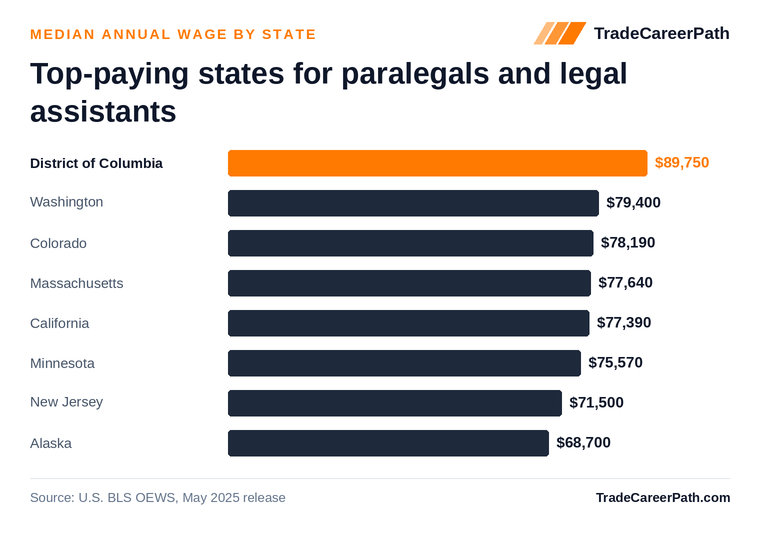
Select your state for local wage data, training options, and requirements:
Alabama · Alaska · Arizona · Arkansas · California · Colorado · Connecticut · Delaware · District of Columbia · Florida · Georgia · Hawaii · Idaho · Illinois · Indiana · Iowa · Kansas · Kentucky · Louisiana · Maine · Maryland · Massachusetts · Michigan · Minnesota · Mississippi · Missouri · Montana · Nebraska · Nevada · New Hampshire · New Jersey · New Mexico · New York · North Carolina · North Dakota · Ohio · Oklahoma · Oregon · Pennsylvania · Rhode Island · South Carolina · South Dakota · Tennessee · Texas · Utah · Vermont · Virginia · Washington · West Virginia · Wisconsin · Wyoming
Workplace Safety Snapshot
BLS Survey of Occupational Injuries and Illnesses data (2023-2024) report approximately 9.0 days-away, restricted, or transfer cases per 10,000 full-time-equivalent workers in paralegals and legal assistants (about 0.09 per 100 FTE). Source: BLS Survey of Occupational Injuries and Illnesses, Table R98.
Frequently Asked Questions
How long does paralegal training take?
It typically takes 6 months to 2 years of training. The most common entry path is a certificate program (6 to 12 months) or an associate degree (about 2 years). A high school diploma or GED is generally required to get started.
How much does paralegal training cost?
Paralegal programs typically cost about $4,000 to $15,000 depending on the format and school, with certificate programs generally costing less than degree programs. Optional certification exams usually add a fee of roughly $150 to $300.
Do you need a college degree to work as a paralegal?
No. A college degree is not required to work as a paralegal. Most people enter the field through a certificate or associate degree program. A high school diploma or GED is typically the only educational prerequisite.
Is paralegal certification required?
In most states, certification is voluntary rather than legally required. Credentials such as the NALA Certified Paralegal (CP), NFPA Registered Paralegal (RP), or NALS Professional Paralegal (PP) can strengthen your resume and earning potential. A few states, such as California, set specific education or experience qualifications for using the paralegal title.
Is it hard to train as a paralegal?
Entry is relatively accessible because no law degree or bar exam is required, and most people finish training in 6 months to 2 years. The coursework and the job itself are demanding, however, with an emphasis on legal research, precise writing, and meeting strict deadlines.
What is the difference between a paralegal and a legal assistant?
The U.S. Bureau of Labor Statistics groups them in a single occupation, "Paralegals and Legal Assistants," and the titles are often used interchangeably. Both support attorneys by researching law, drafting documents, and organizing case files. Some firms use "legal assistant" for more administrative roles and "paralegal" for substantive legal work, but definitions vary by employer.
Can you train as a paralegal online?
Yes. Many accredited colleges and ABA-approved schools offer paralegal certificate and associate degree programs fully online. Before enrolling, confirm the program's accreditation and, where possible, its American Bar Association approval.
How Paralegal Pay Compares to Similar Trades
Side-by-side comparison of Paralegal and the closest related careers, based on U.S. Bureau of Labor Statistics data (May 2025 OEWS + 2025-2035 Employment Projections).
| Career | Median Pay | 10-Year Growth | Annual Openings |
|---|---|---|---|
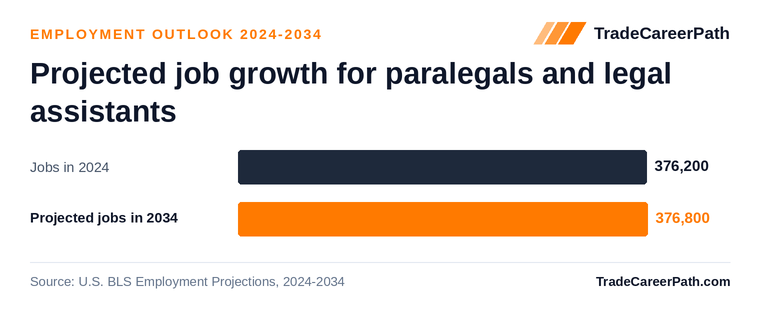
| Paralegal this guide | $62,890 | -0.3% | 40,800 |
| Digital Court Reporter | $72,420 | -0.1% | 1,800 |
| Medical Office Administration | $45,930 | +4.8% | 89,200 |
Source: BLS Occupational Employment and Wage Statistics + BLS Employment Projections.
Degree and Program Guides
- Online Criminal Justice Degrees - the adjacent public-safety and legal degree track
Sources
- U.S. Bureau of Labor Statistics, Occupational Employment and Wage Statistics (May 2025)
- U.S. Bureau of Labor Statistics, Employment Projections 2025-2035
- U.S. Bureau of Labor Statistics, Survey of Occupational Injuries and Illnesses (2023-2024, Table R98)
- U.S. Department of Labor, Wage and Hour Division, Davis-Bacon General Wage Determinations (2026)
Paralegal Salary by State
About this guide: Researched and written by the TradeCareerPath Editorial Team. Our editorial team researches and sources every trade school and career guide using federal labor and education data, including BLS OEWS and Employment Projections, DOL apprenticeship records, IPEDS, College Scorecard, and state licensing boards. We follow the editorial standards documented at /editorial-policy/.
Data sources
Figures on this page are sourced from the federal and state datasets below. Methodology: how we rank and source data.
| Data | Provider | Vintage |
|---|---|---|
| Occupational Employment and Wage Statistics (OEWS) | U.S. Bureau of Labor Statistics | May 2025 |
| Employment Projections | U.S. Bureau of Labor Statistics | 2025-2035 |
| Integrated Postsecondary Education Data System | National Center for Education Statistics (IPEDS) | 2024 |
| College Scorecard (school-level outcomes) | U.S. Department of Education | latest release |
| College Scorecard (field-of-study earnings) | U.S. Department of Education | latest release (updated 2026-06-12) |
| Occupational licensing requirements | CareerOneStop (U.S. Department of Labor) | latest release (updated 2026-02-22) |
| Registered apprenticeship programs | CareerOneStop / Apprenticeship.gov (U.S. Department of Labor) | latest release (updated 2025-10-25) |
| O*NET occupation profiles (skills, tasks, tools, job zones) | U.S. Department of Labor (O*NET / Employment & Training Admin.) | O*NET 31.0 (updated 2026-10-14) |