
Paramedic to RN Bridge Programs: From the Rig to a $97K License (2026)
Quick answer: Paramedic to RN bridges credit your EMS training and field hours toward the nursing degree, typically finishing in 12 to 18 months. The move trades the rig for the unit and raises the median from $60,600 (paramedic) to $97,550 (RN), per BLS OEWS, May 2025.
The Medic to Nurse Pay Gap
| Credential | National median pay | Source |
|---|---|---|
| EMT | $44,470 | BLS OEWS, May 2025 |
| Paramedic | $60,600 | BLS OEWS, May 2025 |
| Registered Nurse (RN) | $97,550 | BLS OEWS, May 2025 |
Medics arrive at nursing school with the strongest patient-assessment skills of any bridge population; ER and ICU units actively recruit former paramedics for exactly that reason.
The gap is not just the median. Registered nursing is a 3,379,720-person occupation nationally (BLS OEWS, May 2025), which means more employers, more shift options, and more room to change specialties without changing careers - things a medic locked into one county’s EMS system rarely gets.
How the Bridge Works
The bridge format exists because making an experienced medic sit through a full standard nursing program is a waste of everyone’s time. You already assess patients, push meds, manage airways, and run scenes; the bridge grants advanced placement for that training and backfills what EMS never taught - long-horizon care planning, pharmacology beyond the drug box, and the nursing process the NCLEX is built around. The typical sequence looks like this:
- Meet the entry bar. Active paramedic certification (NRP or state) plus, at most programs, 1 to 2 years of field experience.
- Choose your bridge. Paramedic-to-ADN is the fast route (12 to 18 months); paramedic-to-BSN (about 3 years) lands at the credential large hospital systems prefer. See the RN to BSN guide for why that matters.
- Complete the program. Advanced placement for EMS training, with coursework scheduled for working medics and clinicals in person.
- Pass the NCLEX-RN. Most bridge curricula include prep; your assessment instincts are an advantage on the clinical-judgment questions.
- Pick your unit. ER and critical care are the natural landings for former medics, and both are on the RN career path.
What the Work Is Like on the Other Side
The honest difference between the rig and the unit is scope of time. On the truck you own a patient for 20 to 40 minutes: assess, stabilize, transport, hand off, clear. As an RN you own the same patient for a 12-hour shift - or, on a med-surg floor, four to six of them at once. The adrenaline moments still exist, especially in the ER and ICU, but the job between them is different work: titrating drips against orders and lab values, catching the slow deterioration a monitor will not alarm on, coordinating with physicians, pharmacy, and family, and charting everything in a way that stands up to audit.
Former medics tend to land in three places. The ER is the most natural fit - triage is field assessment with a badge, and ER charge nurses love hiring people who have already run codes in a living room. The ICU rewards the same instincts at a slower, deeper level: fewer patients, more physiology, ventilators and vasoactive drips instead of load-and-go. Med-surg is the least glamorous landing and the most common first job, and it teaches the time-management and delegation skills the field never demanded of you.
What you give up: autonomy at the scene. In EMS you are the highest medical authority present; on the unit you work under physician orders and hospital policy, and the nursing process is more procedural than field protocols. Most medics make peace with that trade quickly, because what you get back is a controlled environment, a team down the hall instead of a radio, lifting help, climate control, and a schedule measured in shifts rather than 24s. Your back will notice before your paycheck does.
Scheduling is the other quiet upgrade. Hospital nursing runs on three 12-hour shifts a week - a full-time paycheck with four days off, no station time, no posting on a street corner between calls, and no mandatory holdover because the next crew called in. Plenty of former medics use those off days for a per-diem EMS shift at first; most stop within a year, and not because they miss it less than they expected - because the RN differentials pay better than the nostalgia.
What RNs Earn: The Full Range
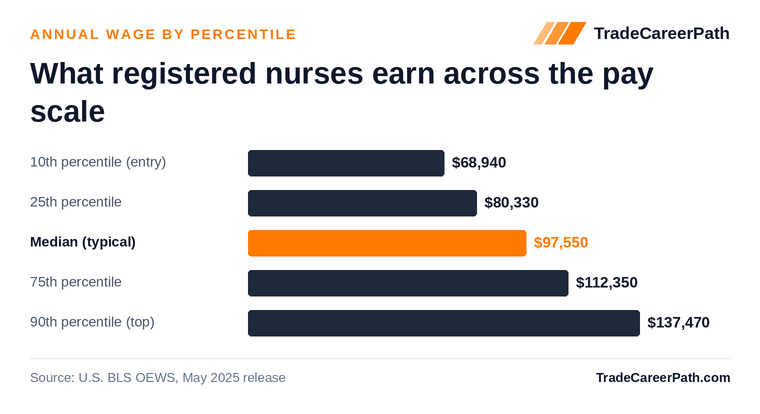
The RN median of $97,550 is only the midpoint. The 10th percentile - roughly where new licensees start in lower-cost markets - is $68,940, which is already above the paramedic median. The 90th percentile reaches $137,470, and the national mean of $101,420 sits above the median because high-cost states pull the average up (BLS OEWS, May 2025).
Read those percentiles against your current run sheet. A medic earning the paramedic median of $60,600 who finishes an 18-month bridge and starts at the RN 10th percentile of $68,940 has taken a raise on day one of orientation - and the median, not the floor, is the realistic mid-career landing. In EMS, reaching the equivalent of the RN 75th percentile usually means going supervisor or flight; in nursing it means being a good staff nurse in the right unit and state.
RN Career Ladder: Titles and Realistic Pay
The wage percentiles map cleanly onto how hospital nursing careers actually progress. Use this as a sanity check on offers, not a guarantee:
| Stage | Typical titles | Years in | Realistic pay (BLS OEWS, May 2025) |
|---|---|---|---|
| New licensee | Graduate nurse, RN I (med-surg, ER, tele) | 0-2 | ~$68,940-$80,330 (10th-25th pct) |
| Established RN | Staff RN II/III, ER or ICU RN | 2-7 | ~$97,550 (median) |
| Senior / specialty | Charge nurse, preceptor, flight or cath-lab RN | 7-12 | ~$112,350 (75th pct) |
| Leadership / advanced | Nurse manager, house supervisor, APRN-track | 12+ | $137,470+ (90th pct) |
Two notes for medics reading this. First, EMS years compress the bottom of this ladder - hospitals routinely move former paramedics through orientation faster and into ER or ICU seats earlier than typical new grads. Second, the base-wage data above excludes shift differentials, overtime, and travel-contract rates, which is where a lot of real RN income lives; night and weekend differentials alone can move a staff nurse a full band up this table.
Where RNs Earn the Most
| State | Median annual wage | Employment |
|---|---|---|
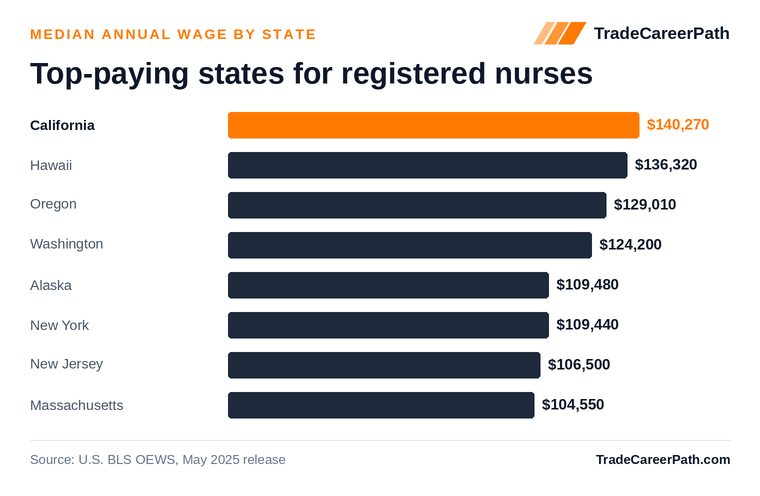
| California | $140,270 | 338,940 |
| Hawaii | $136,320 | 12,940 |
| Oregon | $129,010 | 39,730 |
| Washington | $124,200 | 69,260 |
| Alaska | $109,480 | 7,510 |
The West Coast premium is real: a median RN in California out-earns a 90th-percentile RN nationally. But the license travels - unlike a paramedic cert tied to one state’s protocols and one county’s medical director, an RN license moves through the Nurse Licensure Compact, and the pay floor is solid everywhere: Texas employs 271,380 RNs at a $95,970 median, and Florida 229,940 at $84,190 (BLS OEWS, May 2025).
Job Outlook Through 2034
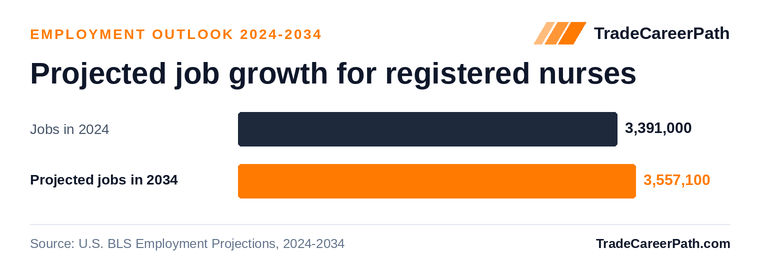
BLS projects RN employment to grow 5.6% from 2025 to 2035 - from 3,465,400 to 3,660,100 jobs (BLS Employment Projections, 2025-35). The number that matters more for a career changer is openings: about 180,800 per year once retirements and occupation changes are counted. That is not a niche field with a hiring window; it is one of the largest, steadiest replacement markets in the economy, driven by an aging patient population and an aging nursing workforce retiring out ahead of it.
Wages have moved with that demand - the projections dataset put the 2024 median at $93,600, and the May 2025 OEWS median is $97,550. For a medic weighing the tuition and 12 to 18 months of grind, the practical read: you are bridging into an occupation that hires everywhere, every year, and has been raising pay to do it.
Licensing: NCLEX-RN and the State Board
Unlike much of the trades world, there is no experience-based workaround here - RN licensure is mandatory in all 50 states, and the path has three fixed gates:
- Graduate from a board-approved nursing program. ADN or BSN; for bridge students, verify the program holds ACEN or CCNE accreditation and approval from the state board where you intend to practice. Your paramedic cert gets you advanced placement inside the program - it does not substitute for the degree at the board.
- Pass the NCLEX-RN. The national licensing exam, now built around clinical-judgment case questions. Medics generally test well on prioritization and emergencies; the traps are pharmacology depth and answers that follow the nursing process rather than field protocol. Answer as the nurse the board wants, not the medic you were.
- Hold an active state board license. Application, background check, and fees run through your state’s board of nursing. Most states participate in the Nurse Licensure Compact, so one multistate license covers practice across compact states - a genuine upgrade over EMS certification, which typically chains you to one state’s system and one medical director’s protocols.
Renewal is periodic and includes continuing-education requirements that vary by state. Specialty certifications (CEN for emergency, CCRN for critical care) are voluntary but are the standard way former medics signal expertise and move up the ladder above.
Frequently Asked Questions
How long does a paramedic to RN bridge take?
Most paramedic-to-RN (ADN) bridges run 12 to 18 months, crediting your paramedic training and field experience toward the nursing curriculum. Standard non-bridge ADN programs take 24 months by comparison.
How much more does an RN make than a paramedic?
The national median for registered nurses is $97,550 versus $60,600 for paramedics (BLS OEWS, May 2025), a median difference of about $37,000 per year, typically with better schedules and less physical wear.
Does paramedic experience count toward nursing school?
In bridge programs, yes: your EMS coursework, patient assessment skills, and field hours earn advanced placement. That is the entire point of the bridge format versus starting a standard nursing program from zero.
Can paramedics do the RN bridge online?
Coursework is commonly online or evening-format for working medics; clinical rotations are in person at facilities near you. Look for ACEN or CCNE accredited programs.
Is the paramedic to RN bridge hard?
The clinical side is easier for medics than for any other student population - assessment and emergencies are already your job. The hard parts are pharmacology depth, care-planning paperwork, and NCLEX-style questions that reward nursing-process answers over field-protocol answers.
Should a paramedic get an ADN or a BSN?
The ADN bridge is the fastest route to the RN license and RN pay - the national median is $97,550 (BLS OEWS, May 2025) with either degree. The BSN takes longer but is preferred by large hospital systems and required for most leadership and specialty tracks; many medics do the ADN bridge first, then an online RN-to-BSN while earning RN wages.
Can you train as an RN without a nursing degree?
No. Every state requires graduation from an approved nursing program (ADN or BSN) before you can sit the NCLEX-RN. Paramedic certification alone does not qualify you - the bridge program is the shortcut, not a workaround.
What license does an RN need?
You must pass the NCLEX-RN and hold an active license from your state board of nursing - both are mandatory in all 50 states. Most states belong to the Nurse Licensure Compact, which lets one multistate license cover practice in other compact states.
Keep Climbing
- How to Become a Registered Nurse: the full guide
- LPN to RN bridge programs
- RN to BSN online
- Paramedic career guide
- All trade careers that require a 4-year degree
Degree and Program Guides
- Online Nursing Degrees - all nursing routes compared
- Accelerated BSN Programs - the fast route if you already hold a bachelor’s
Sources
- U.S. Bureau of Labor Statistics, Occupational Employment and Wage Statistics (OEWS), May 2025 - Registered Nurses (SOC 29-1141); Emergency Medical Technicians (29-2042); Paramedics (29-2043)
- U.S. Bureau of Labor Statistics, Employment Projections, 2025-35
- U.S. Bureau of Labor Statistics, Occupational Outlook Handbook - registered nurses, education and licensure
Paramedic to Rn Salary by State
About this guide: Researched and written by the TradeCareerPath Editorial Team. Our editorial team researches and sources every trade school and career guide using federal labor and education data, including BLS OEWS and Employment Projections, DOL apprenticeship records, IPEDS, College Scorecard, and state licensing boards. We follow the editorial standards documented at /editorial-policy/.
Data sources
Figures on this page are sourced from the federal and state datasets below. Methodology: how we rank and source data.
| Data | Provider | Vintage |
|---|---|---|
| Occupational Employment and Wage Statistics (OEWS) | U.S. Bureau of Labor Statistics | May 2025 |
| Employment Projections | U.S. Bureau of Labor Statistics | 2025-2035 |
| Integrated Postsecondary Education Data System | National Center for Education Statistics (IPEDS) | 2024 |
| College Scorecard (school-level outcomes) | U.S. Department of Education | latest release |
| College Scorecard (field-of-study earnings) | U.S. Department of Education | latest release (updated 2026-06-12) |
| Occupational licensing requirements | CareerOneStop (U.S. Department of Labor) | latest release (updated 2026-02-22) |
| Registered apprenticeship programs | CareerOneStop / Apprenticeship.gov (U.S. Department of Labor) | latest release (updated 2025-10-25) |
| O*NET occupation profiles (skills, tasks, tools, job zones) | U.S. Department of Labor (O*NET / Employment & Training Admin.) | O*NET 31.0 (updated 2026-10-14) |