
How to Become a Paramedic: Steps and Training
Paramedics are the most highly trained professionals in emergency medical response.
They provide advanced life support, administer medication, and make critical decisions that save lives every day.
Paramedics build upon EMT-level training with deeper medical knowledge and clinical experience.
They manage trauma, cardiac, and respiratory emergencies while coordinating with hospitals and physicians.
If you want to take your emergency medical career to the next level, a career as a paramedic offers a challenging and respected path in healthcare.
Quick answers
What does a paramedic do?
Paramedics provide advanced pre-hospital care, administer medication, and make critical decisions during emergencies. They transport patients safely to medical facilities.
Do you have to be an EMT first?
Yes. This guide explains that all paramedics begin as certified EMTs before moving into paramedic-level training.
How long does paramedic training take?
Training as a paramedic typically takes 1.5 to 2 years, including classroom study, clinical experience, and certification.
What certification exam is required?
This page references passing the NREMT Paramedic exam for national certification recognized by most states.
How much does paramedic training cost?
Program costs are listed at varies by school, format and location with certification fees typically under $500.
At a glance
- Role: advanced life support and pre-hospital emergency care
- Typical timeline: 1.5 to 2 years (includes clinical and certification)
- Typical cost: program cost varies by school and format; certification fees typically under $500
- Common workplaces: EMS/ambulance, fire departments, hospitals, air medical transport, industrial or event teams
What Paramedics Do
Paramedics provide advanced pre-hospital care and manage complex medical emergencies in the field.
They perform lifesaving procedures, administer medications, and transport patients safely to medical facilities.
Typical Responsibilities
- Respond to 911 emergency calls
- Assess patients and make treatment decisions
- Administer IVs, medications, and advanced airway management
- Operate defibrillators and life-support equipment
- Coordinate care with doctors and nurses during transport
Paramedics combine clinical knowledge with calm judgment to deliver advanced emergency care in critical moments.
Key Skills and Traits for Success
- Advanced knowledge of anatomy and physiology
- Strong problem-solving and quick decision-making
- Emotional resilience and composure in emergencies
- Physical stamina for lifting and patient care
- Excellent communication and teamwork
Work Settings for Paramedics
Paramedics work in:
- Emergency medical services (EMS) and ambulance units
- Fire departments
- Air medical transport or critical care units
- Hospitals and emergency departments
- Industrial or event medical teams
How to Become a Paramedic (5 Steps)
Training as a paramedic typically takes 1.5 to 2 years, including classroom study, clinical experience, and certification.
1. Earn EMT Certification
All paramedics begin as certified EMTs with a foundation in basic emergency medical care.
2. Enroll in an Accredited Paramedic Program
Accredited programs follow the National EMS Education Standards, covering advanced anatomy, pharmacology, and cardiac life support through classroom and fieldwork.
3. Complete Clinical and Field Training
Gain hands-on experience in hospitals and ambulances under supervision, managing real-world emergencies.
4. Pass the National Certification Exam
Complete the NREMT Paramedic exam to earn national certification recognized by most states.
5. Apply for State Licensure and Continue Education
Apply for licensure in your state and maintain active certification with ongoing education and renewals.
Education and Training Paths
| Pathway | Typical Duration | Outcome |
|---|---|---|
| EMT Certification | 6 months | Entry-level qualification for emergency medical work |
| Paramedic Certificate | 12-18 months | Advanced life support skills and field training |
| Associate Degree | 2 years | Expanded medical and leadership preparation |
| Continuing Education | Ongoing | Skill refreshers and certification maintenance |
Career Growth and Advancement
Paramedics can grow into:
- Flight Paramedic - provides air transport critical care
- EMS Supervisor or Trainer - manages emergency response teams
- Emergency Department Technician - supports hospital emergency care
- Nursing or Physician Assistant Programs - next-level clinical education pathways
Cost and Duration of Training
- Program Cost: varies by school, format and location depending on program and clinical fees
- Duration: 12-24 months
- Certification Fees: typically under $500
Paramedics represent the highest level of pre-hospital care. Their skills save lives every day in homes, workplaces, and on the road.
Pros and Cons
Pros
- High level of responsibility and impact
- Strong respect within the healthcare field
- Varied work environments and daily challenges
- Clear advancement path from EMT to paramedic
Cons
- Physically and emotionally demanding work
- Exposure to trauma and critical situations
- Shift work and long hours
Quick Facts: Paramedic Training and Outlook
Industry Organizations & Certifying Bodies
These are the recognized national organizations, unions, certifying bodies, and regulatory authorities that shape this trade. They issue the credentials, sponsor the apprenticeships, publish the codes, and represent workers and employers.
- National Registry of Emergency Medical Technicians (NREMT) National Paramedic certification recognized by most states.
- Commission on Accreditation of Allied Health Education Programs (CAAHEP) Accredits Paramedic training programs.
- Committee on Accreditation of Educational Programs for the EMS Professions (CoAEMSP) Recommends Paramedic programs for CAAHEP accreditation.
Wage and Employment Charts
Paramedic Salary and Requirements by State
Select your state for local wage data, training options, and requirements:
Alabama · Alaska · Arizona · Arkansas · California · Colorado · Connecticut · Delaware · District of Columbia · Florida · Georgia · Hawaii · Idaho · Illinois · Indiana · Iowa · Kansas · Kentucky · Louisiana · Maine · Maryland · Massachusetts · Michigan · Minnesota · Mississippi · Missouri · Montana · Nebraska · Nevada · New Hampshire · New Jersey · New Mexico · New York · North Carolina · North Dakota · Ohio · Oklahoma · Oregon · Pennsylvania · Rhode Island · South Carolina · South Dakota · Tennessee · Texas · Utah · Vermont · Virginia · Washington · West Virginia · Wisconsin · Wyoming
Workplace Safety Snapshot
BLS Survey of Occupational Injuries and Illnesses data (2023-2024) report approximately 413.8 days-away, restricted, or transfer cases per 10,000 full-time-equivalent workers in paramedics (about 4.14 per 100 FTE). Source: BLS Survey of Occupational Injuries and Illnesses, Table R98.
Frequently Asked Questions
How long does paramedic training take?
It typically takes typically 6 months to 2 years of training. The most common entry path is through a certificate or associate degree program. A high school diploma or GED is generally required to get started.
How much do paramedics make?
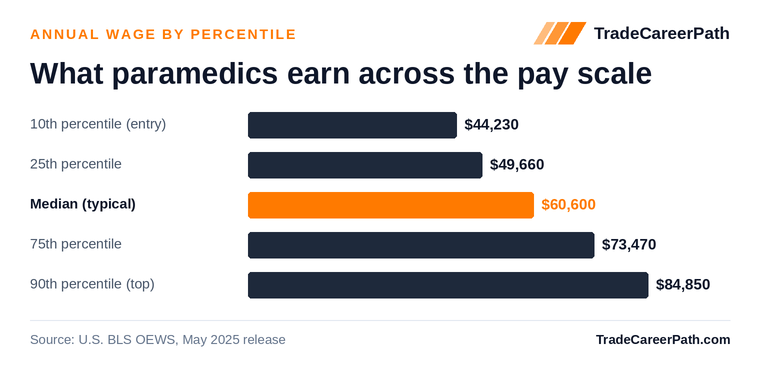
The median annual salary for paramedics is $60,600 according to the Bureau of Labor Statistics (May 2025). Entry-level workers earn around $44,230, while those in the 90th percentile earn over $84,850. Pay varies by state, experience, and specialization.
What is the job outlook for paramedics?
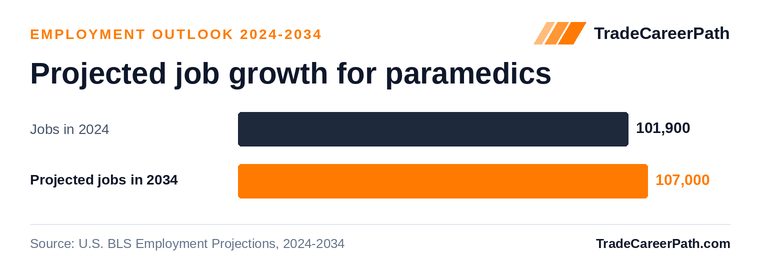
The Bureau of Labor Statistics projects 5.1% employment growth for this occupation from 2024 to 2034, which is about as fast as average. Approximately 14,100 job openings are expected each year due to growth, retirements, and workers leaving the field.
Do you need a college degree to work as a paramedic?
No. A college degree is not required to work as a paramedic. Most people enter the field through a certificate or associate degree program. A high school diploma or GED is typically the only educational prerequisite.
Which states pay paramedics the most?
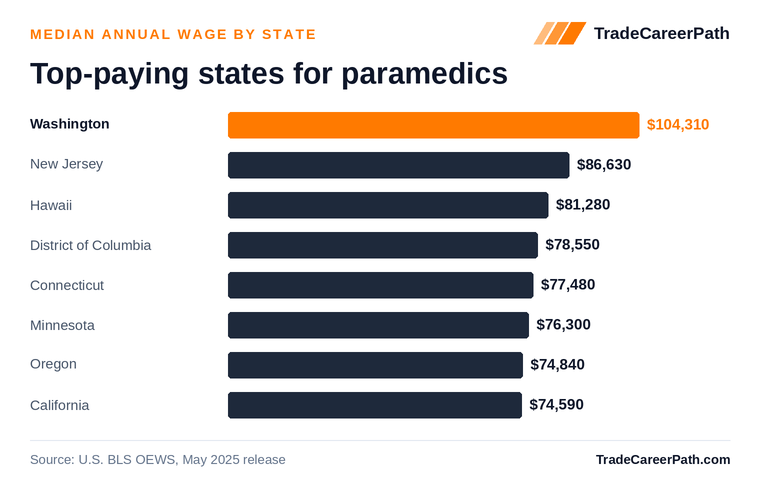
According to the U.S. Bureau of Labor Statistics (May 2025 OEWS), the highest-paying states for paramedics are Washington, New Jersey, and Hawaii. Median annual wages: Washington ($104,310); New Jersey ($86,630); Hawaii ($81,280).
Which states employ the most paramedics?
BLS reports the largest concentrations of paramedics in Texas, Florida, and New York. Employment levels: Texas (8,410 workers); Florida (6,970 workers); New York (6,110 workers) (May 2025).
How much do experienced paramedics earn?
The top 10% of paramedics earn more than $84,850 per year, according to BLS Occupational Employment and Wage Statistics (May 2025). Experienced workers in this band typically hold senior credentials, supervisory roles, or specialty certifications.
What is entry-level pay for paramedics?
BLS reports the bottom 10% of paramedics earn under $44,230 per year. New workers often start near this level and see pay rise as they accumulate experience and credentials.
How many paramedics work in the United States?
BLS reports approximately 100,610 paramedics employed nationwide as of May 2025.
How many job openings are expected for paramedics each year?
BLS projects approximately 4,900 openings per year for paramedics from 2024 through 2034, including new positions, retirements, and workers transitioning out. The occupation is projected to grow 5.0% from 2024 to 2034, classified as faster than average growth.
Is paramedic a growing career?
Yes. BLS projects 5.0% employment growth for paramedics between 2024 and 2034, classified as faster than average. Employment is projected to rise from approximately 101,900 jobs in 2024 to 107,000 in 2034.
How much do paramedics make per hour?
The median hourly wage for paramedics is $29.13, according to BLS (May 2025). Hourly pay ranges from about $21.27 (bottom 10%) to $40.80 (top 10%).
How Paramedic Pay Compares to Similar Trades
Side-by-side comparison of Paramedic and the closest related careers, based on U.S. Bureau of Labor Statistics data (May 2025 OEWS + 2024-2034 Employment Projections).
| Career | Median Pay | 10-Year Growth | Annual Openings |
|---|---|---|---|
| Paramedic this guide | $60,600 | +5.0% | 4,900 |
| Emt | $44,470 | +5.1% | 14,100 |
| Firefighter | $59,280 | +3.4% | 27,100 |
| Medical Assistant | $45,690 | +12.5% | 112,300 |
| Patient Care Technician | $42,260 | +2.3% | 204,100 |
Source: BLS Occupational Employment and Wage Statistics + BLS Employment Projections.
Advance Your Career with a Degree
Experienced Paramedic professionals often step up into degree-track careers where field experience is a hiring advantage:
- Paramedic to RN bridge programs - convert field experience to the RN license
- Registered Nurse (RN) - median pay $97,550 (BLS OEWS, May 2025); requires a 4-year degree
See all trade careers that require a 4-year degree.
Degree and Program Guides
- Online Fire Science Degrees - the degree behind fire service promotion
- Online Emergency Management Degrees - the coordination and planning career track
Sources
- U.S. Bureau of Labor Statistics, Occupational Employment and Wage Statistics (May 2025)
- U.S. Bureau of Labor Statistics, Employment Projections 2024-2034
- U.S. Bureau of Labor Statistics, Survey of Occupational Injuries and Illnesses (2023-2024, Table R98)
- U.S. Department of Labor, Wage and Hour Division, Davis-Bacon General Wage Determinations (2026)
Paramedic Salary by State
About this guide: Researched and written by the TradeCareerPath Editorial Team. Our editorial team researches and sources every trade school and career guide using federal labor and education data, including BLS OEWS and Employment Projections, DOL apprenticeship records, IPEDS, College Scorecard, and state licensing boards. We follow the editorial standards documented at /editorial-policy/.
Data sources
Figures on this page are sourced from the federal and state datasets below. Methodology: how we rank and source data.
| Data | Provider | Vintage |
|---|---|---|
| Occupational Employment and Wage Statistics (OEWS) | U.S. Bureau of Labor Statistics | May 2025 |
| Employment Projections | U.S. Bureau of Labor Statistics | 2024-2034 |
| Integrated Postsecondary Education Data System | National Center for Education Statistics (IPEDS) | 2024 |
| College Scorecard (school-level outcomes) | U.S. Department of Education | latest release |
| College Scorecard (field-of-study earnings) | U.S. Department of Education | latest release (updated 2026-06-12) |
| Occupational licensing requirements | CareerOneStop (U.S. Department of Labor) | latest release (updated 2026-02-22) |
| Registered apprenticeship programs | CareerOneStop / Apprenticeship.gov (U.S. Department of Labor) | latest release (updated 2025-10-25) |
| O*NET occupation profiles (skills, tasks, tools, job zones) | U.S. Department of Labor (O*NET / Employment & Training Admin.) | O*NET 29.1 (updated 2026-06-13) |