
How to Become a Personal Trainer in 2026
Is Personal Trainer Right for You?
The U.S. Department of Labor's O*NET profile for Exercise Trainers and Group Fitness Instructors (SOC 39-9031) describes the work this way: Instruct or coach groups or individuals in exercise activities for the primary purpose of personal fitness. Demonstrate techniques and form, observe participants, and explain to them corrective measures necessary to improve their skills. Develop and implement individualized approaches to exercise.
What the work involves
- Observe participants and inform them of corrective measures necessary for skill improvement.
- Offer alternatives during classes to accommodate different levels of fitness.
- Monitor participants' progress and adapt programs as needed.
- Plan routines, choose appropriate music, and choose different movements for each set of muscles, depending on participants' capabilities and limitations.
- Evaluate individuals' abilities, needs, and physical conditions, and develop suitable training programs to meet any special requirements.
Skills and knowledge that matter
Skills: Instructing, Service Orientation, Speaking, Active Listening, Learning Strategies, Social Perceptiveness.
Knowledge: Customer and Personal Service, Education and Training, English Language, Psychology.
Tools and technology you may use
Technology: Calendar and scheduling software, Data base user interface and query software, Project management software, Intuit QuickBooks, Microsoft Excel, Microsoft Office software.
Typical preparation
O*NET Job Zone Three (Medium Preparation Needed). Most occupations in this zone require training in vocational schools, related on-the-job experience, or an associate's degree. Employees in these occupations usually need one or two years of training involving both on-the-job experience and informal training with experienced workers. A recognized apprenticeship program may be associated with these occupations.
Interest fit
O*NET interest profile: Social, Realistic, Enterprising. People who enjoy working with, helping, and teaching other people often find this occupation a good fit.
Source: O*NET 31.0 (updated 2026-10-14)
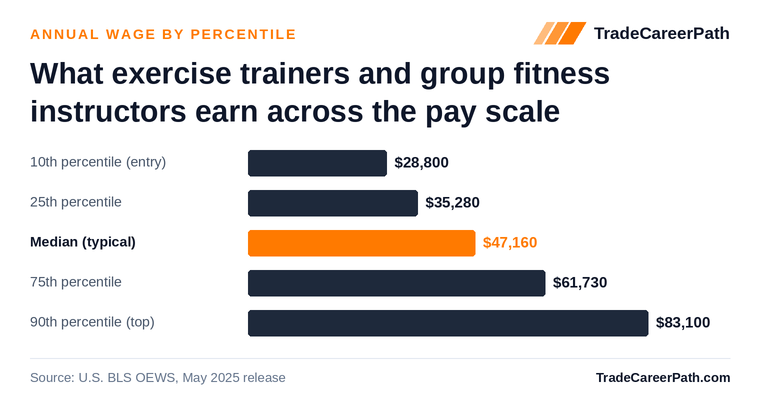
Quick answer: Training as a personal trainer usually takes anywhere from a few months to 2 years, depending on whether you complete a certification course or a longer certificate or associate degree. You earn a high school diploma or GED, get a current CPR/AED card, and pass a certification exam with accreditation from the National Commission for Certifying Agencies (NCCA), such as NASM, ACE, or NSCA. Personal training is not a state-licensed occupation in most places. The median wage for exercise trainers and group fitness instructors is $47,160 per year ($22.67/hour), and there are about 68,000 openings nationwide each year (BLS, May 2025).
Personal trainers assess clients, design safe workout programs, coach proper technique, and keep people motivated toward their fitness goals. You can work in a gym, run your own studio, or coach clients online, and a recognized certification is the credential employers and clients look for first.
How to Become a Personal Trainer
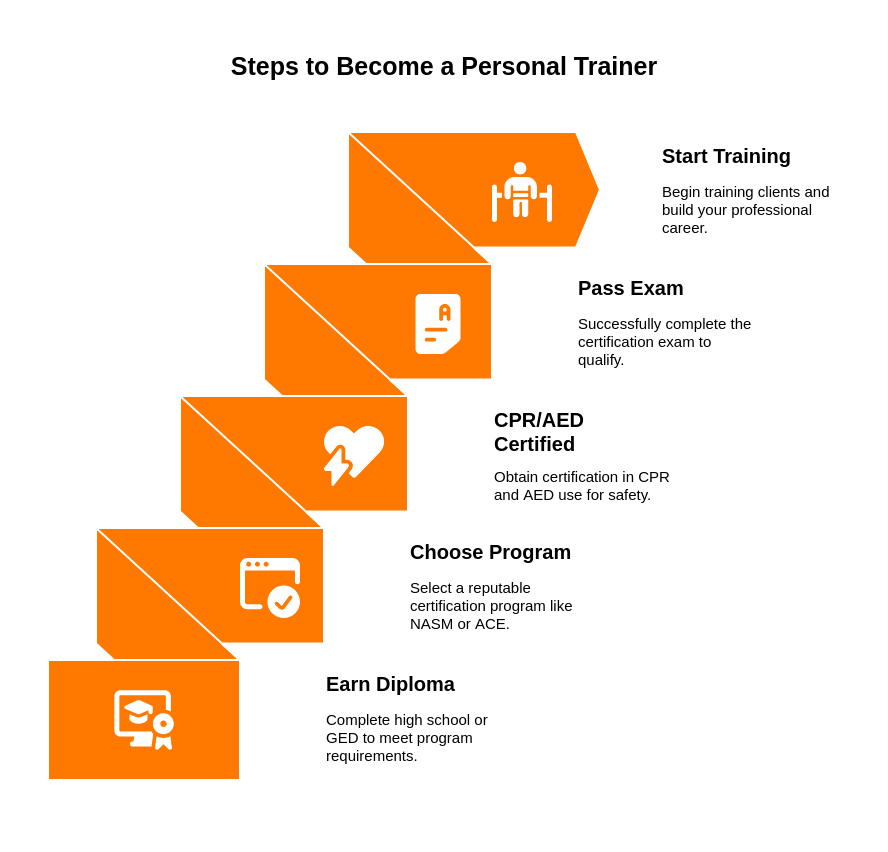
There is no single license to chase in most states. Instead, you build the career through a recognized certification, a CPR/AED card, and real coaching experience. Here is what each step actually involves.
1. Meet the basic requirements
A high school diploma or GED is the baseline most certifying bodies require, and it is enough to start studying. Before you enroll, it helps to build the knowledge the work depends on. Comfort with basic anatomy, physiology, and nutrition makes the certification material far easier to absorb, so high school biology, health, or any sports and conditioning experience is good preparation. If you played a sport, coached, or spent time in the gym yourself, you already understand movement patterns and program structure better than most beginners. You do not need a college degree to start, but a degree in exercise science, kinesiology, or a related field can open doors later if you want to move into clinical exercise, strength and conditioning, or a fitness director role. Career changers from teaching, healthcare, military, or customer-service backgrounds also do well here, because coaching is as much about communication and accountability as it is about exercise.
2. Choose an accredited certification program
This is the credential employers screen for, so choose carefully. Look for a certification with accreditation from the National Commission for Certifying Agencies (NCCA), which sets recognized standards for personal-trainer credentials. The most widely accepted NCCA-accredited options include the National Academy of Sports Medicine (NASM), the American Council on Exercise (ACE), the American College of Sports Medicine (ACSM), and the National Strength and Conditioning Association (NSCA). A typical program covers functional anatomy, exercise physiology, biomechanics, program design, nutrition basics within scope, and client assessment and screening. Most providers offer self-paced online study packages, and many bundle study materials with the exam fee. Costs vary by provider and the level of study support you choose, so request current pricing from a few organizations and compare what is included before you commit. Picking an NCCA-accredited certification keeps your credential portable, since gyms across the country recognize these names.
3. Get CPR and AED certified
Almost every certifying body requires a current CPR and Automated External Defibrillator (AED) certification before you can sit for the exam, and gyms require it on the job. This is hands-on, in-person training in most cases, covering how to respond to cardiac events, choking, and other emergencies on the gym floor. Certifications usually need renewal on a set schedule, so track your expiration date and budget time to recertify. Keeping this card current is non-negotiable: a lapsed CPR/AED certification can keep you from testing or from being hired, even if everything else is in place.
4. Pass your certification exam
Once your study course and CPR/AED card are in order, you sit for the certification exam. These tests mix multiple-choice questions with applied, scenario-based items that ask you to assess a client, spot contraindications, and design or adjust a program safely. They are not casual quizzes, so plan for several weeks of focused study using the official textbook, practice exams, and any workshops the provider offers. Many candidates find the program-design and assessment sections the toughest, since those require applying concepts rather than memorizing them. Pace your study, take the practice tests until you score consistently above the passing mark, and confirm the provider’s remote or in-person testing options. Passing earns you the credential and qualifies you to train clients professionally.
5. Gain experience and build a client base
Certification gets you in the door, but coaching real people is how you build a career. Many new trainers start at a gym, wellness center, or studio, where you get supervised floor hours, a steady stream of members to work with, and mentorship from senior trainers. Use that time to refine your assessments, learn how to retain clients, and find the populations you most enjoy coaching, such as beginners, athletes, older adults, or post-rehab clients. As you build a reputation, referrals and reviews work as your best marketing. From there you can grow your own client base, add online coaching or group fitness classes, or pursue advanced specializations in areas like nutrition, corrective exercise, or strength and conditioning to raise your rates and stand out.
What Personal Trainers Do
Personal trainers help clients set realistic goals, build customized training plans, and stay accountable session after session. The job blends exercise science, coaching, and people skills. You assess where a client is starting, design a safe and progressive program, and adjust it as they improve or hit setbacks.
Typical Responsibilities
- Assess client fitness levels and create personalized exercise programs
- Teach proper form, safety, and workout technique
- Monitor progress and adjust plans as needed
- Provide motivation and accountability
- Advise on nutrition and recovery within certification limits
Key Skills and Traits for Success
- Strong communication and coaching ability
- Knowledge of anatomy, nutrition, and exercise science
- Empathy, patience, and motivation
- Time management and goal setting
- Sales and business skills for independent trainers
Where Personal Trainers Work
Personal trainers can work in many settings, including:
- Fitness centers and commercial gyms
- Corporate wellness programs
- Medical, rehab, and post-injury settings
- Private studios or client homes
- Online coaching platforms
Career Growth Paths
- Master Trainer or Strength Coach
- Nutrition Coach or Wellness Specialist
- Fitness Director or Studio Owner
- Online Fitness Entrepreneur
Certification Options
Top certifications with accreditation from the National Commission for Certifying Agencies (NCCA) include:
| Credential | Organization |
|---|---|
| Certified Personal Trainer (CPT) | National Academy of Sports Medicine (NASM) |
| Certified Personal Trainer | American Council on Exercise (ACE) |
| Certified Personal Trainer | American College of Sports Medicine (ACSM) |
| NSCA-CPT | National Strength and Conditioning Association (NSCA) |
Choosing an NCCA-accredited certification helps ensure your credential is recognized by gyms and employers nationwide.
Cost and Duration of Training
- Time to complete: anywhere from a few months for a certification course to about 2 years for a certificate or associate degree
- Program cost: varies by certifying organization, study package, and school, so request current pricing from each provider you are considering
- CPR/AED certification: required by most certifying bodies and renewed on a set schedule
Many certification programs are available fully online, which lets working students study at a flexible pace.
Pros and Cons
Pros
- Flexible schedule and self-employment potential
- Personally rewarding and socially engaging work
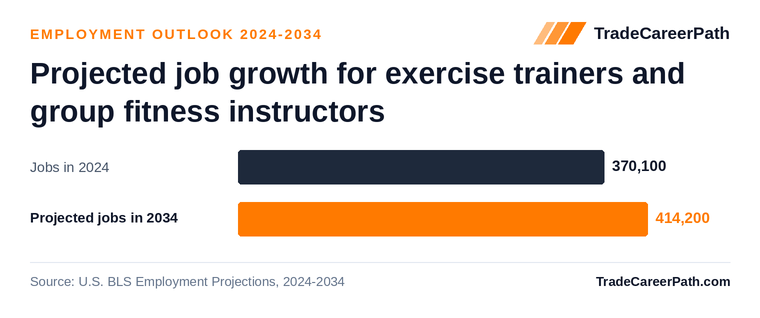
- Strong projected job growth
- No college degree required in most cases
Cons
- Income can vary with clients and hours
- Requires ongoing certification renewals
- Physically active and sometimes demanding
Quick Facts: Personal Trainer Salary, Education, and Outlook
Industry Organizations & Certifying Bodies
These are the recognized national organizations, unions, certifying bodies, and regulatory authorities that shape this trade. They issue the credentials, sponsor the apprenticeships, publish the codes, and represent workers and employers.
- National Commission for Certifying Agencies (NCCA) Accredits the major personal-trainer certifications (NASM, ACE, ACSM, NSCA, NCSF, ISSA, etc.).
- American Council on Exercise (ACE) NCCA-accredited Personal Trainer certification.
- National Academy of Sports Medicine (NASM) NCCA-accredited Certified Personal Trainer (CPT) credential.
- American College of Sports Medicine (ACSM) NCCA-accredited Certified Personal Trainer credential.
- National Strength and Conditioning Association (NSCA) NCCA-accredited NSCA-CPT and CSCS credentials.
Wage and Employment Charts
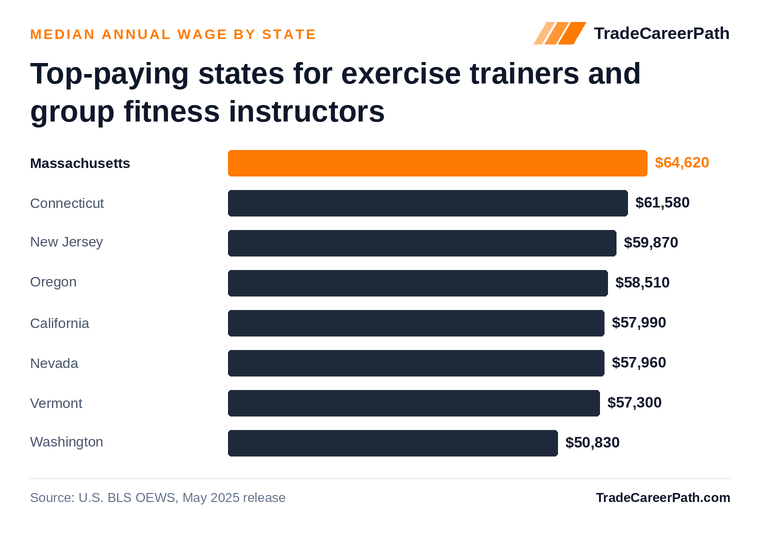
Personal Trainer Salary and Requirements by State
Select your state for local wage data, training options, and requirements:
Alabama · Alaska · Arizona · Arkansas · California · Colorado · Connecticut · Delaware · District of Columbia · Florida · Georgia · Hawaii · Idaho · Illinois · Indiana · Iowa · Kansas · Kentucky · Louisiana · Maine · Maryland · Massachusetts · Michigan · Minnesota · Mississippi · Missouri · Montana · Nebraska · Nevada · New Hampshire · New Jersey · New Mexico · New York · North Carolina · North Dakota · Ohio · Oklahoma · Oregon · Pennsylvania · Rhode Island · South Carolina · South Dakota · Tennessee · Texas · Utah · Vermont · Virginia · Washington · West Virginia · Wisconsin · Wyoming
Workplace Safety Snapshot
BLS Survey of Occupational Injuries and Illnesses data (2023-2024) report approximately 72.9 days-away, restricted, or transfer cases per 10,000 full-time-equivalent workers in exercise trainers and group fitness instructors (about 0.73 per 100 FTE). Source: BLS Survey of Occupational Injuries and Illnesses, Table R98.
Frequently Asked Questions
How long does personal trainer training take?
Many people earn a personal trainer certification in a few months of study, while a certificate or associate degree program can take 6 months to 2 years. A high school diploma or GED is generally required to get started, and most certifying bodies expect a current CPR/AED card before you sit for the exam.
Do you need a college degree to work as a personal trainer?
No. A college degree is not required to work as a personal trainer. Most people enter the field by earning a nationally recognized certification, and a high school diploma or GED is typically the only educational prerequisite. A degree in exercise science can help if you want to move into clinical, strength, or director roles.
Is personal trainer certification required?
Personal training is not a state-licensed occupation in most places, but nearly every gym and employer expects a certification with accreditation from the National Commission for Certifying Agencies (NCCA). Common NCCA-accredited options include the National Academy of Sports Medicine (NASM), the American Council on Exercise (ACE), and the National Strength and Conditioning Association (NSCA).
How much does personal trainer training cost?
Costs vary by program, certifying organization, and school, so compare a few options before you enroll. Many trainers buy a certification study package and exam bundle, while others complete a longer certificate or associate degree program. Request current pricing directly from each provider you are considering.
Is it hard to train as a personal trainer?
Entry is fairly accessible because there is no degree or license requirement in most states, and study materials are widely available online. The certification exams are not trivial, though. They cover anatomy, exercise physiology, program design, and client assessment, so they reward steady study and some hands-on practice.
Can you study to work as a personal trainer online?
Yes. Most major certifying bodies, including NASM, ACE, and NSCA, offer self-paced online study courses and remote or in-person exam options. You will still need hands-on practice coaching real people, which you can get through a gym job, internship, or by training friends and family.
How much do personal trainers make?
The median wage for exercise trainers and group fitness instructors is $47,160 per year, or $22.67 per hour (BLS, May 2025). Pay varies widely with location, client base, and whether you work for a gym or run your own business, since many trainers are paid per session.
How Personal Trainer Pay Compares to Similar Trades
Side-by-side comparison of Personal Trainer and the closest related careers, based on U.S. Bureau of Labor Statistics data (May 2025 OEWS + 2025-2035 Employment Projections).
| Career | Median Pay | 10-Year Growth | Annual Openings |
|---|---|---|---|
| Personal Trainer this guide | $47,160 | +7.3% | 68,000 |
| Massage Therapy | $58,450 | +15.3% | 20,400 |
| Physical Therapy Aide | $35,240 | +4.0% | 6,400 |
| Occupational Therapy Assistant | $72,300 | +21.5% | 8,100 |
Source: BLS Occupational Employment and Wage Statistics + BLS Employment Projections.
Advance Your Career with a Degree
Experienced Personal Trainer professionals often step up into degree-track careers where field experience is a hiring advantage:
- Exercise Physiologist - median pay $59,460 (BLS OEWS, May 2025); requires a 4-year degree
See all trade careers that require a 4-year degree.
Sources
- U.S. Bureau of Labor Statistics, Occupational Employment and Wage Statistics (May 2025)
- U.S. Bureau of Labor Statistics, Employment Projections 2025-2035
- U.S. Bureau of Labor Statistics, Survey of Occupational Injuries and Illnesses (2023-2024, Table R98)
- U.S. Department of Labor, Wage and Hour Division, Davis-Bacon General Wage Determinations (2026)
Personal Trainer Salary by State
About this guide: Researched and written by the TradeCareerPath Editorial Team. Our editorial team researches and sources every trade school and career guide using federal labor and education data, including BLS OEWS and Employment Projections, DOL apprenticeship records, IPEDS, College Scorecard, and state licensing boards. We follow the editorial standards documented at /editorial-policy/.
Data sources
Figures on this page are sourced from the federal and state datasets below. Methodology: how we rank and source data.
| Data | Provider | Vintage |
|---|---|---|
| Occupational Employment and Wage Statistics (OEWS) | U.S. Bureau of Labor Statistics | May 2025 |
| Employment Projections | U.S. Bureau of Labor Statistics | 2025-2035 |
| Integrated Postsecondary Education Data System | National Center for Education Statistics (IPEDS) | 2024 |
| College Scorecard (school-level outcomes) | U.S. Department of Education | latest release |
| College Scorecard (field-of-study earnings) | U.S. Department of Education | latest release (updated 2026-06-12) |
| Occupational licensing requirements | CareerOneStop (U.S. Department of Labor) | latest release (updated 2026-02-22) |
| Registered apprenticeship programs | CareerOneStop / Apprenticeship.gov (U.S. Department of Labor) | latest release (updated 2025-10-25) |
| O*NET occupation profiles (skills, tasks, tools, job zones) | U.S. Department of Labor (O*NET / Employment & Training Admin.) | O*NET 31.0 (updated 2026-10-14) |