
How to Become a Petroleum Engineer in 2026
Is Petroleum Engineer Right for You?
The U.S. Department of Labor's O*NET profile for Petroleum Engineers (SOC 17-2171) describes the work this way: Devise methods to improve oil and gas extraction and production and determine the need for new or modified tool designs. Oversee drilling and offer technical advice.
What the work involves
- Specify and supervise well modification and stimulation programs to maximize oil and gas recovery.
- Monitor production rates, and plan rework processes to improve production.
- Maintain records of drilling and production operations.
- Analyze data to recommend placement of wells and supplementary processes to enhance production.
- Assist engineering and other personnel to solve operating problems.
Skills and knowledge that matter
Skills: Reading Comprehension, Critical Thinking, Active Listening, Writing, Speaking, Complex Problem Solving.
Knowledge: Engineering and Technology, Mathematics, Physics, Computers and Electronics.
Tools and technology you may use
Technology: Computer aided design CAD software, Object or component oriented development software, Analytical or scientific software, Autodesk AutoCAD, C#, C++.
Typical preparation
O*NET Job Zone Four (Considerable Preparation Needed). Most of these occupations require a four-year bachelor's degree, but some do not. Employees in these occupations usually need several years of work-related experience, on-the-job training, and/or vocational training.
Interest fit
O*NET interest profile: Realistic, Investigative, Conventional. People who enjoy hands-on, practical work with tools, machines, plants, or materials often find this occupation a good fit.
Source: O*NET 31.0 (updated 2026-10-14)
Quick answer: Training as a petroleum engineer requires a 4-year degree - typically an ABET-accredited bachelor’s in petroleum, mechanical, or chemical engineering. The national median pay is $144,910 per year, and BLS projects +2.0% employment change from 2025 to 2035 (BLS OEWS, May 2025; BLS Employment Projections, 2025-35).
Petroleum Engineer at a Glance
| Metric | Detail | Source |
|---|---|---|
| Median annual wage | $144,910 | BLS OEWS, May 2025 |
| Typical wage range | $81,440 (10th pct) - $253,200 (90th pct) | BLS OEWS, May 2025 |
| Employment | 18,060 nationwide | BLS OEWS, May 2025 |
| Projected growth (2025-35) | +2.0%, about 1,000 openings per year | BLS Employment Projections, 2025-35 |
| Typical education | ABET-accredited bachelor’s in petroleum, mechanical, or chemical engineering | BLS Occupational Outlook Handbook |
| License / certification | PE license for some roles; not required for most operator jobs | State licensing boards |
What Does a Petroleum Engineer Do?
Petroleum engineers design drilling and completion programs, optimize well production, and plan reservoir development - the engineering desk that directs the rig crews, roughnecks, and service-company hands in the field.
Day to day, the work splits along sub-specialty lines. A drilling engineer plans the well: casing design, mud program, directional plan, and the daily cost tracking that decides whether a well makes economic sense - then troubleshoots by phone or from the wellsite when the bit stops making hole. A completions engineer designs the frac stages, perforation strategy, and downhole hardware that turn a drilled hole into a producing well. A production engineer manages wells after first oil: artificial lift selection, workover planning, and squeezing decline curves for every barrel. A reservoir engineer works furthest from the rig, building models that forecast recovery and deciding where the next wells go and whether the asset is worth the capital. In all four tracks the job is documented, reviewed engineering judgment - AFEs, well plans, and reserve estimates that move real money - not just fieldwork with a nicer title.
If you are coming off the rig floor or a frac crew, the shortest way to say it: the hand executes the well plan; the engineer writes it and owns what it costs. The stuck-pipe call, the casing-point decision, the choice to sidetrack or fish - those work as your call, and operators know that engineers who have thrown chain make those calls with fewer illusions about what the crew can actually do.
Skills That Make a Great Petroleum Engineer
- Reservoir and decline analysis
- Drilling and completion design
- Well-control and process safety
- Project economics modeling
- Field operations judgment
- Fluid mechanics and rock/formation behavior
- Software: nodal analysis, reservoir simulation, and Excel or Python for economics
- Writing: well plans, AFEs, and post-job reports carry the job
Petroleum Engineer Salary
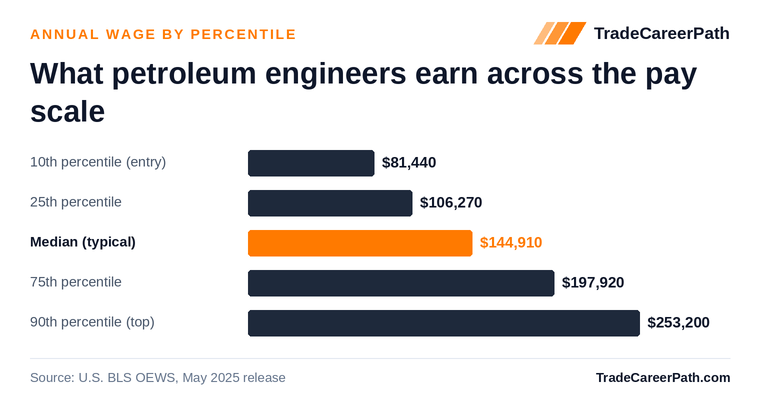
Petroleum engineering is the best-paid destination on this site for an oilfield background. The national median is $144,910 per year, and even the 10th percentile - roughly where new graduates start - is $81,440, with the 25th percentile at $106,270. The 90th percentile reaches $253,200, and the mean of $157,150 sits well above the median because top-end pay in this field runs so high (BLS OEWS, May 2025).
Where the Jobs and the Money Are
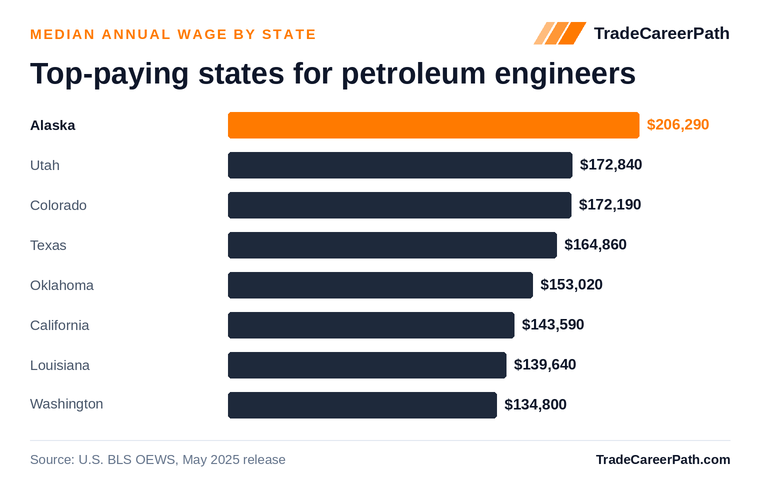
This is a geographically concentrated occupation - just 16 states report meaningful employment data, and one of them dominates. Texas holds about 9,140 of the nation’s 18,060 petroleum engineers, roughly half the entire occupation, anchored by Houston’s operator headquarters and the Permian Basin (BLS OEWS, May 2025).
| State | Median annual wage | Employment |
|---|---|---|
| Alaska | $206,290 | 280 |
| Utah | $172,840 | 280 |
| Colorado | $172,190 | 1,390 |
| Texas | $164,860 | 9,140 |
| Oklahoma | $153,020 | 1,450 |
The location-quotient numbers tell the real story: petroleum engineers are about 7.5 times as common in Alaska’s labor market as in the average state, 7.3 times in Oklahoma, 5.6 times in Texas, and 4.2 times in Colorado. Alaska pays a hardship-and-remoteness premium on the North Slope, but its market is small - Texas is where the depth is, with pay of $164,860 and enough employers that you can change companies without changing zip codes. Oklahoma and Colorado offer the same concentration on a smaller scale.
How to Become a Petroleum Engineer
1. Earn an ABET-accredited bachelor’s
Petroleum engineering, or mechanical/chemical engineering with an energy focus for more flexibility. Accreditation is the one non-negotiable: operators screen for it, graduate schools require it, and the FE/PE licensure path assumes it. Dedicated petroleum engineering programs cluster in oil states and online options are limited, so for working hands the mechanical or chemical route usually offers far more accredited online and evening programs - and operators hire both into drilling and production roles as a matter of course. The broader degree is also your hedge when the cycle turns.
2. Use field experience
Rig, completions, or service-company time is a hiring differentiator operators explicitly screen for. Say so on the application: floorhand, derrickhand, frac crew, wireline, or mud-logging time reads as proof you understand how wells actually get drilled, completed, and broken. Interns and new graduates get sent to the field precisely to acquire what you already have. Some schools also grant transfer credit for military or industry training - get a written transfer evaluation before you enroll anywhere.
3. Start as a field or operations engineer
Drilling, completions, and production engineering are the entry tracks, at operators, service companies, and consultancies alike. Field engineering roles - wellsite drilling engineer, frac engineer - are the classic entry points for former hands, because the job is judging real operations rather than working purely from models. Reservoir engineering usually comes a few years in, after you have seen enough wells to trust the numbers.
4. Ride the cycle deliberately
Hiring in this industry tracks commodity prices, and everyone who stays learns to plan around it. Keep the resume current in the good years, keep cash reserves for the lean ones, and know that the same skills transfer to geothermal, carbon capture and storage, and energy consulting when oil hiring cools - drilling a geothermal well or a CO2 injection well is still drilling. Engineers with field experience are typically the last cut in a downturn and the first hired back.
5. Advance
Senior reservoir engineer, drilling superintendent, or asset management. The fork comes around the ten-year mark: deepen into a technical authority role on the reservoir or drilling side, or take the leadership track toward asset team lead and operations management. Both are covered in the career ladder below.
Career Ladder: Titles and Realistic Pay
The BLS wage percentiles map cleanly onto how oil and gas careers actually progress. Use this as a sanity check on offers, not a guarantee:
| Stage | Typical titles | Years in | Realistic pay (BLS OEWS, May 2025) |
|---|---|---|---|
| Entry level | Field engineer, drilling/completions engineer I | 0-3 | ~$81,440-$106,270 (10th-25th pct) |
| Mid-career | Drilling, completions, or production engineer II/III | 3-10 | ~$144,910 (median) |
| Senior | Senior reservoir engineer, drilling superintendent | 10-15 | ~$197,920 (75th pct) |
| Principal / leadership | Principal engineer, asset team lead, engineering manager | 15+ | $253,200+ (90th pct) |
Two notes for career changers. First, prior oilfield experience compresses this ladder: former rig and service-company hands are routinely hired above the bottom of the entry band because they need less supervision at the wellsite and already hold the safety tickets. Second, the base-wage data understates senior compensation - operator bonus programs, overrides, and field uplifts mean total pay at the top of this ladder often runs well above the 90th-percentile figure shown here, especially in a strong commodity year.
Do You Need a PE License?
Mostly no. Petroleum engineers at operators and service companies work under the “industrial exemption” - the company, not the individual engineer, holds design responsibility, so most never license. Where the PE does matter: consulting practices, expert-witness and regulatory work, and roles that sign engineering reports submitted to state agencies. Independent reserves-evaluation consultants in particular are commonly licensed, because their reports carry financial and legal weight.
If you want the PE, the path is: ABET degree, pass the Fundamentals of Engineering (FE) exam (you can sit for it as a senior), four years of qualifying experience, then the PE exam per your state board’s rules. Alongside or instead of the PE, well-control certification (IADC/IWCF) is a hard requirement for drilling roles, and SPE membership and certification are the recognized professional credentials in the industry - your rig-floor safety tickets already count for something here.
Why an Online Degree Works for This Career
The rig-floor-to-engineering-office jump is a storied path in oil and gas: operators genuinely value engineers who have thrown chain. The trade-off to weigh is cyclicality - BLS projects slow growth for the occupation, and hiring tracks commodity prices - but the pay when hired is the highest of any engineering discipline. ABET-accredited online programs (usually via mechanical or chemical engineering with an energy focus) let hands keep their rotation and their seniority while finishing the degree, and employer tuition assistance is common at operators and the large service companies.
Job Outlook for 2026 and Beyond
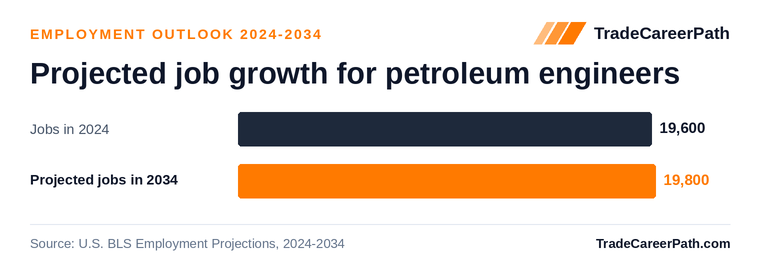
BLS projects petroleum engineering employment to change +2.0% from 2025 to 2035 - from 18,500 to 18,800 jobs - with about 1,000 openings per year once retirements and occupation changes are counted (BLS Employment Projections, 2025-35). The latest wage data (OEWS, May 2025) puts the median at $144,910, up from the 2024 figure of $141,280 - pay keeps climbing even while headcount stays flat.
Read those numbers honestly: this is not a growth field, it is a replacement field. But 1,000 openings a year in an 18,060-person occupation is a meaningful replacement rate - an aging workforce means steady backfill hiring, and the small graduating classes since the last downturn have thinned the candidate pool. For career changers with field experience, that scarcity is the opportunity: you are competing for replacement seats against fewer graduates, with a resume operators explicitly prefer. The same skill set also feeds geothermal, carbon storage, and gas-supply work that sits outside the headline projection.
Cost and Time to Complete the Degree
For petroleum engineers, the credential is: ABET-accredited bachelor’s in petroleum, mechanical, or chemical engineering. A bachelor’s degree is typically 120 credit hours: four years full-time, and commonly five to six years part-time while working. Transfer credit is the other lever: prior college, military training, apprenticeship coursework, and industry certifications can be worth meaningful credit at transfer-friendly schools, so get a written transfer evaluation before enrolling anywhere. Costs vary widely by school type; in-state public online programs are usually the value benchmark, and employer tuition assistance is common for working adults in this field. Set the cost against the payoff: the gap between a rig hand’s wage and the $144,910 median here repays an in-state degree quickly.
Pros and Cons of Training as a Petroleum Engineer
Pros
- Median pay of $144,910 nationally - the highest of any engineering discipline here (BLS OEWS, May 2025)
- Field experience from the trades is a genuine hiring advantage
- About 1,000 openings per year against small graduating classes
- Accredited online and hybrid degree paths exist for working adults
Cons
- Requires a 4-year degree (typically 120 credit hours)
- Entry-level pay starts near $81,440 at the 10th percentile
- Hiring is cyclical and geographically concentrated - BLS projects just +2.0% growth through 2035
- Licensing hurdle: PE license for some roles; not required for most operator jobs
Frequently Asked Questions
Is petroleum engineering still worth it?
BLS projects slow employment growth for the occupation, and hiring is cyclical - but the median pay is the highest of any engineering discipline tracked here, and field-experienced engineers are the last cut and first hired.
How much do petroleum engineers make?
The national median annual wage for petroleum engineers is $144,910 (BLS OEWS, May 2025). The top 10% earn $253,200 or more, while entry-level pay starts around $81,440.
What is the job outlook for petroleum engineers?
BLS projects employment of petroleum engineers to change by +2.0% from 2025 to 2035 (BLS Employment Projections, 2025-35).
How long does petroleum engineer training take?
The ABET-accredited bachelor's is 120 credit hours: four years full-time, commonly five to six years part-time while working. Transfer credit from prior college, military training, or industry certifications can meaningfully shorten it at transfer-friendly schools.
Is petroleum engineering hard?
The degree is math-heavy - calculus, differential equations, fluid mechanics, and thermodynamics are unavoidable, plus reservoir and drilling courses on top. Rig hands and service-company techs usually find the drilling and completions material far easier to absorb than fresh high-school graduates do, because they have seen the equipment work and fail.
Should I get a petroleum or mechanical engineering degree?
For working oilfield hands hedging against the commodity cycle, mechanical or chemical engineering with an energy focus is often the smarter buy: far more ABET-accredited online options, and the degree stays marketable outside oil and gas. Operators hire mechanical and chemical engineers into drilling and production roles constantly; the reverse move is harder.
Can you train as a petroleum engineer without a degree?
Not with the engineer title - operators and service companies require the ABET-accredited bachelor's. Without it, the ceiling is senior field roles like toolpusher, company man, or engineering technician. Rig and completions experience shortens the path and strengthens the resume, but does not replace the degree.
Do petroleum engineers need a PE license?
Usually no - most work for operators and service companies under the industrial exemption, so the company holds design responsibility. The PE matters for consulting, expert-witness work, and roles that sign engineering reports for regulators. The path is the ABET degree, the FE exam, qualifying experience, then the PE exam per your state board.
Petroleum Engineer Salary and Requirements by State
Alaska · California · Colorado · Kansas · Louisiana · Montana · Nebraska · New Mexico · North Dakota · Ohio · Oklahoma · Pennsylvania · Texas · Utah · Washington · West Virginia
Related Careers and Degree Paths
- Mechanical Engineer - the flexible degree that also qualifies you for drilling and production roles
- Chemical Engineer - the refining and process side of the same industry
- Mining Engineer - the other extraction-engineering discipline, with similar field-to-office paths
- Geoscientist - the subsurface science partner on every asset team
- Online Engineering Degrees for Tradespeople - how to pick an ABET program that fits a rotation schedule
Sources
- U.S. Bureau of Labor Statistics, Occupational Employment and Wage Statistics (OEWS), May 2025 - Petroleum Engineers (SOC 17-2171)
- U.S. Bureau of Labor Statistics, Employment Projections, 2025-35
- U.S. Bureau of Labor Statistics, Occupational Outlook Handbook - education and licensing requirements
Petroleum Engineer Salary by State
About this guide: Researched and written by the TradeCareerPath Editorial Team. Our editorial team researches and sources every trade school and career guide using federal labor and education data, including BLS OEWS and Employment Projections, DOL apprenticeship records, IPEDS, College Scorecard, and state licensing boards. We follow the editorial standards documented at /editorial-policy/.
Data sources
Figures on this page are sourced from the federal and state datasets below. Methodology: how we rank and source data.
| Data | Provider | Vintage |
|---|---|---|
| Occupational Employment and Wage Statistics (OEWS) | U.S. Bureau of Labor Statistics | May 2025 |
| Employment Projections | U.S. Bureau of Labor Statistics | 2025-2035 |
| Integrated Postsecondary Education Data System | National Center for Education Statistics (IPEDS) | 2024 |
| College Scorecard (school-level outcomes) | U.S. Department of Education | latest release |
| College Scorecard (field-of-study earnings) | U.S. Department of Education | latest release (updated 2026-06-12) |
| Occupational licensing requirements | CareerOneStop (U.S. Department of Labor) | latest release (updated 2026-02-22) |
| Registered apprenticeship programs | CareerOneStop / Apprenticeship.gov (U.S. Department of Labor) | latest release (updated 2025-10-25) |
| O*NET occupation profiles (skills, tasks, tools, job zones) | U.S. Department of Labor (O*NET / Employment & Training Admin.) | O*NET 31.0 (updated 2026-10-14) |