
How to Become a Pharmacy Technician in 2026
Is Pharmacy Technician Right for You?
The U.S. Department of Labor's O*NET profile for Pharmacy Technicians (SOC 29-2052) describes the work this way: Prepare medications under the direction of a pharmacist. May measure, mix, count out, label, and record amounts and dosages of medications according to prescription orders.
What the work involves
- Receive written prescription or refill requests and verify that information is complete and accurate.
- Enter prescription information into computer databases.
- Establish or maintain patient profiles, including lists of medications taken by individual patients.
- Maintain proper storage and security conditions for drugs.
- Receive and store incoming supplies, verify quantities against invoices, check for outdated medications in current inventory, and inform supervisors of stock needs and shortages.
Skills and knowledge that matter
Skills: Active Listening, Reading Comprehension, Speaking, Critical Thinking, Active Learning, Monitoring.
Knowledge: Customer and Personal Service, Medicine and Dentistry, Mathematics, English Language.
Tools and technology you may use
Technology: Internet browser software, Billing and invoicing software, Medical software, Apple Safari, MEDITECH software, Microsoft Edge.
Typical preparation
O*NET Job Zone Three (Medium Preparation Needed). Most occupations in this zone require training in vocational schools, related on-the-job experience, or an associate's degree. Employees in these occupations usually need one or two years of training involving both on-the-job experience and informal training with experienced workers. A recognized apprenticeship program may be associated with these occupations.
Interest fit
O*NET interest profile: Conventional, Realistic, Social. People who enjoy structured, detail-oriented work with clear procedures and data often find this occupation a good fit.
Source: O*NET 31.0 (updated 2026-10-14)
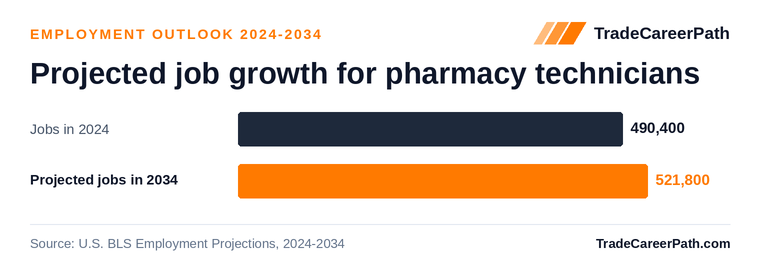
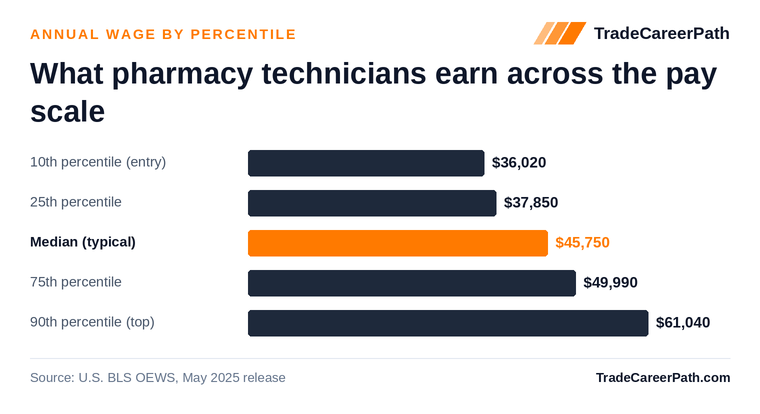
Quick answer: Training as a pharmacy technician usually takes 6 months to 2 years. You complete a certificate or associate degree program, often with a hands-on externship, then earn a national certification such as the Certified Pharmacy Technician (CPhT) from the PTCB or the ExCPT from the NHA. Most states require you to register or get licensed with the state board of pharmacy. No college degree is needed. The median pharmacy technician salary is $45,750 per year ($22.00/hour), and employers post about 44,700 openings nationwide each year (BLS, May 2025).
Pharmacy technicians work alongside pharmacists in retail, hospital, and mail-order pharmacies. They prepare and label prescriptions, manage inventory, handle insurance claims, and help patients, all under a pharmacist’s supervision. If you are detail oriented and want a stable healthcare role without years of school, this is a fast, direct path in.
How to Become a Pharmacy Technician
Most people enter the field in about six months to two years, depending on the program they choose. The path runs through education, certification, and state registration rather than a single licensing exam.
1. Earn a high school diploma or GED
A high school diploma or GED is the minimum requirement for nearly every pharmacy technician program and entry-level pharmacy job. Before you enroll, it helps to build the skills the work depends on. Strong arithmetic matters most, because techs convert units, calculate dosages, and measure quantities accurately every shift. High school math, biology, and chemistry are good preparation, and any class that builds careful, methodical habits will serve you well. Customer service is part of the job too, so comfort talking with the public and handling questions calmly is an asset. Being at ease with computers helps, since pharmacies run on prescription software, insurance billing systems, and inventory databases. If you are changing careers and already hold a diploma or degree, you can move straight to the next step and bring useful skills in organization and communication.
2. Complete a pharmacy technician training program
This is the core credential, and you have a few formats to choose from. Certificate programs usually take 6 months to 1 year and focus tightly on pharmacy skills, while associate degree programs run about 2 years and add general-education credits. When comparing schools, look for accreditation from the American Society of Health-System Pharmacists (ASHP), which signals the program meets recognized standards for curriculum and supervised practice. Typical coursework covers pharmacology, pharmaceutical math and dosage calculations, drug names and classifications, pharmacy law and ethics, sterile and non-sterile compounding, and how to use pharmacy management software. Many programs build in an externship at a working pharmacy so you practice filling prescriptions and serving patients under supervision before you graduate. Some coursework is available online, though hands-on lab or externship hours are usually completed in person. Confirm tuition, accreditation, and externship details with the program before you enroll, since costs vary widely by school.
3. Get certified
Certification is a national credential earned by passing an exam, and many employers prefer or require it. The two recognized credentials are the Certified Pharmacy Technician (CPhT) from the Pharmacy Technician Certification Board (PTCB) and the ExCPT from the National Healthcareer Association (NHA). Eligibility generally depends on completing an approved training program or having equivalent work experience, and each exam tests pharmacy math, medication safety, law, and daily pharmacy operations. Both credentials require ongoing continuing education to keep current. Earning a certification before you apply for jobs can set you apart from other candidates, especially in retail and hospital settings where pharmacists rely on certified techs for accuracy. Check each organization’s site for current eligibility rules and exam fees, which are charged separately from your tuition.
4. Register or get licensed in your state
Pharmacy technician rules are set by each state’s board of pharmacy, and most states require you to register or get licensed before you can work. Requirements vary: some states ask only for registration and a fee, while others require national certification, a background check, fingerprinting, or completion of an approved training program. A number of states also distinguish between a pharmacy technician and a more limited “pharmacy technician trainee” while you finish requirements. Because the rules change from state to state, confirm the steps with your state’s board of pharmacy before you apply for jobs. Staying current on registration renewals and any continuing-education requirements keeps your credential active.
5. Apply for jobs and advance
Pharmacy technicians work in retail and chain drugstores, hospitals, mail-order and specialty pharmacies, long-term care facilities, and clinics. Tailor your resume to the setting you want, highlight your certification and externship experience, and be ready to speak to accuracy and customer service in interviews. Many techs start in retail and later move into hospital or specialty pharmacies, which can offer different schedules and higher pay. With experience you can advance into lead technician, pharmacy technician supervisor, or specialized roles in compounding, chemotherapy preparation, or pharmacy informatics. Some technicians use the role as a stepping stone toward pharmacy school or other healthcare careers.
How long does pharmacy technician training take?
Your timeline depends mostly on the program you choose:
| Your starting point | Typical path | Time to first job |
|---|---|---|
| High school diploma / GED | Certificate program | 6 months to 1 year |
| High school diploma / GED | Associate degree | About 2 years |
| On-the-job entry (where allowed) | Employer training plus certification | Varies by state and employer |
These are typical ranges; part-time study, online formats, and externship requirements can shorten or extend the timeline.
What Does a Pharmacy Technician Do?
Pharmacy technicians are the link between patients, prescribers, and pharmacists. They prepare medications, manage inventory, process insurance, and make sure every prescription is filled safely and correctly under a pharmacist’s supervision. Their work lets pharmacists focus on clinical judgment, patient counseling, and checking final accuracy.
Day-to-day tasks
- Counting, labeling, and packaging prescriptions
- Measuring dosages and preparing medications under pharmacist supervision
- Processing insurance claims and resolving billing issues
- Communicating with prescribers’ offices and patients
- Managing inventory and keeping detailed records
The work blends science, logistics, and people skills, and every shift puts you in a position to help someone get the medication they need.
Skills That Make a Great Pharmacy Technician
- Attention to detail, since one decimal can change a dose
- Comfort with arithmetic and dosage calculations
- Clear, patient communication
- Organization and the ability to multitask under pressure
- Dependability and discretion with private health information
Work Settings for Pharmacy Technicians
Pharmacy technicians work in a range of environments, including:
- Retail and chain drugstores
- Hospital and health-system pharmacies
- Mail-order and specialty pharmacies
- Long-term care and assisted-living facilities
- Clinics and outpatient pharmacies
Education and Certification Paths
| Pathway | Typical Duration | Outcome |
|---|---|---|
| Certificate | 6 months to 1 year | Entry level preparation |
| Associate Degree | About 2 years | Broader credential with general education |
| CPhT (PTCB) | After training or experience | National certification |
| ExCPT (NHA) | After training or experience | National certification |
Career Growth and Advancement
With experience, pharmacy technicians may move into roles such as:
- Lead Pharmacy Technician who guides newer staff and manages workflow
- Pharmacy Technician Supervisor who oversees a team and scheduling
- Specialty Technician in compounding, chemotherapy preparation, or sterile products
- Pharmacy Informatics or Buyer roles focused on systems and inventory
Cost and Duration of Training
- Program cost: varies by program and school; community college certificates are generally less expensive than degree programs, and some employers offer paid on-the-job training
- Time to complete: six months to two years
- Certification exam fees: charged separately by PTCB or NHA; confirm current amounts on their sites
Some pharmacy technician coursework is available online, though hands-on lab and externship hours are usually completed in person.
Pros and Cons
Pros
- Fast entry into healthcare without a four-year degree
- Strong, nationwide job stability
- Clear paths into specialty and supervisory roles
- A stepping stone toward other healthcare careers
Cons
- Repetitive tasks during busy shifts
- Long periods of standing
- Constant precision required when handling medications
Quick Facts: Pharmacy Technician Salary, Education, and Outlook

Industry Organizations & Certifying Bodies
These are the recognized national organizations, unions, certifying bodies, and regulatory authorities that shape this trade. They issue the credentials, sponsor the apprenticeships, publish the codes, and represent workers and employers.
- Pharmacy Technician Certification Board (PTCB) Issues the Certified Pharmacy Technician (CPhT) credential.
- National Healthcareer Association (NHA) Issues the ExCPT pharmacy technician credential.
- American Society of Health-System Pharmacists (ASHP) Accredits pharmacy technician training programs.
Wage and Employment Charts
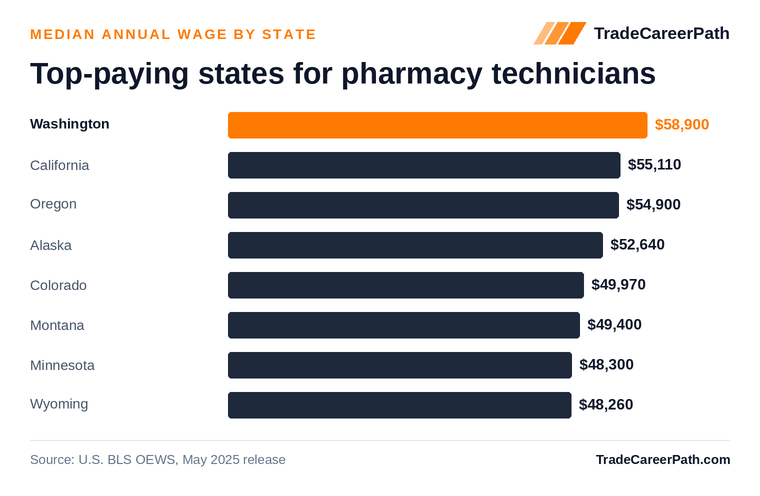
Pharmacy Technician Salary and Requirements by State
Select your state for local wage data, training options, and requirements:
Alabama · Alaska · Arizona · Arkansas · California · Colorado · Connecticut · Delaware · District of Columbia · Florida · Georgia · Hawaii · Idaho · Illinois · Indiana · Iowa · Kansas · Kentucky · Louisiana · Maine · Maryland · Massachusetts · Michigan · Minnesota · Mississippi · Missouri · Montana · Nebraska · Nevada · New Hampshire · New Jersey · New Mexico · New York · North Carolina · North Dakota · Ohio · Oklahoma · Oregon · Pennsylvania · Rhode Island · South Carolina · South Dakota · Tennessee · Texas · Utah · Vermont · Virginia · Washington · West Virginia · Wisconsin · Wyoming
Workplace Safety Snapshot
BLS Survey of Occupational Injuries and Illnesses data (2023-2024) report approximately 68.8 days-away, restricted, or transfer cases per 10,000 full-time-equivalent workers in pharmacy technicians (about 0.69 per 100 FTE). Source: BLS Survey of Occupational Injuries and Illnesses, Table R98.
Frequently Asked Questions
How long does pharmacy technician training take?
It typically takes 6 months to 2 years. A certificate program usually runs 6 months to 1 year, while an associate degree takes about 2 years. A high school diploma or GED is generally required to get started.
Do you need a college degree to work as a pharmacy technician?
No. A college degree is not required to work as a pharmacy technician. Most people enter the field through a certificate or associate degree program. A high school diploma or GED is typically the only educational prerequisite.
How much does pharmacy technician training cost?
Costs vary widely by program and school. Community college certificate programs are generally less expensive than degree programs, and some employers offer paid on-the-job training. Certification exams such as the PTCB or NHA exam charge a separate fee. Always confirm tuition and exam costs directly with the program before enrolling.
Is pharmacy technician certification or a license required?
It depends on your state. Many states require pharmacy technicians to register or get licensed with the state board of pharmacy, and several require national certification. The two recognized credentials are the Certified Pharmacy Technician (CPhT) from the Pharmacy Technician Certification Board (PTCB) and the ExCPT from the National Healthcareer Association (NHA). Check your state board for exact rules.
Is it hard to train as a pharmacy technician?
Entry is relatively accessible because no college degree is required and most people finish training in 6 months to 2 years. The work itself demands precision, since you handle medications and dosages, plus comfort with math, attention to detail, and steady customer service.
Can you train to be a pharmacy technician online?
Yes. Many schools offer pharmacy technician coursework online, often paired with a hands-on externship or lab requirement completed in person. Before enrolling, confirm the program is recognized by your state board and look for accreditation through the American Society of Health-System Pharmacists (ASHP).
How many pharmacy technicians work in the United States?
BLS reports approximately 471,680 pharmacy technicians employed nationwide as of May 2025, with a median wage of $45,750 per year ($22.00 per hour).
How Pharmacy Technician Pay Compares to Similar Trades
Side-by-side comparison of Pharmacy Technician and the closest related careers, based on U.S. Bureau of Labor Statistics data (May 2025 OEWS + 2025-2035 Employment Projections).
| Career | Median Pay | 10-Year Growth | Annual Openings |
|---|---|---|---|
| Pharmacy Technician this guide | $45,750 | +6.4% | 44,700 |
| Medical Office Administration | $45,930 | +4.8% | 89,200 |
| Medical Assistant | $45,690 | +12.9% | 109,700 |
| Optician Certification Programs | $47,260 | +4.2% | 5,600 |
Source: BLS Occupational Employment and Wage Statistics + BLS Employment Projections.
Advance Your Career with a Degree
Experienced Pharmacy Technician professionals often step up into degree-track careers where field experience is a hiring advantage:
- Chemist - median pay $91,240 (BLS OEWS, May 2025); requires a 4-year degree
See all trade careers that require a 4-year degree.
Sources
- U.S. Bureau of Labor Statistics, Occupational Employment and Wage Statistics (May 2025)
- U.S. Bureau of Labor Statistics, Employment Projections 2025-2035
- U.S. Bureau of Labor Statistics, Survey of Occupational Injuries and Illnesses (2023-2024, Table R98)
- U.S. Department of Labor, Wage and Hour Division, Davis-Bacon General Wage Determinations (2026)
Pharmacy Technician Salary by State
About this guide: Researched and written by the TradeCareerPath Editorial Team. Our editorial team researches and sources every trade school and career guide using federal labor and education data, including BLS OEWS and Employment Projections, DOL apprenticeship records, IPEDS, College Scorecard, and state licensing boards. We follow the editorial standards documented at /editorial-policy/.
Data sources
Figures on this page are sourced from the federal and state datasets below. Methodology: how we rank and source data.
| Data | Provider | Vintage |
|---|---|---|
| Occupational Employment and Wage Statistics (OEWS) | U.S. Bureau of Labor Statistics | May 2025 |
| Employment Projections | U.S. Bureau of Labor Statistics | 2025-2035 |
| Integrated Postsecondary Education Data System | National Center for Education Statistics (IPEDS) | 2024 |
| College Scorecard (school-level outcomes) | U.S. Department of Education | latest release |
| College Scorecard (field-of-study earnings) | U.S. Department of Education | latest release (updated 2026-06-12) |
| Occupational licensing requirements | CareerOneStop (U.S. Department of Labor) | latest release (updated 2026-02-22) |
| Registered apprenticeship programs | CareerOneStop / Apprenticeship.gov (U.S. Department of Labor) | latest release (updated 2025-10-25) |
| O*NET occupation profiles (skills, tasks, tools, job zones) | U.S. Department of Labor (O*NET / Employment & Training Admin.) | O*NET 31.0 (updated 2026-10-14) |